
Space Thread
Previous 1 ... 238 239 240 241 242 243 244 Next
DrCaleb @ Wed Jun 11, 2025 6:52 am
1.5 TB of James Webb Space Telescope data just hit the internet
DrCaleb @ Mon Jun 16, 2025 6:40 am
M87 Black hole captured in x-ray by Chandra.
DrCaleb @ Mon Jun 23, 2025 6:00 am
These are first deep-space images from the Vera Rubin Observatory
DrCaleb @ Thu Jun 26, 2025 6:58 am
During a town hall Wednesday, NASA officials on stage looked like hostages
DrCaleb @ Fri Jun 27, 2025 6:20 am
An exceedingly rare asteroid flyby will happen soon, but NASA may be left on the sidelines
$1:
A little less than four years from now, a killer asteroid will narrowly fly past planet Earth. This will be a celestial event visible around the world—for a few weeks, Apophis will shine among the brightest objects in the night sky.
The near miss by the large Apophis asteroid in April 2029 offers NASA a golden—and exceedingly rare—opportunity to observe such an object like this up close. Critically, the interaction between Apophis and Earth's gravitational pull will offer scientists an unprecedented chance to study the interior of an asteroid.
This is fascinating for planetary science, but it also has serious implications for planetary defense. In the future, were such an asteroid on course to strike Earth, an effective plan to deflect it would depend on knowing what the interior looks like.
"This is a remarkable opportunity," said Bobby Braun, who leads space exploration for the Johns Hopkins Applied Physics Laboratory, in an interview. "From a probability standpoint, there’s not going to be another chance to study a killer asteroid like this for thousands of years. Sooner or later, we’re going to need this knowledge."
But we may not get it.
NASA has some options for tracking Apophis during its flyby. However, the most promising of these, a mission named OSIRIS-Apex that breathes new life into an old spacecraft that otherwise would drift into oblivion, is slated for cancellation by the Trump White House's budget for fiscal year 2026.
Other choices, including dragging dual space probes out of storage, the Janus spacecraft, and other concepts that were submitted to NASA a year ago as part of a call for ideas, have already been rejected or simply left on the table. As a result, NASA currently has no plans to study what will be the most important asteroid encounter since the formation of the space agency.
"The world is watching," said Richard Binzel, an asteroid expert at the Massachusetts Institute of Technology. "NASA needs to step up and do their job."
The near miss by the large Apophis asteroid in April 2029 offers NASA a golden—and exceedingly rare—opportunity to observe such an object like this up close. Critically, the interaction between Apophis and Earth's gravitational pull will offer scientists an unprecedented chance to study the interior of an asteroid.
This is fascinating for planetary science, but it also has serious implications for planetary defense. In the future, were such an asteroid on course to strike Earth, an effective plan to deflect it would depend on knowing what the interior looks like.
"This is a remarkable opportunity," said Bobby Braun, who leads space exploration for the Johns Hopkins Applied Physics Laboratory, in an interview. "From a probability standpoint, there’s not going to be another chance to study a killer asteroid like this for thousands of years. Sooner or later, we’re going to need this knowledge."
But we may not get it.
NASA has some options for tracking Apophis during its flyby. However, the most promising of these, a mission named OSIRIS-Apex that breathes new life into an old spacecraft that otherwise would drift into oblivion, is slated for cancellation by the Trump White House's budget for fiscal year 2026.
Other choices, including dragging dual space probes out of storage, the Janus spacecraft, and other concepts that were submitted to NASA a year ago as part of a call for ideas, have already been rejected or simply left on the table. As a result, NASA currently has no plans to study what will be the most important asteroid encounter since the formation of the space agency.
"The world is watching," said Richard Binzel, an asteroid expert at the Massachusetts Institute of Technology. "NASA needs to step up and do their job."
DrCaleb @ Wed Jul 02, 2025 6:57 am
Astronomers may have found a third interstellar object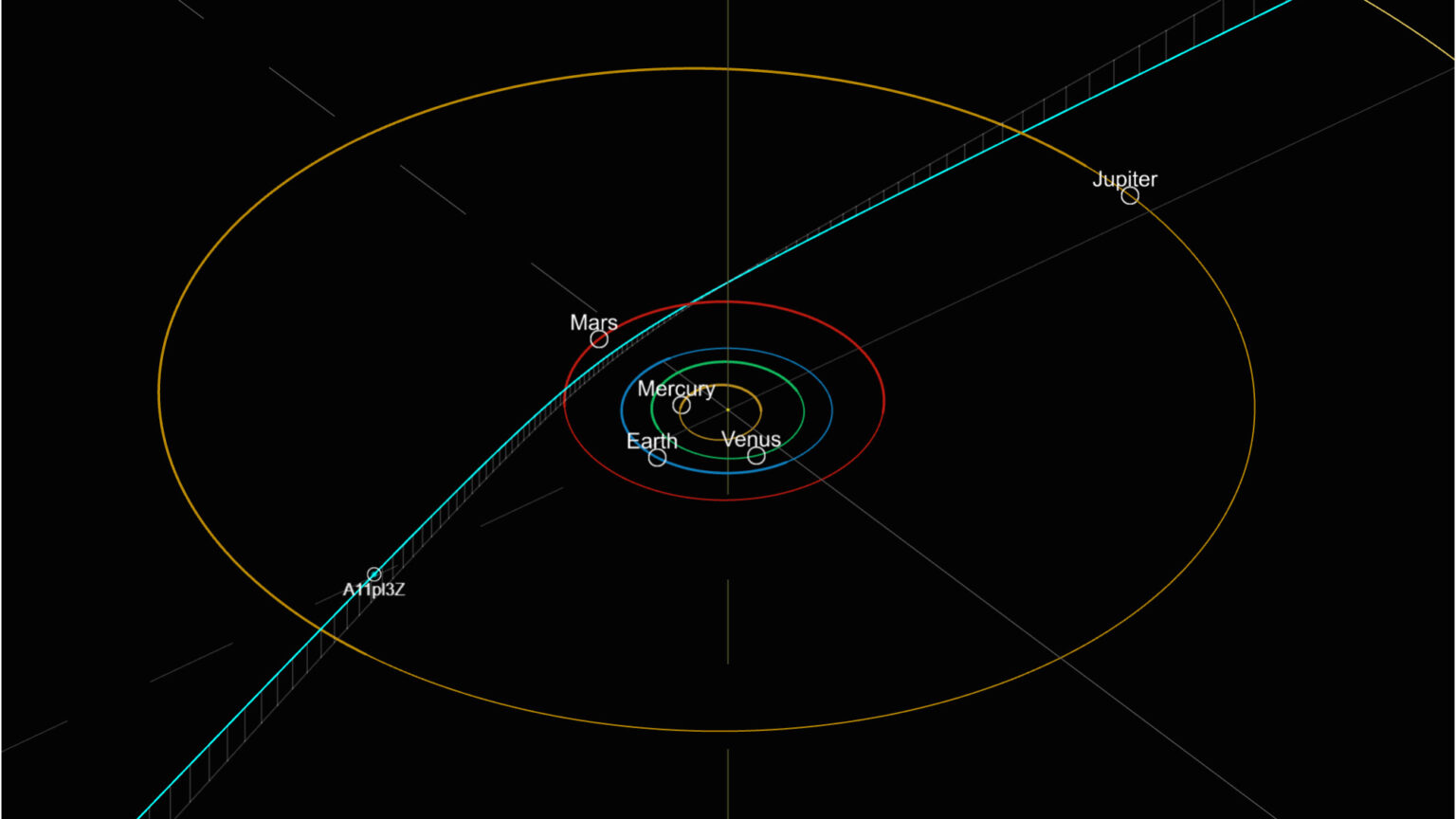
DrCaleb @ Wed Jul 09, 2025 6:58 am
China jumps ahead in the race to achieve a new kind of reuse in space
$1:
Two Chinese satellites have rendezvoused with one another more than 20,000 miles above the Earth in what analysts believe is the first high-altitude attempt at orbital refueling.
DrCaleb @ Tue Jul 15, 2025 6:29 am
LIGO Detects Most Massive Black Hole Merger to Date
Merger of two massive black holes is one for the record books
DrCaleb @ Tue Jul 15, 2025 6:31 am
It’s hunting season in orbit as Russia’s killer satellites mystify skywatchers
DrCaleb @ Thu Jul 17, 2025 6:42 am
Scientists find Uranus is surprisingly warm, heating up the case for a new planetary mission
DrCaleb @ Mon Jul 21, 2025 10:34 am

Betelgeuse’s companion star revealed in new images
DrCaleb @ Wed Aug 06, 2025 6:17 am
Why a NASA satellite that scientists and farmers rely on may be destroyed on purpose
They aren't denying climate change, they are trying to erase any evidence of it.
DrCaleb @ Mon Aug 18, 2025 7:48 am
A Gigantic Jet Caught on Camera: A Spritacular Moment for NASA Astronaut Nicole Ayers!
DrCaleb @ Fri Aug 22, 2025 7:02 am
Voyager missed it, but James Webb Just Found Uranus’ hidden moon
DrCaleb @ Wed Sep 10, 2025 8:36 am
Rocks found on Mars are some of the strongest clues yet of past life
Previous 1 ... 238 239 240 241 242 243 244 Next