
Space Thread
Previous 1 ... 52 53 54 55 56 57 58 ... 244 Next
Goober911 @ Tue Jul 15, 2014 4:50 pm
http://www.washingtonpost.com/national/ ... d=z9#item0
DrCaleb @ Wed Jul 16, 2014 7:48 am
$1:
Looking Back at the Jupiter Crash 20 Years Later
Twenty years ago, human and robotic eyes observed the first recorded impact between cosmic bodies in the solar system, as fragments of comet Shoemaker-Levy 9 slammed into the atmosphere of Jupiter. Between July 16 and July 22, 1994, space- and Earth-based assets managed by NASA's Jet Propulsion Laboratory in Pasadena, California, joined an armada of other NASA and international telescopes, straining to get a glimpse of the historic event:
- NASA's Galileo spacecraft, still a year-and-a-half out from its arrival at Jupiter, had a unique view of fireballs that erupted from Jupiter's southern hemisphere as the comet fragments struck.
- NASA's Hubble Space Telescope, using the JPL-developed and -built Wide Field and Planetary Camera 2, observed the comet and the impact scars it left on Jupiter.
- The giant radio telescopes of NASA's Deep Space Network -- which perform radio and radar astronomy research in addition to their communications functions -- were tasked with observing radio emissions from Jupiter's radiation belt, looking for disturbances caused by comet dust.
- NASA's Voyager 2 spacecraft, then about 3.7 billion miles (6 billion kilometers) from Jupiter, observed the impacts with its ultraviolet spectrometer and a planetary radio astronomy instrument.
- The Ulysses spacecraft also made observations during the comet impact from about 500 million miles (800 million kilometers) away. Ulysses observed radio transmissions from Jupiter with its combined radio wave and plasma wave instrument.

Impacts in Jupiter's atmosphere from SL9: (pretty much everything in this image is larger than the Earth)

Twenty years ago, human and robotic eyes observed the first recorded impact between cosmic bodies in the solar system, as fragments of comet Shoemaker-Levy 9 slammed into the atmosphere of Jupiter. Between July 16 and July 22, 1994, space- and Earth-based assets managed by NASA's Jet Propulsion Laboratory in Pasadena, California, joined an armada of other NASA and international telescopes, straining to get a glimpse of the historic event:
- NASA's Galileo spacecraft, still a year-and-a-half out from its arrival at Jupiter, had a unique view of fireballs that erupted from Jupiter's southern hemisphere as the comet fragments struck.
- NASA's Hubble Space Telescope, using the JPL-developed and -built Wide Field and Planetary Camera 2, observed the comet and the impact scars it left on Jupiter.
- The giant radio telescopes of NASA's Deep Space Network -- which perform radio and radar astronomy research in addition to their communications functions -- were tasked with observing radio emissions from Jupiter's radiation belt, looking for disturbances caused by comet dust.
- NASA's Voyager 2 spacecraft, then about 3.7 billion miles (6 billion kilometers) from Jupiter, observed the impacts with its ultraviolet spectrometer and a planetary radio astronomy instrument.
- The Ulysses spacecraft also made observations during the comet impact from about 500 million miles (800 million kilometers) away. Ulysses observed radio transmissions from Jupiter with its combined radio wave and plasma wave instrument.
Impacts in Jupiter's atmosphere from SL9: (pretty much everything in this image is larger than the Earth)
http://www.jpl.nasa.gov/news/news.php?release=2014-231
DrCaleb @ Wed Jul 16, 2014 7:51 am
$1:
Would-Be Rescuers of Wayward Spacecraft Previously Solved a NASA Mystery
Before reviving a zombie spacecraft, Dennis Wingo and Keith Cowing traveled to the past to rescue a trove of early moon photographs that otherwise would have been destined for oblivion.
They did not actually time travel, but that might have been easier.
In the past couple of months, Mr. Wingo and Mr. Cowing have popped into the news for re-establishing contact with a 36-year-old spacecraft, NASA’s International Sun-Earth Explorer-3, or ISEE-3, which is quickly approaching Earth after a long trip circling the inner solar system. NASA retired ISEE-3 in 1997 and then dismantled the transmitter for talking to it, but most of the systems on the craft remain operational. A shoestring effort led by Mr. Wingo and Mr. Cowing got back in touch with ISEE-3 in May, although last week they ran into possibly insurmountable problems trying to fire the thrusters and change its course.
Mr. Wingo, an entrepreneur and an engineer, and Mr. Cowing, the editor in chief of the NASA Watch website, had confidence that they could decipher decades-obsolete NASA equipment, because, as Mr. Cowing said, “we’ve done this before.”
The earlier project involved 1,500 magnetic tapes and a couple of old, broken tape drives. In 1966 and 1967, NASA sent five robotic spacecraft, the Lunar Orbiters, to photograph the moon’s surface to help find safe landing sites for the Apollo astronauts. The tapes, which recorded the original high-resolution images, and the tape drives ended up in the garage of a former NASA employee, and Mr. Wingo and Mr. Cowing embarked on a quixotic mission to retrieve the images.
“It’s the antithesis of your typical NASA project,” Mr. Cowing said.
On Monday, the Carnegie Museum of Art in Pittsburgh posted a 22-minute documentary about that project, part of a series of short films looking at how modern digital technologies are transforming photography. An earlier episode showed how a forensic analysis of computer disks discovered previously unknown works by Andy Warhol. This week, the Carnegie team is in Switzerland, working on its next installment, about the CERN particle physics laboratory and how it employs techniques of photography to record the ephemeral tracks of subatomic particles.


Before reviving a zombie spacecraft, Dennis Wingo and Keith Cowing traveled to the past to rescue a trove of early moon photographs that otherwise would have been destined for oblivion.
They did not actually time travel, but that might have been easier.
In the past couple of months, Mr. Wingo and Mr. Cowing have popped into the news for re-establishing contact with a 36-year-old spacecraft, NASA’s International Sun-Earth Explorer-3, or ISEE-3, which is quickly approaching Earth after a long trip circling the inner solar system. NASA retired ISEE-3 in 1997 and then dismantled the transmitter for talking to it, but most of the systems on the craft remain operational. A shoestring effort led by Mr. Wingo and Mr. Cowing got back in touch with ISEE-3 in May, although last week they ran into possibly insurmountable problems trying to fire the thrusters and change its course.
Mr. Wingo, an entrepreneur and an engineer, and Mr. Cowing, the editor in chief of the NASA Watch website, had confidence that they could decipher decades-obsolete NASA equipment, because, as Mr. Cowing said, “we’ve done this before.”
The earlier project involved 1,500 magnetic tapes and a couple of old, broken tape drives. In 1966 and 1967, NASA sent five robotic spacecraft, the Lunar Orbiters, to photograph the moon’s surface to help find safe landing sites for the Apollo astronauts. The tapes, which recorded the original high-resolution images, and the tape drives ended up in the garage of a former NASA employee, and Mr. Wingo and Mr. Cowing embarked on a quixotic mission to retrieve the images.
“It’s the antithesis of your typical NASA project,” Mr. Cowing said.
On Monday, the Carnegie Museum of Art in Pittsburgh posted a 22-minute documentary about that project, part of a series of short films looking at how modern digital technologies are transforming photography. An earlier episode showed how a forensic analysis of computer disks discovered previously unknown works by Andy Warhol. This week, the Carnegie team is in Switzerland, working on its next installment, about the CERN particle physics laboratory and how it employs techniques of photography to record the ephemeral tracks of subatomic particles.
http://www.nytimes.com/2014/07/16/scien ... stery.html
Go here too:
http://moonviews.com/
DrCaleb @ Wed Jul 16, 2014 7:55 am
$1:
ASU, USGS project yields sharpest map of Mars' surface properties
A heat-sensing camera designed at Arizona State University has provided data to create themost detailed global map yet made of Martian surface properties.
The map uses data from the Thermal Emission Imaging System (THEMIS), a nine-band visual and infrared camera on NASA's Mars Odysseyorbiter. A version of the map optimized for scientific researchers is available at the U.S. Geological Survey (USGS).
The new Mars map was developed by the Geological Survey's Robin Fergason at the USGS Astrogeology Science Center in Flagstaff, Arizona, in collaboration with researchers at ASU's Mars Space Flight Facility. The work reflects the close ties between space exploration efforts at Arizona universities and the U.S. Geological Survey.
"We used more than 20,000 THEMIS nighttime temperature images to generate the highest resolution surface property map of Mars ever created," says Fergason, who earned her doctorate at ASU in 2006. "Now these data are freely available to researchers and the public alike."
Surface properties tell geologists about the physical nature of a planet or moon's surface. Is a particular area coated with dust, and if so, how thick is it likely to be? Where are the outcrops of bedrock? How loose are the sediments that fill this crater or that valley? A map of surface properties lets scientists begin to answer questions such as these.


A heat-sensing camera designed at Arizona State University has provided data to create themost detailed global map yet made of Martian surface properties.
The map uses data from the Thermal Emission Imaging System (THEMIS), a nine-band visual and infrared camera on NASA's Mars Odysseyorbiter. A version of the map optimized for scientific researchers is available at the U.S. Geological Survey (USGS).
The new Mars map was developed by the Geological Survey's Robin Fergason at the USGS Astrogeology Science Center in Flagstaff, Arizona, in collaboration with researchers at ASU's Mars Space Flight Facility. The work reflects the close ties between space exploration efforts at Arizona universities and the U.S. Geological Survey.
"We used more than 20,000 THEMIS nighttime temperature images to generate the highest resolution surface property map of Mars ever created," says Fergason, who earned her doctorate at ASU in 2006. "Now these data are freely available to researchers and the public alike."
Surface properties tell geologists about the physical nature of a planet or moon's surface. Is a particular area coated with dust, and if so, how thick is it likely to be? Where are the outcrops of bedrock? How loose are the sediments that fill this crater or that valley? A map of surface properties lets scientists begin to answer questions such as these.
http://phys.org/news/2014-07-asu-usgs-y ... -mars.html
http://mars.jpl.nasa.gov/odyssey/news/w ... ewsID=1668
Go here too:
http://jmars.asu.edu/maps/?layer=thm_ti ... reenlabels
Regina @ Wed Jul 16, 2014 8:19 am
Those maps are better than Google earth. 
DrCaleb @ Wed Jul 16, 2014 8:33 am
Regina Regina:
Those maps are better than Google earth.
Google has other apps: http://www.google.ca/mars/ and http://www.google.ca/moon/

DrCaleb @ Wed Jul 23, 2014 12:35 pm
Reg is probably still surfing those sites. 
$1:
Fermi finds a “transformer” pulsar
An exceptional binary containing a rapidly spinning neutron star underwent a dramatic change in behavior never before observed — the pulsar's radio beacon vanished while at the same time the system brightened fivefold in gamma rays.
In late June 2013, an exceptional binary containing a rapidly spinning neutron star underwent a dramatic change in behavior never before observed. The pulsar's radio beacon vanished while at the same time the system brightened fivefold in gamma rays, the most powerful form of light, according to measurements by NASA's Fermi Gamma-ray Space Telescope.
"It's almost as if someone flipped a switch, morphing the system from a lower-energy state to a higher-energy one," said Benjamin Stappers from the University of Manchester in England, who led an international effort to understand this striking transformation. "The change appears to reflect an erratic interaction between the pulsar and its companion, one that allows us an opportunity to explore a rare transitional phase in the life of this binary."
A binary consists of two stars orbiting around their common center of mass. This system, known as AY Sextantis, is located about 4,400 light-years away in the constellation Sextans. It pairs a 1.7-millisecond pulsar named PSR J1023+0038 (J1023) with a star containing about one-fifth the mass of the Sun. The stars complete an orbit in only 4.8 hours, which places them so close together that the pulsar will gradually evaporate its companion.
When a massive star collapses and explodes as a supernova, its crushed core may survive as a compact remnant called a neutron star or pulsar, an object squeezing more mass than the Sun's into a sphere no larger than Washington, D.C. Young isolated neutron stars rotate tens of times each second and generate beams of radio, visible light, X-rays, and gamma rays that astronomers observe as pulses whenever the beams sweep past Earth. Pulsars also generate powerful outflows, or "winds," of high-energy particles moving near the speed of light. The power for all this comes from the pulsar's rapidly spinning magnetic field, and over time, as the pulsars wind down, these emissions fade.
More than 30 years ago, astronomers discovered another type of pulsar revolving in 10 milliseconds or less, reaching rotational speeds up to 43,000 rpm. While young pulsars usually appear in isolation, more than half of millisecond pulsars occur in binary systems, which suggested an explanation for their rapid spin.
"Astronomers have long suspected millisecond pulsars were spun up through the transfer and accumulation of matter from their companion stars, so we often refer to them as recycled pulsars," said Anne Archibald from the Netherlands Institute for Radio Astronomy (ASTRON) in Dwingeloo, who discovered J1023 in 2007.
An exceptional binary containing a rapidly spinning neutron star underwent a dramatic change in behavior never before observed — the pulsar's radio beacon vanished while at the same time the system brightened fivefold in gamma rays.
In late June 2013, an exceptional binary containing a rapidly spinning neutron star underwent a dramatic change in behavior never before observed. The pulsar's radio beacon vanished while at the same time the system brightened fivefold in gamma rays, the most powerful form of light, according to measurements by NASA's Fermi Gamma-ray Space Telescope.
"It's almost as if someone flipped a switch, morphing the system from a lower-energy state to a higher-energy one," said Benjamin Stappers from the University of Manchester in England, who led an international effort to understand this striking transformation. "The change appears to reflect an erratic interaction between the pulsar and its companion, one that allows us an opportunity to explore a rare transitional phase in the life of this binary."
A binary consists of two stars orbiting around their common center of mass. This system, known as AY Sextantis, is located about 4,400 light-years away in the constellation Sextans. It pairs a 1.7-millisecond pulsar named PSR J1023+0038 (J1023) with a star containing about one-fifth the mass of the Sun. The stars complete an orbit in only 4.8 hours, which places them so close together that the pulsar will gradually evaporate its companion.
When a massive star collapses and explodes as a supernova, its crushed core may survive as a compact remnant called a neutron star or pulsar, an object squeezing more mass than the Sun's into a sphere no larger than Washington, D.C. Young isolated neutron stars rotate tens of times each second and generate beams of radio, visible light, X-rays, and gamma rays that astronomers observe as pulses whenever the beams sweep past Earth. Pulsars also generate powerful outflows, or "winds," of high-energy particles moving near the speed of light. The power for all this comes from the pulsar's rapidly spinning magnetic field, and over time, as the pulsars wind down, these emissions fade.
More than 30 years ago, astronomers discovered another type of pulsar revolving in 10 milliseconds or less, reaching rotational speeds up to 43,000 rpm. While young pulsars usually appear in isolation, more than half of millisecond pulsars occur in binary systems, which suggested an explanation for their rapid spin.
"Astronomers have long suspected millisecond pulsars were spun up through the transfer and accumulation of matter from their companion stars, so we often refer to them as recycled pulsars," said Anne Archibald from the Netherlands Institute for Radio Astronomy (ASTRON) in Dwingeloo, who discovered J1023 in 2007.
http://www.astronomy.com/news/videos/20 ... mer-pulsar
DrCaleb @ Fri Jul 25, 2014 7:50 am
$1:
The 5 Massive New Telescopes That Will Change Astronomy Forever
The biggest building boom in the history of astronomy is upon us. In Chile and Hawaii and in space, astronomers are getting powerful telescopes that dwarf the current state-of-the-art instruments. When the mountain blasting and the mirror polishing are all done, we will have the clearest and most detailed views of outer space ever.
This boom has long been in the works for years, as billion-dollar telescopes don't just fund and plan themselves. Now, these telescopes are starting to break ground. "If it all plays out as expected and budgeted," writes Dennis Overbye in the New York Times, "astronomers of the 2020s will be swimming in petabytes of data streaming from space and the ground." Let's take a closer took at what these billion-dollar telescopes can do for astronomy in the decades to come.
Thirty Meter Telescope, Hawaii


European Extremely Large Telescope, Chile

James Webb Space Telescope
Image: 6 of the 18 mirror segments that will make up the James Webb Space Telescope. NASA
The long-awaited—and long-delayed—James Webb Space Telescope (JWST) was supposed to launch this year. Since blowing past its initial budget and launch data, NASA promises the ambitious project is on-track for 2018. And it better, because astronomers are eagerly awaiting its data.
Like its predecessor the Hubble Space Telescope, JWST will travel through space, where it won't have to deal with the distortion effects of Earth's atmosphere. Unlike the Hubble, its primary mirror is three times as big. And instead of detecting visible light, JWST is specialized to detect the infrared spectrum. That's because JWST is designed to probe the origins of the early universe. As objects in an expanding universe move away from us, the light that comes from them is redshifted due to the Doppler effect. Incidentally, an infrared camera is also great for detecting heat coming from possible exoplanets.

Giant Magellan Telescope, Chile

Large Synoptic Survey Telescope, Chile

The biggest building boom in the history of astronomy is upon us. In Chile and Hawaii and in space, astronomers are getting powerful telescopes that dwarf the current state-of-the-art instruments. When the mountain blasting and the mirror polishing are all done, we will have the clearest and most detailed views of outer space ever.
This boom has long been in the works for years, as billion-dollar telescopes don't just fund and plan themselves. Now, these telescopes are starting to break ground. "If it all plays out as expected and budgeted," writes Dennis Overbye in the New York Times, "astronomers of the 2020s will be swimming in petabytes of data streaming from space and the ground." Let's take a closer took at what these billion-dollar telescopes can do for astronomy in the decades to come.
Thirty Meter Telescope, Hawaii
European Extremely Large Telescope, Chile
James Webb Space Telescope
Image: 6 of the 18 mirror segments that will make up the James Webb Space Telescope. NASA
The long-awaited—and long-delayed—James Webb Space Telescope (JWST) was supposed to launch this year. Since blowing past its initial budget and launch data, NASA promises the ambitious project is on-track for 2018. And it better, because astronomers are eagerly awaiting its data.
Like its predecessor the Hubble Space Telescope, JWST will travel through space, where it won't have to deal with the distortion effects of Earth's atmosphere. Unlike the Hubble, its primary mirror is three times as big. And instead of detecting visible light, JWST is specialized to detect the infrared spectrum. That's because JWST is designed to probe the origins of the early universe. As objects in an expanding universe move away from us, the light that comes from them is redshifted due to the Doppler effect. Incidentally, an infrared camera is also great for detecting heat coming from possible exoplanets.
Giant Magellan Telescope, Chile
Large Synoptic Survey Telescope, Chile
http://gizmodo.com/the-5-massive-new-te ... 1610529758
DrCaleb @ Mon Jul 28, 2014 8:54 am
$1:
Astronomy Photo of the Day: 7/28/14 – NGC 3293
Meet NGC 3293, small cluster of stars in the Carina constellation. Here, we can see that the young stars are enshrouded by an immensely large cloud of ionized, gaseous material. The chain reaction that sparked this brilliant glow began about 10 million years ago, when the region was merely a large gas cloud, with bits of dust and some older stars scattered about. Eventually, sections of the cloud collapsed and birthed new stars, which returned the favor by providing the ultraviolet radiation needed to knock atoms of their electrons. Once they found their way back to each other, the glow made its appearance.

Meet NGC 3293, small cluster of stars in the Carina constellation. Here, we can see that the young stars are enshrouded by an immensely large cloud of ionized, gaseous material. The chain reaction that sparked this brilliant glow began about 10 million years ago, when the region was merely a large gas cloud, with bits of dust and some older stars scattered about. Eventually, sections of the cloud collapsed and birthed new stars, which returned the favor by providing the ultraviolet radiation needed to knock atoms of their electrons. Once they found their way back to each other, the glow made its appearance.
http://www.fromquarkstoquasars.com/apotd-ngc-3293/
DrCaleb @ Tue Jul 29, 2014 7:25 am
$1:
When Good Meteor Showers Go Bad: Prospects for the 2014 Perseids
It’s that time of year again, when the most famous of all meteor showers puts on its best display.
Why are the Perseids such an all ‘round favorite of sky watchers? Well, while it’s true that other annual meteor showers such as the Quadrantids and Geminids can exceed the Perseids in maximum output, the Perseids do have a few key things going for them. First, the shower happens in mid-August, which finds many northern hemisphere residents camping out under warm, dark skies prior to the start of the new school year. And second, unlike showers such as the elusive Quads which peak over just a few hours, the Perseids enjoy a broad span of enhanced activity, often covering a week or more.
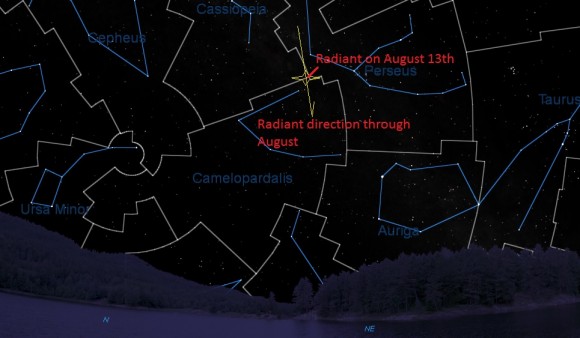
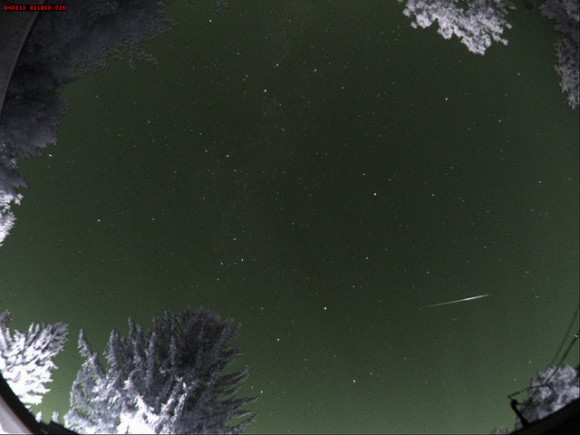
It’s that time of year again, when the most famous of all meteor showers puts on its best display.
Why are the Perseids such an all ‘round favorite of sky watchers? Well, while it’s true that other annual meteor showers such as the Quadrantids and Geminids can exceed the Perseids in maximum output, the Perseids do have a few key things going for them. First, the shower happens in mid-August, which finds many northern hemisphere residents camping out under warm, dark skies prior to the start of the new school year. And second, unlike showers such as the elusive Quads which peak over just a few hours, the Perseids enjoy a broad span of enhanced activity, often covering a week or more.
http://www.universetoday.com/113455/whe ... -perseids/
DrCaleb @ Tue Jul 29, 2014 7:29 am
$1:
NASA Long-Lived Mars Opportunity Rover Sets Off-World Driving Record
NASA's Opportunity Mars rover, which landed on the Red Planet in 2004, now holds the off-Earth roving distance record after accruing 25 miles (40 kilometers) of driving. The previous record was held by the Soviet Union's Lunokhod 2 rover.
"Opportunity has driven farther than any other wheeled vehicle on another world," said Mars Exploration Rover Project Manager John Callas, of NASA's Jet Propulsion Laboratory in Pasadena, California. "This is so remarkable considering Opportunity was intended to drive about one kilometer and was never designed for distance. But what is really important is not how many miles the rover has racked up, but how much exploration and discovery we have accomplished over that distance."
A drive of 157 feet (48 meters) on July 27 put Opportunity's total odometry at 25.01 miles (40.25 kilometers). This month's driving brought the rover southward along the western rim of Endeavour Crater. The rover had driven more than 20 miles (32 kilometers) before arriving at Endeavour Crater in 2011, where it has examined outcrops on the crater's rim containing clay and sulfate-bearing minerals. The sites are yielding evidence of ancient environments with less acidic water than those examined at Opportunity's landing site.
If the rover can continue to operate the distance of a marathon -- 26.2 miles (about 42.2 kilometers) -- it will approach the next major investigation site mission scientists have dubbed "Marathon Valley." Observations from spacecraft orbiting Mars suggest several clay minerals are exposed close together at this valley site, surrounded by steep slopes where the relationships among different layers may be evident.
The Russian Lunokhod 2 rover, a successor to the first Lunokhod mission in 1970, landed on Earth's moon on Jan. 15, 1973, where it drove about 24.2 miles (39 kilometers) in less than five months, according to calculations recently made using images from NASA's Lunar Reconnaissance Orbiter (LRO) cameras that reveal Lunokhod 2's tracks.
Irina Karachevtseva at Moscow State University of Geodesy and Cartography's Extraterrestrial Laboratory in Russia, Brad Jolliff of Washington University in St. Louis, Tim Parker of JPL, and others collaborated to verify the map-based methods for computing distances are comparable for Lunokhod-2 and Opportunity.
"The Lunokhod missions still stand as two signature accomplishments of what I think of as the first golden age of planetary exploration, the 1960s and '70s," said Steve Squyres of Cornell University in Ithaca, New York, and principal investigator for NASA's twin Mars rovers, Opportunity and Spirit. "We're in a second golden age now, and what we've tried to do on Mars with Spirit and Opportunity has been very much inspired by the accomplishments of the Lunokhod team on the moon so many years ago. It has been a real honor to follow in their historical wheel tracks."

NASA's Opportunity Mars rover, which landed on the Red Planet in 2004, now holds the off-Earth roving distance record after accruing 25 miles (40 kilometers) of driving. The previous record was held by the Soviet Union's Lunokhod 2 rover.
"Opportunity has driven farther than any other wheeled vehicle on another world," said Mars Exploration Rover Project Manager John Callas, of NASA's Jet Propulsion Laboratory in Pasadena, California. "This is so remarkable considering Opportunity was intended to drive about one kilometer and was never designed for distance. But what is really important is not how many miles the rover has racked up, but how much exploration and discovery we have accomplished over that distance."
A drive of 157 feet (48 meters) on July 27 put Opportunity's total odometry at 25.01 miles (40.25 kilometers). This month's driving brought the rover southward along the western rim of Endeavour Crater. The rover had driven more than 20 miles (32 kilometers) before arriving at Endeavour Crater in 2011, where it has examined outcrops on the crater's rim containing clay and sulfate-bearing minerals. The sites are yielding evidence of ancient environments with less acidic water than those examined at Opportunity's landing site.
If the rover can continue to operate the distance of a marathon -- 26.2 miles (about 42.2 kilometers) -- it will approach the next major investigation site mission scientists have dubbed "Marathon Valley." Observations from spacecraft orbiting Mars suggest several clay minerals are exposed close together at this valley site, surrounded by steep slopes where the relationships among different layers may be evident.
The Russian Lunokhod 2 rover, a successor to the first Lunokhod mission in 1970, landed on Earth's moon on Jan. 15, 1973, where it drove about 24.2 miles (39 kilometers) in less than five months, according to calculations recently made using images from NASA's Lunar Reconnaissance Orbiter (LRO) cameras that reveal Lunokhod 2's tracks.
Irina Karachevtseva at Moscow State University of Geodesy and Cartography's Extraterrestrial Laboratory in Russia, Brad Jolliff of Washington University in St. Louis, Tim Parker of JPL, and others collaborated to verify the map-based methods for computing distances are comparable for Lunokhod-2 and Opportunity.
"The Lunokhod missions still stand as two signature accomplishments of what I think of as the first golden age of planetary exploration, the 1960s and '70s," said Steve Squyres of Cornell University in Ithaca, New York, and principal investigator for NASA's twin Mars rovers, Opportunity and Spirit. "We're in a second golden age now, and what we've tried to do on Mars with Spirit and Opportunity has been very much inspired by the accomplishments of the Lunokhod team on the moon so many years ago. It has been a real honor to follow in their historical wheel tracks."
http://www.jpl.nasa.gov/news/news.php?release=2014-245
DrCaleb @ Tue Jul 29, 2014 12:00 pm
$1:
Vintage NASA Probe Out of Gas, But Still Alive, Private Team Says
Alas, ISEE-3 spacecraft, we almost caught you. Attempts to move a 36-year-old NASA probe closer to Earth have failed, but only because the vintage spacecraft is simply out of gas, according to the team of volunteer engineers now controlling the spacecraft.
The spacecraft, called the International Sun-Earth Explorer 3 (ISEE-3), has run out of vital nitrogen gas needed to pressurize its propulsion system, according the private team of engineers.
The team, which calls itself the ISEE-3 Reboot Project, has spent recent weeks puzzling through an issue that shut down attempts to send the ISEE-3 spacecraft on a new trajectory on July 10. With all options exhausted, the team now plans to do science in a different location instead.
"We have completely accomplished all of our original goals except for one: firing the ISEE-3 propulsion system in a sufficient fashion to alter its trajectory," project co-leaders Keith Cowing and Dennis Wingo wrote in a mission update posted to the project's website on July 24.
"Thirty-six years and more than 30 billion miles have taken its toll on the spacecraft's propulsion system," they added. "We have exhausted every option to bring the engines online so as to conduct the correction maneuver required to place it in its planned orbit. Without the pressurant (the nitrogen gas), it just won't work."

Alas, ISEE-3 spacecraft, we almost caught you. Attempts to move a 36-year-old NASA probe closer to Earth have failed, but only because the vintage spacecraft is simply out of gas, according to the team of volunteer engineers now controlling the spacecraft.
The spacecraft, called the International Sun-Earth Explorer 3 (ISEE-3), has run out of vital nitrogen gas needed to pressurize its propulsion system, according the private team of engineers.
The team, which calls itself the ISEE-3 Reboot Project, has spent recent weeks puzzling through an issue that shut down attempts to send the ISEE-3 spacecraft on a new trajectory on July 10. With all options exhausted, the team now plans to do science in a different location instead.
"We have completely accomplished all of our original goals except for one: firing the ISEE-3 propulsion system in a sufficient fashion to alter its trajectory," project co-leaders Keith Cowing and Dennis Wingo wrote in a mission update posted to the project's website on July 24.
"Thirty-six years and more than 30 billion miles have taken its toll on the spacecraft's propulsion system," they added. "We have exhausted every option to bring the engines online so as to conduct the correction maneuver required to place it in its planned orbit. Without the pressurant (the nitrogen gas), it just won't work."
http://www.space.com/26674-vintage-nasa ... f-gas.html
DrCaleb @ Wed Jul 30, 2014 6:30 am
$1:
Cassini Spacecraft Reveals 101 Geysers and More on Icy Saturn Moon
Scientists using mission data from NASA's Cassini spacecraft have identified 101 distinct geysers erupting on Saturn's icy moon Enceladus. Their analysis suggests it is possible for liquid water to reach from the moon's underground sea all the way to its surface.
These findings, and clues to what powers the geyser eruptions, are presented in two articles published in the current online edition of the Astronomical Journal.
Over a period of almost seven years, Cassini's cameras surveyed the south polar terrain of the small moon, a unique geological basin renowned for its four prominent "tiger stripe" fractures and the geysers of tiny icy particles and water vapor first sighted there nearly 10 years ago. The result of the survey is a map of 101 geysers, each erupting from one of the tiger stripe fractures, and the discovery that individual geysers are coincident with small hot spots. These relationships pointed the way to the geysers' origin
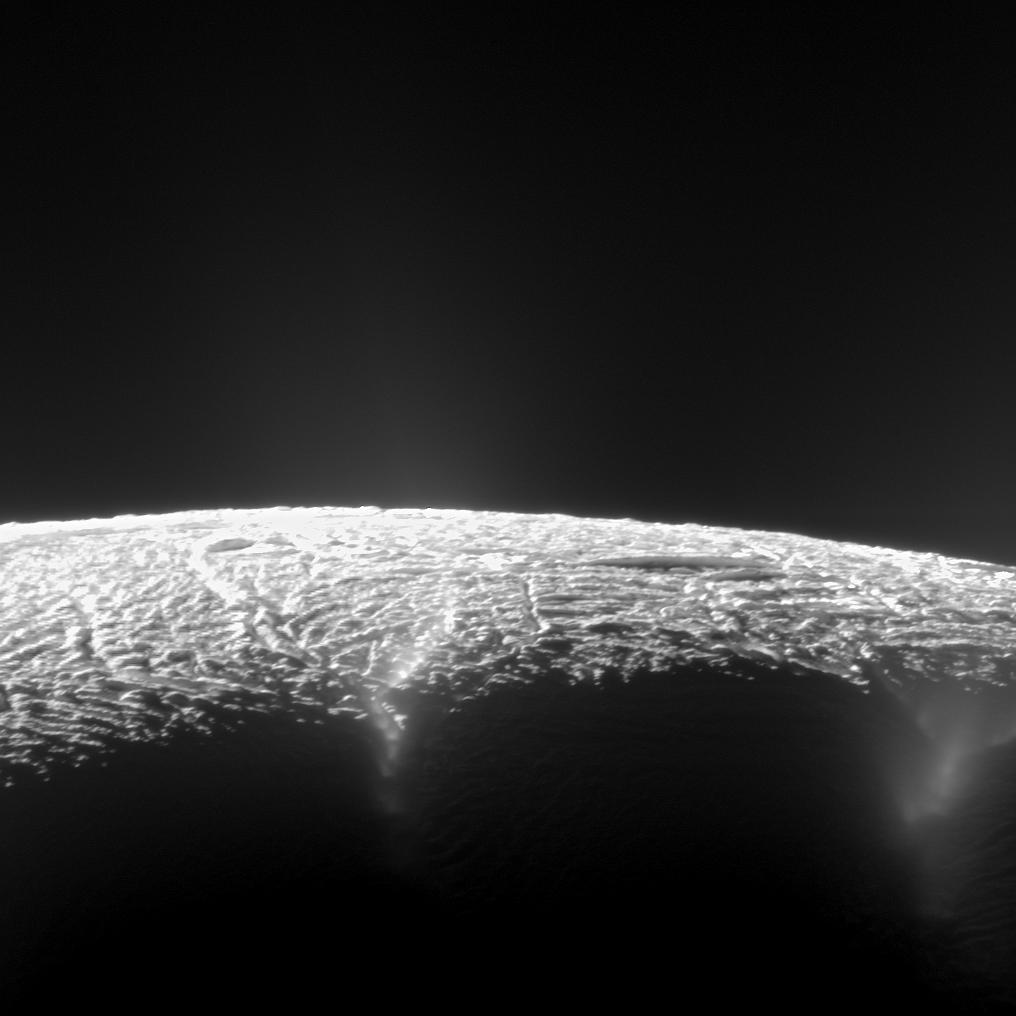


Scientists using mission data from NASA's Cassini spacecraft have identified 101 distinct geysers erupting on Saturn's icy moon Enceladus. Their analysis suggests it is possible for liquid water to reach from the moon's underground sea all the way to its surface.
These findings, and clues to what powers the geyser eruptions, are presented in two articles published in the current online edition of the Astronomical Journal.
Over a period of almost seven years, Cassini's cameras surveyed the south polar terrain of the small moon, a unique geological basin renowned for its four prominent "tiger stripe" fractures and the geysers of tiny icy particles and water vapor first sighted there nearly 10 years ago. The result of the survey is a map of 101 geysers, each erupting from one of the tiger stripe fractures, and the discovery that individual geysers are coincident with small hot spots. These relationships pointed the way to the geysers' origin
http://saturn.jpl.nasa.gov/news/newsrel ... e20140728/
DrCaleb @ Fri Aug 01, 2014 6:44 am
$1:
Nasa validates 'impossible' space drive
Nasa is a major player in space science, so when a team from the agency this week presents evidence that "impossible" microwave thrusters seem to work, something strange is definitely going on. Either the results are completely wrong, or Nasa has confirmed a major breakthrough in space propulsion.
British scientist Roger Shawyer has been trying to interest people in his EmDrive for some years through his company SPR Ltd. Shawyer claims the EmDrive converts electric power into thrust, without the need for any propellant by bouncing microwaves around in a closed container. He has built a number of demonstration systems, but critics reject his relativity-based theory and insist that, according to the law of conservation of momentum, it cannot work.
According to good scientific practice, an independent third party needed to replicate Shawyer's results. As Wired.co.uk reported, this happened last year when a Chinese team built its own EmDrive and confirmed that it produced 720 mN (about 72 grams) of thrust, enough for a practical satellite thruster. Such a thruster could be powered by solar electricity, eliminating the need for the supply of propellant that occupies up to half the launch mass of many satellites. The Chinese work attracted little attention; it seems that nobody in the West believed in it.
However, a US scientist, Guido Fetta, has built his own propellant-less microwave thruster, and managed to persuade Nasa to test it out. The test results were presented on July 30 at the 50th Joint Propulsion Conference in Cleveland, Ohio. Astonishingly enough, they are positive.
The Nasa team based at the Johnson Space Centre gave its paper the title "Anomalous Thrust Production from an RF [radio frequency] Test Device Measured on a Low-Thrust Torsion Pendulum". The five researchers spent six days setting up test equipment followed by two days of experiments with various configurations. These tests included using a "null drive" similar to the live version but modified so it would not work, and using a device which would produce the same load on the apparatus to establish whether the effect might be produced by some effect unrelated to the actual drive. They also turned the drive around the other way to check whether that had any effect.
Back in the 90s, Nasa tested what was claimed to be an antigravity device based on spinning superconducting discs. That was reported to give good test results, until researchers realised that interference from the device was affecting their measuring instruments. They have probably learned a lot since then.
The torsion balance they used to test the thrust was sensitive enough to detect a thrust of less than ten micronewtons, but the drive actually produced 30 to 50 micronewtons -- less than a thousandth of the Chinese results, but emphatically a positive result, in spite of the law of conservation of momentum:
"Test results indicate that the RF resonant cavity thruster design, which is unique as an electric propulsion device, is producing a force that is not attributable to any classical electromagnetic phenomenon and therefore is potentially demonstrating an interaction with the quantum vacuum virtual plasma."
This last line implies that the drive may work by pushing against the ghostly cloud of particles and anti-particles that are constantly popping into being and disappearing again in empty space. But the Nasa team has avoided trying to explain its results in favour of simply reporting what it found: "This paper will not address the physics of the quantum vacuum plasma thruster, but instead will describe the test integration, test operations, and the results obtained from the test campaign."
The drive's inventor, Guido Fetta calls it the "Cannae Drive", which he explains as a reference to the Battle of Cannae in which Hannibal decisively defeated a much stronger Roman army: you're at your best when you are in a tight corner. However, it's hard not to suspect that Star Trek's Engineer Scott -- "I cannae change the laws of physics" -- might also be an influence. (It was formerly known as the Q-Drive.)
. . .
A working microwave thruster would radically cut the cost of satellites and space stations and extend their working life, drive deep-space missions, and take astronauts to Mars in weeks rather than months. In hindsight, it may turn out to be another great British invention that someone else turned into a success.
Nasa is a major player in space science, so when a team from the agency this week presents evidence that "impossible" microwave thrusters seem to work, something strange is definitely going on. Either the results are completely wrong, or Nasa has confirmed a major breakthrough in space propulsion.
British scientist Roger Shawyer has been trying to interest people in his EmDrive for some years through his company SPR Ltd. Shawyer claims the EmDrive converts electric power into thrust, without the need for any propellant by bouncing microwaves around in a closed container. He has built a number of demonstration systems, but critics reject his relativity-based theory and insist that, according to the law of conservation of momentum, it cannot work.
According to good scientific practice, an independent third party needed to replicate Shawyer's results. As Wired.co.uk reported, this happened last year when a Chinese team built its own EmDrive and confirmed that it produced 720 mN (about 72 grams) of thrust, enough for a practical satellite thruster. Such a thruster could be powered by solar electricity, eliminating the need for the supply of propellant that occupies up to half the launch mass of many satellites. The Chinese work attracted little attention; it seems that nobody in the West believed in it.
However, a US scientist, Guido Fetta, has built his own propellant-less microwave thruster, and managed to persuade Nasa to test it out. The test results were presented on July 30 at the 50th Joint Propulsion Conference in Cleveland, Ohio. Astonishingly enough, they are positive.
The Nasa team based at the Johnson Space Centre gave its paper the title "Anomalous Thrust Production from an RF [radio frequency] Test Device Measured on a Low-Thrust Torsion Pendulum". The five researchers spent six days setting up test equipment followed by two days of experiments with various configurations. These tests included using a "null drive" similar to the live version but modified so it would not work, and using a device which would produce the same load on the apparatus to establish whether the effect might be produced by some effect unrelated to the actual drive. They also turned the drive around the other way to check whether that had any effect.
Back in the 90s, Nasa tested what was claimed to be an antigravity device based on spinning superconducting discs. That was reported to give good test results, until researchers realised that interference from the device was affecting their measuring instruments. They have probably learned a lot since then.
The torsion balance they used to test the thrust was sensitive enough to detect a thrust of less than ten micronewtons, but the drive actually produced 30 to 50 micronewtons -- less than a thousandth of the Chinese results, but emphatically a positive result, in spite of the law of conservation of momentum:
"Test results indicate that the RF resonant cavity thruster design, which is unique as an electric propulsion device, is producing a force that is not attributable to any classical electromagnetic phenomenon and therefore is potentially demonstrating an interaction with the quantum vacuum virtual plasma."
This last line implies that the drive may work by pushing against the ghostly cloud of particles and anti-particles that are constantly popping into being and disappearing again in empty space. But the Nasa team has avoided trying to explain its results in favour of simply reporting what it found: "This paper will not address the physics of the quantum vacuum plasma thruster, but instead will describe the test integration, test operations, and the results obtained from the test campaign."
The drive's inventor, Guido Fetta calls it the "Cannae Drive", which he explains as a reference to the Battle of Cannae in which Hannibal decisively defeated a much stronger Roman army: you're at your best when you are in a tight corner. However, it's hard not to suspect that Star Trek's Engineer Scott -- "I cannae change the laws of physics" -- might also be an influence. (It was formerly known as the Q-Drive.)
. . .
A working microwave thruster would radically cut the cost of satellites and space stations and extend their working life, drive deep-space missions, and take astronauts to Mars in weeks rather than months. In hindsight, it may turn out to be another great British invention that someone else turned into a success.
http://www.wired.co.uk/news/archive/201 ... pace-drive
DrCaleb @ Fri Aug 01, 2014 7:01 am
$1:
Despite extensive analysis, Fermi bubbles defy explanation
Scientists from Stanford and the Department of Energy's SLAC National Accelerator Laboratory have analyzed more than four years of data from NASA's Fermi Gamma-ray Space Telescope, along with data from other experiments, to create the most detailed portrait yet of two towering bubbles that stretch tens of thousands of light-years above and below our galaxy.
The bubbles, which shine most brightly in energetic gamma rays, were discovered almost four years ago by a team of Harvard astrophysicists led by Douglas Finkbeiner who combed through data from Fermi's main instrument, the Large Area Telescope.
The new portrait, described in a paper that has been accepted for publication in The Astrophysical Journal, reveals several puzzling features, said Dmitry Malyshev, a postdoctoral researcher at the Kavli Institute for Particle Astrophysics and Cosmology who co-led on the analysis.
For example, the outlines of the bubbles are quite sharp, and the bubbles themselves glow in nearly uniform gamma rays over their colossal surfaces, like two 30,000-light-year-tall incandescent bulbs screwed into the center of the galaxy.
Their size is another puzzle. The farthest reaches of the Fermi bubbles boast some of the highest energy gamma rays, but there's no discernable cause for them that far from the galaxy.
Finally, although the parts of the bubbles closest to the galactic plane shine in microwaves as well as gamma rays, about two-thirds of the way out the microwaves fade and only gamma rays are detectable. Not only is this different from other galactic bubbles, but it makes the researchers' work that much more challenging, said Malyshev's co-lead, KIPAC postdoctoral researcher Anna Franckowiak.
"Since the Fermi bubbles have no known counterparts in other wavelengths in areas high above the galactic plane, all we have to go on for clues are the gamma rays themselves," she said.

This artist's representation shows the Fermi bubbles towering above and below the galaxy. Credit: NASA's Goddard Space Flight Center
Scientists from Stanford and the Department of Energy's SLAC National Accelerator Laboratory have analyzed more than four years of data from NASA's Fermi Gamma-ray Space Telescope, along with data from other experiments, to create the most detailed portrait yet of two towering bubbles that stretch tens of thousands of light-years above and below our galaxy.
The bubbles, which shine most brightly in energetic gamma rays, were discovered almost four years ago by a team of Harvard astrophysicists led by Douglas Finkbeiner who combed through data from Fermi's main instrument, the Large Area Telescope.
The new portrait, described in a paper that has been accepted for publication in The Astrophysical Journal, reveals several puzzling features, said Dmitry Malyshev, a postdoctoral researcher at the Kavli Institute for Particle Astrophysics and Cosmology who co-led on the analysis.
For example, the outlines of the bubbles are quite sharp, and the bubbles themselves glow in nearly uniform gamma rays over their colossal surfaces, like two 30,000-light-year-tall incandescent bulbs screwed into the center of the galaxy.
Their size is another puzzle. The farthest reaches of the Fermi bubbles boast some of the highest energy gamma rays, but there's no discernable cause for them that far from the galaxy.
Finally, although the parts of the bubbles closest to the galactic plane shine in microwaves as well as gamma rays, about two-thirds of the way out the microwaves fade and only gamma rays are detectable. Not only is this different from other galactic bubbles, but it makes the researchers' work that much more challenging, said Malyshev's co-lead, KIPAC postdoctoral researcher Anna Franckowiak.
"Since the Fermi bubbles have no known counterparts in other wavelengths in areas high above the galactic plane, all we have to go on for clues are the gamma rays themselves," she said.
This artist's representation shows the Fermi bubbles towering above and below the galaxy. Credit: NASA's Goddard Space Flight Center
http://phys.org/news/2014-08-extensive- ... ation.html
Previous 1 ... 52 53 54 55 56 57 58 ... 244 Next