
Space Thread
Previous 1 ... 55 56 57 58 59 60 61 ... 244 Next
DrCaleb @ Fri Aug 22, 2014 7:06 am
$1:
A chemical signature of first generation of massive stars
Astronomers have discovered a low-mass star that exhibits the peculiar chemical abundance ratios associated with the process of creating new atomic nuclei in a first-generation massive star.
A team of astronomers from the National Astronomical Observatory of Japan (NAOJ), the Konan University and the University of Hyogo in Japan, the University of Notre Dame, and New Mexico State University has used the 8.2-meter Subaru Telescope’s High Dispersion Spectrograph (HDS) to discover a low-mass star, SDSS J0018-0939, that exhibits the peculiar chemical abundance ratios associated with the process of creating new atomic nuclei — nucleosynthesis — in a first-generation massive star. Until now, no observational evidence has supported numerical simulations of the existence of massive stars among the first generation of stars formed after the Big Bang.
The importance of the mass of first-generation stars
First-generation stars are objects formed in the early universe — within a few hundred million years after the Big Bang — from gas clouds containing only hydrogen and helium. They are the probable precursors of the formation of the universe’s structure and chemical enrichment; large stellar systems, like galaxies, formed later.
Numerical simulations have made significant progress in understanding the formation of the first stars. Recent simulations suggest that a small fraction of stars with masses exceeding 100 times that of the Sun could have formed in the early universe, even though the large majority of first stars formed with masses of 10 to 100 times that of the Sun. Their strong UV radiation and energetic explosions are likely to have had a significant impact on the evolution of stellar systems.
Signatures of first stars recorded by low-mass Milky Way stars
Supernova explosions ejected elements formed by the first massive stars and dispersed them into the gas that formed the next generations of stars.
Stars with masses slightly less than the Sun’s have long lifetimes, long enough that they are still shining. The Milky Way contains such low-mass stars with low overall metal content, including the elements produced by the first massive stars. The distinctive chemical abundance patterns of these stars can be used to estimate the masses of the first stars.
Over the past 30 years, astronomers have conducted large-scale investigations to find low-mass, metal-poor stars formed in the early universe. Follow-up spectroscopic studies, which measured their chemical abundances, have identified stars that recorded the abundance patterns associated with the first stars that had several tens of solar masses and produced large amounts of carbon and other light elements. However, no previous research of low-mass metal-poor Milky Way stars has found the signature of supernova explosions of massive stars with more than 100 solar masses, which synthesize large amounts of iron but little carbon.

Astronomers have discovered a low-mass star that exhibits the peculiar chemical abundance ratios associated with the process of creating new atomic nuclei in a first-generation massive star.
A team of astronomers from the National Astronomical Observatory of Japan (NAOJ), the Konan University and the University of Hyogo in Japan, the University of Notre Dame, and New Mexico State University has used the 8.2-meter Subaru Telescope’s High Dispersion Spectrograph (HDS) to discover a low-mass star, SDSS J0018-0939, that exhibits the peculiar chemical abundance ratios associated with the process of creating new atomic nuclei — nucleosynthesis — in a first-generation massive star. Until now, no observational evidence has supported numerical simulations of the existence of massive stars among the first generation of stars formed after the Big Bang.
The importance of the mass of first-generation stars
First-generation stars are objects formed in the early universe — within a few hundred million years after the Big Bang — from gas clouds containing only hydrogen and helium. They are the probable precursors of the formation of the universe’s structure and chemical enrichment; large stellar systems, like galaxies, formed later.
Numerical simulations have made significant progress in understanding the formation of the first stars. Recent simulations suggest that a small fraction of stars with masses exceeding 100 times that of the Sun could have formed in the early universe, even though the large majority of first stars formed with masses of 10 to 100 times that of the Sun. Their strong UV radiation and energetic explosions are likely to have had a significant impact on the evolution of stellar systems.
Signatures of first stars recorded by low-mass Milky Way stars
Supernova explosions ejected elements formed by the first massive stars and dispersed them into the gas that formed the next generations of stars.
Stars with masses slightly less than the Sun’s have long lifetimes, long enough that they are still shining. The Milky Way contains such low-mass stars with low overall metal content, including the elements produced by the first massive stars. The distinctive chemical abundance patterns of these stars can be used to estimate the masses of the first stars.
Over the past 30 years, astronomers have conducted large-scale investigations to find low-mass, metal-poor stars formed in the early universe. Follow-up spectroscopic studies, which measured their chemical abundances, have identified stars that recorded the abundance patterns associated with the first stars that had several tens of solar masses and produced large amounts of carbon and other light elements. However, no previous research of low-mass metal-poor Milky Way stars has found the signature of supernova explosions of massive stars with more than 100 solar masses, which synthesize large amounts of iron but little carbon.
http://www.astronomy.com/news/2014/08/a ... sive-stars
DrCaleb @ Tue Aug 26, 2014 10:51 am
$1:
Best view yet of merging galaxies in distant universe
Using the Atacama Large Millimeter/submillimeter Array, and other telescopes, an international team of astronomers has obtained the best view yet of a collision that took place between two galaxies when the Universe was half its current age. They enlisted the help of a galaxy-sized magnifying glass to reveal otherwise invisible detail. These studies of the galaxy H-ATLAS J142935.3-002836 have shown that this complex distant object looks like the local galaxy collision, the Antennae Galaxies.
The famous fictional detective Sherlock Holmes used a magnifying lens to reveal barely visible but important evidence. Astronomers are now combining the power of many telescopes on Earth and in space with a vastly larger form of cosmic lens to study a case of vigorous star formation in the early Universe.
"While astronomers are often limited by the power of their telescopes, in some cases our ability to see detail is hugely boosted by natural lenses, created by the Universe," explains lead author Hugo Messiasof the Universidad de Concepción (Chile) and the Centro de Astronomia e Astrofísica da Universidade de Lisboa (Portugal). "Einstein predicted in his theory of general relativity that, given enough mass, light does not travel in a straight line but will be bent in a similar way to light refracted by a normal lens."
These cosmic lenses are created by massive structures like galaxies and galaxy clusters, which deflect the light from objects behind them due to their strong gravity—an effect, called gravitational lensing. The magnifying properties of this effect allow astronomers to study objects which would not be visible otherwise and to directly compare local galaxies with much more remote ones, seen when the Universe was significantly younger.
But for these gravitational lenses to work, the lensing galaxy, and the one far behind it, need to be very precisely aligned.
"These chance alignments are quite rare and tend to be hard to identify," adds Hugo Messias, "but, recent studies have shown that by observing at far-infrared and millimetre wavelengths we can find these cases much more efficiently."
H-ATLAS J142935.3-002836 (or just H1429-0028 for short) is one of these sources and was found in the Herschel Astrophysical Terahertz Large Area Survey (H-ATLAS). Although very faint in visible light pictures, it is among the brightest gravitationally lensed objects in the far-infrared regime found so far, even though we are seeing it at a time when the Universe was just half its current age.

Using the Atacama Large Millimeter/submillimeter Array, and other telescopes, an international team of astronomers has obtained the best view yet of a collision that took place between two galaxies when the Universe was half its current age. They enlisted the help of a galaxy-sized magnifying glass to reveal otherwise invisible detail. These studies of the galaxy H-ATLAS J142935.3-002836 have shown that this complex distant object looks like the local galaxy collision, the Antennae Galaxies.
The famous fictional detective Sherlock Holmes used a magnifying lens to reveal barely visible but important evidence. Astronomers are now combining the power of many telescopes on Earth and in space with a vastly larger form of cosmic lens to study a case of vigorous star formation in the early Universe.
"While astronomers are often limited by the power of their telescopes, in some cases our ability to see detail is hugely boosted by natural lenses, created by the Universe," explains lead author Hugo Messiasof the Universidad de Concepción (Chile) and the Centro de Astronomia e Astrofísica da Universidade de Lisboa (Portugal). "Einstein predicted in his theory of general relativity that, given enough mass, light does not travel in a straight line but will be bent in a similar way to light refracted by a normal lens."
These cosmic lenses are created by massive structures like galaxies and galaxy clusters, which deflect the light from objects behind them due to their strong gravity—an effect, called gravitational lensing. The magnifying properties of this effect allow astronomers to study objects which would not be visible otherwise and to directly compare local galaxies with much more remote ones, seen when the Universe was significantly younger.
But for these gravitational lenses to work, the lensing galaxy, and the one far behind it, need to be very precisely aligned.
"These chance alignments are quite rare and tend to be hard to identify," adds Hugo Messias, "but, recent studies have shown that by observing at far-infrared and millimetre wavelengths we can find these cases much more efficiently."
H-ATLAS J142935.3-002836 (or just H1429-0028 for short) is one of these sources and was found in the Herschel Astrophysical Terahertz Large Area Survey (H-ATLAS). Although very faint in visible light pictures, it is among the brightest gravitationally lensed objects in the far-infrared regime found so far, even though we are seeing it at a time when the Universe was just half its current age.
http://phys.org/news/2014-08-view-mergi ... verse.html
DrCaleb @ Wed Aug 27, 2014 6:14 am
$1:
Water clouds tentatively detected just 7 light-years from Earth
Astronomers have found signs of water ice clouds on an object just 7.3 light-years from Earth—less than twice the distance of Alpha Centauri, the nearest star system to the sun. If confirmed, the discovery is the first sighting of water clouds beyond our solar system. The clouds shroud a Jupiter-sized object known as a brown dwarf and should yield insight into the nature of cool giant planets orbiting other suns.
Kevin Luhman, an astronomer at Pennsylvania State University, University Park, recently discovered the nearby object by using images from NASA’s WISE infrared space telescope, which scanned the sky from 2010 to 2011. A brown dwarf is a failed star and has so little mass that it can't sustain nuclear reactions, so after its birth it fades and cools. This brown dwarf, named WISE J0855-0714, is the coldest known. Its temperature is slightly below the freezing point of water, so it's colder than Earth's mean temperature but warmer than Jupiter’s.
"I've been obsessed with this object since its discovery," says astronomer Jacqueline Faherty of the Carnegie Institution for Science in Washington, D.C. The new neighbor resembles a giant planet—it's as large as Jupiter and three to 10 times as massive—but is solitary, which means it has no sun whose glare interferes with our view of it. Moreover, it's nearby: the fourth closest system to the sun, after Alpha Centauri, Barnard's star, and Luhman 16.
Still, because the object is small and cold, it's so dim that no ground-based observatory had seen it. "I went to battle at the telescope to try and get this detection," Faherty says. "I wanted to put war paint under my eyes and wear a bandanna, because I knew this was not going to be an easy thing to do. At the telescope, I've never been so nervous. I've never wanted clear conditions so badly."

Astronomers have found signs of water ice clouds on an object just 7.3 light-years from Earth—less than twice the distance of Alpha Centauri, the nearest star system to the sun. If confirmed, the discovery is the first sighting of water clouds beyond our solar system. The clouds shroud a Jupiter-sized object known as a brown dwarf and should yield insight into the nature of cool giant planets orbiting other suns.
Kevin Luhman, an astronomer at Pennsylvania State University, University Park, recently discovered the nearby object by using images from NASA’s WISE infrared space telescope, which scanned the sky from 2010 to 2011. A brown dwarf is a failed star and has so little mass that it can't sustain nuclear reactions, so after its birth it fades and cools. This brown dwarf, named WISE J0855-0714, is the coldest known. Its temperature is slightly below the freezing point of water, so it's colder than Earth's mean temperature but warmer than Jupiter’s.
"I've been obsessed with this object since its discovery," says astronomer Jacqueline Faherty of the Carnegie Institution for Science in Washington, D.C. The new neighbor resembles a giant planet—it's as large as Jupiter and three to 10 times as massive—but is solitary, which means it has no sun whose glare interferes with our view of it. Moreover, it's nearby: the fourth closest system to the sun, after Alpha Centauri, Barnard's star, and Luhman 16.
Still, because the object is small and cold, it's so dim that no ground-based observatory had seen it. "I went to battle at the telescope to try and get this detection," Faherty says. "I wanted to put war paint under my eyes and wear a bandanna, because I knew this was not going to be an easy thing to do. At the telescope, I've never been so nervous. I've never wanted clear conditions so badly."
http://news.sciencemag.org/space/2014/0 ... ears-earth
DrCaleb @ Thu Aug 28, 2014 6:03 am
$1:
NASA Telescopes Uncover Early Construction of Giant Galaxy
Astronomers have uncovered for the first time the earliest stages of a massive galaxy forming in the young Universe. The discovery was made possible through combining observations from the NASA/ESA Hubble Space Telescope, NASA‘s Spitzer Space Telescope, ESA’s Herschel Space Observatory, and the W.M. Keck Observatory in Hawaii. The growing galaxy core is blazing with the light of millions of newborn stars that are forming at a ferocious rate. The paper appears in the journal Nature on 27 August.
Elliptical galaxies are large, gas-poor gatherings of older stars and are one of the main types of galaxy along with their spiral and lenticular relatives. Galaxy formation theories suggest that giant elliptical galaxies form from the inside out, with a large core marking the very first stages of formation.
However, evidence of this early construction phase has eluded astronomers — until now.
Astronomers have now spotted a compact galactic core known as GOODS-N-774, and nicknamed Sparky [1]. It is seen as it appeared eleven billion years ago, just three billion years after the Big Bang.
“This core formation process is a phenomenon unique to the early Universe,” explains Erica Nelson of Yale University, USA, lead author of the science paper announcing the results, “we do not see galaxies forming in this way any more. There’s something about the Universe at that time that could form galaxies in this way that it now can’t. We suspect that the Universe could produce denser objects because the Universe as a whole was denser shortly after the Big Bang. It is much less dense now, so it can’t do it anymore.”

Astronomers have uncovered for the first time the earliest stages of a massive galaxy forming in the young Universe. The discovery was made possible through combining observations from the NASA/ESA Hubble Space Telescope, NASA‘s Spitzer Space Telescope, ESA’s Herschel Space Observatory, and the W.M. Keck Observatory in Hawaii. The growing galaxy core is blazing with the light of millions of newborn stars that are forming at a ferocious rate. The paper appears in the journal Nature on 27 August.
Elliptical galaxies are large, gas-poor gatherings of older stars and are one of the main types of galaxy along with their spiral and lenticular relatives. Galaxy formation theories suggest that giant elliptical galaxies form from the inside out, with a large core marking the very first stages of formation.
However, evidence of this early construction phase has eluded astronomers — until now.
Astronomers have now spotted a compact galactic core known as GOODS-N-774, and nicknamed Sparky [1]. It is seen as it appeared eleven billion years ago, just three billion years after the Big Bang.
“This core formation process is a phenomenon unique to the early Universe,” explains Erica Nelson of Yale University, USA, lead author of the science paper announcing the results, “we do not see galaxies forming in this way any more. There’s something about the Universe at that time that could form galaxies in this way that it now can’t. We suspect that the Universe could produce denser objects because the Universe as a whole was denser shortly after the Big Bang. It is much less dense now, so it can’t do it anymore.”
http://spaceindustrynews.com/nasa-teles ... laxy/4663/
DrCaleb @ Thu Aug 28, 2014 6:06 am
$1:
Underground experiment confirms what powers the sun
Scientists have long believed that the power of the sun comes largely from the fusion of protons into helium, but now they can finally prove it. An international team of researchers using a detector buried deep below the mountains of central Italy has detected neutrinos—ghostly particles that interact only very reluctantly with matter—streaming from the heart of the sun. Other solar neutrinos have been detected before, but these particular ones come from the key proton-proton fusion reaction that is the first part of a chain of reactions that provides 99% of the sun’s power.
The results also show that the sun is a remarkably steady power source. Neutrinos take only 8 minutes to get from the sun’s core to Earth, so the rate of neutrino production that the team detected reflects the amount of heat the sun is producing today. It just so happens that this is the same as the amount of energy now being radiated from the sun’s surface, even though those photons have taken 100,000 years to work their way from the core to the surface. Hence, the sun’s energy production hasn’t changed in 100 millennia. “This is direct proof of the stability of the sun over the past 100,000 years or so,” says team member Andrea Pocar of the University of Massachusetts, Amherst.
The core of the sun is a fiery furnace so hot and dense that protons—nuclei of hydrogen, the sun’s main constituent—slam together with such force that they fuse, producing a deuterium nucleus (heavy hydrogen, made of a proton and a neutron) plus an antielectron and a neutrino. This is the start of a whole sequence of reactions: Protons collide with deuterium to produce helium-3; helium-3s combine to give helium-4 plus protons; other reactions produce lithium, beryllium, and boron. Many of these reactions produce neutrinos, but the vast majority of the neutrino flux from the sun is produced by the original proton-proton, or pp, reaction. “The pp reaction is the most basic process. Everything that goes on in the sun stems from it,” says Steve Biller of the University of Oxford and U.K. spokesperson for the SNO+ neutrino detector under construction in Canada, who was not involved in the new work.

Scientists have long believed that the power of the sun comes largely from the fusion of protons into helium, but now they can finally prove it. An international team of researchers using a detector buried deep below the mountains of central Italy has detected neutrinos—ghostly particles that interact only very reluctantly with matter—streaming from the heart of the sun. Other solar neutrinos have been detected before, but these particular ones come from the key proton-proton fusion reaction that is the first part of a chain of reactions that provides 99% of the sun’s power.
The results also show that the sun is a remarkably steady power source. Neutrinos take only 8 minutes to get from the sun’s core to Earth, so the rate of neutrino production that the team detected reflects the amount of heat the sun is producing today. It just so happens that this is the same as the amount of energy now being radiated from the sun’s surface, even though those photons have taken 100,000 years to work their way from the core to the surface. Hence, the sun’s energy production hasn’t changed in 100 millennia. “This is direct proof of the stability of the sun over the past 100,000 years or so,” says team member Andrea Pocar of the University of Massachusetts, Amherst.
The core of the sun is a fiery furnace so hot and dense that protons—nuclei of hydrogen, the sun’s main constituent—slam together with such force that they fuse, producing a deuterium nucleus (heavy hydrogen, made of a proton and a neutron) plus an antielectron and a neutrino. This is the start of a whole sequence of reactions: Protons collide with deuterium to produce helium-3; helium-3s combine to give helium-4 plus protons; other reactions produce lithium, beryllium, and boron. Many of these reactions produce neutrinos, but the vast majority of the neutrino flux from the sun is produced by the original proton-proton, or pp, reaction. “The pp reaction is the most basic process. Everything that goes on in the sun stems from it,” says Steve Biller of the University of Oxford and U.K. spokesperson for the SNO+ neutrino detector under construction in Canada, who was not involved in the new work.
http://news.sciencemag.org/physics/2014 ... powers-sun
Original paper in Nature:
http://www.nature.com/nature/journal/v5 ... 13702.html
$1:
Neutrinos from the primary proton–proton fusion process in the Sun
In the core of the Sun, energy is released through sequences of nuclear reactions that convert hydrogen into helium. The primary reaction is thought to be the fusion of two protons with the emission of a low-energy neutrino. These so-called pp neutrinos constitute nearly the entirety of the solar neutrino flux, vastly outnumbering those emitted in the reactions that follow. Although solar neutrinos from secondary processes have been observed, proving the nuclear origin of the Sun’s energy and contributing to the discovery of neutrino oscillations, those from proton–proton fusion have hitherto eluded direct detection. Here we report spectral observations of pp neutrinos, demonstrating that about 99 per cent of the power of the Sun, 3.84 × 1033 ergs per second, is generated by the proton–proton fusion process.
In the core of the Sun, energy is released through sequences of nuclear reactions that convert hydrogen into helium. The primary reaction is thought to be the fusion of two protons with the emission of a low-energy neutrino. These so-called pp neutrinos constitute nearly the entirety of the solar neutrino flux, vastly outnumbering those emitted in the reactions that follow. Although solar neutrinos from secondary processes have been observed, proving the nuclear origin of the Sun’s energy and contributing to the discovery of neutrino oscillations, those from proton–proton fusion have hitherto eluded direct detection. Here we report spectral observations of pp neutrinos, demonstrating that about 99 per cent of the power of the Sun, 3.84 × 1033 ergs per second, is generated by the proton–proton fusion process.
DrCaleb @ Thu Aug 28, 2014 6:15 am
$1:
NASA's New Mega-Rocket for Deep Space Will Be Launch Ready by 2018
NASA new mega-rocket, a towering booster designed for deep space missions, will be ready for its first test flight no later than November 2018, space agency officials announced Wednesday (Aug. 27).
It's possible that the Space Launch System rocket test flight could launch as early as December 2017, but NASA officials have committed to having the rocket ready for flight be the end of 2018 to be safe. That extra wiggle room should let the space agency cope with scheduling and funding issues as they crop up in the future, NASA officials said in a teleconference with reporters.
The SLS will be the largest rocket ever constructed and it is designed to send humans deeper into space than ever before. The huge launcher — which will stand at 400-feet-tall (122 meters) in its final configuration — could deliver NASA astronauts to an asteroid and even Mars sometime in the future

NASA new mega-rocket, a towering booster designed for deep space missions, will be ready for its first test flight no later than November 2018, space agency officials announced Wednesday (Aug. 27).
It's possible that the Space Launch System rocket test flight could launch as early as December 2017, but NASA officials have committed to having the rocket ready for flight be the end of 2018 to be safe. That extra wiggle room should let the space agency cope with scheduling and funding issues as they crop up in the future, NASA officials said in a teleconference with reporters.
The SLS will be the largest rocket ever constructed and it is designed to send humans deeper into space than ever before. The huge launcher — which will stand at 400-feet-tall (122 meters) in its final configuration — could deliver NASA astronauts to an asteroid and even Mars sometime in the future
http://www.space.com/12957-nasa-giant-r ... aphic.html
Twila2 @ Thu Aug 28, 2014 11:13 am
I just discovered this thread! I think I'm going to need a cosy seat and a hot cup of tea to help me settle in and start reading.
Jabberwalker @ Thu Aug 28, 2014 2:27 pm
It's a blast.
What sort of super rocket are the Russians going to answer with?
DrCaleb @ Fri Aug 29, 2014 11:38 am
$1:
Controversy Erupts over Distance to Pleiades Star Cluster
The most precise measurement yet of the distance to the Pleiades star cluster is reviving a dispute that has split the astronomy community largely down a trans-Atlantic divide for the past 17 years.
The latest result, from a US team using a worldwide network of radio telescopes, is in good agreement with more than a dozen previous measurements to the Pleiades, made using multiple techniques. But it stands in sharp contrast to a figure from the Hipparcos satellite of the European Space Agency (ESA).
The authors of the latest study, published today in Science, say they believe that the Hipparcos measurement is an error, and worry that the same problem could affect its successor mission, ESA's Gaia space telescope, which began taking data last month. The alternative is even less appealing: if Hipparcos is right, then accepted theories of the physics of stars could require some mending.
Parsecs from parallax
Using radio telescopes including the Very Long Baseline Array, the US team exploited the physics of electromagnetic waves to operate the instruments as one giant, precise, Earth-sized telescope. They calculated the distance to the Pleiades cluster by watching five of its stars (two of them forming a binary system) over a period of 18 months. They calculated the cluster’s distance by watching four of its stars appear to shift ever-so-slightly in the sky as the Earth orbited the Sun, in a modern twist to the centuries-old parallax method. The less those stars shifted relative to the background — defined by a galaxy so distant it doesn’t appear to move at all — the farther away they were.
The team got a result of 136.2 parsecs (444.2 light years), concurring with nearly all previous estimates. But the Hipparcos result puts the cluster 16 parsecs closer to Earth. The uncertainties of both measurements are less than two parsecs.
Much rides on the debate. The Pleiades cluster is made of young stars, only 100 million years old, and visible to the naked eye in the Taurus constellation. Many of the consensus measurements were made using the apparent brightness of the stars, and compared that with their intrinsic brightness based on models of their stellar burning processes. This means that if the Hipparcos distance is correct, it challenges scientists’ understanding of young stars — and everything that happens to them afterwards, including the fate of their planetary systems, says Carl Melis, an astronomer at the University of California in San Diego and the study’s first author. “If we don’t understand young stars, we’re kind of hosed.”

The most precise measurement yet of the distance to the Pleiades star cluster is reviving a dispute that has split the astronomy community largely down a trans-Atlantic divide for the past 17 years.
The latest result, from a US team using a worldwide network of radio telescopes, is in good agreement with more than a dozen previous measurements to the Pleiades, made using multiple techniques. But it stands in sharp contrast to a figure from the Hipparcos satellite of the European Space Agency (ESA).
The authors of the latest study, published today in Science, say they believe that the Hipparcos measurement is an error, and worry that the same problem could affect its successor mission, ESA's Gaia space telescope, which began taking data last month. The alternative is even less appealing: if Hipparcos is right, then accepted theories of the physics of stars could require some mending.
Parsecs from parallax
Using radio telescopes including the Very Long Baseline Array, the US team exploited the physics of electromagnetic waves to operate the instruments as one giant, precise, Earth-sized telescope. They calculated the distance to the Pleiades cluster by watching five of its stars (two of them forming a binary system) over a period of 18 months. They calculated the cluster’s distance by watching four of its stars appear to shift ever-so-slightly in the sky as the Earth orbited the Sun, in a modern twist to the centuries-old parallax method. The less those stars shifted relative to the background — defined by a galaxy so distant it doesn’t appear to move at all — the farther away they were.
The team got a result of 136.2 parsecs (444.2 light years), concurring with nearly all previous estimates. But the Hipparcos result puts the cluster 16 parsecs closer to Earth. The uncertainties of both measurements are less than two parsecs.
Much rides on the debate. The Pleiades cluster is made of young stars, only 100 million years old, and visible to the naked eye in the Taurus constellation. Many of the consensus measurements were made using the apparent brightness of the stars, and compared that with their intrinsic brightness based on models of their stellar burning processes. This means that if the Hipparcos distance is correct, it challenges scientists’ understanding of young stars — and everything that happens to them afterwards, including the fate of their planetary systems, says Carl Melis, an astronomer at the University of California in San Diego and the study’s first author. “If we don’t understand young stars, we’re kind of hosed.”
Winnipegger @ Fri Aug 29, 2014 9:29 pm
Info-graphics are fun. They have lots of information in a single page. But the summary can be misleading.
Saturn INT-21: used to launch Skylab. First and second stage only, no third stage. Able to lift 115,900kg to 185km @ 28.0° inclination
Saturn V: used to launch Apollo to the Moon: 47,000kg to Translunar trajectory. Or able to lift 118,000kg to 185km @ 28.0° inclination
Note: That isn't the "130 metric ton" capacity that the info-graphic claims. However, lift capacities for SLS initial and final configurations do match current NASA documents. That means the final configuration will be even more powerful than Saturn V.
As for "Orion MPCV": it has the same life support system as Apollo or Shuttle. That is bottled oxygen, lithium hydroxide to scrub CO2, and activated charcoal to remove bad smells. Lithium hydroxide cannot be reused. This gives Orion 21 days of life support. A mission to an asteroid requires a module the size of a space station module with the same recycling life support system. Orion was said to carry 6 astronauts to a space station in Low Earth Orbit, or 4 to the Moon. For the Moon you need food and more lithium hydroxide canisters. Apollo could carry 5 to Skylab, or 3 to the Moon. So Orion can only carry one more. Dragon can carry 7 to ISS, or 4 to the Moon. And Dragon was originally designed to go to the Moon. Orion has the same heat shield as Apollo, so able to return from the Moon, but can't handle direct return from Mars. Dragon has the new heat shield material that NASA developed specifically to return from Mars. The first version of Dragon, used to deliver cargo to ISS, used the large square CBM hatch. It requires the station's arm to gently "berth". But Dragon v2 has the same small, round, APAS hatch that Shuttle used; so able to dock itself. Dragon also has non-regenerable life support. But the lower cost and lighter weight of Dragon, and larger interior volume? Anything Orion can do, Dragon can do better.
"Inspiration Mars" has been designed with Orion. But notice the return trip loops past Venus, then falls "up" from the Sun back to Earth. That fall "up" causes it to slow down. This loop past Venus is necessary to ensure it hits Earth's atmosphere slow enough that Orion's heat shield can handle it. Orion can't handle a direct return from Mars. Dragon can.
And as a "bean counter", I argue the much lower cost of Dragon is far superior. And the fact Dragon has actually flown in space. Orion got the contract first, but still hasn't flown even once. Not even an unmanned test. That test is currently scheduled for December, but it was scheduled for September. Expect it will be delayed yet again. One member of the US Congress pointed out the cost to develop the launch escape tower for Orion cost as much as the entire Falcon 9 launch vehicle used to launch Dragon. And Boeing hasn't even been able to complete the service module for Orion. They're current plan is to test the Orion capsule on a Delta 4 Heavy rocket, using a service module from the European Space Agency's ATV. Again this "bean counter" argues to keep Dragon, keep SLS, but scrap Orion.
Gunnair @ Fri Aug 29, 2014 9:43 pm
$1:
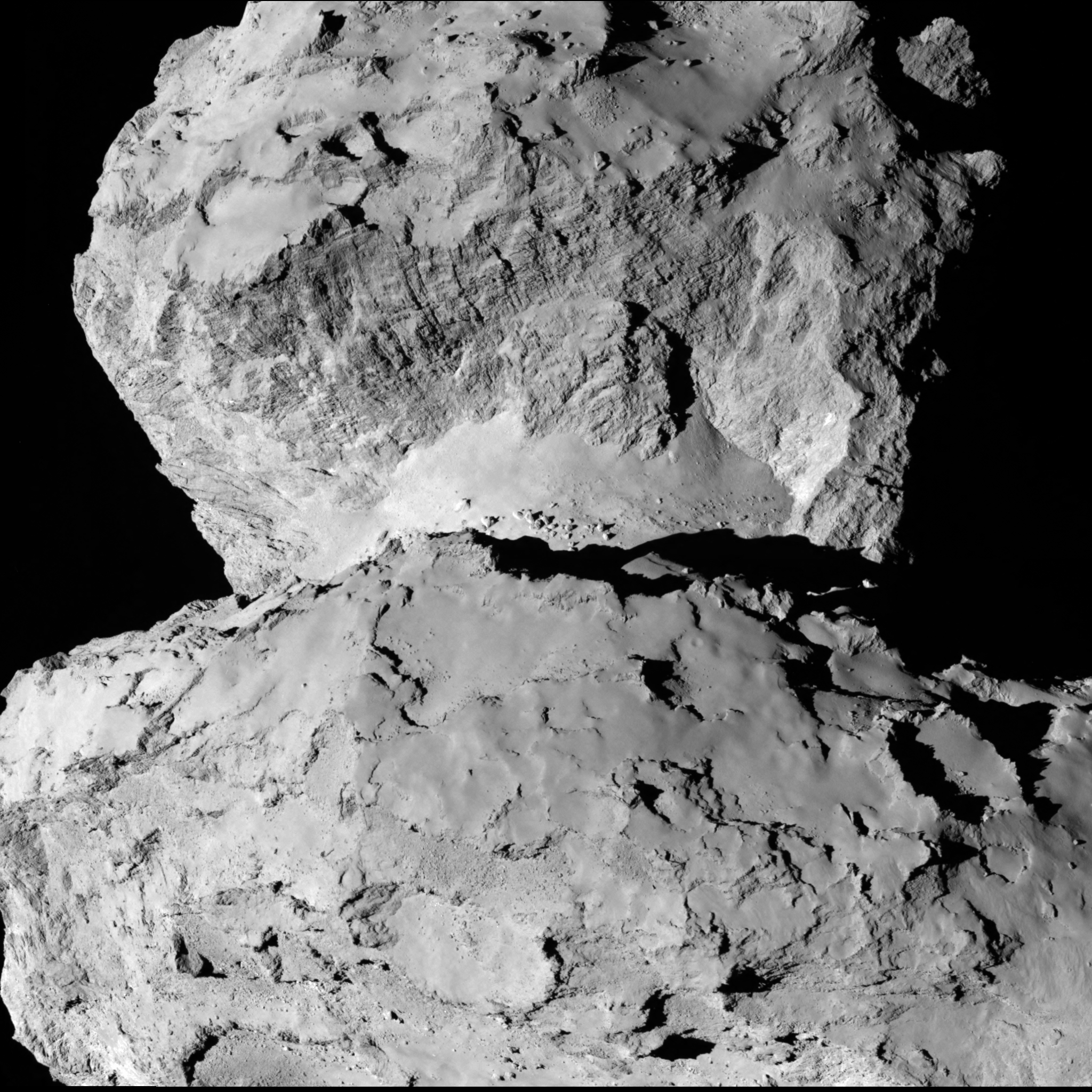
Contrasting Terrains on Comet Churyumov-Gerasimenko
Image Credit: ESA / Rosetta / MPS for OSIRIS Team; MPS/UPD/LAM/IAA/SSO/INTA/UPM/DASP/IDA
Explanation: Where should Philae land? As ESA's robotic spacecraft Rosetta circles toward Comet 67P/ Churyumov-Gerasimenko, a decision must eventually be made as to where its mechanical lander should attempt to touch-down. Reaching the comet earlier this month, Rosetta is sending back detailed pictures of the comet's unusual nucleus from which a smooth landing site will be selected. Pictured above, near the image top, the head of the comet's nucleus shows rugged grooves, while near the image bottom, the body shows a patch-work of areas sometimes separated by jagged hills. Some of the patch-work areas apparent on both the head and body seem to have fields of relatively smooth terrain. In the connecting area called the neck, however, visible across the image center, a relatively large swath of light-colored smooth terrain appears, punctuated occasionally by large boulders. Rosetta is scheduled to release Philae toward the dark mountain-sized comet nucleus with an anticipated landing date in November.
Image Credit: ESA / Rosetta / MPS for OSIRIS Team; MPS/UPD/LAM/IAA/SSO/INTA/UPM/DASP/IDA
Explanation: Where should Philae land? As ESA's robotic spacecraft Rosetta circles toward Comet 67P/ Churyumov-Gerasimenko, a decision must eventually be made as to where its mechanical lander should attempt to touch-down. Reaching the comet earlier this month, Rosetta is sending back detailed pictures of the comet's unusual nucleus from which a smooth landing site will be selected. Pictured above, near the image top, the head of the comet's nucleus shows rugged grooves, while near the image bottom, the body shows a patch-work of areas sometimes separated by jagged hills. Some of the patch-work areas apparent on both the head and body seem to have fields of relatively smooth terrain. In the connecting area called the neck, however, visible across the image center, a relatively large swath of light-colored smooth terrain appears, punctuated occasionally by large boulders. Rosetta is scheduled to release Philae toward the dark mountain-sized comet nucleus with an anticipated landing date in November.
Gunnair @ Fri Aug 29, 2014 9:44 pm
$1:
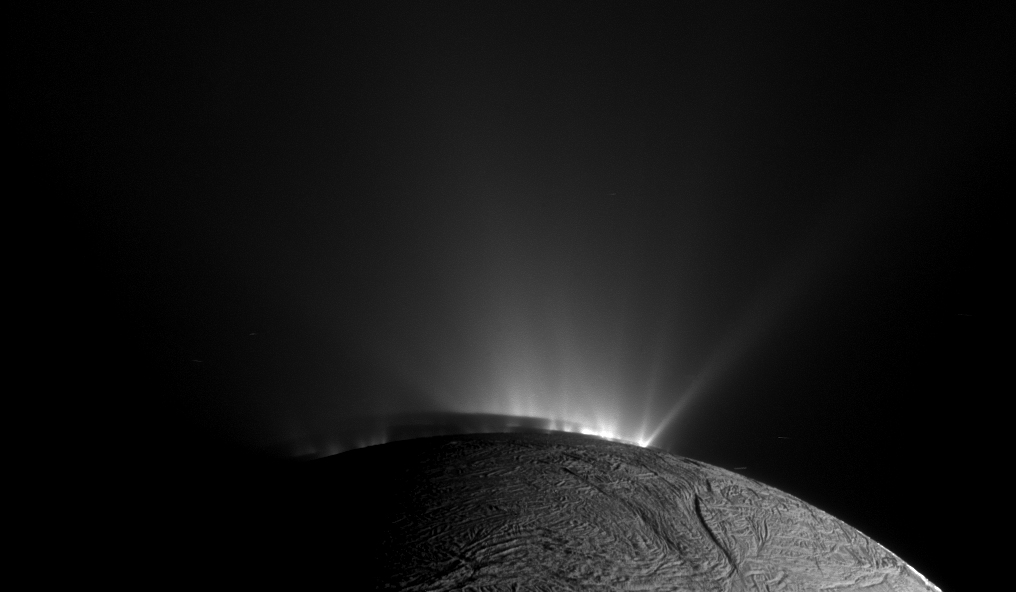
Shadows and Plumes Across Enceladus
Image Credit: Cassini Imaging Team, SSI, JPL, ESA, NASA
Explanation: Why does Enceladus have ice plumes? The discovery of jets spewing water vapor and ice was detected by the Saturn-orbiting Cassini spacecraft in 2005. The origin of the water feeding the jets, however, remained a topic of research. A leading hypothesis held that the source might originate from a deep underground sea, but another hypothesis indicated that it might just be ice melted off walls of deep rifts by the moon's tidal flexing and heating. Pictured above, the textured surface of Enceladus is visible in the foreground, while rows of plumes rise from ice fractures in the distance. These jets are made more visible by the Sun angle and the encroaching shadow of night. Recent study of over a hundred images like this -- of geysers crossing Enceladus' South Pole, together with regional heat maps, indicate that these plumes likely originate from a hidden sea, incresaing the chance that this frosty globe might be harboring life.
Image Credit: Cassini Imaging Team, SSI, JPL, ESA, NASA
Explanation: Why does Enceladus have ice plumes? The discovery of jets spewing water vapor and ice was detected by the Saturn-orbiting Cassini spacecraft in 2005. The origin of the water feeding the jets, however, remained a topic of research. A leading hypothesis held that the source might originate from a deep underground sea, but another hypothesis indicated that it might just be ice melted off walls of deep rifts by the moon's tidal flexing and heating. Pictured above, the textured surface of Enceladus is visible in the foreground, while rows of plumes rise from ice fractures in the distance. These jets are made more visible by the Sun angle and the encroaching shadow of night. Recent study of over a hundred images like this -- of geysers crossing Enceladus' South Pole, together with regional heat maps, indicate that these plumes likely originate from a hidden sea, incresaing the chance that this frosty globe might be harboring life.
Gunnair @ Fri Aug 29, 2014 9:45 pm

$1:
Collapse in Hebes Chasma on Mars
Image Credit & Copyright: ESA/DLR/FU Berlin (G. Neukum)
Explanation: What's happened in Hebes Chasma on Mars? Hebes Chasma is a depression just north of the enormous Valles Marineris canyon. Since the depression is unconnected to other surface features, it is unclear where the internal material went. Inside Hebes Chasma is Hebes Mensa, a 5 kilometer high mesa that appears to have undergone an unusual partial collapse -- a collapse that might be providing clues. The above image, taken by the robotic Mars Express spacecraft currently orbiting Mars, shows great details of the chasm and the unusual horseshoe shaped indentation in the central mesa. Material from the mesa appears to have flowed onto the floor of the chasm, while a possible dark layer appears to have pooled like ink on a downslope landing. A recent hypothesis holds that salty rock composes some lower layers in Hebes Chasma, with the salt dissolving in melted ice flows that drained through holes into an underground aquifer.
Image Credit & Copyright: ESA/DLR/FU Berlin (G. Neukum)
Explanation: What's happened in Hebes Chasma on Mars? Hebes Chasma is a depression just north of the enormous Valles Marineris canyon. Since the depression is unconnected to other surface features, it is unclear where the internal material went. Inside Hebes Chasma is Hebes Mensa, a 5 kilometer high mesa that appears to have undergone an unusual partial collapse -- a collapse that might be providing clues. The above image, taken by the robotic Mars Express spacecraft currently orbiting Mars, shows great details of the chasm and the unusual horseshoe shaped indentation in the central mesa. Material from the mesa appears to have flowed onto the floor of the chasm, while a possible dark layer appears to have pooled like ink on a downslope landing. A recent hypothesis holds that salty rock composes some lower layers in Hebes Chasma, with the salt dissolving in melted ice flows that drained through holes into an underground aquifer.
Gunnair @ Fri Aug 29, 2014 9:46 pm

$1:
Four Billion BCE: Battered Earth
Illustration Credit: Simone Marchi (SwRI), SSERVI, NASA
Explanation: No place on Earth was safe. Four billion years ago, during the Hadean eon, our Solar System was a dangerous shooting gallery of large and dangerous rocks and ice chunks. Recent examination of lunar and Earth bombardment data indicate that the entire surface of the Earth underwent piecemeal upheavals, hiding our globe's ancient geologic history, and creating a battered world with no remaining familiar land masses. The rain of devastation made it difficult for any life to survive, although bacteria that could endure high temperatures had the best chance. Oceans thought to have formed during this epoch would boil away after particularly heavy impacts, only to reform again. The above artist's illustration depicts how Earth might have looked during this epoch, with circular impact features dotting the daylight side, and hot lava flows visible in the night. One billion years later, in a calmer Solar System, Earth's first supercontinent formed.
Illustration Credit: Simone Marchi (SwRI), SSERVI, NASA
Explanation: No place on Earth was safe. Four billion years ago, during the Hadean eon, our Solar System was a dangerous shooting gallery of large and dangerous rocks and ice chunks. Recent examination of lunar and Earth bombardment data indicate that the entire surface of the Earth underwent piecemeal upheavals, hiding our globe's ancient geologic history, and creating a battered world with no remaining familiar land masses. The rain of devastation made it difficult for any life to survive, although bacteria that could endure high temperatures had the best chance. Oceans thought to have formed during this epoch would boil away after particularly heavy impacts, only to reform again. The above artist's illustration depicts how Earth might have looked during this epoch, with circular impact features dotting the daylight side, and hot lava flows visible in the night. One billion years later, in a calmer Solar System, Earth's first supercontinent formed.
Winnipegger @ Fri Aug 29, 2014 9:47 pm
Dragon V2 Unveil - May 29, 2014
Previous 1 ... 55 56 57 58 59 60 61 ... 244 Next