
Space Thread
Previous 1 ... 4 5 6 7 8 9 10 ... 244 Next
Tyler_1 @ Thu Mar 29, 2012 11:12 am
DrCaleb DrCaleb:
DonnaWho DonnaWho:
I thought all the stars were big. 
Neutron stars are not. They are just a fraction too light for them to completely crush under their own weight and become a black hole.
If an atom's nucleus is a grain of sand on a beach on Earth, it's first electron orbiting the nucleus is a grain of sand on the dark side of the moon. In between is nothing, empty space. What has happend in a neutron star is the gravity is so strong that all the electrons have been torn off all the atoms in the star, and the remaining neutrons are all squished together to form the bulk of the star without all the extra space the atoms normally would have.
The star is extremely small, but still weighs a hundred times what our Sun does. A teaspoon of the matter making up the star would weigh 1000 times more than the Great Pyramid at Giza.
It also makes for some of the coolest things in the Universe, Pulsars, Magentars and Star Quakes.
http://imagine.gsfc.nasa.gov/docs/scien ... lsars.html
http://en.wikipedia.org/wiki/Magnetar
http://en.wikipedia.org/wiki/Starquake_(astrophysics)#Starquake
Oh that is heavy.
 I checked the links and I now think that star that was my favorite in your big sky picture thread was probably a pulsar.
  Thank you Dr.
 ![[B-o]](./images/smilies/drinkup.gif "Drink up")
Gunnair @ Thu Mar 29, 2012 4:40 pm
DonnaWho DonnaWho:
Gunnair Gunnair:
Jupiter's moon, Io.
What is that lump?
Is it an electric dome that the Ions built to power their underground city?
cool
Volcanic eruptions. Because of the pull of Jupiter's gravity, Io is the most active moons with respect to volcanology.
Gunnair @ Thu Mar 29, 2012 4:42 pm

New image of Dione, moon of Saturn.
Gunnair @ Thu Mar 29, 2012 4:43 pm

New image of Janus, moon of Saturn. Snapped by Cassini.
Gunnair @ Thu Mar 29, 2012 4:46 pm

Titan's southern pole. The dark object is Ontario Lacus, a hydrocarbon lake composed of methane, propane, and ethane. 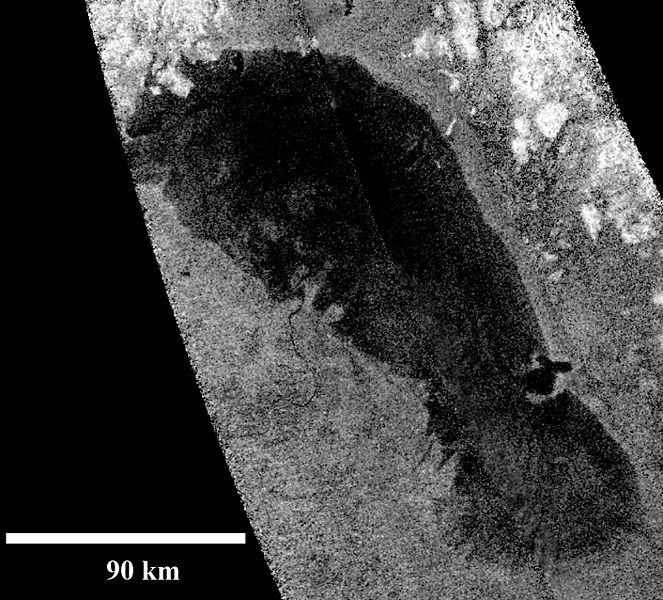
wiki wiki:
Shorelines
On January 12, 2010, Cassini took a more detailed radar-image of Ontario Lacus showing numerous remarkable features. The northern shoreline features low hills, probably about 1 kilometer (3,000 feet) in altitude, and flooded river valleys. A smooth, wave-sculpted shoreline, like that seen on the southeastern side of Lake Michigan, can be seen at the northeastern part of the lake. Smooth lines parallel to the current shoreline could be formed by low waves over time, which were likely driven by winds sweeping in from the west or southwest. The southeast shore features a round-headed bay intruding into the shore.
The middle part of the western shoreline shows the first well-developed river delta observed on Titan, showing that liquid hydrocarbons flowing down from a higher plain have switched channels on their way into the lake, forming at least two lobes. Examples of this kind of channel switching and wave-modified deltas can be found on Earth at the southern end of Lake Albert between Uganda and the Democratic Republic of Congo in Africa and in the remains of an ancient lake known as Megachad in the African country Chad.[2]
[edit]Shore recession
Infrared observations indicate that the southwestern shoreline of the lake receded 9-11 km over a four year period (2005-2009), evidently due to evaporation during the dry southern hemisphere fall.[3] Over the same interval, no change was observed in the southern or southeastern shorelines, indicative of steeper slopes in those regions. The sizes of northern hemisphere lakes and maria, in contrast, have been much more stable.[3]
[edit]Depth
By terrestrial standards, the lake appears to be extremely shallow. Radar measurements made in July 2009 and January 2010 indicate an average depth of 0.4 – 3.2 m, and a maximum depth of 2.9 – 7.4 m.[4] This gives the lake an estimated volume of 7 to 50 km3, less than one thirtieth the volume of Earth's Lake Ontario.
[edit]Waves
Any waves present on the lake are also far smaller than those that would be present on a sizable body of liquid water on Earth; their estimated maximum height was less than 3 mm during observations of a radar specular reflection during Cassini's T49 flyover of July 2009.[5] On Titan, waves can be generated at lower wind speeds than on Earth, due to the four times greater atmospheric density, and should be seven times higher at a given wind speed, due to Titan's surface gravity being one seventh as strong.[5] The lack of waves could indicate either wind speed less than 0.5 m/s, or an unexpectedly viscous composition of the hydrocarbon fluid.[4][5] However, the apparent presence of a wave-generated beach on the lake's northeast shore suggests that at times considerably higher waves form.[5]
Gunnair @ Thu Mar 29, 2012 5:18 pm

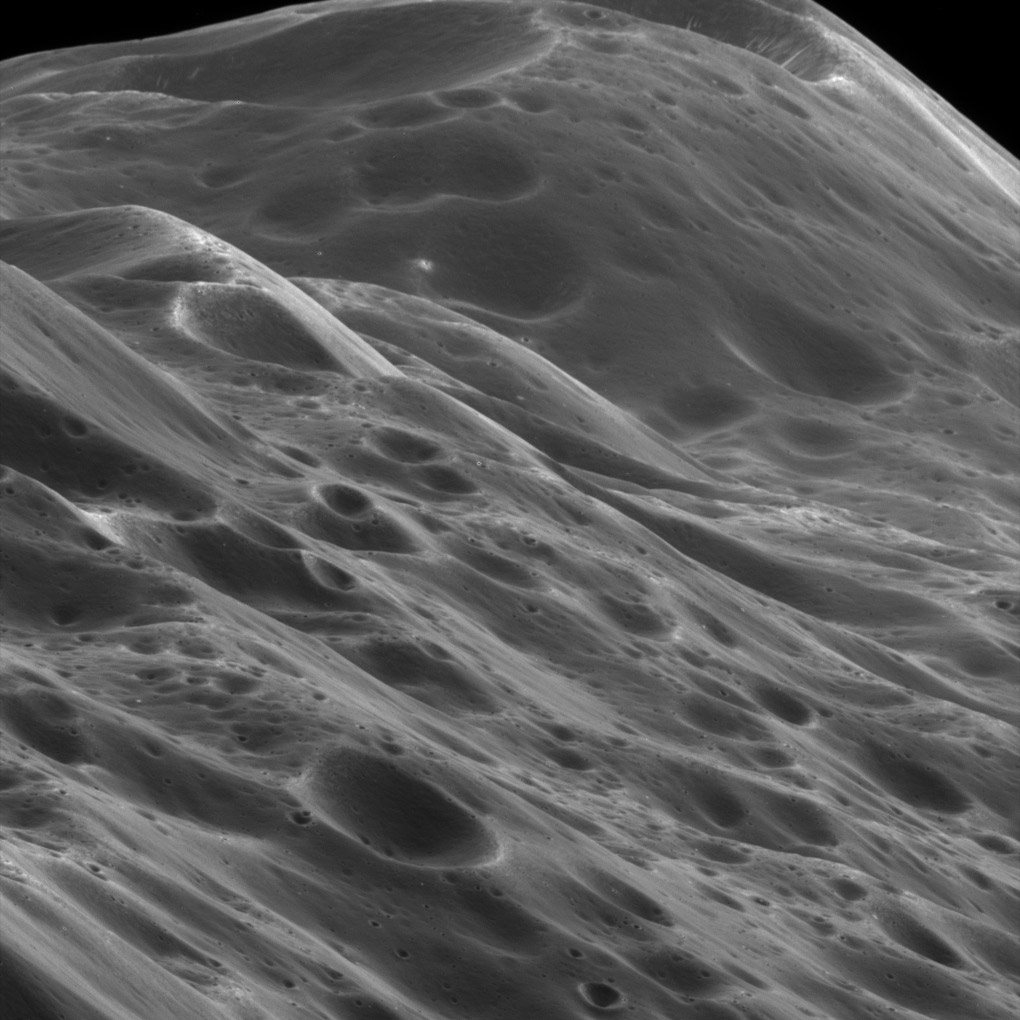
New image of Iapetus, one of Saturn's smaller moons.
$1:
Iapetus (moon)
Iapetus ( /aɪˈæpɨtəs/;[7]Greek: Ιαπετός), occasionally Japetus ( /ˈdʒæpɨtəs/),[8] is the third-largest moon of Saturn, and eleventh in the Solar System.[9] It was discovered by Giovanni Domenico Cassini in 1671. Iapetus is best known for its dramatic 'two-tone' coloration, but recent discoveries by the Cassini mission have revealed several other unusual physical characteristics, such as an equatorial ridge that runs about halfway around the moon.
Contents [hide]
1 Discovery
2 Name
3 Physical characteristics
3.1 Two-tone coloration
3.2 Overall shape
3.3 Equatorial ridge
4 Temperatures
5 Orbit
6 Exploration
7 See also
8 References
9 External links
[edit]Discovery
Iapetus was discovered by Giovanni Domenico Cassini, an Italian/French astronomer, in October 1671. He had discovered the moon on the western side of Saturn and tried viewing it on the eastern side some months later, but was unsuccessful. The pattern continued the following year as he was able to observe it on the western side, but not the eastern side. Cassini finally observed Iapetus on the eastern side in 1705 with the help of an improved telescope, finding it two magnitudes dimmer on that side.[10][11]
Cassini correctly surmised that Iapetus has a bright hemisphere and a dark hemisphere, and that it is tidally locked, always keeping the same face towards Saturn. This means that the bright hemisphere is visible from Earth when Iapetus is on the western side of Saturn, and that the dark hemisphere is visible when Iapetus is on the eastern side. The dark hemisphere was later named Cassini Regio in his honour.
Name
Iapetus is named after the Titan Iapetus from Greek mythology. The name was suggested by John Herschel (son of William Herschel, discoverer of Mimas and Enceladus) in his 1847 publication Results of Astronomical Observations made at the Cape of Good Hope,[8] in which he advocated naming the moons of Saturn after the Titans, sisters and brothers of the Titan Cronus (whom the Romans equated with their god Saturn).
When first discovered, Iapetus was among four Saturnian moons labelled the Sidera Lodoicea by their discoverer Giovanni Cassini after King Louis XIV (the other three were Tethys, Dione and Rhea). However, astronomers fell into the habit of referring to them using Roman numerals, with Iapetus being Saturn V. Once Mimas and Enceladus were discovered in 1789, the numbering scheme was extended and Iapetus became Saturn VII. And with the discovery of Hyperion in 1848, Iapetus became Saturn VIII, which it is still known by today (see naming of natural satellites).
Geological features on Iapetus are named after characters and places from the French epic poem The Song of Roland. Examples of names used include the craters Charlemagne and Baligant, and the northern bright region, Roncevaux Terra. The one exception is Cassini Regio, the dark region of the moon, named after the region's discoverer, Giovanni Cassini.
Physical characteristics
Main article: List of geological features on Iapetus
The low density of Iapetus indicates that it is mostly composed of ice, with only a small (~20%) amount of rocky materials.[12]
Unlike most moons, its overall shape is neither spherical nor ellipsoid, but has a bulging waistline and squashed poles;[13] also, its unique equatorial ridge (see below) is so high that it visibly distorts the moon's shape even when viewed from a distance. These features often lead it to be characterized as walnut-shaped.
Iapetus is heavily cratered, and Cassini images have revealed large impact basins, at least five of which are over 350 km wide. The largest, Turgis, has a diameter of 580 km;[14] its rim is extremely steep and includes a scarp about 15 km high.[15]
Two-tone coloration
In the 17th century, Giovanni Cassini observed that he could see Iapetus only on the west side of Saturn and never on the east. He correctly deduced that Iapetus is locked in synchronous rotation about Saturn and that one side of Iapetus is darker than the other, conclusions later confirmed by larger telescopes.
The bright regions of Iapetus. Roncevaux Terra is at the top (north); Saragossa Terra with its prominent basin Engelier, the moon's second largest, is at the bottom.
The difference in colouring between the two Iapetian hemispheres is striking. The leading hemisphere and sides are dark (albedo 0.03–0.05) with a slight reddish-brown coloring, while most of the trailing hemisphere and poles are bright (albedo 0.5–0.6, almost as bright as Europa). Thus, the apparent magnitude of the trailing hemisphere is around 10.2, whereas that of the leading hemisphere is around 11.9 – beyond the capacity of the best telescopes in the 17th century. The pattern of coloration is analogous to a spherical yin-yang symbol or the two sections of a tennis ball. The dark region is named Cassini Regio, and the bright region is divided into Roncevaux Terra north of the equator, and Saragossa Terra south of it. The original dark material is believed to have come from outside Iapetus, but now it consists principally of lag from the sublimation of ice from the warmer areas of Iapetus's surface.[16][17][18] It contains organic compounds similar to the substances found in primitive meteorites or on the surfaces of comets; Earth-based observations have shown it to be carbonaceous, and it probably includes cyano-compounds such as frozen hydrogen cyanide polymers.
On September 10, 2007 the Cassini orbiter passed within 1,640 kilometres (1,020 mi) of Iapetus and demonstrated that both hemispheres are heavily cratered. The color dichotomy of scattered patches of light and dark material in the transition zone between Cassini Regio and the bright areas exists at very small scales, down to the imaging resolution of 30 meters. There is dark material filling in low-lying regions, and light material on the weakly illuminated pole-facing slopes of craters, but no shades of grey.[19] The dark material is a very thin layer, only a few tens of centimeters (approx. one foot) thick at least in some areas,[20] according to Cassini radar imaging and the fact that very small meteor impacts have punched through to the ice underneath.[18][21]
Close-up of north polar region, with the large impact crater Falsaron near bottom
NASA scientists now believe that the dark material is lag (residue) from the sublimation (evaporation) of water ice on the surface of Iapetus,[17][21] possibly darkened further upon exposure to sunlight. Because of its slow rotation of 79 days (equal to its revolution and the longest in the Saturnian system), Iapetus would have had the warmest daytime surface temperature and coldest nighttime temperature in the Saturnian system even before the development of the color contrast; near the equator, heat absorption by the dark material results in a daytime temperatures of 129 K in the dark Cassini Regio compared to 113 K in the bright regions.[18][22] The difference in temperature means that ice preferentially sublimates from Cassini, and deposits in the bright areas and especially at the even colder poles. Over geologic time scales, this would further darken Cassini Regio and brighten the rest of Iapetus, creating a positive feedback thermal runaway process of ever greater contrast in albedo, ending with all exposed ice being lost from Cassini.[18] It is estimated that over a period of one billion years at current temperatures, dark areas of Iapetus would lose about 20 meters of ice to sublimation, while the bright regions would lose only 10 centimeters, not considering the ice transferred from the dark regions.[22][23] This model explains the distribution of light and dark areas, the absence of shades of grey, and the thinness of the dark material covering Cassini. The redistribution of ice is facilitated by Iapetus's weak gravity, which means that at ambient temperatures a water molecule can migrate from one hemisphere to the other in just a few hops.[18]
However, a separate process of color segregation would be required to get the thermal feedback started. The initial dark material is thought to have been debris blasted by meteors off small outer moons in retrograde orbits and swept up by the leading hemisphere of Iapetus. The core of this model is some 30 years old, and was revived by the September 2007 flyby.[16][17]
Light debris outside of Iapetus's orbit, either knocked free from the surface of a moon by micrometeoroid impacts or created in a collision, would spiral in as its orbit decays. It would have been darkened by exposure to sunlight. A portion of any such material that crossed Iapetus's orbit would have been swept up by its leading hemisphere, coating it; once this process created a modest contrast in albedo, and so a contrast in temperature, the thermal feedback described above would have come into play and exaggerated the contrast.[17][18] In support of the hypothesis, simple numerical models of the exogenic deposition and thermal water redistribution processes can closely predict the two-toned appearance of Iapetus.[18] A subtle color dichotomy between Iapetus's leading and trailing hemispheres, with the former being more reddish, can in fact be observed in comparisons between both bright and dark areas of the two hemispheres.[17] In contrast to the elliptical shape of Cassini Regio, the color contrast closely follows the hemisphere boundaries; the gradation between the differently colored regions is gradual, on a scale of hundreds of km.[17] The next moon inward from Iapetus, chaotically rotating Hyperion, also has an unusual reddish color.
The largest reservoir of such infalling material is Phoebe, the largest of the outer moons. Although Phoebe's composition is closer to that of the bright hemisphere of Iapetus than the dark one,[24] dust from Phoebe would only be needed to establish a contrast in albedo, and presumably would have been largely obscured by later sublimation. The discovery of a tenuous disk of material in the plane of and just inside Phoebe's orbit was announced on 6 October 2009,[25] supporting the model.[26] The disk extends from 128 to 207 times the radius of Saturn, while Phoebe orbits at an average distance of 215 Saturn radii. It was detected with the Spitzer Space Telescope,
Overall shape
Current triaxial measurements of Iapetus give it dimensions of 746 × 746 × 712 km, with a mean radius of 734.5 ± 2.8 km.[3] However, these measurements may be inaccurate on the kilometer scale as Iapetus's entire surface has not yet been imaged in high enough resolution. The observed oblateness corresponds to a rotation period of 10 hours, not to the 79 days observed. A possible explanation for this is that the shape of the moon was frozen by formation of a thick crust shortly after its formation, while its rotation continued to slow afterwards due to tidal dissipation, until it became tidally locked.[13]
Equatorial ridge
A further mystery of Iapetus is the equatorial ridge that runs along the center of Cassini Regio, about 1,300 km long, 20 km wide, 13 km high. It was discovered when the Cassini spacecraft imaged Iapetus on December 31, 2004. Peaks in the ridge rise more than 20 km above the surrounding plains, making them some of the tallest mountains in the Solar System. The ridge forms a complex system including isolated peaks, segments of more than 200 km and sections with three near parallel ridges.[27] Within the bright regions there is no ridge, but there are a series of isolated 10 km peaks along the equator.[28] The ridge system is heavily cratered, indicating that it is ancient. The prominent equatorial bulge gives the moon a walnut-like appearance.
It is not clear how the ridge formed. One difficulty is to explain why it follows the equator almost perfectly. There are at least three current hypotheses, but none of them explains why the ridge is confined to Cassini Regio. A team of scientists associated with the Cassini mission have argued that the ridge could be a remnant of the oblate shape of the young Iapetus, when it was rotating more rapidly than it does today.[29] The height of the ridge suggests a maximum rotational period of 17 hours. If Iapetus cooled fast enough to preserve the ridge but remained plastic long enough for the tides raised by Saturn to have slowed the rotation to its current tidally locked 79 days, Iapetus must have been heated by the radioactive decay of aluminium-26. This isotope appears to have been abundant in the solar nebula from which Saturn formed, but has since all decayed. The quantities of aluminium-26 needed to heat Iapetus to the required temperature give a tentative date to its formation relative to the rest of the Solar System: Iapetus must have come together earlier than expected, only two million years after the asteroids started to form. The ridge could be icy material that welled up from beneath the surface and then solidified. If it had formed away from the position of the equator at the time, this hypothesis requires that the rotational axis would have been driven to its current position by the ridge.
It has also been suggested that Iapetus could have had a ring system during its formation due to its large Hill sphere, and that the equatorial ridge was then produced by collisional accretion of this ring.[30] However, the ridge appears too solid to be the result of a collapsed ring. Also, recent images show tectonic faults running through the ridge, apparently inconsistent with the collapsed ring hypothesis.[21]
Temperatures
Temperatures on the dark region's surface reach 130 K (−143 °C; −226 °F) at the equator, as heating is made more effective by Iapetus's slow rotation. The brighter surfaces absorb less sunlight so temperatures there only reach about 100 K (−173 °C; −280 °F).[31]
Orbit
The orbit of Iapetus is somewhat unusual. Although it is Saturn's third-largest moon, it orbits much farther from Saturn than the next closest major moon, Titan. It has also the most inclined orbital plane of the regular satellites; only the irregular outer satellites like Phoebe have more inclined orbits. The cause of this is unknown.
Because of this distant, inclined orbit, Iapetus is the only large moon from which the rings of Saturn would be clearly visible; from the other inner moons, the rings would be edge-on and difficult to see. From Iapetus, Saturn would appear to be 1°56' in diameter (four times the size of the Moon viewed from Earth).[32]
Exploration
Iapetus has been imaged multiple times from moderate distances by the Cassini orbiter. However, its great distance from Saturn makes close observation difficult. There has been one close targeted flyby, at a minimum range of 1227 km, on September 10, 2007; no additional close flybys are planned. One viewing opportunity is possible in 2015.
Iapetus ( /aɪˈæpɨtəs/;[7]Greek: Ιαπετός), occasionally Japetus ( /ˈdʒæpɨtəs/),[8] is the third-largest moon of Saturn, and eleventh in the Solar System.[9] It was discovered by Giovanni Domenico Cassini in 1671. Iapetus is best known for its dramatic 'two-tone' coloration, but recent discoveries by the Cassini mission have revealed several other unusual physical characteristics, such as an equatorial ridge that runs about halfway around the moon.
Contents [hide]
1 Discovery
2 Name
3 Physical characteristics
3.1 Two-tone coloration
3.2 Overall shape
3.3 Equatorial ridge
4 Temperatures
5 Orbit
6 Exploration
7 See also
8 References
9 External links
[edit]Discovery
Iapetus was discovered by Giovanni Domenico Cassini, an Italian/French astronomer, in October 1671. He had discovered the moon on the western side of Saturn and tried viewing it on the eastern side some months later, but was unsuccessful. The pattern continued the following year as he was able to observe it on the western side, but not the eastern side. Cassini finally observed Iapetus on the eastern side in 1705 with the help of an improved telescope, finding it two magnitudes dimmer on that side.[10][11]
Cassini correctly surmised that Iapetus has a bright hemisphere and a dark hemisphere, and that it is tidally locked, always keeping the same face towards Saturn. This means that the bright hemisphere is visible from Earth when Iapetus is on the western side of Saturn, and that the dark hemisphere is visible when Iapetus is on the eastern side. The dark hemisphere was later named Cassini Regio in his honour.
Name
Iapetus is named after the Titan Iapetus from Greek mythology. The name was suggested by John Herschel (son of William Herschel, discoverer of Mimas and Enceladus) in his 1847 publication Results of Astronomical Observations made at the Cape of Good Hope,[8] in which he advocated naming the moons of Saturn after the Titans, sisters and brothers of the Titan Cronus (whom the Romans equated with their god Saturn).
When first discovered, Iapetus was among four Saturnian moons labelled the Sidera Lodoicea by their discoverer Giovanni Cassini after King Louis XIV (the other three were Tethys, Dione and Rhea). However, astronomers fell into the habit of referring to them using Roman numerals, with Iapetus being Saturn V. Once Mimas and Enceladus were discovered in 1789, the numbering scheme was extended and Iapetus became Saturn VII. And with the discovery of Hyperion in 1848, Iapetus became Saturn VIII, which it is still known by today (see naming of natural satellites).
Geological features on Iapetus are named after characters and places from the French epic poem The Song of Roland. Examples of names used include the craters Charlemagne and Baligant, and the northern bright region, Roncevaux Terra. The one exception is Cassini Regio, the dark region of the moon, named after the region's discoverer, Giovanni Cassini.
Physical characteristics
Main article: List of geological features on Iapetus
The low density of Iapetus indicates that it is mostly composed of ice, with only a small (~20%) amount of rocky materials.[12]
Unlike most moons, its overall shape is neither spherical nor ellipsoid, but has a bulging waistline and squashed poles;[13] also, its unique equatorial ridge (see below) is so high that it visibly distorts the moon's shape even when viewed from a distance. These features often lead it to be characterized as walnut-shaped.
Iapetus is heavily cratered, and Cassini images have revealed large impact basins, at least five of which are over 350 km wide. The largest, Turgis, has a diameter of 580 km;[14] its rim is extremely steep and includes a scarp about 15 km high.[15]
Two-tone coloration
In the 17th century, Giovanni Cassini observed that he could see Iapetus only on the west side of Saturn and never on the east. He correctly deduced that Iapetus is locked in synchronous rotation about Saturn and that one side of Iapetus is darker than the other, conclusions later confirmed by larger telescopes.
The bright regions of Iapetus. Roncevaux Terra is at the top (north); Saragossa Terra with its prominent basin Engelier, the moon's second largest, is at the bottom.
The difference in colouring between the two Iapetian hemispheres is striking. The leading hemisphere and sides are dark (albedo 0.03–0.05) with a slight reddish-brown coloring, while most of the trailing hemisphere and poles are bright (albedo 0.5–0.6, almost as bright as Europa). Thus, the apparent magnitude of the trailing hemisphere is around 10.2, whereas that of the leading hemisphere is around 11.9 – beyond the capacity of the best telescopes in the 17th century. The pattern of coloration is analogous to a spherical yin-yang symbol or the two sections of a tennis ball. The dark region is named Cassini Regio, and the bright region is divided into Roncevaux Terra north of the equator, and Saragossa Terra south of it. The original dark material is believed to have come from outside Iapetus, but now it consists principally of lag from the sublimation of ice from the warmer areas of Iapetus's surface.[16][17][18] It contains organic compounds similar to the substances found in primitive meteorites or on the surfaces of comets; Earth-based observations have shown it to be carbonaceous, and it probably includes cyano-compounds such as frozen hydrogen cyanide polymers.
On September 10, 2007 the Cassini orbiter passed within 1,640 kilometres (1,020 mi) of Iapetus and demonstrated that both hemispheres are heavily cratered. The color dichotomy of scattered patches of light and dark material in the transition zone between Cassini Regio and the bright areas exists at very small scales, down to the imaging resolution of 30 meters. There is dark material filling in low-lying regions, and light material on the weakly illuminated pole-facing slopes of craters, but no shades of grey.[19] The dark material is a very thin layer, only a few tens of centimeters (approx. one foot) thick at least in some areas,[20] according to Cassini radar imaging and the fact that very small meteor impacts have punched through to the ice underneath.[18][21]
Close-up of north polar region, with the large impact crater Falsaron near bottom
NASA scientists now believe that the dark material is lag (residue) from the sublimation (evaporation) of water ice on the surface of Iapetus,[17][21] possibly darkened further upon exposure to sunlight. Because of its slow rotation of 79 days (equal to its revolution and the longest in the Saturnian system), Iapetus would have had the warmest daytime surface temperature and coldest nighttime temperature in the Saturnian system even before the development of the color contrast; near the equator, heat absorption by the dark material results in a daytime temperatures of 129 K in the dark Cassini Regio compared to 113 K in the bright regions.[18][22] The difference in temperature means that ice preferentially sublimates from Cassini, and deposits in the bright areas and especially at the even colder poles. Over geologic time scales, this would further darken Cassini Regio and brighten the rest of Iapetus, creating a positive feedback thermal runaway process of ever greater contrast in albedo, ending with all exposed ice being lost from Cassini.[18] It is estimated that over a period of one billion years at current temperatures, dark areas of Iapetus would lose about 20 meters of ice to sublimation, while the bright regions would lose only 10 centimeters, not considering the ice transferred from the dark regions.[22][23] This model explains the distribution of light and dark areas, the absence of shades of grey, and the thinness of the dark material covering Cassini. The redistribution of ice is facilitated by Iapetus's weak gravity, which means that at ambient temperatures a water molecule can migrate from one hemisphere to the other in just a few hops.[18]
However, a separate process of color segregation would be required to get the thermal feedback started. The initial dark material is thought to have been debris blasted by meteors off small outer moons in retrograde orbits and swept up by the leading hemisphere of Iapetus. The core of this model is some 30 years old, and was revived by the September 2007 flyby.[16][17]
Light debris outside of Iapetus's orbit, either knocked free from the surface of a moon by micrometeoroid impacts or created in a collision, would spiral in as its orbit decays. It would have been darkened by exposure to sunlight. A portion of any such material that crossed Iapetus's orbit would have been swept up by its leading hemisphere, coating it; once this process created a modest contrast in albedo, and so a contrast in temperature, the thermal feedback described above would have come into play and exaggerated the contrast.[17][18] In support of the hypothesis, simple numerical models of the exogenic deposition and thermal water redistribution processes can closely predict the two-toned appearance of Iapetus.[18] A subtle color dichotomy between Iapetus's leading and trailing hemispheres, with the former being more reddish, can in fact be observed in comparisons between both bright and dark areas of the two hemispheres.[17] In contrast to the elliptical shape of Cassini Regio, the color contrast closely follows the hemisphere boundaries; the gradation between the differently colored regions is gradual, on a scale of hundreds of km.[17] The next moon inward from Iapetus, chaotically rotating Hyperion, also has an unusual reddish color.
The largest reservoir of such infalling material is Phoebe, the largest of the outer moons. Although Phoebe's composition is closer to that of the bright hemisphere of Iapetus than the dark one,[24] dust from Phoebe would only be needed to establish a contrast in albedo, and presumably would have been largely obscured by later sublimation. The discovery of a tenuous disk of material in the plane of and just inside Phoebe's orbit was announced on 6 October 2009,[25] supporting the model.[26] The disk extends from 128 to 207 times the radius of Saturn, while Phoebe orbits at an average distance of 215 Saturn radii. It was detected with the Spitzer Space Telescope,
Overall shape
Current triaxial measurements of Iapetus give it dimensions of 746 × 746 × 712 km, with a mean radius of 734.5 ± 2.8 km.[3] However, these measurements may be inaccurate on the kilometer scale as Iapetus's entire surface has not yet been imaged in high enough resolution. The observed oblateness corresponds to a rotation period of 10 hours, not to the 79 days observed. A possible explanation for this is that the shape of the moon was frozen by formation of a thick crust shortly after its formation, while its rotation continued to slow afterwards due to tidal dissipation, until it became tidally locked.[13]
Equatorial ridge
A further mystery of Iapetus is the equatorial ridge that runs along the center of Cassini Regio, about 1,300 km long, 20 km wide, 13 km high. It was discovered when the Cassini spacecraft imaged Iapetus on December 31, 2004. Peaks in the ridge rise more than 20 km above the surrounding plains, making them some of the tallest mountains in the Solar System. The ridge forms a complex system including isolated peaks, segments of more than 200 km and sections with three near parallel ridges.[27] Within the bright regions there is no ridge, but there are a series of isolated 10 km peaks along the equator.[28] The ridge system is heavily cratered, indicating that it is ancient. The prominent equatorial bulge gives the moon a walnut-like appearance.
It is not clear how the ridge formed. One difficulty is to explain why it follows the equator almost perfectly. There are at least three current hypotheses, but none of them explains why the ridge is confined to Cassini Regio. A team of scientists associated with the Cassini mission have argued that the ridge could be a remnant of the oblate shape of the young Iapetus, when it was rotating more rapidly than it does today.[29] The height of the ridge suggests a maximum rotational period of 17 hours. If Iapetus cooled fast enough to preserve the ridge but remained plastic long enough for the tides raised by Saturn to have slowed the rotation to its current tidally locked 79 days, Iapetus must have been heated by the radioactive decay of aluminium-26. This isotope appears to have been abundant in the solar nebula from which Saturn formed, but has since all decayed. The quantities of aluminium-26 needed to heat Iapetus to the required temperature give a tentative date to its formation relative to the rest of the Solar System: Iapetus must have come together earlier than expected, only two million years after the asteroids started to form. The ridge could be icy material that welled up from beneath the surface and then solidified. If it had formed away from the position of the equator at the time, this hypothesis requires that the rotational axis would have been driven to its current position by the ridge.
It has also been suggested that Iapetus could have had a ring system during its formation due to its large Hill sphere, and that the equatorial ridge was then produced by collisional accretion of this ring.[30] However, the ridge appears too solid to be the result of a collapsed ring. Also, recent images show tectonic faults running through the ridge, apparently inconsistent with the collapsed ring hypothesis.[21]
Temperatures
Temperatures on the dark region's surface reach 130 K (−143 °C; −226 °F) at the equator, as heating is made more effective by Iapetus's slow rotation. The brighter surfaces absorb less sunlight so temperatures there only reach about 100 K (−173 °C; −280 °F).[31]
Orbit
The orbit of Iapetus is somewhat unusual. Although it is Saturn's third-largest moon, it orbits much farther from Saturn than the next closest major moon, Titan. It has also the most inclined orbital plane of the regular satellites; only the irregular outer satellites like Phoebe have more inclined orbits. The cause of this is unknown.
Because of this distant, inclined orbit, Iapetus is the only large moon from which the rings of Saturn would be clearly visible; from the other inner moons, the rings would be edge-on and difficult to see. From Iapetus, Saturn would appear to be 1°56' in diameter (four times the size of the Moon viewed from Earth).[32]
Exploration
Iapetus has been imaged multiple times from moderate distances by the Cassini orbiter. However, its great distance from Saturn makes close observation difficult. There has been one close targeted flyby, at a minimum range of 1227 km, on September 10, 2007; no additional close flybys are planned. One viewing opportunity is possible in 2015.


Gunnair @ Fri Mar 30, 2012 7:58 pm
raydan @ Fri Mar 30, 2012 8:01 pm
Nice picture, but a bit small Gun...
...just realized that it sounds like the story of my life. 
Tyler_1 @ Fri Mar 30, 2012 10:11 pm
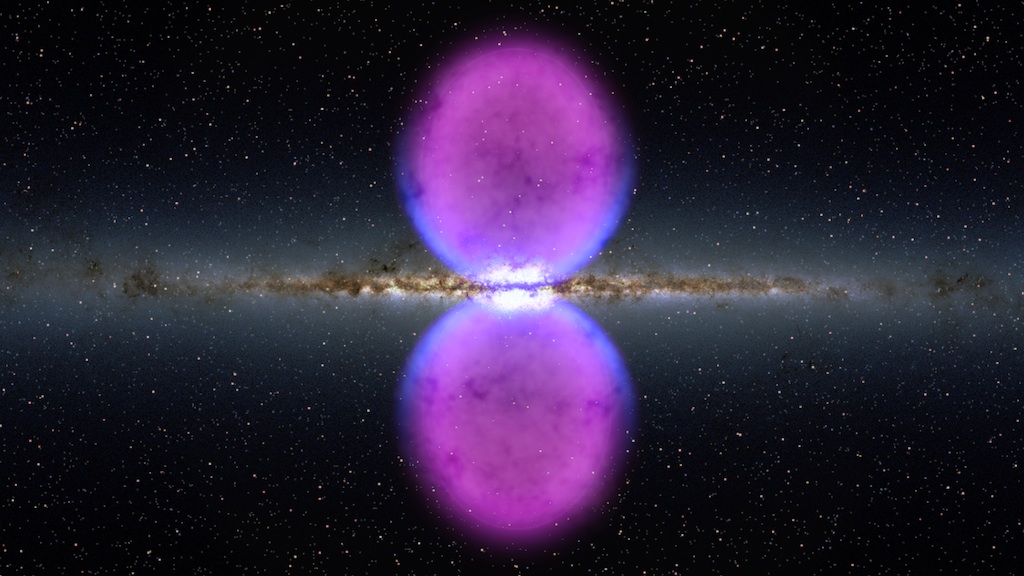
Wow what is that double purple unit???! 
Iapetus is really cool too that one picture looks like it's made of plastic.
ShepherdsDog @ Fri Mar 30, 2012 11:27 pm
see Ray's comment above..... he's telling us that he has a stellar set of purple testicles.
Tyler_1 @ Sat Mar 31, 2012 8:56 am
ShepherdsDog ShepherdsDog:
see Ray's comment above..... he's telling us that he has a stellar set of purple testicles.
Ohhhhh

Well they are by far the prettiest pair I have ever seen.
Gunnair @ Tue Apr 03, 2012 10:08 pm

Cygnus Loop Nebula
Gunnair @ Tue Apr 03, 2012 10:10 pm

Canuleia Crater - Vesta
Gunnair @ Tue Apr 03, 2012 10:11 pm

Bright and Dark at West Rim of Marcia Crater - Vesta
Gunnair @ Tue Apr 03, 2012 10:12 pm

Crater on Vesta
Previous 1 ... 4 5 6 7 8 9 10 ... 244 Next