
Space Thread
Previous 1 ... 14 15 16 17 18 19 20 ... 244 Next
DrCaleb @ Wed Nov 07, 2012 12:36 pm
$1:
The black hole at the centre of our galaxy isn't growing old gracefully. Every day or so this big beast belies its age by shooting off an X-ray flare that can outshine its usual output by more than a hundred times.
This image, taken in February by NASA's orbiting Chandra X-Ray Observatory, shows the brightest such flare ever seen. It's 150 times brighter than the usual luminosity of the black hole, known as Sagittarius A*. It's not clear why these flares happen, but researcher Michael Nowak of the Massachusetts Institute of Technology, who led the study, suggests they may be the last gasps of asteroids being swallowed by the black hole.
This image, taken in February by NASA's orbiting Chandra X-Ray Observatory, shows the brightest such flare ever seen. It's 150 times brighter than the usual luminosity of the black hole, known as Sagittarius A*. It's not clear why these flares happen, but researcher Michael Nowak of the Massachusetts Institute of Technology, who led the study, suggests they may be the last gasps of asteroids being swallowed by the black hole.

http://www.newscientist.com/blogs/short ... flare.html
Gunnair @ Tue Nov 20, 2012 5:48 pm
Brenda @ Tue Nov 20, 2012 5:55 pm
Hubble helps find candidate for most distant object in the Universe yet observed
http://www.spacetelescope.org/news/heic1217/
ShepherdsDog @ Tue Nov 20, 2012 7:17 pm
DrCaleb DrCaleb:
$1:
The black hole at the centre of our galaxy isn't growing old gracefully. Every day or so this big beast belies its age by shooting off an X-ray flare that can outshine its usual output by more than a hundred times.
This image, taken in February by NASA's orbiting Chandra X-Ray Observatory, shows the brightest such flare ever seen. It's 150 times brighter than the usual luminosity of the black hole, known as Sagittarius A*. It's not clear why these flares happen, but researcher Michael Nowak of the Massachusetts Institute of Technology, who led the study, suggests they may be the last gasps of asteroids being swallowed by the black hole.
This image, taken in February by NASA's orbiting Chandra X-Ray Observatory, shows the brightest such flare ever seen. It's 150 times brighter than the usual luminosity of the black hole, known as Sagittarius A*. It's not clear why these flares happen, but researcher Michael Nowak of the Massachusetts Institute of Technology, who led the study, suggests they may be the last gasps of asteroids being swallowed by the black hole.
http://www.newscientist.com/blogs/short ... flare.html
cosmic burritos
DrCaleb @ Fri Nov 23, 2012 1:25 pm
$1:
The outer reaches of the Solar System are home to many small bodies, of which Pluto is the most famous. Due to their distance from Earth and relatively small sizes, these trans-Neptunian objects are somewhat difficult to study: even our most powerful telescopes can't image their surfaces in any detail, leaving astronomers either waiting impatiently for the New Horizons space probe to reach Pluto or resorting to more indirect methods. One such method is occultation, where one of these bodies briefly blocks (or occults) the light of a star.
A group of astronomers used 7 different telescopes in South America to track the occultation of a star by the dwarf planet Makemake (pronounced MAHkayMAHkay) and measured many of its properties for the first time. They concluded Makemake is noticeably non-spherical and may consist of two distinct types of terrain to explain the surface brightness.
A group of astronomers used 7 different telescopes in South America to track the occultation of a star by the dwarf planet Makemake (pronounced MAHkayMAHkay) and measured many of its properties for the first time. They concluded Makemake is noticeably non-spherical and may consist of two distinct types of terrain to explain the surface brightness.
$1:
The "official" dwarf planets designated by the International Astronomical Union are Ceres (the largest body in the Asteroid Belt), Eris, Haumea, Makemake, and Pluto (the four biggest objects in the region beyond Neptune's orbit). Of those, Eris is the most massive, though it and Pluto are nearly the same size. This hints at some significant variation in the composition of the trans-Neptunian objects, as does the contrast between Pluto's thin atmosphere and Eris' lack thereof. Makemake is roughly 2/3 the diameter of Pluto
http://arstechnica.com/science/2012/11/ ... -and-rock/
Zipperfish @ Fri Nov 23, 2012 3:25 pm
Gunnair Gunnair:
very good, thx
DrCaleb @ Mon Nov 26, 2012 9:06 pm
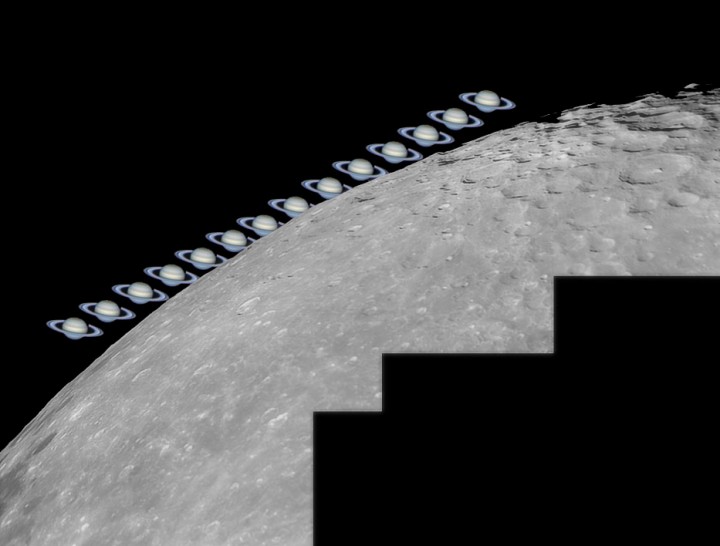
A time lapse photo of Saturn being eclipsed by our moon.

http://apod.nasa.gov/apod/ap070316.html
Gunnair @ Mon Nov 26, 2012 9:26 pm
Nice!
DrCaleb @ Wed Nov 28, 2012 11:19 am
New Cassini pics (as in taken today!) of the Hexagonal Storms on Saturn's poles.
http://saturn.jpl.nasa.gov/photos/raw/r ... eID=273933
http://saturn.jpl.nasa.gov/photos/raw/r ... eID=274025
http://saturn.jpl.nasa.gov/photos/image ... ageId=2354
http://www.planetary.org/blogs/emily-la ... e-raw.html
bootlegga @ Fri Dec 07, 2012 10:01 am
Anyone seen NASA's Black Marble picture?
Screen Shot 2012-12-07 at 10.01.34 AM.png [ 181.24 KiB | Viewed 228 times ]
DrCaleb @ Fri Dec 07, 2012 12:03 pm
bootlegga bootlegga:
Anyone seen NASA's Black Marble picture?
There is a whole article about it.

http://www.canadaka.net/link.php?id=77100
DrCaleb @ Wed Dec 12, 2012 12:17 pm
$1:
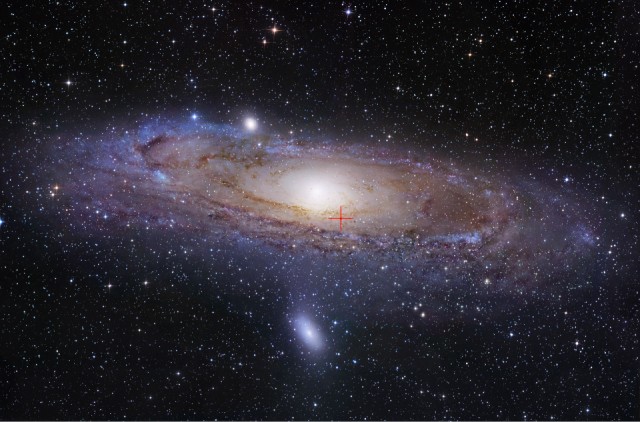
Astronomers locate a miniature quasar in Andromeda
Some of the brightest objects in the Universe are supermassive black holes at the hearts of galaxies—black holes with masses millions or billions of times greater than the Sun. As matter falls toward these black holes, the system emits intense radiation, especially in the radio and X-ray portions of the electromagnetic spectrum. When light from the infalling matter reaches a maximum intensity, the systems are known as quasars, which are bright enough to shine out from the early Universe.
Stellar-mass black holes, which are "only" 5 to 20 times more massive than the Sun, can also produce intense light. However, interstellar gas absorbs and scatters the X-rays, making them difficult to spot. As a result, only four microquasars are known in the Milky Way, and we haven't been able to observe many details of them. No similar systems have been spotted in other galaxies—until now. Observers found the first microquasar in M31 (Andromeda Galaxy), the nearest large galaxy to the Milky Way.
Though black holes (either stellar-mass or supermassive) emit no light of their own, their intense gravity gathers matter around them. As charged particles such as electrons accelerate, they emit light; with the high acceleration rates around black holes, this light takes the form of X-rays and radio waves. (Even though X-rays are some of the highest energy radiation and radio waves are the lowest in energy, they are often produced by the same physical phenomena, and provide dual ways to observe some of the most violent events in the cosmos.)
Some of the brightest objects in the Universe are supermassive black holes at the hearts of galaxies—black holes with masses millions or billions of times greater than the Sun. As matter falls toward these black holes, the system emits intense radiation, especially in the radio and X-ray portions of the electromagnetic spectrum. When light from the infalling matter reaches a maximum intensity, the systems are known as quasars, which are bright enough to shine out from the early Universe.
Stellar-mass black holes, which are "only" 5 to 20 times more massive than the Sun, can also produce intense light. However, interstellar gas absorbs and scatters the X-rays, making them difficult to spot. As a result, only four microquasars are known in the Milky Way, and we haven't been able to observe many details of them. No similar systems have been spotted in other galaxies—until now. Observers found the first microquasar in M31 (Andromeda Galaxy), the nearest large galaxy to the Milky Way.
Though black holes (either stellar-mass or supermassive) emit no light of their own, their intense gravity gathers matter around them. As charged particles such as electrons accelerate, they emit light; with the high acceleration rates around black holes, this light takes the form of X-rays and radio waves. (Even though X-rays are some of the highest energy radiation and radio waves are the lowest in energy, they are often produced by the same physical phenomena, and provide dual ways to observe some of the most violent events in the cosmos.)
http://arstechnica.com/science/2012/12/ ... content%29
Gunnair @ Mon Dec 17, 2012 6:53 pm
$1:
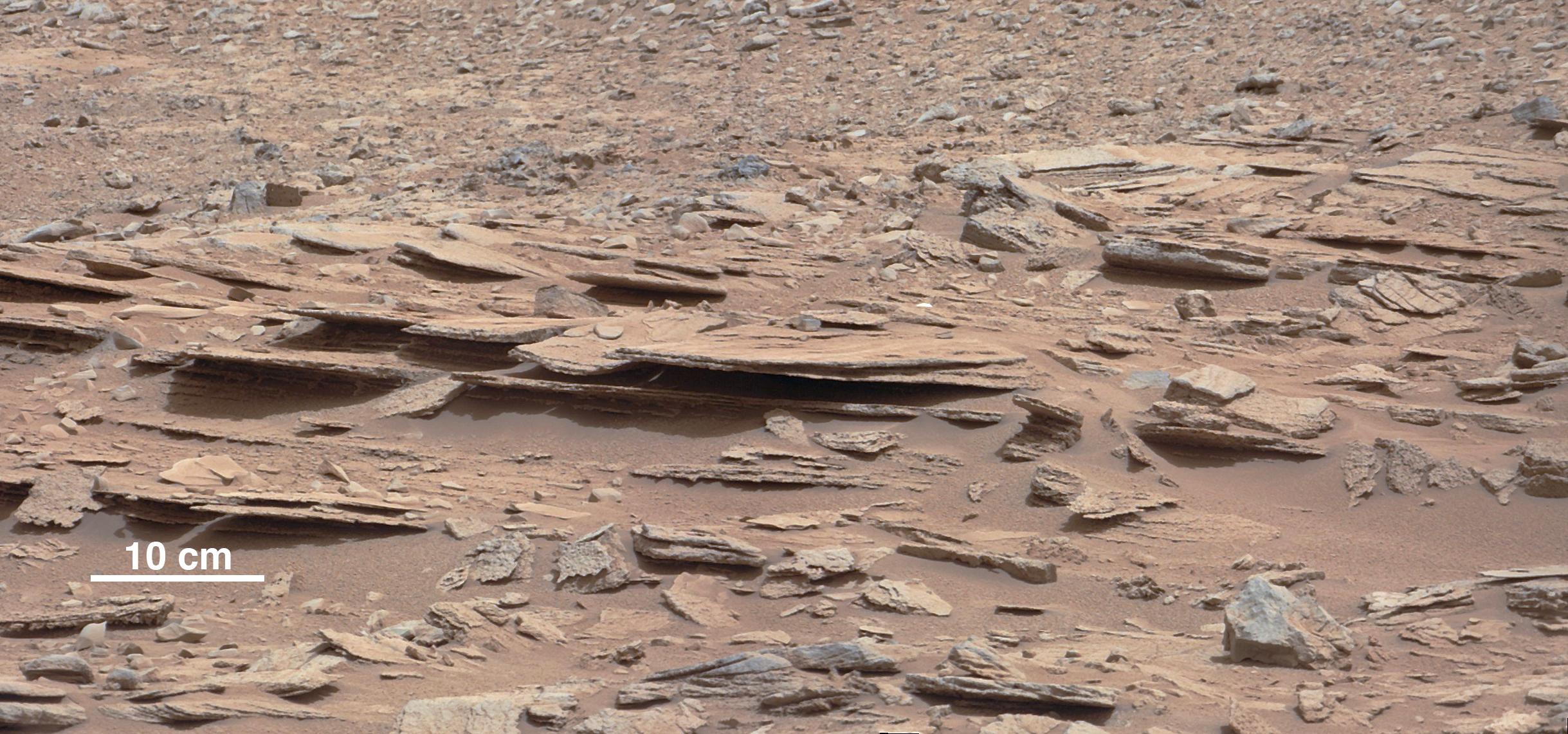
Layered Martian Outcrop 'Shaler' in 'Glenelg' Area
The NASA Mars rover Curiosity used its Mast Camera (Mastcam) during the mission's 120th Martian day, or sol (Dec. 7, 2012), to record this view of a rock outcrop informally named "Shaler."
The outcrop's striking layers, some at angles to each other in a pattern called crossbedding, made it a target of interest for the mission's science team. The site is near where three types of terrain meet at a place called "Glenelg," inside Gale Crater.
The NASA Mars rover Curiosity used its Mast Camera (Mastcam) during the mission's 120th Martian day, or sol (Dec. 7, 2012), to record this view of a rock outcrop informally named "Shaler."
The outcrop's striking layers, some at angles to each other in a pattern called crossbedding, made it a target of interest for the mission's science team. The site is near where three types of terrain meet at a place called "Glenelg," inside Gale Crater.
Gunnair @ Mon Dec 17, 2012 6:54 pm

$1:
Sol 120 Panorama from Curiosity, near 'Shaler'
The NASA Mars rover Curiosity used its Navigation Camera (Navcam) during the mission's 120th Martian day, or sol (Dec. 7, 2012), to record the seven images combined into this panoramic view.
The scene spans from north-northwest at the left to south-southwest at the right, and is presented in a cylindrical projection. The layered outcrop in the foreground is called "Shaler."
NASA's Jet Propulsion Laboratory, a division of the California Institute of Technology, Pasadena, manages the Mars Science Laboratory Project for NASA's Science Mission Directorate, Washington. JPL designed and built the project's
The NASA Mars rover Curiosity used its Navigation Camera (Navcam) during the mission's 120th Martian day, or sol (Dec. 7, 2012), to record the seven images combined into this panoramic view.
The scene spans from north-northwest at the left to south-southwest at the right, and is presented in a cylindrical projection. The layered outcrop in the foreground is called "Shaler."
NASA's Jet Propulsion Laboratory, a division of the California Institute of Technology, Pasadena, manages the Mars Science Laboratory Project for NASA's Science Mission Directorate, Washington. JPL designed and built the project's
Gunnair @ Mon Dec 17, 2012 6:55 pm
$1:
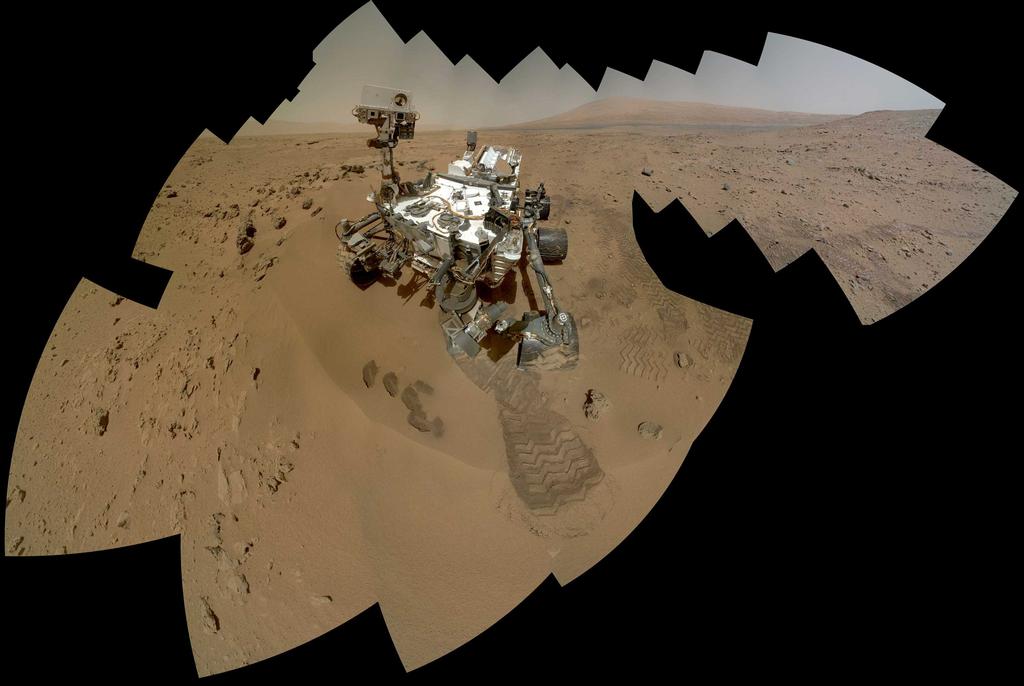
Curiosity Self-Portrait, Wide View
On the 84th and 85th Martian days of the NASA Mars rover Curiosity's mission on Mars (Oct. 31 and Nov. 1, 2012), NASA's Curiosity rover used the Mars Hand Lens Imager (MAHLI) to capture dozens of high-resolution images to be combined into self-portrait images of the rover. This version of the full-color self-portrait includes more of the surrounding terrain than a version produced earlier (PIA16239).
The mosaic shows the rover at "Rocknest," the spot in Gale Crater where the mission's first scoop sampling took place. Four scoop scars can be seen in the regolith in front of the rover. A fifth scoop was collected later.
The base of Gale Crater's 3-mile-high (5-kilometer) sedimentary mountain, Mount Sharp, rises on the horizon in the right half of the mosaic. Mountains in the background to the left are the northern wall of Gale Crater. The Martian landscape and the turret on the rover's arm appear inverted within the round, reflective ChemCam instrument at the top of the rover's mast.
The rover's robotic arm is not visible in the mosaic. MAHLI, which took the component images for this mosaic, is mounted on a turret at the end of the arm. Wrist motions and turret rotations on the arm allowed MAHLI to acquire the mosaic's component images. The arm was positioned out of the shot in the images or portions of images used in the mosaic. An animation of the complex choreography the arm used for positioning the camera to take each of the images is at http://www.nasa.gov/multimedia/videogal ... =156880341 .
Self-portraits like this one document the state of the rover and allow mission engineers to track changes over time, such as dust accumulation and wheel wear. Due to its location on the end of the robotic arm, only MAHLI (among the rover's 17 cameras) is able to image some parts of the craft, including the port-side wheels.
Malin Space Science Systems, San Diego, developed, built and operates MAHLI. NASA's Jet Propulsion Laboratory, Pasadena, Calif., manages the Mars Science Laboratory Project and the mission's Curiosity rover for NASA's Science Mission Directorate in Washington. The rover was designed and assembled at JPL, a division of the California Institute of Technology in Pasadena.
On the 84th and 85th Martian days of the NASA Mars rover Curiosity's mission on Mars (Oct. 31 and Nov. 1, 2012), NASA's Curiosity rover used the Mars Hand Lens Imager (MAHLI) to capture dozens of high-resolution images to be combined into self-portrait images of the rover. This version of the full-color self-portrait includes more of the surrounding terrain than a version produced earlier (PIA16239).
The mosaic shows the rover at "Rocknest," the spot in Gale Crater where the mission's first scoop sampling took place. Four scoop scars can be seen in the regolith in front of the rover. A fifth scoop was collected later.
The base of Gale Crater's 3-mile-high (5-kilometer) sedimentary mountain, Mount Sharp, rises on the horizon in the right half of the mosaic. Mountains in the background to the left are the northern wall of Gale Crater. The Martian landscape and the turret on the rover's arm appear inverted within the round, reflective ChemCam instrument at the top of the rover's mast.
The rover's robotic arm is not visible in the mosaic. MAHLI, which took the component images for this mosaic, is mounted on a turret at the end of the arm. Wrist motions and turret rotations on the arm allowed MAHLI to acquire the mosaic's component images. The arm was positioned out of the shot in the images or portions of images used in the mosaic. An animation of the complex choreography the arm used for positioning the camera to take each of the images is at http://www.nasa.gov/multimedia/videogal ... =156880341 .
Self-portraits like this one document the state of the rover and allow mission engineers to track changes over time, such as dust accumulation and wheel wear. Due to its location on the end of the robotic arm, only MAHLI (among the rover's 17 cameras) is able to image some parts of the craft, including the port-side wheels.
Malin Space Science Systems, San Diego, developed, built and operates MAHLI. NASA's Jet Propulsion Laboratory, Pasadena, Calif., manages the Mars Science Laboratory Project and the mission's Curiosity rover for NASA's Science Mission Directorate in Washington. The rover was designed and assembled at JPL, a division of the California Institute of Technology in Pasadena.
Previous 1 ... 14 15 16 17 18 19 20 ... 244 Next