
Space Thread
Previous 1 ... 17 18 19 20 21 22 23 ... 244 Next
Danostases @ Sat May 04, 2013 4:40 am
This is an excellent tour of the ISS. Hope nobody has posted it yet.
https://www.youtube.com/watch?v=afBm0Dpfj_k
How do I EMBED a vid? I couldn't find directions in the FAQ.
Gunnair @ Sun Jun 02, 2013 3:19 pm

$1:
Explanation: Is that a spaceship or a cloud? Although it may seem like an alien mothership, it's actually a impressive thunderstorm cloud called a supercell. Such colossal storm systems center on mesocyclones -- rotating updrafts that can span several kilometers and deliver torrential rain and high winds including tornadoes. Jagged sculptured clouds adorn the supercell's edge, while wind swept dust and rain dominate the center. A tree waits patiently in the foreground. The above supercell cloud was photographed in July west of Glasgow, Montana, USA, caused minor damage, and lasted several hours before moving on.
Gunnair @ Sun Jun 02, 2013 3:21 pm
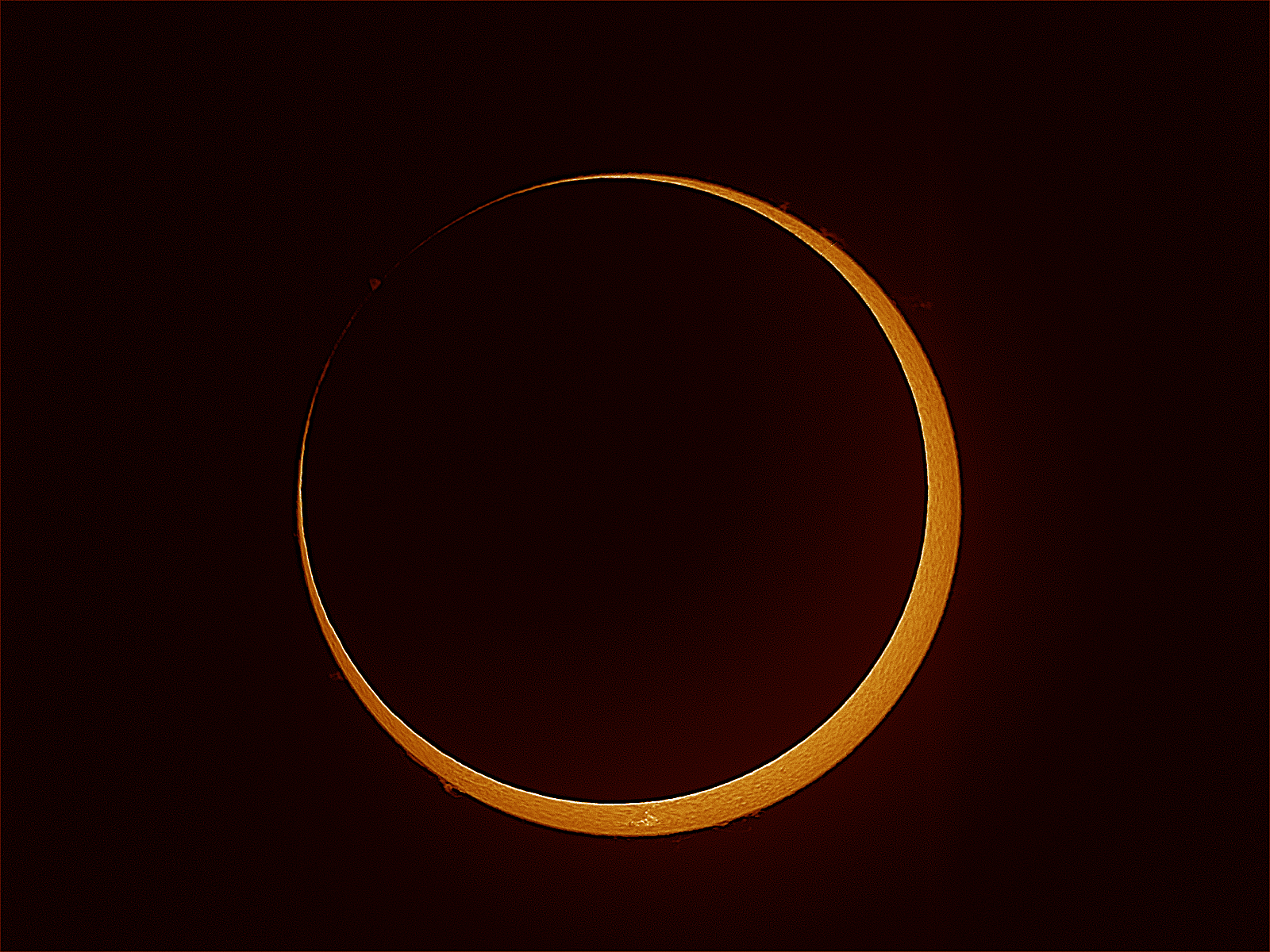
$1:
This week the shadow of the New Moon fell on planet Earth, crossing Queensland's Cape York in northern Australia ... for the second time in six months. On the morning of May 10, the Moon's apparent size was too small to completely cover the Sun though, revealing a "ring of fire" along the central path of the annular solar eclipse. Near mid-eclipse from Coen, Australia, a webcast team captured this telescopic snapshot of the annular phase. Taken with a hydrogen-alpha filter, the dramatic image finds the Moon's silhouette just within the solar disk, and the limb of the active Sun spiked with solar prominences. Still, after hosting back-to-back solar eclipses, northern Australia will miss the next and final solar eclipse of 2013. This November, a rare hybrid eclipse will track across the North Atlantic and equatorial Africa.
DrCaleb @ Tue Jun 04, 2013 8:04 am
$1:
Why does this bizarro asteroid have a million-kilometer-long tail?
Three years ago, something rather cataclysmic happened to this asteroid. Whatever it was — and it was probably a collision with a smaller asteroid — has now resulted in an exceptionally long debris tail that just keeps getting longer.
Asteroids aren’t supposed to have tails. That’s comet territory. But this object, called P/2010 A2 (LINEAR), is leaking a dust trail of a kind never seen before by astronomers.
Just to put this length into perspective, a million-kilometers is roughly three times the distance from the Earth to the Moon. That’s a long distance — and a lot of debris. Observations indicate that the tail consists of chunks about one centimeter across or smaller.
Three years ago, something rather cataclysmic happened to this asteroid. Whatever it was — and it was probably a collision with a smaller asteroid — has now resulted in an exceptionally long debris tail that just keeps getting longer.
Asteroids aren’t supposed to have tails. That’s comet territory. But this object, called P/2010 A2 (LINEAR), is leaking a dust trail of a kind never seen before by astronomers.
Just to put this length into perspective, a million-kilometers is roughly three times the distance from the Earth to the Moon. That’s a long distance — and a lot of debris. Observations indicate that the tail consists of chunks about one centimeter across or smaller.

DrCaleb @ Wed Jun 12, 2013 9:44 am
stratos @ Wed Jun 12, 2013 10:30 am
I know I dont comment on this thread but just wanted to say thanks. I'm really enjoying the pic's you all are posting.
DrCaleb @ Thu Jul 11, 2013 8:11 am
$1:
Charon Revealed!
New Horizons Camera Spots Pluto’s Largest Moon
“The image itself might not look very impressive to the untrained eye, but compared to the discovery images of Charon from Earth, these ‘discovery’ images from New Horizons look great!” says New Horizons Project Scientist Hal Weaver, of the Johns Hopkins University Applied Physics Laboratory, Laurel, Md. “We’re very excited to see Pluto and Charon as separate objects for the first time from New Horizons.”
The spacecraft was still 550 million miles from Pluto – farther than the distance from Earth to Jupiter – when its LOng Range Reconnaissance Imager (LORRI) snapped a total of six images: three on July 1 and three more on July 3. LORRI’s excellent sensitivity and spatial resolution revealed Charon at exactly the predicted offset from Pluto, 35 years after the announcement of Charon’s discovery in 1978 by James Christy of the Naval Observatory.
New Horizons Camera Spots Pluto’s Largest Moon
“The image itself might not look very impressive to the untrained eye, but compared to the discovery images of Charon from Earth, these ‘discovery’ images from New Horizons look great!” says New Horizons Project Scientist Hal Weaver, of the Johns Hopkins University Applied Physics Laboratory, Laurel, Md. “We’re very excited to see Pluto and Charon as separate objects for the first time from New Horizons.”
The spacecraft was still 550 million miles from Pluto – farther than the distance from Earth to Jupiter – when its LOng Range Reconnaissance Imager (LORRI) snapped a total of six images: three on July 1 and three more on July 3. LORRI’s excellent sensitivity and spatial resolution revealed Charon at exactly the predicted offset from Pluto, 35 years after the announcement of Charon’s discovery in 1978 by James Christy of the Naval Observatory.

I love some of the speed comparisons for the New Horizons probe. It is the fastest object to ever leave Earth's orbit. There are faster spacecraft, (Voyager) but they got boosted to those speeds by heavy gravity planets.
It took the Apollo missions 3 days to reach the Moon. It took New Horizons 9 hours. And it will take 9 1/2 years to reach Pluto! Only 2 1/2 years left! Currently, it takes light 7 *hours* to do a round trip to New Horizons.
DrCaleb @ Thu Jul 11, 2013 8:40 am
$1:
Hubble spots azure blue planet
True colour of exoplanet measured for the first time
Astronomers using the NASA/ESA Hubble Space Telescope have, for the first time, determined the true colour of a planet orbiting another star. If seen up close this planet, known as HD 189733b, would be a deep azure blue, reminiscent of Earth’s colour as seen from space.
But that's where the similarities end. This "deep blue dot" is a huge gas giant orbiting very close to its host star. The planet's atmosphere is scorching with a temperature of over 1000 degrees Celsius, and it rains glass, sideways, in howling 7000 kilometre-per-hour winds [1].
True colour of exoplanet measured for the first time
Astronomers using the NASA/ESA Hubble Space Telescope have, for the first time, determined the true colour of a planet orbiting another star. If seen up close this planet, known as HD 189733b, would be a deep azure blue, reminiscent of Earth’s colour as seen from space.
But that's where the similarities end. This "deep blue dot" is a huge gas giant orbiting very close to its host star. The planet's atmosphere is scorching with a temperature of over 1000 degrees Celsius, and it rains glass, sideways, in howling 7000 kilometre-per-hour winds [1].
http://www.spacetelescope.org/news/heic1312/
Jabberwalker @ Thu Jul 11, 2013 2:05 pm
[... looks through each photo for flat, black monolith ...]
DrCaleb @ Wed Jul 17, 2013 7:05 am
Astronomers have been watching the Black Hole at the center of the galaxy for a while, ever since a powerful X-ray burst was detected a few months ago. There is a large cloud of gas headed for the black hole, so it's a very exciting time because we can study what happens when a black hole 'feeds'. Now the gas cloud is starting to enter the event horizon and emit x-rays.
$1:
A cloud of gas has begun its death spiral around the supermassive black hole lurking at the heart of the Milky Way, astronomers announced today. Their observations show that the cloud is stretching like a piece of taffy, pulled by the black hole’s gravitational forces, which are expected to tear it to pieces in the coming months.
Astronomer Stefan Gillessen will be following every gory detail of the death, which offers a rare opportunity to learn more about black holes in action. He and his colleagues at the Max Planck Institute for Extraterrestrial Physics in Garching, Germany, discovered the gas cloud, dubbed G2, in 2011. The researchers have been tracking its movements ever since, using the European Southern Observatory’s Very Large Telescope in Chile. Many λ-ray and X-ray astronomers have also tuned in to the drama at the centre of the Galaxy.
But the latest measurements, made in April, are in the infrared part of the spectrum. They show the speeds of different parts of the cloud. Most of the gas is travelling away from Earth and towards the black hole. But the head of the cloud has already accelerated around the black hole and is now coming back in the opposite direction, as revealed by a shift in the light’s wavelength towards the blue end of the spectrum. “The cloud is behaving like a comet swinging by the Sun,” says Gillessen. The work will be published in an upcoming issue of the Astrophysical Journal.
Astronomer Stefan Gillessen will be following every gory detail of the death, which offers a rare opportunity to learn more about black holes in action. He and his colleagues at the Max Planck Institute for Extraterrestrial Physics in Garching, Germany, discovered the gas cloud, dubbed G2, in 2011. The researchers have been tracking its movements ever since, using the European Southern Observatory’s Very Large Telescope in Chile. Many λ-ray and X-ray astronomers have also tuned in to the drama at the centre of the Galaxy.
But the latest measurements, made in April, are in the infrared part of the spectrum. They show the speeds of different parts of the cloud. Most of the gas is travelling away from Earth and towards the black hole. But the head of the cloud has already accelerated around the black hole and is now coming back in the opposite direction, as revealed by a shift in the light’s wavelength towards the blue end of the spectrum. “The cloud is behaving like a comet swinging by the Sun,” says Gillessen. The work will be published in an upcoming issue of the Astrophysical Journal.

http://www.nature.com/news/giant-black- ... it-1.13405
Its doubly exciting because my favourite cosmic character has also been detected near the black hole - a Magnetar!
$1:
Dale Frail couldn’t resist the prospect of watching a black hole swallow its prey. Frail, who is in charge of the Very Large Array (VLA) of radio telescopes near Socorro in New Mexico, had seen a report last month about a long-lived X-ray flare emanating from the centre of the Milky Way, home to a supermassive black hole called Sagittarius A* (Sgr A*). Astronomers were speculating that the flare might be a sign that a gas cloud they had been tracking had begun its death spiral into the black hole.
Frail was sceptical. The cloud’s death was not expected until between September this year and March 2014. But Frail did not want to risk missing the action. Within hours of seeing the report, he had trained the VLA’s radio dishes on the scene, only to find nothing remarkable. Frail was puzzled. If the flare wasn’t the arrival of the gas cloud, what was it?
An answer soon came from other telescopes watching the drama at the centre of the Galaxy: the flare was coming from a magnetar, a highly magnetized kind of pulsar, or rotating neutron star. Its position near Sgr A* makes it a precious find. The magnetar’s regular radio pulses could be used to measure the warping of space-time near the monster black hole and to test predictions of Einstein’s general theory of relativity.
Frail was sceptical. The cloud’s death was not expected until between September this year and March 2014. But Frail did not want to risk missing the action. Within hours of seeing the report, he had trained the VLA’s radio dishes on the scene, only to find nothing remarkable. Frail was puzzled. If the flare wasn’t the arrival of the gas cloud, what was it?
An answer soon came from other telescopes watching the drama at the centre of the Galaxy: the flare was coming from a magnetar, a highly magnetized kind of pulsar, or rotating neutron star. Its position near Sgr A* makes it a precious find. The magnetar’s regular radio pulses could be used to measure the warping of space-time near the monster black hole and to test predictions of Einstein’s general theory of relativity.
http://www.nature.com/news/magnetar-fou ... le-1.12984
DrCaleb @ Mon Jul 22, 2013 9:56 am
New Cassini pics from Saturn - You are here:

Jabberwalker @ Mon Jul 22, 2013 10:06 am
Can you actually see the blue of our oceans from Cassini or is that enhanced?
DrCaleb @ Mon Jul 22, 2013 10:18 am
Jabberwalker Jabberwalker:
Can you actually see the blue of our oceans from Cassini or is that enhanced?
You can see it, but the final image is yet to be released. They made photos through several different colour filters and need to combine them.
DrCaleb @ Tue Jul 23, 2013 9:22 am
Earth, and moon as seen from Saturn:
More:
http://www.jpl.nasa.gov/news/news.php?r ... 2013-229#3
DrCaleb @ Tue Jul 30, 2013 8:00 am
$1:
The n-body problem is a classic in physics. Its solutions are configurations in which objects – planets, say — can travel around in each other’s gravity in a stable manner. (The moon and Earth perform a modified version of a 2-body solution — they travel in each other’s gravity, but also that of the Sun, and other planets. The n-body problem assumes bodies that are of equal mass, and in an environment where there is no other gravity. I’ll keep calling them planets, but understand that they are not ordinary planets.)
To find a solution to the n-body problem is to minimize something called an action functional, which describes the energy of group of planets — the accumulated difference between the kinetic and potential energy, to be more specific about it — as they swing and pull and dance around each other. The result is the path of least resistance, the way that the planet’s motion will naturally fall into place, without an external forces – a purely gravitational path. Out of these paths, the ones that are periodic — that is, the planets swing around in the same motion for at least some extended period of time — are the solutions to the n-body problem.
Vanderbei first learned of a solution to the n-body problem called the figure 8, discovered by physicist Cris Moore, the first physicist who used a computer to solve the n-body problem.
To find a solution to the n-body problem is to minimize something called an action functional, which describes the energy of group of planets — the accumulated difference between the kinetic and potential energy, to be more specific about it — as they swing and pull and dance around each other. The result is the path of least resistance, the way that the planet’s motion will naturally fall into place, without an external forces – a purely gravitational path. Out of these paths, the ones that are periodic — that is, the planets swing around in the same motion for at least some extended period of time — are the solutions to the n-body problem.
Vanderbei first learned of a solution to the n-body problem called the figure 8, discovered by physicist Cris Moore, the first physicist who used a computer to solve the n-body problem.

http://blogs.scientificamerican.com/gue ... dy-orbits/
Previous 1 ... 17 18 19 20 21 22 23 ... 244 Next