
Space Thread
Previous 1 ... 19 20 21 22 23 24 25 ... 244 Next
DrCaleb @ Thu Aug 15, 2013 12:33 pm
$1:
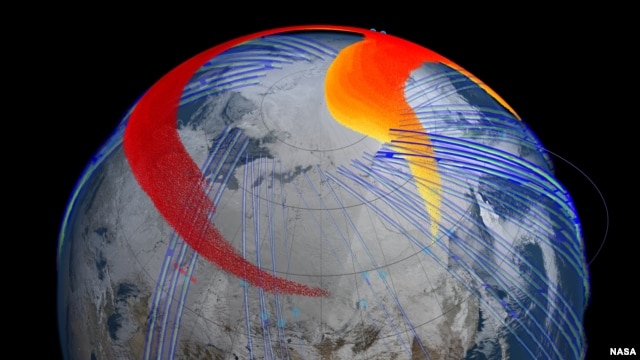
NASA Maps Global Spread of Chelyabinsk Meteor Plume
The U.S. space agency, NASA, has mapped the massive plume of dust and debris created by the Chelyabinsk meteor that exploded over Russia last February with the force of 30 Hiroshima atom bombs.
Measuring 18 meters across and weighing 11,000 metric tons, the meteor screamed into Earth's atmosphere on February 15 at 18.6 kilometers per second. Burning from the friction with Earth's thin air, the space rock exploded 23.3 kilometers above Chelyabinsk causing extensive damage in the region.
The explosion also deposited hundreds of tons of dust in the stratosphere, allowing a NASA satellite to make unprecedented measurements of how the material formed a thin but cohesive and persistent stratospheric dust belt.
"We wanted to know if our satellite could detect the meteor dust," said atmospheric physicist Nick Gorkavyi of NASA's Goddard Space Flight Center in Greenbelt, Maryland, who led the meteor study. "Indeed, we saw the formation of a new dust belt in Earth's stratosphere, and achieved the first space-based observation of the long-term evolution of a bolide [meteor] plume."
Combining satellite observations with atmospheric models, Gorkavyi and his colleagues created a model of how the plume from the explosion moved around the Northern Hemisphere.
The U.S. space agency, NASA, has mapped the massive plume of dust and debris created by the Chelyabinsk meteor that exploded over Russia last February with the force of 30 Hiroshima atom bombs.
Measuring 18 meters across and weighing 11,000 metric tons, the meteor screamed into Earth's atmosphere on February 15 at 18.6 kilometers per second. Burning from the friction with Earth's thin air, the space rock exploded 23.3 kilometers above Chelyabinsk causing extensive damage in the region.
The explosion also deposited hundreds of tons of dust in the stratosphere, allowing a NASA satellite to make unprecedented measurements of how the material formed a thin but cohesive and persistent stratospheric dust belt.
"We wanted to know if our satellite could detect the meteor dust," said atmospheric physicist Nick Gorkavyi of NASA's Goddard Space Flight Center in Greenbelt, Maryland, who led the meteor study. "Indeed, we saw the formation of a new dust belt in Earth's stratosphere, and achieved the first space-based observation of the long-term evolution of a bolide [meteor] plume."
Combining satellite observations with atmospheric models, Gorkavyi and his colleagues created a model of how the plume from the explosion moved around the Northern Hemisphere.
http://www.voanews.com/content/nasa-map ... 30261.html
Jabberwalker @ Thu Aug 15, 2013 12:43 pm
Was this a "metal rich" object?
DrCaleb @ Thu Aug 15, 2013 1:34 pm
Jabberwalker Jabberwalker:
Was this a "metal rich" object?
Why, do you have no respect for the "metally challenged" cosmic debris?
Jabberwalker @ Thu Aug 15, 2013 1:56 pm
DrCaleb DrCaleb:
Jabberwalker Jabberwalker:
Was this a "metal rich" object?
Why, do you have no respect for the "metally challenged" cosmic debris?
Oh, Bruvva!
No, I find that the huge asteroid that buried itself under Sudbury to be rather interesting and I was curious if these smaller objects are elementally similar. Will there a possibility of directing object like this in the future for commercial exploitation of some sort?
DrCaleb @ Thu Aug 15, 2013 2:18 pm
Jabberwalker Jabberwalker:
DrCaleb DrCaleb:
Jabberwalker Jabberwalker:
Was this a "metal rich" object?
Why, do you have no respect for the "metally challenged" cosmic debris?
Oh, Bruvva!
No, I find that the huge asteroid that buried itself under Sudbury to be rather interesting and I was curious if these smaller objects are elementally similar. Will there a possibility of directing object like this in the future for commercial exploitation of some sort?
I don't think the article discusses exactly what the meteor was made of, but from the amount of damage it did it had to contain some heavier elements.
And space mining has been a hot topic since 2007 when Earth had a second moon for a few months. Then we realized how easily large objects could be captured in Earth's gravity well and exploited.
$1:
By looking through the catalog of known asteroids, aerospace engineers have identified 12 candidates that we could reach out and capture using existing rocket technology.
Long overlooked as mere rocky chunks leftover from the formation of the solar system, asteroids have recently gotten a lot more scrutiny. A couple years ago, researchers outlined a seemingly daring plan to lasso and bring an asteroid back to Earth. NASA doesn’t seem to think this is too crazy, and is moving forward with plans to capture, tow, and place a small asteroid somewhere near our planet. There are also two different private space companies, Planetary Resources and Deep Space Industries, with plans to seek out and mine precious metals and water from near-Earth asteroids. And finally, the widely filmed Chelyabinsk meteor, which exploded over Russia in February, has focused international attention on the fact that we may one day want to deflect a potentially catastrophic Earth-asteroid crash.
Long overlooked as mere rocky chunks leftover from the formation of the solar system, asteroids have recently gotten a lot more scrutiny. A couple years ago, researchers outlined a seemingly daring plan to lasso and bring an asteroid back to Earth. NASA doesn’t seem to think this is too crazy, and is moving forward with plans to capture, tow, and place a small asteroid somewhere near our planet. There are also two different private space companies, Planetary Resources and Deep Space Industries, with plans to seek out and mine precious metals and water from near-Earth asteroids. And finally, the widely filmed Chelyabinsk meteor, which exploded over Russia in February, has focused international attention on the fact that we may one day want to deflect a potentially catastrophic Earth-asteroid crash.
http://www.wired.com/wiredscience/2013/ ... asteroids/
DrCaleb @ Fri Aug 16, 2013 7:19 am
The Dog star, Sirius has risen above the horizon. The Dog Days of Summer are here.
Jabberwalker @ Fri Aug 16, 2013 9:24 am
DrCaleb DrCaleb:
The Dog star, Sirius has risen above the horizon. The Dog Days of Summer are here.
Isn't there another star in Orion called "Puppus"?
Tyler_1 @ Fri Aug 16, 2013 9:24 am
No one should panic. The cats eye is still ruling over us. 
meow.jpg [ 235.06 KiB | Viewed 190 times ]
DrCaleb @ Fri Aug 16, 2013 10:00 am
Jabberwalker Jabberwalker:
DrCaleb DrCaleb:
The Dog star, Sirius has risen above the horizon. The Dog Days of Summer are here.
Isn't there another star in Orion called "Puppus"?
Not in Orion, in Canus Major. There is the Great and Lesser dog constillations right next to Orion. Syrius is in the 'Great Dog', Puppus is in the Lesser.


Orion also contains the star Betelgeuse, which you should never say 3 times out loud.
Jabberwalker @ Fri Aug 16, 2013 10:05 am
Did you know that they've renamed Ursa Major: Mike Duffy ...The Big Dipper?
DrCaleb @ Fri Aug 16, 2013 2:47 pm
$1:
Incredible Footage Shows a Perseid Meteor Exploding
Personally, I’ve never seen anything like this, and photographer and digital artist Michael K. Chung said he couldn’t believe what he saw when he was processing images he took for a timelapse of the Perseid meteor shower. It appears he captured a meteor explosion and the resulting expansion of a shock wave or debris ring.
“It was taken early in the morning on August 12, 2013 from my backyard in Victorville, CA,” Michael told Universe Today via email. “The fade to white is NOT an edit- it is overexposure due to the sun coming up. From what I can tell, the timelapse sequence of the explosion and expanding debris span an actual time of approximately 20 minutes.”
Read more: http://www.universetoday.com/104149/inc ... -exploding
Personally, I’ve never seen anything like this, and photographer and digital artist Michael K. Chung said he couldn’t believe what he saw when he was processing images he took for a timelapse of the Perseid meteor shower. It appears he captured a meteor explosion and the resulting expansion of a shock wave or debris ring.
“It was taken early in the morning on August 12, 2013 from my backyard in Victorville, CA,” Michael told Universe Today via email. “The fade to white is NOT an edit- it is overexposure due to the sun coming up. From what I can tell, the timelapse sequence of the explosion and expanding debris span an actual time of approximately 20 minutes.”
Read more: http://www.universetoday.com/104149/inc ... -exploding

If the timing is correct, it co-incides with the fire alarm in my home going off for a couple seconds.

Jabberwalker @ Sat Aug 17, 2013 1:35 pm
DrCaleb DrCaleb:
$1:
Incredible Footage Shows a Perseid Meteor Exploding
Personally, I’ve never seen anything like this, and photographer and digital artist Michael K. Chung said he couldn’t believe what he saw when he was processing images he took for a timelapse of the Perseid meteor shower. It appears he captured a meteor explosion and the resulting expansion of a shock wave or debris ring.
“It was taken early in the morning on August 12, 2013 from my backyard in Victorville, CA,” Michael told Universe Today via email. “The fade to white is NOT an edit- it is overexposure due to the sun coming up. From what I can tell, the timelapse sequence of the explosion and expanding debris span an actual time of approximately 20 minutes.”
Read more: http://www.universetoday.com/104149/inc ... -exploding
Personally, I’ve never seen anything like this, and photographer and digital artist Michael K. Chung said he couldn’t believe what he saw when he was processing images he took for a timelapse of the Perseid meteor shower. It appears he captured a meteor explosion and the resulting expansion of a shock wave or debris ring.
“It was taken early in the morning on August 12, 2013 from my backyard in Victorville, CA,” Michael told Universe Today via email. “The fade to white is NOT an edit- it is overexposure due to the sun coming up. From what I can tell, the timelapse sequence of the explosion and expanding debris span an actual time of approximately 20 minutes.”
Read more: http://www.universetoday.com/104149/inc ... -exploding
If the timing is correct, it co-incides with the fire alarm in my home going off for a couple seconds.
Are we seeing the object explode or superheated atmospheric gasses emitting light as they blow outward?
It is very cool, to be sure.
DrCaleb @ Mon Aug 19, 2013 1:48 pm
$1:
The Dirtiest Lunar Mystery Of All
The Apollo astronauts were the first to witness a strange twilight phenomenon, a mysterious spread of light above and across the horizon. These remarkable displays were in stark contrast to the otherwise black skies, and a subject of considerable speculation.

They weren’t simple in structure, as seen in this page of sketches from Apollo 17 made during sunrise. In the span of a few minutes the glow above the horizon went from a centrally peaked luminosity to a set of ‘linear structures’ radiating outwards.
But what could be reflecting and scattering sunlight in the lunar vacuum? It could be something like the tenuous glow of irradiated sodium ions, but it could also be the glinting of lunar dust – levitated from the surface by powerful electrostatic charges generated by interplanetary radiation swirling across the landscape.

The Apollo astronauts were the first to witness a strange twilight phenomenon, a mysterious spread of light above and across the horizon. These remarkable displays were in stark contrast to the otherwise black skies, and a subject of considerable speculation.
They weren’t simple in structure, as seen in this page of sketches from Apollo 17 made during sunrise. In the span of a few minutes the glow above the horizon went from a centrally peaked luminosity to a set of ‘linear structures’ radiating outwards.
But what could be reflecting and scattering sunlight in the lunar vacuum? It could be something like the tenuous glow of irradiated sodium ions, but it could also be the glinting of lunar dust – levitated from the surface by powerful electrostatic charges generated by interplanetary radiation swirling across the landscape.
http://blogs.scientificamerican.com/lif ... ry-of-all/
DrCaleb @ Tue Aug 20, 2013 9:17 am
$1:
Amazing Star Birth Photos: ALMA Telescope's Views of Herbig-Haro Object HH 46/47
This image of Herbig-Haro object HH 46/47 combines radio observations acquired with the Atacama Large Millimeter/submillimeter Array (ALMA) with much shorter wavelength visible light observations from ESO’s New Technology Telescope (NTT). The ALMA observations (orange and green, lower right) of the newborn star reveal a large energetic jet moving away from us, which in the visible is hidden by dust and gas. To the left (in pink and purple) the visible part of the jet is seen, streaming partly towards us

This image of Herbig-Haro object HH 46/47 combines radio observations acquired with the Atacama Large Millimeter/submillimeter Array (ALMA) with much shorter wavelength visible light observations from ESO’s New Technology Telescope (NTT). The ALMA observations (orange and green, lower right) of the newborn star reveal a large energetic jet moving away from us, which in the visible is hidden by dust and gas. To the left (in pink and purple) the visible part of the jet is seen, streaming partly towards us
$1:
Star Birth Drama Captured by Giant Radio Telescope (Photos)
"This system is similar to most isolated low mass stars during their formation and birth," Diego Mardones, a co-author of the study detailing the stellar findings said in a statement. "But it is also unusual because the outflow impacts the cloud directly on one side of the young star and escapes out of the cloud on the other. This makes it an excellent system for studying the impact of the stellar winds on the parent cloud from which the young star is formed."
"This system is similar to most isolated low mass stars during their formation and birth," Diego Mardones, a co-author of the study detailing the stellar findings said in a statement. "But it is also unusual because the outflow impacts the cloud directly on one side of the young star and escapes out of the cloud on the other. This makes it an excellent system for studying the impact of the stellar winds on the parent cloud from which the young star is formed."
http://www.space.com/22434-stunning-bab ... scope.html
DrCaleb @ Tue Aug 20, 2013 9:20 am
$1:
Blue Moon from dusk until dawn night of August 20, 2013
Yes, it’ll be a Blue Moon that lights up the night sky on August 20-21 from dusk till dawn! But it won’t be a Blue Moon by the most popular definition of the term – the second of two full moons to occur in the same calendar month. Nor is the moon likely to be blue in color, as that’s caused by exceedingly rare atmospheric conditions.
Rather, the August 2013 full moon will present the third of four full moons to fall in the same season. A season is defined as the period of time in between a solstice and an equinox – or vice versa. This full moon is the third of four full moons to take place in between the June 2013 solstice and the September 2013 equinox. That makes the August 2013 full moon a Blue Moon!
The moon turns full on August 21, at 1:45 Universal Time. Although the full moon happens at the same moment worldwide, the clock reads differently by time zone. The moon turns full in the United States on Tuesday, August 20, at 9:45 p.m. EDT, 8:45 p.m. CDT, 7:45 p.m MDT or 6:45 p.m. PDT. Astronomically speaking, the moon is full when it’s most directly opposite the sun for the month.
Many of you may not be familiar with the definition of Blue Moon as the third of four full moons in one season. But this definition actually preceded the more modern definition of a Blue Moon as being the second of two full moons to occur in one calendar month.
How often do we have a seasonal Blue Moon?
In both instances, the Blue Moon is a calendar oddity caused by the 19-year Metonic cycle. There are 235 full moons in 19 calendar years, but only 228 calendar months (or 76 three-month seasons). Therefore, it’s inevitable that 7 out of 19 years will feature two full moons in one calendar month. And it’s also inevitable that 7 out of 19 years will have four full moons in one season.
Yes, it’ll be a Blue Moon that lights up the night sky on August 20-21 from dusk till dawn! But it won’t be a Blue Moon by the most popular definition of the term – the second of two full moons to occur in the same calendar month. Nor is the moon likely to be blue in color, as that’s caused by exceedingly rare atmospheric conditions.
Rather, the August 2013 full moon will present the third of four full moons to fall in the same season. A season is defined as the period of time in between a solstice and an equinox – or vice versa. This full moon is the third of four full moons to take place in between the June 2013 solstice and the September 2013 equinox. That makes the August 2013 full moon a Blue Moon!
The moon turns full on August 21, at 1:45 Universal Time. Although the full moon happens at the same moment worldwide, the clock reads differently by time zone. The moon turns full in the United States on Tuesday, August 20, at 9:45 p.m. EDT, 8:45 p.m. CDT, 7:45 p.m MDT or 6:45 p.m. PDT. Astronomically speaking, the moon is full when it’s most directly opposite the sun for the month.
Many of you may not be familiar with the definition of Blue Moon as the third of four full moons in one season. But this definition actually preceded the more modern definition of a Blue Moon as being the second of two full moons to occur in one calendar month.
How often do we have a seasonal Blue Moon?
In both instances, the Blue Moon is a calendar oddity caused by the 19-year Metonic cycle. There are 235 full moons in 19 calendar years, but only 228 calendar months (or 76 three-month seasons). Therefore, it’s inevitable that 7 out of 19 years will feature two full moons in one calendar month. And it’s also inevitable that 7 out of 19 years will have four full moons in one season.
http://earthsky.org/tonight/blue-moon-f ... st-20-2013
Previous 1 ... 19 20 21 22 23 24 25 ... 244 Next