
Space Thread
Previous 1 ... 15 16 17 18 19 20 21 ... 244 Next
Gunnair @ Mon Dec 17, 2012 6:57 pm

$1:
A Martian Rock Called 'Rocknest 3' (Raw-Color)
This view of a Martian rock called "Rocknest 3" combines four images taken by the right-eye camera of the Mast Camera (Mastcam) instrument, which has a telephoto, 100-millimeter-focal-length lens. The component images were taken a few minutes after Martian noon on the 59th Martian day, or sol, of Curiosity's operations on Mars (evening of Oct. 5, 2012, PDT).
Rocknest 3 is a rock approximately 15 inches (40 centimeters) long and 4 inches (10 centimeters) tall, next to the "Rocknest" patch of windblown dust and sand where Curiosity scooped and analyzed soil samples. The Mastcam was about 13 feet (4 meters) from the rock when the component images were taken, providing an image scale of about 0.01 inch (0.3 millimeter) per pixel.
The white-balanced version of the image shows what the rock would look like if it were on Earth. This raw-color version of the image shows what the rock looks like on Mars to the camera. An annotated version indicates the portion of Rocknest 3 covered in Sol 57 imaging by Curiosity's Chemistry and Camera (ChemCam) instrument.
This view of a Martian rock called "Rocknest 3" combines four images taken by the right-eye camera of the Mast Camera (Mastcam) instrument, which has a telephoto, 100-millimeter-focal-length lens. The component images were taken a few minutes after Martian noon on the 59th Martian day, or sol, of Curiosity's operations on Mars (evening of Oct. 5, 2012, PDT).
Rocknest 3 is a rock approximately 15 inches (40 centimeters) long and 4 inches (10 centimeters) tall, next to the "Rocknest" patch of windblown dust and sand where Curiosity scooped and analyzed soil samples. The Mastcam was about 13 feet (4 meters) from the rock when the component images were taken, providing an image scale of about 0.01 inch (0.3 millimeter) per pixel.
The white-balanced version of the image shows what the rock would look like if it were on Earth. This raw-color version of the image shows what the rock looks like on Mars to the camera. An annotated version indicates the portion of Rocknest 3 covered in Sol 57 imaging by Curiosity's Chemistry and Camera (ChemCam) instrument.
DrCaleb @ Tue Dec 18, 2012 3:07 pm

http://news.discovery.com/space/cassini ... 21218.html
Strutz @ Wed Dec 19, 2012 12:58 am
From National Geographic
Best Space Pictures of 2012: Editor's Picks
http://news.nationalgeographic.com/news/2012/12/pictures/121211-best-space-2012-endeavour-mars-rover-nasa-science/?source=best_2012_DL
Gunnair @ Fri Dec 21, 2012 11:40 pm
$1:
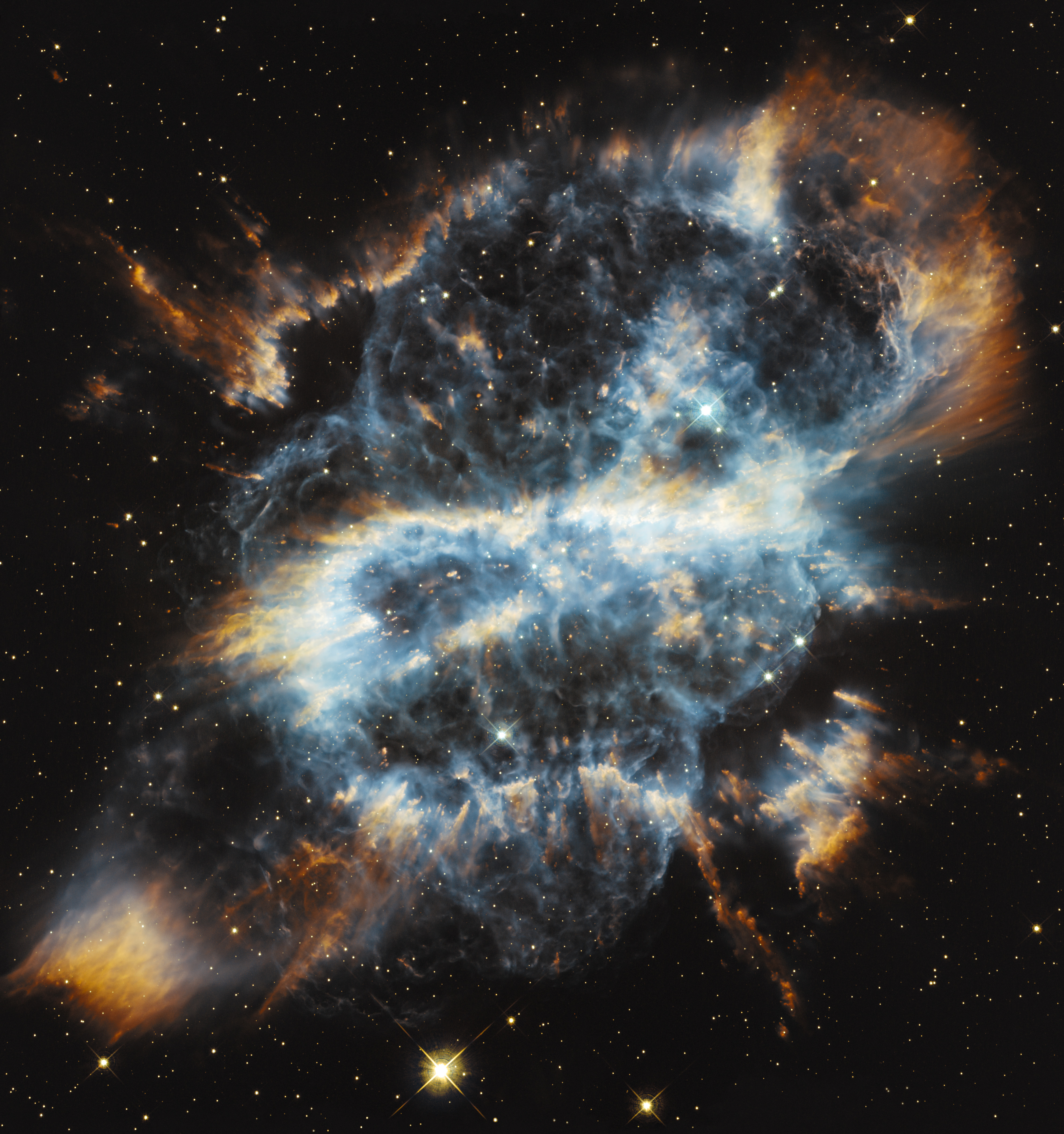
Why is this nebula so complex? When a star like our Sun is dying, it will cast off its outer layers, usually into a simple overall shape. Sometimes this shape is a sphere, sometimes a double lobe, and sometimes a ring or a helix. In the case of planetary nebula NGC 5189, however, no such simple structure has emerged. To help find out why, the Earth-orbiting Hubble Space Telescope recently observed NGC 5189 in great detail. Previous findings indicated the existence of multiple epochs of material outflow, including a recent one that created a bright but distorted torus running horizontally across image center. Results appear consistent with a hypothesis that the dying star is part of a binary star system with a precessing symmetry axis. Given this new data, though, research is sure to continue. NGC 5189 spans about three light years and lies about 3,000 light years away toward the southern constellation of the Fly (Musca).
Gunnair @ Fri Jan 04, 2013 11:37 pm
$1:
Carbon in Vesta's craters
The protoplanet Vesta has been witness to an eventful past: images taken by the framing camera onboard NASA's space probe Dawn show two enormous craters in the southern hemisphere. The images were obtained during Dawn's year-long visit to Vesta that ended in September 2012. These huge impacts not only altered Vesta's shape, but also its surface composition. Scientists under the lead of the Max Planck Institute for Solar System Research in Katlenburg-Lindau in Germany have shown that impacting small asteroids delivered dark, carbonaceous material to the protoplanet. In the early days of our solar system, similar events may have provided the inner planets such as Earth with carbon, an essential building block for organic molecules. These results were published in the November-December issue of the journal Icarus.
Vesta is remarkable in many respects. With a diameter of approximately 530 kilometres, Vesta is the one of the few protoplanets in our solar system still intact today. Like other protoplanets, Vesta underwent complete melting approximately 4.5 billion years ago. However, most of the volcanic activity on Vesta is thought to have ceased within a few million years making it a time capsule from the early solar system. Dawn observations of Vesta have shown a surface with diverse brightness variations and surface composition. There is bright material on Vesta that is as white as snow and dark material on Vesta as black as coal.
The enigmatic dark material holds the key to understanding the impact environment around Vesta early in its evolution. Research led by scientists at the Max Planck Institute in Katlenburg-Lindau has shown that this dark material is not native to Vesta but was delivered by impacting asteroids. "The evidence suggests that the dark material on Vesta is rich in carbonaceous material and was brought there by collisions with smaller asteroids," explains. Vishnu Reddy from the Max Planck Institute for Solar System Research and the University of North Dakota, the lead author of the paper. In the journal Icarus, he and his colleagues now present the most comprehensive analysis of this material so far. Compositional analysis, mapping, and modelling of dark material distribution on Vesta suggest that it was delivered during the formation of giant impact basins on Vesta.
The dark material arrived with the first impact on the protoplanet
"First, we created a map showing the distribution of dark material on Vesta using the framing camera data and found something remarkable," explains Lucille Le Corre from the Max Planck Institute for Solar System Research one of the lead authors of the study. Dark material was preferentially spread around the edges of the giant impact basins in the southern hemisphere of Vesta suggesting a link to one of the two large impact basins. A closer examination showed that the dark material was most probably delivered during the formation of the older Veneneia basin when a slow impacting asteroid collided with Vesta. Dark material from this two to three billion year old basin was covered up by the impact that subsequently created the Rheasilvia basin. "We believe that the Veneneia basin was created by the first of two impacts two to three billion years ago," says Reddy. In fact, impact modelling presented in the paper reproduces the distribution of dark material from such a low velocity impact.
HED meteorites are fragments of Vesta
Evidence for dark material is also found in the HED meteorites that come from Vesta. Some of the meteorites show dark inclusions that are carbon-rich. Colour spectra of dark material on Vesta are identical to these carbon-rich inclusions in HED meteorites. The link between dark material on Vesta and dark clasts in HED meteorites provides us with direct evidence that these meteorites are indeed from Vesta. "Our analysis of the dark material on Vesta and comparisons with laboratory studies of HED meteorites for the first time proves directly that these meteorites are fragments from Vesta," says Le Corre.
"The aim of our efforts was not only to reconstruct Vesta's history, but also to understand the conditions in the early solar system," says Holger Sierks, co-investigator of the Dawn mission at the Max Planck Institute for Solar System Research.
The Dawn mission was launched approximately five years ago and entered orbit around Vesta on July 16th, 2011. In 2015, Dawn will arrive at its second destination, the dwarf planet Ceres, that like Vesta orbits the Sun between the orbits of Mars and Jupiter within the so-called asteroid belt. The Dawn mission to Vesta and Ceres is managed by NASA's Jet Propulsion Laboratory, a division of the California Institute of Technology in Pasadena, for NASA's Science Mission Directorate, Washington. The University of California, Los Angeles, is responsible for overall Dawn mission science. The Dawn framing cameras have been developed and built under the leadership of the Max Planck Institute for Solar System Research, Katlenburg-Lindau, Germany, with significant contributions by DLR German Aerospace Center, Institute of Planetary Research, Berlin, and in coordination with the Institute of Computer and Communication Network Engineering, Braunschweig. The Framing Camera project is funded by the Max Planck Society, DLR, and NASA/JPL.
Source: Max-Planck-Gesellschaft
The protoplanet Vesta has been witness to an eventful past: images taken by the framing camera onboard NASA's space probe Dawn show two enormous craters in the southern hemisphere. The images were obtained during Dawn's year-long visit to Vesta that ended in September 2012. These huge impacts not only altered Vesta's shape, but also its surface composition. Scientists under the lead of the Max Planck Institute for Solar System Research in Katlenburg-Lindau in Germany have shown that impacting small asteroids delivered dark, carbonaceous material to the protoplanet. In the early days of our solar system, similar events may have provided the inner planets such as Earth with carbon, an essential building block for organic molecules. These results were published in the November-December issue of the journal Icarus.
Vesta is remarkable in many respects. With a diameter of approximately 530 kilometres, Vesta is the one of the few protoplanets in our solar system still intact today. Like other protoplanets, Vesta underwent complete melting approximately 4.5 billion years ago. However, most of the volcanic activity on Vesta is thought to have ceased within a few million years making it a time capsule from the early solar system. Dawn observations of Vesta have shown a surface with diverse brightness variations and surface composition. There is bright material on Vesta that is as white as snow and dark material on Vesta as black as coal.
The enigmatic dark material holds the key to understanding the impact environment around Vesta early in its evolution. Research led by scientists at the Max Planck Institute in Katlenburg-Lindau has shown that this dark material is not native to Vesta but was delivered by impacting asteroids. "The evidence suggests that the dark material on Vesta is rich in carbonaceous material and was brought there by collisions with smaller asteroids," explains. Vishnu Reddy from the Max Planck Institute for Solar System Research and the University of North Dakota, the lead author of the paper. In the journal Icarus, he and his colleagues now present the most comprehensive analysis of this material so far. Compositional analysis, mapping, and modelling of dark material distribution on Vesta suggest that it was delivered during the formation of giant impact basins on Vesta.
The dark material arrived with the first impact on the protoplanet
"First, we created a map showing the distribution of dark material on Vesta using the framing camera data and found something remarkable," explains Lucille Le Corre from the Max Planck Institute for Solar System Research one of the lead authors of the study. Dark material was preferentially spread around the edges of the giant impact basins in the southern hemisphere of Vesta suggesting a link to one of the two large impact basins. A closer examination showed that the dark material was most probably delivered during the formation of the older Veneneia basin when a slow impacting asteroid collided with Vesta. Dark material from this two to three billion year old basin was covered up by the impact that subsequently created the Rheasilvia basin. "We believe that the Veneneia basin was created by the first of two impacts two to three billion years ago," says Reddy. In fact, impact modelling presented in the paper reproduces the distribution of dark material from such a low velocity impact.
HED meteorites are fragments of Vesta
Evidence for dark material is also found in the HED meteorites that come from Vesta. Some of the meteorites show dark inclusions that are carbon-rich. Colour spectra of dark material on Vesta are identical to these carbon-rich inclusions in HED meteorites. The link between dark material on Vesta and dark clasts in HED meteorites provides us with direct evidence that these meteorites are indeed from Vesta. "Our analysis of the dark material on Vesta and comparisons with laboratory studies of HED meteorites for the first time proves directly that these meteorites are fragments from Vesta," says Le Corre.
"The aim of our efforts was not only to reconstruct Vesta's history, but also to understand the conditions in the early solar system," says Holger Sierks, co-investigator of the Dawn mission at the Max Planck Institute for Solar System Research.
The Dawn mission was launched approximately five years ago and entered orbit around Vesta on July 16th, 2011. In 2015, Dawn will arrive at its second destination, the dwarf planet Ceres, that like Vesta orbits the Sun between the orbits of Mars and Jupiter within the so-called asteroid belt. The Dawn mission to Vesta and Ceres is managed by NASA's Jet Propulsion Laboratory, a division of the California Institute of Technology in Pasadena, for NASA's Science Mission Directorate, Washington. The University of California, Los Angeles, is responsible for overall Dawn mission science. The Dawn framing cameras have been developed and built under the leadership of the Max Planck Institute for Solar System Research, Katlenburg-Lindau, Germany, with significant contributions by DLR German Aerospace Center, Institute of Planetary Research, Berlin, and in coordination with the Institute of Computer and Communication Network Engineering, Braunschweig. The Framing Camera project is funded by the Max Planck Society, DLR, and NASA/JPL.
Source: Max-Planck-Gesellschaft
Strutz @ Sat Jan 05, 2013 9:11 pm
Just had to share this collection of pics.
These are awesome!
Chris Hadfield's view of Earth from Space.
http://www.ctvnews.ca/photo-galleries/chris-hadfield-s-view-of-earth-from-space-1.1099966
kilroy @ Sat Jan 05, 2013 9:25 pm
Strutz Strutz:
Just had to share this collection of pics.
These are awesome!
Chris Hadfield's view of Earth from Space.
http://www.ctvnews.ca/photo-galleries/chris-hadfield-s-view-of-earth-from-space-1.1099966
These are awesome!
Chris Hadfield's view of Earth from Space.
http://www.ctvnews.ca/photo-galleries/chris-hadfield-s-view-of-earth-from-space-1.1099966
It is a beautiful place isn't it? great pictures.
Strutz @ Sat Jan 05, 2013 9:31 pm
kilroy kilroy:
Strutz Strutz:
Just had to share this collection of pics.
These are awesome!
Chris Hadfield's view of Earth from Space.
http://www.ctvnews.ca/photo-galleries/chris-hadfield-s-view-of-earth-from-space-1.1099966
These are awesome!
Chris Hadfield's view of Earth from Space.
http://www.ctvnews.ca/photo-galleries/chris-hadfield-s-view-of-earth-from-space-1.1099966
It is a beautiful place isn't it? great pictures.
Yes... beautiful and peaceful.
Always an awesome thing to see things from a different perspective.
I hope Chris shares more of them soon! I`ll certainly be watching for them.
DrCaleb @ Tue Jan 08, 2013 3:32 pm

$1:
The string of brushfires currently raging throughout five of Australia's six states are so massive that they can be seen from space. Canadian astronaut Chris Hadfield captured these detailed images on Jan. 8 from on board the International Space Station.
The Australian brushfires stem from the worst heatwave the country has seen in more than 80 years, with temperatures hitting 107 degrees Fahrenheit in some areas. Due to the threatening combination of high winds and extreme temperature, Australian authorities say the fires could be catastrophic.
The Australian brushfires stem from the worst heatwave the country has seen in more than 80 years, with temperatures hitting 107 degrees Fahrenheit in some areas. Due to the threatening combination of high winds and extreme temperature, Australian authorities say the fires could be catastrophic.
http://mashable.com/2013/01/08/australi ... res-space/
Strutz @ Wed Jan 09, 2013 4:24 pm
An updated gallery of pictures from Chris Hadfield. Some of these were in the previous post I made above but many new ones have been added to the gallery.
http://www.ctvnews.ca/photo-galleries/chris-hadfield-s-view-of-earth-from-space-1.1099966
Strutz @ Wed Feb 06, 2013 4:19 pm
And another update from Chris Hadfield.
Some really amazing ones have been added since the last update.
http://www.ctvnews.ca/photo-galleries/chris-hadfield-s-view-of-earth-from-space-1.1099966
DrCaleb @ Tue Feb 19, 2013 12:47 pm
An absolutely fantastic show. Stunning pics, and many revealing interrelationships between ourselves and our planet.
$1:
"Earth From Space" is a groundbreaking two-hour special that reveals a spectacular new space-based vision of our planet. Produced in extensive consultation with NASA scientists, NOVA takes data from earth-observing satellites and transforms it into dazzling visual sequences, each one exposing the intricate and surprising web of forces that sustains life on earth. Viewers witness how dust blown from the Sahara fertilizes the Amazon; how a vast submarine "waterfall" off Antarctica helps drive ocean currents around the world; and how the Sun's heating up of the southern Atlantic gives birth to a colossally powerful hurricane. From the microscopic world of water molecules vaporizing over the ocean to the magnetic field that is bigger than Earth itself, the show reveals the astonishing beauty and complexity of our dynamic planet.
Link to the show:
http://www.pbs.org/wgbh/nova/space/eart ... space.html
Link for those outside the US:
http://forums.mvgroup.org/torrents/PBS. ... p4.torrent
DrCaleb @ Wed Feb 27, 2013 3:03 pm
Black holes rotate at nearly the speed of light!
$1:
Astronomers have directly measured the spin of a black hole for the first time by detecting the mind-bending relativistic effects that warp space-time at the very edge of its event horizon -- the point of no return, beyond which even light cannot escape.
By monitoring X-ray emissions from iron ions (iron atoms with some electrons missing) trapped in the black hole’s accretion disk, the rapidly-rotating inner edge of the disk of hot material has provided direct information about how fast the black hole is spinning.
And by doing this, a long-standing controversy surrounding black hole studies has been laid to rest.
By monitoring X-ray emissions from iron ions (iron atoms with some electrons missing) trapped in the black hole’s accretion disk, the rapidly-rotating inner edge of the disk of hot material has provided direct information about how fast the black hole is spinning.
And by doing this, a long-standing controversy surrounding black hole studies has been laid to rest.
http://news.discovery.com/space/galaxie ... 130227.htm
DrCaleb @ Thu Mar 07, 2013 12:36 pm
The Space invader galaxy!
http://hubblesite.org/newscenter/archiv ... s/2013/09/
raydan @ Thu Mar 07, 2013 1:18 pm
DrCaleb DrCaleb:
Black holes rotate at nearly the speed of light!
http://news.discovery.com/space/galaxie ... 130227.htm
$1:
Astronomers have directly measured the spin of a black hole for the first time by detecting the mind-bending relativistic effects that warp space-time at the very edge of its event horizon -- the point of no return, beyond which even light cannot escape.
By monitoring X-ray emissions from iron ions (iron atoms with some electrons missing) trapped in the black hole’s accretion disk, the rapidly-rotating inner edge of the disk of hot material has provided direct information about how fast the black hole is spinning.
And by doing this, a long-standing controversy surrounding black hole studies has been laid to rest.
By monitoring X-ray emissions from iron ions (iron atoms with some electrons missing) trapped in the black hole’s accretion disk, the rapidly-rotating inner edge of the disk of hot material has provided direct information about how fast the black hole is spinning.
And by doing this, a long-standing controversy surrounding black hole studies has been laid to rest.
http://news.discovery.com/space/galaxie ... 130227.htm
So we have something so massive that light cannot escape...
...and now we know that it's spinning at nearly the speed of light.
You want to try to calculate what E is equal to?

Previous 1 ... 15 16 17 18 19 20 21 ... 244 Next