
Space Thread
Previous 1 ... 23 24 25 26 27 28 29 ... 244 Next
DrCaleb @ Fri Sep 13, 2013 11:46 am
$1:
Team Discovers Comet Hiding in Plain Sight
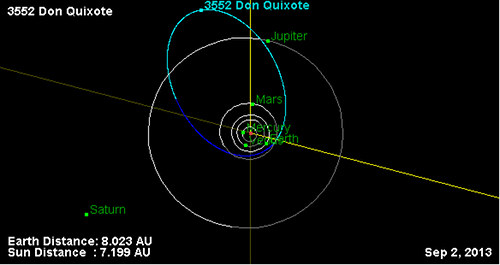
For 30 years, a large near-Earth asteroid wandered its lone, intrepid path, passing before the scrutinizing eyes of scientists while keeping something to itself: (3552) Don Quixote, whose journey stretches to the orbit of Jupiter, now appears to be a comet.
The discovery resulted from an ongoing project coordinated by researchers at Northern Arizona University using the Spitzer Space Telescope. Through a lot of focused attention and a little bit of luck, they found evidence of cometary activity that had evaded detection for three decades.
“Don Quixote's orbit resembles that of a comet, so people assumed it was a comet that had gotten rid of all its ice deposits thousands of years ago,” said Michael Mommert, a Ph.D. student of team member Prof. Alan Harris at the German Aerospace Center (DLR) in Berlin at the time this work was carried out. Near-Earth asteroids that are former comets make up roughly 5 percent of the whole near-Earth asteroid population, as found by Mommert and colleagues in a related study. These objects are mostly “dead comets” – comets that had shed the carbon dioxide and water that give them their spectacular comae and tails long time ago.
What Mommert, now a post-doctoral researcher at NAU, and an international team of researchers discovered, though, was that Don Quixote was not actually a dead comet. In fact, the third-biggest near-Earth asteroid out there, skirting Earth with an erratic, extended orbit, is “sopping wet,” said NAU associate professor David Trilling, with large deposits of carbon dioxide and presumably water ice.
http://www.newswise.com/articles/nau-led-team-discovers-comet-hiding-in-plain-sightFor 30 years, a large near-Earth asteroid wandered its lone, intrepid path, passing before the scrutinizing eyes of scientists while keeping something to itself: (3552) Don Quixote, whose journey stretches to the orbit of Jupiter, now appears to be a comet.
The discovery resulted from an ongoing project coordinated by researchers at Northern Arizona University using the Spitzer Space Telescope. Through a lot of focused attention and a little bit of luck, they found evidence of cometary activity that had evaded detection for three decades.
“Don Quixote's orbit resembles that of a comet, so people assumed it was a comet that had gotten rid of all its ice deposits thousands of years ago,” said Michael Mommert, a Ph.D. student of team member Prof. Alan Harris at the German Aerospace Center (DLR) in Berlin at the time this work was carried out. Near-Earth asteroids that are former comets make up roughly 5 percent of the whole near-Earth asteroid population, as found by Mommert and colleagues in a related study. These objects are mostly “dead comets” – comets that had shed the carbon dioxide and water that give them their spectacular comae and tails long time ago.
What Mommert, now a post-doctoral researcher at NAU, and an international team of researchers discovered, though, was that Don Quixote was not actually a dead comet. In fact, the third-biggest near-Earth asteroid out there, skirting Earth with an erratic, extended orbit, is “sopping wet,” said NAU associate professor David Trilling, with large deposits of carbon dioxide and presumably water ice.
DrCaleb @ Thu Sep 19, 2013 8:26 am

$1:
Take a look at the competition's other prize-winning starlight snaps in our gallery.
http://www.newscientist.com/article/dn2 ... photo.html
DrCaleb @ Thu Sep 19, 2013 9:21 am
$1:
NASA’s Plutonium Problem Could End Deep-Space Exploration
In 1977, the Voyager 1 spacecraft left Earth on a five-year mission to explore Jupiter and Saturn. Thirty-six years later, the car-size probe is still exploring, still sending its findings home. It has now put more than 19 billion kilometers between itself and the sun. Last week NASA announced that Voyager 1 had become the first man-made object to reach interstellar space.
The distance this craft has covered is almost incomprehensible. It’s so far away that it takes more than 17 hours for its signals to reach Earth. Along the way, Voyager 1 gave scientists their first close-up looks at Saturn, took the first images of Jupiter’s rings, discovered many of the moons circling those planets and revealed that Jupiter’s moon Io has active volcanoes. Now the spacecraft is discovering what the edge of the solar system is like, piercing the heliosheath where the last vestiges of the sun’s influence are felt and traversing the heliopause where cosmic currents overcome the solar wind. Voyager 1 is expected to keep working until 2025 when it will finally run out of power.
None of this would be possible without the spacecraft’s three batteries filled with plutonium-238. In fact, Most of what humanity knows about the outer planets came back to Earth on plutonium power. Cassini’s ongoing exploration of Saturn, Galileo’s trip to Jupiter, Curiosity’s exploration of the surface of Mars, and the 2015 flyby of Pluto by the New Horizons spacecraft are all fueled by the stuff. The characteristics of this metal’s radioactive decay make it a super-fuel. More importantly, there is no other viable option. Solar power is too weak, chemical batteries don’t last, nuclear fission systems are too heavy. So, we depend on plutonium-238, a fuel largely acquired as by-product of making nuclear weapons.
But there’s a problem: We’ve almost run out.
In 1977, the Voyager 1 spacecraft left Earth on a five-year mission to explore Jupiter and Saturn. Thirty-six years later, the car-size probe is still exploring, still sending its findings home. It has now put more than 19 billion kilometers between itself and the sun. Last week NASA announced that Voyager 1 had become the first man-made object to reach interstellar space.
The distance this craft has covered is almost incomprehensible. It’s so far away that it takes more than 17 hours for its signals to reach Earth. Along the way, Voyager 1 gave scientists their first close-up looks at Saturn, took the first images of Jupiter’s rings, discovered many of the moons circling those planets and revealed that Jupiter’s moon Io has active volcanoes. Now the spacecraft is discovering what the edge of the solar system is like, piercing the heliosheath where the last vestiges of the sun’s influence are felt and traversing the heliopause where cosmic currents overcome the solar wind. Voyager 1 is expected to keep working until 2025 when it will finally run out of power.
None of this would be possible without the spacecraft’s three batteries filled with plutonium-238. In fact, Most of what humanity knows about the outer planets came back to Earth on plutonium power. Cassini’s ongoing exploration of Saturn, Galileo’s trip to Jupiter, Curiosity’s exploration of the surface of Mars, and the 2015 flyby of Pluto by the New Horizons spacecraft are all fueled by the stuff. The characteristics of this metal’s radioactive decay make it a super-fuel. More importantly, there is no other viable option. Solar power is too weak, chemical batteries don’t last, nuclear fission systems are too heavy. So, we depend on plutonium-238, a fuel largely acquired as by-product of making nuclear weapons.
But there’s a problem: We’ve almost run out.

http://www.wired.com/wiredscience/2013/ ... 8-problem/
Jabberwalker @ Thu Sep 19, 2013 9:45 am
$1:
So, we depend on plutonium-238, a fuel largely acquired as by-product of making nuclear weapons.
But there’s a problem: We’ve almost run out.
But there’s a problem: We’ve almost run out.
Perhaps we can sub-out Plutonium production to the Iranians.
DrCaleb @ Thu Sep 19, 2013 10:16 am
Jabberwalker Jabberwalker:
$1:
So, we depend on plutonium-238, a fuel largely acquired as by-product of making nuclear weapons.
But there’s a problem: We’ve almost run out.
But there’s a problem: We’ve almost run out.
Perhaps we can sub-out Plutonium production to the Iranians.
One of the by-products of a Liquid Flouride Thorium Reactor (LFTR) is P-238. One more reason to use Thorium reactors instead of Uranium.
Jabberwalker @ Thu Sep 19, 2013 11:07 am
$1:
One of the by-products of a Liquid Flouride Thorium Reactor (LFTR) is P-238. One more reason to use Thorium reactors instead of Uranium.
... that, and the relative abundance of Thorium ...
Zipperfish @ Thu Sep 19, 2013 12:49 pm
Thorium can tear the fabric of teh space-time continuum releasing Cthuluhu back into our dimension. So fuck that.
Jabberwalker @ Thu Sep 19, 2013 1:00 pm
$1:
Thorium can tear the fabric of teh space-time continuum releasing Cthuluhu back into our dimension. So fuck that.
Love ith never having to thay thorium.
DrCaleb @ Thu Sep 19, 2013 1:45 pm
Jabberwalker Jabberwalker:
$1:
Thorium can tear the fabric of teh space-time continuum releasing Cthuluhu back into our dimension. So fuck that.
Love ith never having to thay thorium.
I'm tho thorium I can hardly pith.
DrCaleb @ Fri Sep 20, 2013 9:42 am

$1:
NASA today announced the end of operations for the Deep Impact spacecraft, history's most traveled deep-space comet hunter, after trying unsuccessfully for more than a month to regain contact with the spacecraft.
UMD scientists—who helped conceive the mission, bring it to reality and keep it going years longer than originally planned—say it is a big loss, but find great satisfaction that Deep Impact exceeded all expectations and that the science derived from it transformed our understanding of comets.
"The impact on comet Tempel 1, the flyby of comet Hartley 2, and the remote sensing of comet Garradd have led to so many surprising results that there is a complete rethinking of our understanding of the formation of comets and of how they work. These small, icy remnants of the formation of our solar system are much more varied, both one from another and even from one part to another of a single comet, than we had ever anticipated," said University of Maryland astronomer Michael A'Hearn, who led the Deep Impact science team from the successful Deep Impact proposal to its unanticipated completion.
"Deep Impact has been a principal focus of my astronomy work for more than a decade and I'm saddened by its functional loss. But, I am very proud of the many contributions to our evolving understanding of comets that it has made possible," A'Hearn said.
UMD scientists—who helped conceive the mission, bring it to reality and keep it going years longer than originally planned—say it is a big loss, but find great satisfaction that Deep Impact exceeded all expectations and that the science derived from it transformed our understanding of comets.
"The impact on comet Tempel 1, the flyby of comet Hartley 2, and the remote sensing of comet Garradd have led to so many surprising results that there is a complete rethinking of our understanding of the formation of comets and of how they work. These small, icy remnants of the formation of our solar system are much more varied, both one from another and even from one part to another of a single comet, than we had ever anticipated," said University of Maryland astronomer Michael A'Hearn, who led the Deep Impact science team from the successful Deep Impact proposal to its unanticipated completion.
"Deep Impact has been a principal focus of my astronomy work for more than a decade and I'm saddened by its functional loss. But, I am very proud of the many contributions to our evolving understanding of comets that it has made possible," A'Hearn said.
http://phys.org/news/2013-09-deep-impac ... comet.html
DrCaleb @ Wed Sep 25, 2013 10:38 am
$1:
Planetary Nebula Glows Like a Blue Space Bubble in Amazing Photo
The blue sphere seen here in this cool night sky photo is the shell of unique planetary nebula, Abell 39.
Astrophotographer Bob Franke captured this stunning image Abell 39 from the Focal Pointe Observatory in Chino Valley, Ariz. The nebula is located in the constellation Hercules roughly 6,800 light-years away from Earth. It is considered a low-surface brightness planetary nebula characterized by an almost-perfect spherical shell and a slightly off center (0.1 light-years) central star. A light-year is the distance light travels in one year, or about 6 trillion miles (10 trillion kilometers).
Despite their name, planetary nebulas have nothing to do with planets. They are actually the cast-off gas shell from stars near the end of their lifecycle. The first planetary nebula was discovered in 1764 by noted astronomers Charles Messier. But it was not until 1790 that the 18th-century astronomer William Herschel discovered that the objects were made up of gas and dust. Herschel, who had recently discovered the planet Uranus at the time, coined the term "planetary nebula" because of how the objects resembled planets in the night sky.
The blue sphere seen here in this cool night sky photo is the shell of unique planetary nebula, Abell 39.
Astrophotographer Bob Franke captured this stunning image Abell 39 from the Focal Pointe Observatory in Chino Valley, Ariz. The nebula is located in the constellation Hercules roughly 6,800 light-years away from Earth. It is considered a low-surface brightness planetary nebula characterized by an almost-perfect spherical shell and a slightly off center (0.1 light-years) central star. A light-year is the distance light travels in one year, or about 6 trillion miles (10 trillion kilometers).
Despite their name, planetary nebulas have nothing to do with planets. They are actually the cast-off gas shell from stars near the end of their lifecycle. The first planetary nebula was discovered in 1764 by noted astronomers Charles Messier. But it was not until 1790 that the 18th-century astronomer William Herschel discovered that the objects were made up of gas and dust. Herschel, who had recently discovered the planet Uranus at the time, coined the term "planetary nebula" because of how the objects resembled planets in the night sky.

DrCaleb @ Wed Sep 25, 2013 12:01 pm
$1:
Pulsar’s magnetic field strong enough to clean up after nuclear explosion
Pulsars are astronomical laboratories where nature plays with extreme gravity and electromagnetic phenomena. Formed in the deaths of massive stars, these bodies shine and influence their environment in ways that are disproportionate to their size. Some of them rotate hundreds or thousands of times each second. Called millisecond pulsars, they are some of the most precisely timed phenomena we know.
For a number of reasons, astronomers are sure the fastest spinning pulsars are driven by matter they strip off companion stars, but direct observations proved hard to obtain. A new set of data could help with that. A. Papitto and colleagues found a pulsar locked in mutual orbit with a star, transitioning between feeding off gas from its companion to rapid stable rotation. This shows not only that matter transfer between a star and pulsar could drive the rapid rotation, but that the transition between feeding and a stable, millisecond rotation occurs in a very short time.
Pulsars are the very dense remains of stars that started more massive than our Sun. After the collapse of a supernova, they pack a star's worth of mass into a body about 20 kilometers (12.4 miles) in diameter. These objects emit powerful beams of light. Due to their rapid rotation, those beams appear to us as regular pulses. An isolated pulsar emits light with several seconds between flashes, but some can spin up to hundreds or thousands of times faster (the millisecond pulsars).
According to theoretical models, these millisecond pulsars are produced when they accrete—feed on matter—from a companion star. This idea is supported observationally. X-ray binaries emit bursts of energetic radiation from nuclear reactions that occur when matter falls onto a pulsar from its companion. However, the connection between accretion and millisecond pulsars was inferred mostly from indirect evidence, which is why the current observations are important.
The researchers associated a transient bright X-ray flare detected on March 28, 2013 with a millisecond pulsar known as PSR J1824-2452I, which is located in the globular star cluster M28. This pulsar rotates about 254 times each second as measured in radio light; follow-up observations showed that rate was matched by variations in the X-ray emissions.
Pulsars are astronomical laboratories where nature plays with extreme gravity and electromagnetic phenomena. Formed in the deaths of massive stars, these bodies shine and influence their environment in ways that are disproportionate to their size. Some of them rotate hundreds or thousands of times each second. Called millisecond pulsars, they are some of the most precisely timed phenomena we know.
For a number of reasons, astronomers are sure the fastest spinning pulsars are driven by matter they strip off companion stars, but direct observations proved hard to obtain. A new set of data could help with that. A. Papitto and colleagues found a pulsar locked in mutual orbit with a star, transitioning between feeding off gas from its companion to rapid stable rotation. This shows not only that matter transfer between a star and pulsar could drive the rapid rotation, but that the transition between feeding and a stable, millisecond rotation occurs in a very short time.
Pulsars are the very dense remains of stars that started more massive than our Sun. After the collapse of a supernova, they pack a star's worth of mass into a body about 20 kilometers (12.4 miles) in diameter. These objects emit powerful beams of light. Due to their rapid rotation, those beams appear to us as regular pulses. An isolated pulsar emits light with several seconds between flashes, but some can spin up to hundreds or thousands of times faster (the millisecond pulsars).
According to theoretical models, these millisecond pulsars are produced when they accrete—feed on matter—from a companion star. This idea is supported observationally. X-ray binaries emit bursts of energetic radiation from nuclear reactions that occur when matter falls onto a pulsar from its companion. However, the connection between accretion and millisecond pulsars was inferred mostly from indirect evidence, which is why the current observations are important.
The researchers associated a transient bright X-ray flare detected on March 28, 2013 with a millisecond pulsar known as PSR J1824-2452I, which is located in the globular star cluster M28. This pulsar rotates about 254 times each second as measured in radio light; follow-up observations showed that rate was matched by variations in the X-ray emissions.

DrCaleb @ Thu Sep 26, 2013 1:46 pm
$1:
The life and death of Buran, the USSR shuttle built on faulty assumptions
Just before dawn on the morning of November 15, 1988, the mood at Baikonur, the Soviet Union’s launch site, was tense and businesslike. It was a cold morning marked by low cloud cover, a persistent drizzle, and warnings of gale force winds. It was a terrible day for a launch.
But on the pad stood the Energiya rocket, fueled and ready to carry the Buran space shuttle orbiter on its maiden flight. A thin layer of ice coating both vehicles threatened to postpone the event, though no one on site wanted to see the spacecraft stay on the pad. A scrubbed launch could delay Buran’s debut until the spring—or even deal a death blow to the whole program. Weighing the odds, Soviet space officials decided to take their chances. At 8:00am local time, exactly on schedule, Energiya roared to life and Buran took flight.
The next morning, half a world away in the United States, American reports on the mission focused as much on Buran’s similarity to NASA’s space shuttle as on the flight itself. The Soviet design seems indebted to NASA, newspapers proclaimed, citing experts’ opinions that there were few, if any, fundamental differences between the spacecraft. This sentiment has persisted in the general public’s mind for the nearly 30 years since Buran flew.
. . .
When the program was cancelled, half-built orbiters were suddenly homeless and unwanted. Orbiter OK-1.02, a copy of the original Buran known as Ptichka (little bird) or Buria (storm), was almost finished when the Buran program ended in 1993; all that remained was to install a handful of electronic units. It’s in a hangar at Baikonur, but the orbiter is actually the property of Kazakhstan. Orbiter OK-2.01, the first in a second series of orbiters that included a number of improvements over the original model, was also under construction when the program was canceled. It was dismantled and sat gathering dust at the Tushina factory near Moscow for years until 2011 when it was reportedly moved to an aviation museum in Germany for restoration. Orbiter OK-2.02, in the early phases of construction when the program ended, was quickly dismantled; the few pieces that were salvaged were sold online. Construction had just begun on a fifth orbiter, OK-2.03, in 1993. It was dismantled and its remains were destroyed.
. . .
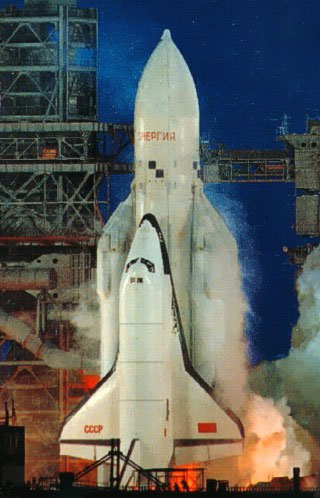
Just before dawn on the morning of November 15, 1988, the mood at Baikonur, the Soviet Union’s launch site, was tense and businesslike. It was a cold morning marked by low cloud cover, a persistent drizzle, and warnings of gale force winds. It was a terrible day for a launch.
But on the pad stood the Energiya rocket, fueled and ready to carry the Buran space shuttle orbiter on its maiden flight. A thin layer of ice coating both vehicles threatened to postpone the event, though no one on site wanted to see the spacecraft stay on the pad. A scrubbed launch could delay Buran’s debut until the spring—or even deal a death blow to the whole program. Weighing the odds, Soviet space officials decided to take their chances. At 8:00am local time, exactly on schedule, Energiya roared to life and Buran took flight.
The next morning, half a world away in the United States, American reports on the mission focused as much on Buran’s similarity to NASA’s space shuttle as on the flight itself. The Soviet design seems indebted to NASA, newspapers proclaimed, citing experts’ opinions that there were few, if any, fundamental differences between the spacecraft. This sentiment has persisted in the general public’s mind for the nearly 30 years since Buran flew.
. . .
When the program was cancelled, half-built orbiters were suddenly homeless and unwanted. Orbiter OK-1.02, a copy of the original Buran known as Ptichka (little bird) or Buria (storm), was almost finished when the Buran program ended in 1993; all that remained was to install a handful of electronic units. It’s in a hangar at Baikonur, but the orbiter is actually the property of Kazakhstan. Orbiter OK-2.01, the first in a second series of orbiters that included a number of improvements over the original model, was also under construction when the program was canceled. It was dismantled and sat gathering dust at the Tushina factory near Moscow for years until 2011 when it was reportedly moved to an aviation museum in Germany for restoration. Orbiter OK-2.02, in the early phases of construction when the program ended, was quickly dismantled; the few pieces that were salvaged were sold online. Construction had just begun on a fifth orbiter, OK-2.03, in 1993. It was dismantled and its remains were destroyed.
. . .
Jabberwalker @ Thu Sep 26, 2013 1:55 pm
It's a shame, really, as the Russians are the only remaining world experts at manned space flight.
The story of the Buran is an echo of the end of the Avro Arrow.
DrCaleb @ Thu Sep 26, 2013 2:16 pm
Except, the Russians probabally didn't destroy all materials needed to rebuild the program.
Previous 1 ... 23 24 25 26 27 28 29 ... 244 Next