
Space Thread
Previous 1 ... 26 27 28 29 30 31 32 ... 244 Next
DrCaleb @ Wed Oct 16, 2013 12:54 pm
$1:
Strongly magnetic pulsar could explain anomalous supernovas
Most super-luminous supernovae are driven by "pair instability," the production of electron-positron pairs during the death throes of a very massive star. The creation of these particles produces a rapid contraction in the dying star, resulting in a powerful nuclear explosion that blows everything apart, possibly leaving nothing behind. Pair-instability supernovae only occur if the star is more than about 140 times the mass of the Sun, so they are extremely rare.
Since a star's chemistry reflects the environment in which it was born, the supernova explosion does as well. Massive stars formed in the early Universe are relatively lacking in "metals"—heavier chemical elements such as oxygen, carbon, and iron—while stars of a more recent vintage contain higher abundances of those nuclei. Pair-instability supernovae can only occur in low-metal stars; high-mass stars that formed later leave behind black holes instead.
For that reason, the observation of two super-luminous supernovas in the nearby Universe was anomalous. These explosions were low in the heavier elements, consistent with the early birth required for a pair-instability supernova but inconsistent with the life cycle of a high-mass star. Additionally, the light emission peaked more quickly and contained more blue light than expected from pair-instability supernovae, which are distinctly red. The slow fade of pair-instability supernovae is due to the emissions from a decay of radioactive nickel (56Ni), an element produced during the explosion.
Most super-luminous supernovae are driven by "pair instability," the production of electron-positron pairs during the death throes of a very massive star. The creation of these particles produces a rapid contraction in the dying star, resulting in a powerful nuclear explosion that blows everything apart, possibly leaving nothing behind. Pair-instability supernovae only occur if the star is more than about 140 times the mass of the Sun, so they are extremely rare.
Since a star's chemistry reflects the environment in which it was born, the supernova explosion does as well. Massive stars formed in the early Universe are relatively lacking in "metals"—heavier chemical elements such as oxygen, carbon, and iron—while stars of a more recent vintage contain higher abundances of those nuclei. Pair-instability supernovae can only occur in low-metal stars; high-mass stars that formed later leave behind black holes instead.
For that reason, the observation of two super-luminous supernovas in the nearby Universe was anomalous. These explosions were low in the heavier elements, consistent with the early birth required for a pair-instability supernova but inconsistent with the life cycle of a high-mass star. Additionally, the light emission peaked more quickly and contained more blue light than expected from pair-instability supernovae, which are distinctly red. The slow fade of pair-instability supernovae is due to the emissions from a decay of radioactive nickel (56Ni), an element produced during the explosion.
http://arstechnica.com/science/2013/10/ ... upernovas/
DrCaleb @ Thu Oct 17, 2013 7:39 am
I urge you to open the article and click on the photo for a full size image!
$1:
On Oct. 10, 2013, Cassini took 36 shots of Saturn, a dozen each using red, green, and blue filters which approximate true color. Ugarkovic grabbed the raw files, processed them, and assembled them into this mosaic.
The detail is incredible. Cassini was high above Saturn to the north, looking “down” on the ringed world when it took these images. You can see the bizarre hexagonal north polar vortex, the six-sided jet stream flowing around Saturn. The subtle but beautiful bands mark the cloud tops of Saturn’s atmosphere. Unless I'm mistaken, the thin white line you see wrapping around the planet at mid-latitude is the remnant of a vast storm so huge it completely dwarfed our own home world of Earth. And if you look carefully (you can measure it!) you can see that Saturn is highly flattened, its equatorial diameter wider than through the poles.
But dominating this jaw-dropping scene are Saturn’s magnificent rings, seen here far more circular than usual. Cassini’s mission has been to observe Saturn and its moons, which means it tends to stay near the planet’s equator. But now scientists are playing with the orbit more, to do more interesting science. The spacecraft is swinging well out of the equatorial plane, so here we see the rings at a much steeper angle, and they are less affected by perspective.
The detail is incredible. Cassini was high above Saturn to the north, looking “down” on the ringed world when it took these images. You can see the bizarre hexagonal north polar vortex, the six-sided jet stream flowing around Saturn. The subtle but beautiful bands mark the cloud tops of Saturn’s atmosphere. Unless I'm mistaken, the thin white line you see wrapping around the planet at mid-latitude is the remnant of a vast storm so huge it completely dwarfed our own home world of Earth. And if you look carefully (you can measure it!) you can see that Saturn is highly flattened, its equatorial diameter wider than through the poles.
But dominating this jaw-dropping scene are Saturn’s magnificent rings, seen here far more circular than usual. Cassini’s mission has been to observe Saturn and its moons, which means it tends to stay near the planet’s equator. But now scientists are playing with the orbit more, to do more interesting science. The spacecraft is swinging well out of the equatorial plane, so here we see the rings at a much steeper angle, and they are less affected by perspective.
Saturn 2013 10 17.JPG [ 30.55 KiB | Viewed 264 times ]
http://www.slate.com/blogs/bad_astronom ... kovic.html
DrCaleb @ Thu Oct 17, 2013 8:04 am
$1:
As largest star in Milky Way dies, fascinated scientists look on
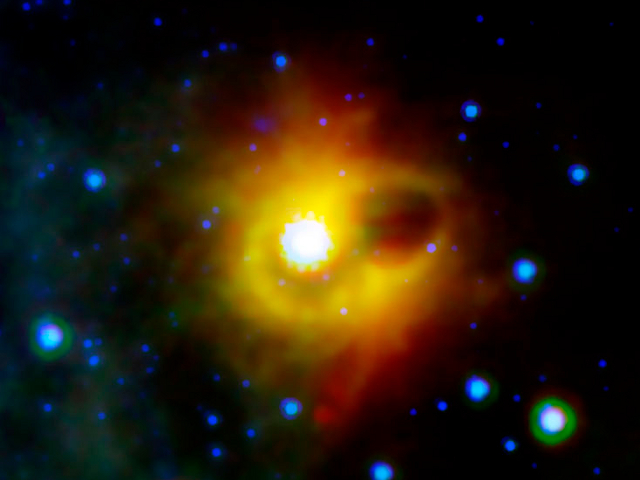
A red supergiant star that is 1,500 times larger than the sun is in its death-throes. Scientists rarely see the demise of such massive stars, and they stand to learn a lot from the data.
The largest known star in the galaxy, parked in a star cluster some 16,000 light-years away, has exhausted its hydrogen fuel and is shedding gas in a signal that the end is near – at least on cosmic timescales.
The star, a red supergiant, is surrounded by clouds of glowing hydrogen, providing a rare opportunity to observe a massive star during such an early stage in its prolonged demise – a path slated to end with the star's catastrophic collapse and the subsequent explosion at its core, known as a supernova.
Such explosions seed the galaxy with chemical elements heavier than hydrogen and helium. These elements form in the fusion furnaces at the heart of stars. The elements get ejected into interstellar space by stellar winds as well as by events that occur at the end of a star's life. They become the raw material for building other objects in the cosmos – from planets to people.
A red supergiant star that is 1,500 times larger than the sun is in its death-throes. Scientists rarely see the demise of such massive stars, and they stand to learn a lot from the data.
The largest known star in the galaxy, parked in a star cluster some 16,000 light-years away, has exhausted its hydrogen fuel and is shedding gas in a signal that the end is near – at least on cosmic timescales.
The star, a red supergiant, is surrounded by clouds of glowing hydrogen, providing a rare opportunity to observe a massive star during such an early stage in its prolonged demise – a path slated to end with the star's catastrophic collapse and the subsequent explosion at its core, known as a supernova.
Such explosions seed the galaxy with chemical elements heavier than hydrogen and helium. These elements form in the fusion furnaces at the heart of stars. The elements get ejected into interstellar space by stellar winds as well as by events that occur at the end of a star's life. They become the raw material for building other objects in the cosmos – from planets to people.

http://www.csmonitor.com/Science/2013/1 ... ts-look-on
DrCaleb @ Thu Oct 17, 2013 9:35 am
$1:
Here’s A Nine-Billion-Year Old Gravitational Lens In Space
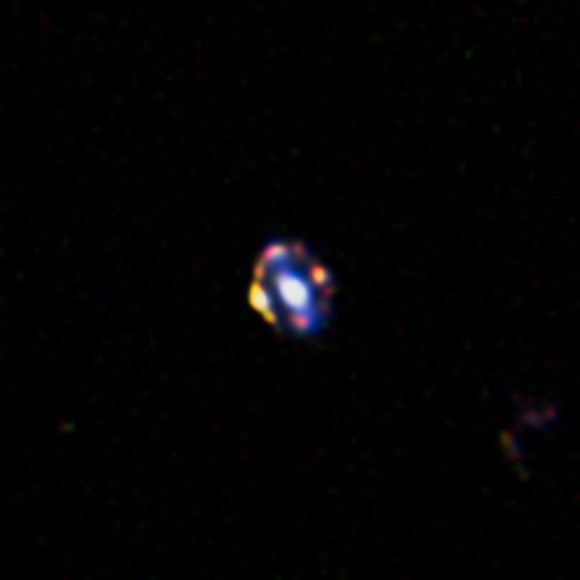
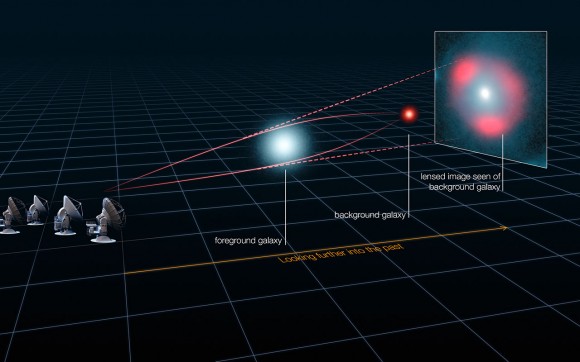
Here’s a picture of what deflected light looks like from 9.4 billion years away. This is the most faraway “gravitational lens” that we know of, and a demonstration of how a galaxy can bend the light of an object behind it. The phenomenon was first predicted by Einstein, and is a handy way of measuring mass (including the mass of mysterious dark matter.)
“The discovery was completely by chance,” stated Arjen van der Wel, who is with the Max Planck Institute for Astronomy in Heidelberg, Germany.
“I had been reviewing observations from an earlier project when I noticed a galaxy that was decidedly odd. It looked like an extremely young galaxy, but it seemed to be at a much larger distance than expected. It shouldn’t even have been part of our observing program.”
The alignment between object J1000+0221 and the object in behind is so perfect that you can see rings of light being formed in the image. Scientists previously believed this kind of lens would happen very rarely. This leaves two possibilities: that the astronomy team was lucky, or there are way more young galaxies than previously thought.
Here’s a picture of what deflected light looks like from 9.4 billion years away. This is the most faraway “gravitational lens” that we know of, and a demonstration of how a galaxy can bend the light of an object behind it. The phenomenon was first predicted by Einstein, and is a handy way of measuring mass (including the mass of mysterious dark matter.)
“The discovery was completely by chance,” stated Arjen van der Wel, who is with the Max Planck Institute for Astronomy in Heidelberg, Germany.
“I had been reviewing observations from an earlier project when I noticed a galaxy that was decidedly odd. It looked like an extremely young galaxy, but it seemed to be at a much larger distance than expected. It shouldn’t even have been part of our observing program.”
The alignment between object J1000+0221 and the object in behind is so perfect that you can see rings of light being formed in the image. Scientists previously believed this kind of lens would happen very rarely. This leaves two possibilities: that the astronomy team was lucky, or there are way more young galaxies than previously thought.
http://www.universetoday.com/105597/her ... -in-space/
DrCaleb @ Fri Oct 18, 2013 7:47 am
I like this one, just for the radio telescope image of twin particle jets from twin black holes.
$1:
Gravitational waves show deficit in black hole collisions
Not as many gravity waves from supermassive black hole collisions as we expected
How do supermassive black holes grow to be millions or billions of times bigger than their more ordinary cousins? No star grows that huge, so they aren't created from the same kinds of supernovae that make stellar-mass black holes. The earliest known galaxies indicate that these monsters were present from nearly the start, meaning that they were unlikely to be normal black holes that slowly gorged their way to supermassiveness. One potential explanation that has been considered is that they were born large and became truly gigantic when two or more collided and merged.
New observations could place stringent limits on that merger rate, however. R. M. Shannon and colleagues used the timing of light from pulsars as a means of measuring gravitational radiation. Gravity waves should be generated by pairs of black holes before and during their collisions. If there were a lot of mergers, the waves would create a noticeable fluctuation in the pulsar timing. But the new results are inconsistent with the merger rate predicted by the most widely accepted theoretical models, suggesting that either binary black holes don't collide as often as expected or that some other mechanisms for their growth are at work.
Supermassive black holes (SMBHs), which are hundreds of thousands to billions of times more massive than the Sun, lie at the center of nearly every large galaxy. These objects frequently drive powerful jets of matter, which (if the alignment is right) astronomers observe as quasars. The most distant quasars indicate that SMBHs have existed nearly as long as galaxies. Their large mass and early existence indicate that they could not have formed from the explosions of large stars, which is the mechanism by which stellar-mass black holes are born.
As a result, it's likely that SMBHs were born supermassive through one of several plausible scenarios involving the rapid collapse of matter during the early moments of galaxy formation. However, observations show that galaxies collide and merge after birth; the largest galaxies were likely produced by such processes. Based on that information, astronomers hypothesized that the galaxies' SMBHs also merge during galactic collisions.
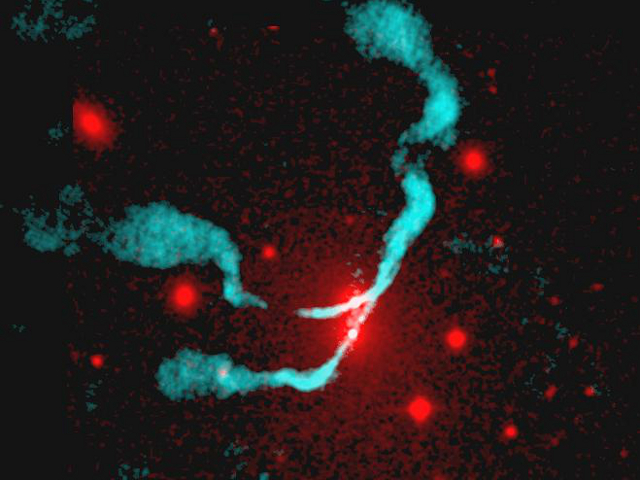
Visible (red) and radio (blue) image of the binary black hole in the galaxy 3C75. The black holes themselves are the two bright dots in the radio emission, which are the sources of the streaming jets.
Not as many gravity waves from supermassive black hole collisions as we expected
How do supermassive black holes grow to be millions or billions of times bigger than their more ordinary cousins? No star grows that huge, so they aren't created from the same kinds of supernovae that make stellar-mass black holes. The earliest known galaxies indicate that these monsters were present from nearly the start, meaning that they were unlikely to be normal black holes that slowly gorged their way to supermassiveness. One potential explanation that has been considered is that they were born large and became truly gigantic when two or more collided and merged.
New observations could place stringent limits on that merger rate, however. R. M. Shannon and colleagues used the timing of light from pulsars as a means of measuring gravitational radiation. Gravity waves should be generated by pairs of black holes before and during their collisions. If there were a lot of mergers, the waves would create a noticeable fluctuation in the pulsar timing. But the new results are inconsistent with the merger rate predicted by the most widely accepted theoretical models, suggesting that either binary black holes don't collide as often as expected or that some other mechanisms for their growth are at work.
Supermassive black holes (SMBHs), which are hundreds of thousands to billions of times more massive than the Sun, lie at the center of nearly every large galaxy. These objects frequently drive powerful jets of matter, which (if the alignment is right) astronomers observe as quasars. The most distant quasars indicate that SMBHs have existed nearly as long as galaxies. Their large mass and early existence indicate that they could not have formed from the explosions of large stars, which is the mechanism by which stellar-mass black holes are born.
As a result, it's likely that SMBHs were born supermassive through one of several plausible scenarios involving the rapid collapse of matter during the early moments of galaxy formation. However, observations show that galaxies collide and merge after birth; the largest galaxies were likely produced by such processes. Based on that information, astronomers hypothesized that the galaxies' SMBHs also merge during galactic collisions.
Visible (red) and radio (blue) image of the binary black hole in the galaxy 3C75. The black holes themselves are the two bright dots in the radio emission, which are the sources of the streaming jets.
http://arstechnica.com/science/2013/10/ ... ollisions/
Regina @ Fri Oct 18, 2013 8:17 am
I see that every time I mix wine with Scotch and Grand Marnier. ![[drunk]](./images/smilies/drunken_smilie.gif "Drunken Smile")
DrCaleb @ Fri Oct 18, 2013 8:22 am
You mix Scotch!? Heathen!
Regina @ Fri Oct 18, 2013 8:28 am
DrCaleb DrCaleb:
You mix Scotch!? Heathen!
 NEVAAAAA!! And I have a special glass for my Scotch.
BartSimpson @ Fri Oct 18, 2013 9:01 am
DrCaleb DrCaleb:
I urge you to open the article and click on the photo for a full size image!
Saturn 2013 10 17.JPG
http://www.slate.com/blogs/bad_astronom ... kovic.html
$1:
On Oct. 10, 2013, Cassini took 36 shots of Saturn, a dozen each using red, green, and blue filters which approximate true color. Ugarkovic grabbed the raw files, processed them, and assembled them into this mosaic.
The detail is incredible. Cassini was high above Saturn to the north, looking “down” on the ringed world when it took these images. You can see the bizarre hexagonal north polar vortex, the six-sided jet stream flowing around Saturn. The subtle but beautiful bands mark the cloud tops of Saturn’s atmosphere. Unless I'm mistaken, the thin white line you see wrapping around the planet at mid-latitude is the remnant of a vast storm so huge it completely dwarfed our own home world of Earth. And if you look carefully (you can measure it!) you can see that Saturn is highly flattened, its equatorial diameter wider than through the poles.
But dominating this jaw-dropping scene are Saturn’s magnificent rings, seen here far more circular than usual. Cassini’s mission has been to observe Saturn and its moons, which means it tends to stay near the planet’s equator. But now scientists are playing with the orbit more, to do more interesting science. The spacecraft is swinging well out of the equatorial plane, so here we see the rings at a much steeper angle, and they are less affected by perspective.
The detail is incredible. Cassini was high above Saturn to the north, looking “down” on the ringed world when it took these images. You can see the bizarre hexagonal north polar vortex, the six-sided jet stream flowing around Saturn. The subtle but beautiful bands mark the cloud tops of Saturn’s atmosphere. Unless I'm mistaken, the thin white line you see wrapping around the planet at mid-latitude is the remnant of a vast storm so huge it completely dwarfed our own home world of Earth. And if you look carefully (you can measure it!) you can see that Saturn is highly flattened, its equatorial diameter wider than through the poles.
But dominating this jaw-dropping scene are Saturn’s magnificent rings, seen here far more circular than usual. Cassini’s mission has been to observe Saturn and its moons, which means it tends to stay near the planet’s equator. But now scientists are playing with the orbit more, to do more interesting science. The spacecraft is swinging well out of the equatorial plane, so here we see the rings at a much steeper angle, and they are less affected by perspective.
Saturn 2013 10 17.JPG
http://www.slate.com/blogs/bad_astronom ... kovic.html
HOLEEE COW!!!!
What an amazing picture!!!

BartSimpson @ Fri Oct 18, 2013 9:02 am
Regina Regina:
DrCaleb DrCaleb:
You mix Scotch!? Heathen!
NEVAAAAA!! And I have a special glass for my Scotch. LOL! I do, too!
![[B-o]](./images/smilies/drinkup.gif "Drink up")
Jabberwalker @ Fri Oct 18, 2013 10:55 am
DrCaleb DrCaleb:
You mix Scotch!? Heathen!
I have it on good authority (from Skye, no less) that it should be consumed mixed with a bit of CLEAR, FRESH room temperature water to bring out it's full character.
DrCaleb @ Fri Oct 18, 2013 11:45 am
Jabberwalker Jabberwalker:
DrCaleb DrCaleb:
You mix Scotch!? Heathen!
I have it on good authority (form Skye, no less) that it should be consumed mixed with a bit of CLEAR, FRESH room temperature water to bring out it's full character.
Heresy! Burn the heretic! 'Branchwater' is for Burbon!
I have a special glass too, and rocks! Not 'ice' but actual granite rocks that can be chilled and don't dilute the 'water of life' or change it's flavour.
DrCaleb @ Mon Oct 21, 2013 8:40 am
$1:
Celebrating the legacy of ESA's Planck mission
From the tiniest fraction of a second after the Big Bang to the evolution of stars and galaxies over 13.8 billion years, ESA's Planck space telescope has provided new insight into the history of our Universe. Although science observations are now complete, the legacy of the Planck mission lives on.
Planck was launched in 2009 and spent 4.5 years scanning the sky to study the evolution of cosmic matter over time. Tomorrow, the Low Frequency Instrument will be switched off, having completed its science operations on 3 October.
Planck's High Frequency Instrument already ended its observations in January 2012, after a total of five all-sky surveys had been completed with both instruments.
. . .
On 21 October, Planck will burn the last of its fuel to ensure its long-term stable parking orbit is maintained. On 23 October, the spacecraft will finally be switched off.
From the tiniest fraction of a second after the Big Bang to the evolution of stars and galaxies over 13.8 billion years, ESA's Planck space telescope has provided new insight into the history of our Universe. Although science observations are now complete, the legacy of the Planck mission lives on.
Planck was launched in 2009 and spent 4.5 years scanning the sky to study the evolution of cosmic matter over time. Tomorrow, the Low Frequency Instrument will be switched off, having completed its science operations on 3 October.
Planck's High Frequency Instrument already ended its observations in January 2012, after a total of five all-sky surveys had been completed with both instruments.
. . .
On 21 October, Planck will burn the last of its fuel to ensure its long-term stable parking orbit is maintained. On 23 October, the spacecraft will finally be switched off.

http://phys.org/news/2013-10-celebratin ... ssion.html
DrCaleb @ Wed Oct 23, 2013 11:17 am
$1:
New galaxy 'most distant' yet discovered
Because it takes light so long to travel from the outer edge of the Universe to us, the galaxy appears as it was 13.1 billion years ago.
Lead researcher Steven Finkelstein, from the University of Texas at Austin, US, said: "This is the most distant galaxy we've confirmed. We are seeing this galaxy as it was 700 million years after the Big Bang."
The far-off galaxy goes by the catchy name of z8_GND_5296.
Astronomers were able to measure how far it was from Earth by analysing its colour.
Because the Universe is expanding and everything is moving away from us, light waves are stretched. This makes objects look redder than they actually are.
Astronomers rate this apparent colour-change on a scale that is called redshift.
They found that this galaxy has a redshift of 7.51, beating the previous record-holder, which had a redshift of 7.21.
This makes it the most distant galaxy ever found.
Because it takes light so long to travel from the outer edge of the Universe to us, the galaxy appears as it was 13.1 billion years ago.
Lead researcher Steven Finkelstein, from the University of Texas at Austin, US, said: "This is the most distant galaxy we've confirmed. We are seeing this galaxy as it was 700 million years after the Big Bang."
The far-off galaxy goes by the catchy name of z8_GND_5296.
Astronomers were able to measure how far it was from Earth by analysing its colour.
Because the Universe is expanding and everything is moving away from us, light waves are stretched. This makes objects look redder than they actually are.
Astronomers rate this apparent colour-change on a scale that is called redshift.
They found that this galaxy has a redshift of 7.51, beating the previous record-holder, which had a redshift of 7.21.
This makes it the most distant galaxy ever found.

http://www.bbc.co.uk/news/science-environment-24637890
DrCaleb @ Wed Oct 23, 2013 11:21 am
Just an FYI, I sourced 3 different articles on the above galaxy, and the only ones with the correct figure for the distance of the galaxy wouldn't allow quoting the article.
It's 13.8 billion light years away, not 13.1 as this article states. Up from 13.7 billion years.
Previous 1 ... 26 27 28 29 30 31 32 ... 244 Next