
Space Thread
Previous 1 ... 28 29 30 31 32 33 34 ... 244 Next
DrCaleb @ Fri Nov 22, 2013 11:35 am
$1:
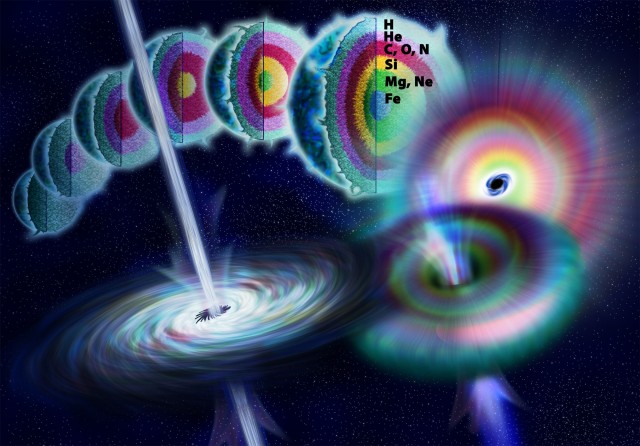
Intense gamma-ray burst spells doom—for our models of gamma-ray bursts
Back in April, orbiting observatories started picking up the first indications of a gamma-ray burst. By the time observations wrapped up, the event (GRB 130427A) produced the largest outpouring of photons of any yet detected, and it set a record for the highest energy photon we've seen from these events. And because it was unusually close to Earth, GRB 130427A provided a wealth of information about these extreme events—and told us that we don't really understand how they produce the gamma-rays that are their signature.
Yesterday's issue of Science contains four papers that describe the event, partly because it was unusually well-documented. The enormous stars that produce gamma-ray bursts were much more common in the early Universe and, as a result, most of them occur out at the edge of the observable Universe. But GRB 130427A is an exception; the Universe was already about 10 billion years old when it happened, meaning the supernova that produced the gamma rays occurred less than four billion light years from Earth. As a result, ground-based instruments that were directed to the right area of the sky by the orbiting instruments were quickly able to identify the supernova involved (SN 2013cq).
Meanwhile, the orbiting observatories like SWIFT and Fermi continued to track the event as it occurred. The data they gathered showed that GRB 130427A was an impressive event. At lower energies, it showed a characteristic initial burst followed by a pause of several seconds. The pause ended with a long and complex series of emissions that lasted for roughly 10 seconds, after which there was a gradual tailing off of activity. At the highest energies, however, there was a steady buzz of activity from five seconds out to at least 30, and gamma rays continued to be detected out to 20 hours, setting a record for these events
The record-setting photon, at 95GeV, was actually detected several minutes after the initial outburst. Due to the amount of redshifting that occurred during its billions of years of travel, it actually arrived at a much lower energy than when it was first produced; calculations suggest it was initially 128 GeV.
And that causes a problem for our model of how a gamma-ray burst operates. The model posits that the first burst of radiation signaling that the supernova has started is caused by the matter being rocketed out of the explosion at nearly the speed of light. The larger burst that follows is caused by that matter slamming into material that the star had shed prior to its death, creating a massive shock wave. This slowly fades as the shockwave propagates into the material and the remains of the star start to lose energy through these interactions.
In general, it's a nice explanation for the overall pattern of emissions and what we see at optical wave lengths and on the lower side of the energy spectrum. But things start to go wrong in the details. One paper notes that the initial pulse of photons, thought to come from the material shot out from the explosion, appears to come from a region larger than the shock radius of the explosion, decays in an unexpected way, and is distributed in an unusual manner. It's possible to get the models to handle one of these oddities, but "it is a challenge to explain all these behaviors simultaneously."
Back in April, orbiting observatories started picking up the first indications of a gamma-ray burst. By the time observations wrapped up, the event (GRB 130427A) produced the largest outpouring of photons of any yet detected, and it set a record for the highest energy photon we've seen from these events. And because it was unusually close to Earth, GRB 130427A provided a wealth of information about these extreme events—and told us that we don't really understand how they produce the gamma-rays that are their signature.
Yesterday's issue of Science contains four papers that describe the event, partly because it was unusually well-documented. The enormous stars that produce gamma-ray bursts were much more common in the early Universe and, as a result, most of them occur out at the edge of the observable Universe. But GRB 130427A is an exception; the Universe was already about 10 billion years old when it happened, meaning the supernova that produced the gamma rays occurred less than four billion light years from Earth. As a result, ground-based instruments that were directed to the right area of the sky by the orbiting instruments were quickly able to identify the supernova involved (SN 2013cq).
Meanwhile, the orbiting observatories like SWIFT and Fermi continued to track the event as it occurred. The data they gathered showed that GRB 130427A was an impressive event. At lower energies, it showed a characteristic initial burst followed by a pause of several seconds. The pause ended with a long and complex series of emissions that lasted for roughly 10 seconds, after which there was a gradual tailing off of activity. At the highest energies, however, there was a steady buzz of activity from five seconds out to at least 30, and gamma rays continued to be detected out to 20 hours, setting a record for these events
The record-setting photon, at 95GeV, was actually detected several minutes after the initial outburst. Due to the amount of redshifting that occurred during its billions of years of travel, it actually arrived at a much lower energy than when it was first produced; calculations suggest it was initially 128 GeV.
And that causes a problem for our model of how a gamma-ray burst operates. The model posits that the first burst of radiation signaling that the supernova has started is caused by the matter being rocketed out of the explosion at nearly the speed of light. The larger burst that follows is caused by that matter slamming into material that the star had shed prior to its death, creating a massive shock wave. This slowly fades as the shockwave propagates into the material and the remains of the star start to lose energy through these interactions.
In general, it's a nice explanation for the overall pattern of emissions and what we see at optical wave lengths and on the lower side of the energy spectrum. But things start to go wrong in the details. One paper notes that the initial pulse of photons, thought to come from the material shot out from the explosion, appears to come from a region larger than the shock radius of the explosion, decays in an unexpected way, and is distributed in an unusual manner. It's possible to get the models to handle one of these oddities, but "it is a challenge to explain all these behaviors simultaneously."
http://arstechnica.com/science/2013/11/ ... ay-bursts/
DrCaleb @ Fri Nov 22, 2013 12:03 pm
DrCaleb @ Fri Nov 22, 2013 1:16 pm
$1:
Close-up of 12-billion-year old Messier 15 star cluster
Thirty-five thousand light years away in the constellation of Pegasus lies this beautiful cluster of stars, known as Messier 15. At 12 billion years old, the formation is one of the oldest globular clusters known in the Milky Way.
The image has been captured by the Hubble Telescope. It took two cameras, and five different filters, including infrared, ultraviolet and optical, to create such a wide range of features in the final shot.
Thirty-five thousand light years away in the constellation of Pegasus lies this beautiful cluster of stars, known as Messier 15. At 12 billion years old, the formation is one of the oldest globular clusters known in the Milky Way.
The image has been captured by the Hubble Telescope. It took two cameras, and five different filters, including infrared, ultraviolet and optical, to create such a wide range of features in the final shot.

http://www.newscientist.com/article/dn2 ... nline-news
Strutz @ Fri Nov 22, 2013 1:36 pm
That pic is so beautiful!
DrCaleb @ Mon Nov 25, 2013 12:13 pm
Strutz Strutz:
That pic is so beautiful!
There wouldn't be a planet orbiting any of those stars where they would have a word for 'night'.

DrCaleb @ Mon Nov 25, 2013 12:15 pm
$1:
Comet Ison to light up morning skies in the run-up to Christmas
If it survives an encounter with the sun this week, comet Ison will put on an impressive early morning display in the run-up to Christmas. But anyone hoping for a Bethlehem-style celestial sign on the big day will be disappointed. By then the comet will probably be too faint to see with a naked eye.
Ison is currently speeding towards a fiery encounter on Thursday, which could destroy it. It will pass 720,000 miles above the solar surface, 130 times closer than our planet ever reaches.
The intense sunlight will heat the comet to about 2,700C, speeding up its evaporation. In the past some comets have been seen to vaporise under such an onslaught.
Over the weekend the comet received a sudden boost in its brightness, making it easily visible to the naked eye. After a disappointing few months, its intensity shot up by a factor of around six on Saturday, delighting stargazers and scientists.
The unexpected outburst also raised fears that it was breaking up. However, it is now clear that the comet is "still keeping it together", according to Alan Fitzsimmons, of Queen's University, Belfast.
Comet Ison was discovered on 21 September 2012 by astronomers using the international scientific optical network (Ison) telescope near Kislovodsk, Russia.
If it survives an encounter with the sun this week, comet Ison will put on an impressive early morning display in the run-up to Christmas. But anyone hoping for a Bethlehem-style celestial sign on the big day will be disappointed. By then the comet will probably be too faint to see with a naked eye.
Ison is currently speeding towards a fiery encounter on Thursday, which could destroy it. It will pass 720,000 miles above the solar surface, 130 times closer than our planet ever reaches.
The intense sunlight will heat the comet to about 2,700C, speeding up its evaporation. In the past some comets have been seen to vaporise under such an onslaught.
Over the weekend the comet received a sudden boost in its brightness, making it easily visible to the naked eye. After a disappointing few months, its intensity shot up by a factor of around six on Saturday, delighting stargazers and scientists.
The unexpected outburst also raised fears that it was breaking up. However, it is now clear that the comet is "still keeping it together", according to Alan Fitzsimmons, of Queen's University, Belfast.
Comet Ison was discovered on 21 September 2012 by astronomers using the international scientific optical network (Ison) telescope near Kislovodsk, Russia.

http://www.theguardian.com/science/2013 ... s-december
DrCaleb @ Mon Nov 25, 2013 12:21 pm
$1:
Herschel’s 37 000 science observations
This animation shows the timeline of over 37 000 scientific observations made by ESA’s Herschel space observatory throughout its entire mission, condensed into less than a minute.
The animation was prepared by Pedro Gómez-Alvarez in the Herschel Science Centre Community Support Group and presented by Herschel’s Project Scientist Göran Pilbratt during the opening session of The Universe Explored by Herschel symposium held at ESA’s ESTEC facility, in Noordwijk, the Netherlands, last month.
The animation runs from launch, on 14 May 2009, until the infrared observatory made its last observation on 29 April 2013.
Running through the centre of the graphic is the ‘ecliptic plane’ tracing the paths of the planets with respect to Herschel’s viewpoint from its orbit around L2, which is located 1.5 million kilometres behind the Earth as viewed from the Sun.
A horseshoe shape marks the Galactic Plane, the direction in which much of the Milky Way’s mass lies, and where many of Herschel’s observations were focused.
In total, Herschel observed almost a tenth of the entire sky for over 23 500 hours, providing new views into the previously hidden Universe, pointing to unseen star birth and galaxy formation, and tracing water through the Universe from molecular clouds to newborn stars and to their planet-forming discs and belts of comets.
This animation shows the timeline of over 37 000 scientific observations made by ESA’s Herschel space observatory throughout its entire mission, condensed into less than a minute.
The animation was prepared by Pedro Gómez-Alvarez in the Herschel Science Centre Community Support Group and presented by Herschel’s Project Scientist Göran Pilbratt during the opening session of The Universe Explored by Herschel symposium held at ESA’s ESTEC facility, in Noordwijk, the Netherlands, last month.
The animation runs from launch, on 14 May 2009, until the infrared observatory made its last observation on 29 April 2013.
Running through the centre of the graphic is the ‘ecliptic plane’ tracing the paths of the planets with respect to Herschel’s viewpoint from its orbit around L2, which is located 1.5 million kilometres behind the Earth as viewed from the Sun.
A horseshoe shape marks the Galactic Plane, the direction in which much of the Milky Way’s mass lies, and where many of Herschel’s observations were focused.
In total, Herschel observed almost a tenth of the entire sky for over 23 500 hours, providing new views into the previously hidden Universe, pointing to unseen star birth and galaxy formation, and tracing water through the Universe from molecular clouds to newborn stars and to their planet-forming discs and belts of comets.
http://spaceinvideos.esa.int/Videos/201 ... servations
DrCaleb @ Tue Nov 26, 2013 12:00 pm
$1:
NASA outlines ingenious plan to resurrect the Kepler planet hunter
Back in August, NASA formally threw in the towel on attempts to get its Kepler planet-hunting probe working again. With the probe down to just two fine-pointing devices, there was just no way to keep the telescope consistently pointed at the right field of stars. Apart from the pointing issue, however, the remaining hardware was all fine, so NASA said it would consider proposals for alternate uses of the probe. Now, the agency has announced that it has settled on one proposal and will consider putting it into its 2014 budget.
The failed hardware is called a reaction wheel, and its job is to exert a small force that can turn the telescope over time. At least three of these wheels are required to keep the telescope staring at a specific spot long enough to gather useful data. The new proposal would effectively turn the probe's solar panels into a third reaction wheel—though an extremely limited one.
As photons are absorbed and emitted, they generate a small force on the object doing the absorbing (it's the same force that causes some asteroids to spin). Kepler is powered by solar panels that are arranged symmetrically across the probe's long axis. If the probe can be oriented so that the sunlight strikes these panels evenly, the photons will exert a constant and symmetric force against the probe. Kepler's two remaining reaction wheels can then push against that force and keep the telescope gazing steadily at one point in the sky, just as it was designed to do.
Back in August, NASA formally threw in the towel on attempts to get its Kepler planet-hunting probe working again. With the probe down to just two fine-pointing devices, there was just no way to keep the telescope consistently pointed at the right field of stars. Apart from the pointing issue, however, the remaining hardware was all fine, so NASA said it would consider proposals for alternate uses of the probe. Now, the agency has announced that it has settled on one proposal and will consider putting it into its 2014 budget.
The failed hardware is called a reaction wheel, and its job is to exert a small force that can turn the telescope over time. At least three of these wheels are required to keep the telescope staring at a specific spot long enough to gather useful data. The new proposal would effectively turn the probe's solar panels into a third reaction wheel—though an extremely limited one.
As photons are absorbed and emitted, they generate a small force on the object doing the absorbing (it's the same force that causes some asteroids to spin). Kepler is powered by solar panels that are arranged symmetrically across the probe's long axis. If the probe can be oriented so that the sunlight strikes these panels evenly, the photons will exert a constant and symmetric force against the probe. Kepler's two remaining reaction wheels can then push against that force and keep the telescope gazing steadily at one point in the sky, just as it was designed to do.

http://arstechnica.com/science/2013/11/ ... et-hunter/
DrCaleb @ Thu Nov 28, 2013 12:17 pm
If anyone wants to see ISON reach perihelion (closest to the Sun) live, NASA has a Youtube channel:
http://www.youtube.com/watch?v=q03I1B_y ... e=youtu.be
It should be in the next hour or so.
DrCaleb @ Thu Nov 28, 2013 12:23 pm
Oh oh! Looks like ISON broke up, so as it emerges it might produce multiple tails. Or it might be a McNugget and never emerge.
DrCaleb @ Thu Nov 28, 2013 1:13 pm
ISON was a 2km wide snowball moving at 0.2% the speed of light within 2 solar radii of the sun. Right into the million degree corona. It's a McNugget.
Interesting tidbit I learnt on the broadcast: Because of the SOHO satellite which was launched in 1995, we see a comet about the size of a bus hit the sun every 3 or 4 days! We only detect it a day or two ahead of time.
ISON-20131128_192424_d7c2A.jpg [ 15.12 KiB | Viewed 263 times ]
DrCaleb @ Fri Nov 29, 2013 8:44 am
A tiny bit of ISON may have survived! Excellent news! It probably won't have a visible tail as it heads away from the Sun, but the parts that it's shed will tell us quite a lot about the Oort Cloud and how the solar system formed.
soho_ison_c3_0.jpg [ 266.08 KiB | Viewed 260 times ]
soho-going-coming.jpg [ 147.1 KiB | Viewed 262 times ]
Regina @ Fri Nov 29, 2013 8:56 am


DrCaleb @ Fri Nov 29, 2013 12:39 pm
Regina Regina:
8O
Meanwhile, in the Oort Cloud:
DrCaleb @ Wed Dec 04, 2013 12:21 pm
$1:
Ready For Your Closeup, Ceres? NASA Spacecraft Gets Closer To Dwarf Planet
The next few years will be banner ones for learning about dwarf planets. While the high-profile New Horizons spacecraft zooms towards a Pluto date in 2015, the Dawn spacecraft is making a more stealthy (in terms of media coverage) run at Ceres, which is the smallest and closest dwarf planet to Earth.
The Dawn spacecraft, as readers likely recall, made its first port of call at fellow protoplanet Vesta. What excites scientists this time around is the likelihood of water ice on Ceres’ surface. Vesta, by contrast, was very dry.
Here’s Dawn’s agenda once it gets to Ceres in April 2015:
“Dawn will make its first full characterization of Ceres later in April, at an altitude of about 8,400 miles (13,500 kilometers) above the icy surface. Then, it will spiral down to an altitude of about 2,750 miles (4,430 kilometers), and obtain more science data in its survey science orbit. This phase will last for 22 days, and is designed to obtain a global view of Ceres with Dawn’s framing camera, and global maps with the visible and infrared mapping spectrometer (VIR),” NASA stated.
“Dawn will then continue to spiral its way down to an altitude of about 920 miles (1,480 kilometers), and in August 2015 will begin a two-month phase known as the high-altitude mapping orbit. During this phase, the spacecraft will continue to acquire near-global maps with the VIR and framing camera at higher resolution than in the survey phase. The spacecraft will also image in ‘stereo’ to resolve the surface in 3-D.”
The next few years will be banner ones for learning about dwarf planets. While the high-profile New Horizons spacecraft zooms towards a Pluto date in 2015, the Dawn spacecraft is making a more stealthy (in terms of media coverage) run at Ceres, which is the smallest and closest dwarf planet to Earth.
The Dawn spacecraft, as readers likely recall, made its first port of call at fellow protoplanet Vesta. What excites scientists this time around is the likelihood of water ice on Ceres’ surface. Vesta, by contrast, was very dry.
Here’s Dawn’s agenda once it gets to Ceres in April 2015:
“Dawn will make its first full characterization of Ceres later in April, at an altitude of about 8,400 miles (13,500 kilometers) above the icy surface. Then, it will spiral down to an altitude of about 2,750 miles (4,430 kilometers), and obtain more science data in its survey science orbit. This phase will last for 22 days, and is designed to obtain a global view of Ceres with Dawn’s framing camera, and global maps with the visible and infrared mapping spectrometer (VIR),” NASA stated.
“Dawn will then continue to spiral its way down to an altitude of about 920 miles (1,480 kilometers), and in August 2015 will begin a two-month phase known as the high-altitude mapping orbit. During this phase, the spacecraft will continue to acquire near-global maps with the VIR and framing camera at higher resolution than in the survey phase. The spacecraft will also image in ‘stereo’ to resolve the surface in 3-D.”
http://www.universetoday.com/106918/rea ... rf-planet/
Previous 1 ... 28 29 30 31 32 33 34 ... 244 Next