
Space Thread
Previous 1 ... 25 26 27 28 29 30 31 ... 244 Next
DrCaleb @ Tue Oct 01, 2013 8:22 am
$1:
Alien Atmosphere: Plastic Ingredient Detected on Saturn’s Moon Titan
By peering into the hydrocarbon haze of Saturn’s moon Titan, NASA’s Cassini spacecraft has made the first off-world detection of a molecule called propylene, one of the most important starting products of the modern plastic industry.
Propylene, also known as propene, is one of the simplest organic compounds, made from a chain of three carbons. On Earth, it is a byproduct of oil refining and other fossil fuel extraction processes. Humans use it as a raw material in creating many of the products in our world, including films, storage containers, and car bumpers. The molecule is also created naturally by some tree species and given off as a combustion product in forest fires.
Cassini detected propylene using its infrared spectrometer. Finding the molecule wasn’t too surprising — Titan is full of many different hydrocarbons including methane and propane — but spotting propylene has thus far eluded scientists. Previous missions had found other organic molecules with a three-carbon backbone, yet propylene was missing. Since it’s the lightest and simplest of this chemical family, its non-existence on Titan was perplexing. Researchers used Cassini’s data to sift through the hydrocarbon noise and finally extract propylene’s relatively weak signal. Their results appear today in the Astrophysical Journal Letters.
By peering into the hydrocarbon haze of Saturn’s moon Titan, NASA’s Cassini spacecraft has made the first off-world detection of a molecule called propylene, one of the most important starting products of the modern plastic industry.
Propylene, also known as propene, is one of the simplest organic compounds, made from a chain of three carbons. On Earth, it is a byproduct of oil refining and other fossil fuel extraction processes. Humans use it as a raw material in creating many of the products in our world, including films, storage containers, and car bumpers. The molecule is also created naturally by some tree species and given off as a combustion product in forest fires.
Cassini detected propylene using its infrared spectrometer. Finding the molecule wasn’t too surprising — Titan is full of many different hydrocarbons including methane and propane — but spotting propylene has thus far eluded scientists. Previous missions had found other organic molecules with a three-carbon backbone, yet propylene was missing. Since it’s the lightest and simplest of this chemical family, its non-existence on Titan was perplexing. Researchers used Cassini’s data to sift through the hydrocarbon noise and finally extract propylene’s relatively weak signal. Their results appear today in the Astrophysical Journal Letters.

DrCaleb @ Fri Oct 04, 2013 11:12 am
$1:
Fomalhaut, the most massive and widest star system that's relatively nearby Earth, contains more stars than astronomers previously believed.
Astronomers had long thought that Fomalhaut was a binary star system, but recent observations and a bit of serendipity have revealed that the are actually three stars in the system, according to a paper scheduled for publication in the Astronomical Journal, which reveals that a third star nearby the binary pair is itself part of the star system.
The triple star system of Fomalhaut is one of the widest triple star systems known; the distance between the main star, dubbed Fomalhaut A -- a behemoth double the size of the Sun -- and the third star, Fomalhaut C, is more than 150,000 times the distance from Earth to the Sun. Fomalhaut A is the 18th brightest star visible in the night sky
Astronomers had long thought that Fomalhaut was a binary star system, but recent observations and a bit of serendipity have revealed that the are actually three stars in the system, according to a paper scheduled for publication in the Astronomical Journal, which reveals that a third star nearby the binary pair is itself part of the star system.
The triple star system of Fomalhaut is one of the widest triple star systems known; the distance between the main star, dubbed Fomalhaut A -- a behemoth double the size of the Sun -- and the third star, Fomalhaut C, is more than 150,000 times the distance from Earth to the Sun. Fomalhaut A is the 18th brightest star visible in the night sky
http://www.natureworldnews.com/articles ... system.htm
DrCaleb @ Thu Oct 10, 2013 9:06 am
Another comet heading to it's death: (Lower right)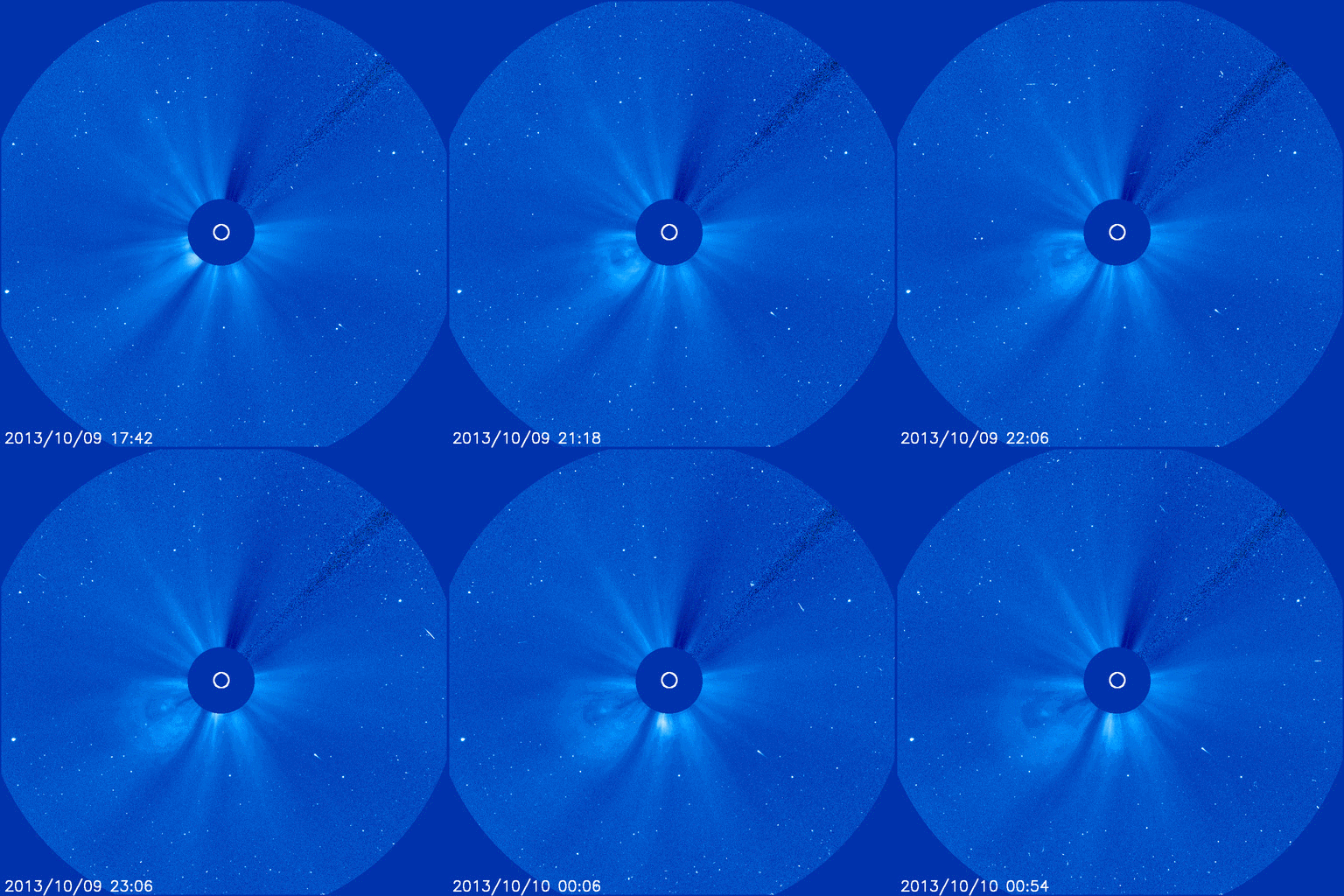
DrCaleb @ Thu Oct 10, 2013 9:09 am
A huge CME (solar flare) has been generating some amazing northern lights the last few days.
DrCaleb @ Thu Oct 10, 2013 9:15 am
3 Minute video of the Mauna Kea telescopes firing lasers (to change their telescopes depending on atmosphereic conditions)
http://www.thisiscolossal.com/2013/10/m ... timelapse/
DrCaleb @ Thu Oct 10, 2013 9:17 am
$1:
Sun Unleashes Strongest Solar Flare In 2 Months (Video)
The strongest solar flare in nearly two months erupted from the sun Tuesday (Oct. , causing a minor geomagnetic storm as charged particles from the sun passed by the planet.
The sun unleashed the moderate M2.8-class solar flare at 9:48 p.m. EDT (0148 GMT on Oct. 9). NASA's Solar Dynamics Observatory (SDO) recorded a video of the October solar flare's dramatic genesis.
The strongest solar flare in nearly two months erupted from the sun Tuesday (Oct.
, causing a minor geomagnetic storm as charged particles from the sun passed by the planet.The sun unleashed the moderate M2.8-class solar flare at 9:48 p.m. EDT (0148 GMT on Oct. 9). NASA's Solar Dynamics Observatory (SDO) recorded a video of the October solar flare's dramatic genesis.
http://www.space.com/23147-sun-unleashe ... storm.html
DrCaleb @ Thu Oct 10, 2013 9:21 am
$1:
Astronomers find young planet without a star wandering Milky Way galaxy
According to a news release from the Institute for Astronomy at the University of Hawaii at Manoa, astronomers have found a young planet that is not circling a star. This lonely planet, named PSO J318.5-22, is a mere 80 light-years away from our planet and has a mass only six times that of Jupiter. The planet developed approximately 12 million years ago.
It was spotted from its faint and uncommon heat signature by the Pan-STARRS 1 wide-field survey telescope on Haleakala, Maui. Other telescopes reveal that it has characteristics similar to those of gas-giant planets discovered circling around young stars.
“We have never before seen an object free-floating in space that looks like this. It has all the characteristics of young planets found around other stars, but it is drifting out there all alone,” said Dr. Michael Liu of the Institute for Astronomy at the University of Hawaii at Manoa. “I had often wondered if such solitary objects exist, and now we know they do.”
Over the last ten years, extrasolar planets have been found at a rapid pace, with approximately a thousand discovered by roundabout techniques like wobbling or dimming of their host stars brought about by the planet. However, only a few planets have been directly imaged, all of which are around young stars. According to astronomers, PSO J318.5-22 is one of the lowest-mass lonesome objects known.
“Planets found by direct imaging are incredibly hard to study, since they are right next to their much brighter host stars. PSO J318.5-22 is not orbiting a star so it will be much easier for us to study. It is going to provide a wonderful view into the inner workings of gas-giant planets like Jupiter shortly after their birth,” said Dr. Niall Deacon of the Max Planck Institute for Astronomy in Germany.
http://natmonitor.com/2013/10/10/astron ... ay-galaxy/
Strutz @ Thu Oct 10, 2013 9:33 am
DrCaleb DrCaleb:
A huge CME (solar flare) has been generating some amazing northern lights the last few days.
Beautiful picture!
Do you know where was that taken?
DrCaleb @ Thu Oct 10, 2013 9:55 am
Strutz Strutz:
Beautiful picture!
Do you know where was that taken?
Do you know where was that taken?
I think the caption on it was Copenhagen. The photographer is Norwegian.
http://no.linkedin.com/pub/harald-albrigtsen/45/7a7/b47
DrCaleb @ Fri Oct 11, 2013 7:18 am
One of the last 2 Mercury program Astronauts has passed away.
$1:
Scott Carpenter, One of the Original Seven Astronauts, Is Dead at 88
M. Scott Carpenter, whose flight into space in 1962 as the second American to orbit the Earth was marred by technical problems and ended with the nation waiting anxiously to see if he had survived a landing far from the target site, died on Thursday in Denver. He was 88 and one of the last two surviving astronauts of America’s original space program, Project Mercury.
His wife, Patty Carpenter, announced the death. No cause was given. Mr. Carpenter had entered hospice care recently after having a stroke.
M. Scott Carpenter, whose flight into space in 1962 as the second American to orbit the Earth was marred by technical problems and ended with the nation waiting anxiously to see if he had survived a landing far from the target site, died on Thursday in Denver. He was 88 and one of the last two surviving astronauts of America’s original space program, Project Mercury.
His wife, Patty Carpenter, announced the death. No cause was given. Mr. Carpenter had entered hospice care recently after having a stroke.

http://www.nytimes.com/2013/10/11/us/sc ... d=all&_r=0
$1:
National Aeronautics and Space Administration
Lyndon B. Johnson Space Center
Houston, Texas 77058
Biographical Data
--------------------------------------------------------------------------------
SCOTT CARPENTER
NASA ASTRONAUT (FORMER)
Scott Carpenter, a dynamic pioneer of modern exploration, has the unique distinction of being the first human ever to penetrate both inner and outer space, thereby acquiring the dual title, Astronaut/Aquanaut.
He was born in Boulder, Colorado, on May 1, 1925, the son of research chemist Dr. M. Scott Carpenter and Florence Kelso Noxon Carpenter. He attended the University of Colorado from 1945 to 1949 and received a bachelor of science degree in Aeronautical Engineering.
Carpenter was commissioned in the U.S. Navy in 1949. He was given flight training at Pensacola, Florida and Corpus Christi, Texas and designated a Naval Aviator in April, 1951. During the Korean War he served with patrol Squadron Six, flying anti-submarine, ship surveillance, and aerial mining, and ferret missions in the Yellow Sea, South China Sea, and the Formosa Straits. He attended the Navy Test Pilot School at Patuxent River, Maryland, in 1954 and was subsequently assigned to the Electronics Test Division of the Naval Air Test Center, also at Patuxent. In that assignment he flew tests in every type of naval aircraft, including multi- and single-engine jet and propeller-driven fighters, attack planes, patrol bombers, transports, and seaplanes.
From 1957 to 1959 he attended the Navy General Line School and the Navy Air Intelligence School and was then assigned as Air Intelligence Officer to the Aircraft Carrier, USS Hornet.
Carpenter was selected as one of the original seven Mercury Astronauts on April 9, 1959. He underwent intensive training with the National Aeronautics and Space Administration (NASA), specializing in communication and navigation. He served as backup pilot for John Glenn during the preparation for Americas first manned orbital space flight in February 1962.
Lyndon B. Johnson Space Center
Houston, Texas 77058
Biographical Data
--------------------------------------------------------------------------------
SCOTT CARPENTER
NASA ASTRONAUT (FORMER)
Scott Carpenter, a dynamic pioneer of modern exploration, has the unique distinction of being the first human ever to penetrate both inner and outer space, thereby acquiring the dual title, Astronaut/Aquanaut.
He was born in Boulder, Colorado, on May 1, 1925, the son of research chemist Dr. M. Scott Carpenter and Florence Kelso Noxon Carpenter. He attended the University of Colorado from 1945 to 1949 and received a bachelor of science degree in Aeronautical Engineering.
Carpenter was commissioned in the U.S. Navy in 1949. He was given flight training at Pensacola, Florida and Corpus Christi, Texas and designated a Naval Aviator in April, 1951. During the Korean War he served with patrol Squadron Six, flying anti-submarine, ship surveillance, and aerial mining, and ferret missions in the Yellow Sea, South China Sea, and the Formosa Straits. He attended the Navy Test Pilot School at Patuxent River, Maryland, in 1954 and was subsequently assigned to the Electronics Test Division of the Naval Air Test Center, also at Patuxent. In that assignment he flew tests in every type of naval aircraft, including multi- and single-engine jet and propeller-driven fighters, attack planes, patrol bombers, transports, and seaplanes.
From 1957 to 1959 he attended the Navy General Line School and the Navy Air Intelligence School and was then assigned as Air Intelligence Officer to the Aircraft Carrier, USS Hornet.
Carpenter was selected as one of the original seven Mercury Astronauts on April 9, 1959. He underwent intensive training with the National Aeronautics and Space Administration (NASA), specializing in communication and navigation. He served as backup pilot for John Glenn during the preparation for Americas first manned orbital space flight in February 1962.
http://www.jsc.nasa.gov/Bios/htmlbios/carpenter-ms.html
DrCaleb @ Fri Oct 11, 2013 8:16 am
$1:
Jupiter And Saturn May Be Rich In Diamonds
“Picture yourself in a boat on a river…” And make it a river of liquid hydrogen and helium deep within the atmospheres of Jupiter and Saturn. You might not find a girl with kaleidoscope eyes, but you may very well find diamonds. According to new research, there may be an abundance of these precious gemstones swirling about in the skies of our solar system’s giant planets.
Recent data compiled by planetary scientists Mona L. Delitsky of California Specialty Engineering in Pasadena, California, and Kevin H. Baines of the University of Wisconsin-Madison, has been combined with newly published pressure temperature diagrams of Jupiter and Saturn. These diagrams, known as adiabats, allow researchers to decipher at what interior level that diamond would become stable. They also allow for calculations at lower levels – regions where both temperature and pressure are so concentrated that diamond becomes a liquid. Imagine diamond rain… or rivulets of pure gemstone.
These adiabats of Saturn and Jupiter’s interior materials have been improved through new equations. Through the use of shockwave techniques, researchers at Sandia Laboratories and Lawrence Livermore National Laboratory have been provided with set boundaries for the various states of carbon. From these findings, you would be amazed at the chain of events at what might make diamonds occur. According to Delitsky and Baines, carbon could be generated as soot or graphite from a lightning strike. Since lightning is normal during Saturn’s many huge electrical storms, it stands to reason this elemental carbon would descend to a lower atmospheric level to be compressed into solid diamonds. It would then further descend towards the planet’s core to be eventually “pressure cooked” into a liquid state.
While the idea of diamonds at the heart of planets like Uranus and Neptune has been known for at least three decades, planetary scientists have been hesitant to include Jupiter and Saturn, concluding they were either too cool, too hot, or otherwise not suitable for the production of solid diamonds. Just as Jupiter and Saturn are much warmer at their cores, Uranus and Neptune are much too cold to sustain diamonds in a liquid state. However, thanks to the latest data, researchers are confident that deep inside Saturn there may be diamonds so large that they could be referred to as “diamondbergs”!
“Picture yourself in a boat on a river…” And make it a river of liquid hydrogen and helium deep within the atmospheres of Jupiter and Saturn. You might not find a girl with kaleidoscope eyes, but you may very well find diamonds. According to new research, there may be an abundance of these precious gemstones swirling about in the skies of our solar system’s giant planets.
Recent data compiled by planetary scientists Mona L. Delitsky of California Specialty Engineering in Pasadena, California, and Kevin H. Baines of the University of Wisconsin-Madison, has been combined with newly published pressure temperature diagrams of Jupiter and Saturn. These diagrams, known as adiabats, allow researchers to decipher at what interior level that diamond would become stable. They also allow for calculations at lower levels – regions where both temperature and pressure are so concentrated that diamond becomes a liquid. Imagine diamond rain… or rivulets of pure gemstone.
These adiabats of Saturn and Jupiter’s interior materials have been improved through new equations. Through the use of shockwave techniques, researchers at Sandia Laboratories and Lawrence Livermore National Laboratory have been provided with set boundaries for the various states of carbon. From these findings, you would be amazed at the chain of events at what might make diamonds occur. According to Delitsky and Baines, carbon could be generated as soot or graphite from a lightning strike. Since lightning is normal during Saturn’s many huge electrical storms, it stands to reason this elemental carbon would descend to a lower atmospheric level to be compressed into solid diamonds. It would then further descend towards the planet’s core to be eventually “pressure cooked” into a liquid state.
While the idea of diamonds at the heart of planets like Uranus and Neptune has been known for at least three decades, planetary scientists have been hesitant to include Jupiter and Saturn, concluding they were either too cool, too hot, or otherwise not suitable for the production of solid diamonds. Just as Jupiter and Saturn are much warmer at their cores, Uranus and Neptune are much too cold to sustain diamonds in a liquid state. However, thanks to the latest data, researchers are confident that deep inside Saturn there may be diamonds so large that they could be referred to as “diamondbergs”!
http://www.universetoday.com/105420/jup ... -diamonds/
DrCaleb @ Fri Oct 11, 2013 9:37 am
DrCaleb @ Fri Oct 11, 2013 11:35 am
$1:
NASA’s Juno Spacecraft Returns 1st Flyby images of Earth while Sailing On to Jupiter
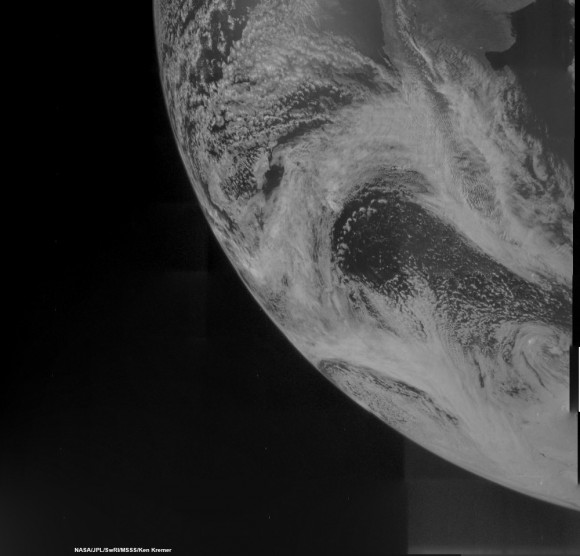
Following the speed boosting slingshot of Earth on Wednesday, Oct. 9, that sent NASA’s Juno orbiter hurtling towards Jupiter, the probe has successfully transmitted back data and the very first flyby images despite unexpectedly going into ‘safe mode’ during the critical maneuver.
“Juno is transmitting telemetry today,” spokesman Guy Webster, of NASA’s Jet Propulsion Lab (JPL), told me in a phone interview late today (Oct. 10), as Juno continues sailing on its 2.8 Billion kilometer (1.7 Billion mile) outbound trek to the Jovian system.
The new images of Earth captured by the Junocam imager serves as tangible proof that Juno is communicating.
“Juno is still in safe mode today (Oct. 10),” Webster told Universe Today.
“Teams at mission control at JPL and Lockheed Martin are actively working to bring Juno out of safe mode. And that could still require a few days,” Webster explained.
Lockheed Martin is the prime contractor for Juno.
Following the speed boosting slingshot of Earth on Wednesday, Oct. 9, that sent NASA’s Juno orbiter hurtling towards Jupiter, the probe has successfully transmitted back data and the very first flyby images despite unexpectedly going into ‘safe mode’ during the critical maneuver.
“Juno is transmitting telemetry today,” spokesman Guy Webster, of NASA’s Jet Propulsion Lab (JPL), told me in a phone interview late today (Oct. 10), as Juno continues sailing on its 2.8 Billion kilometer (1.7 Billion mile) outbound trek to the Jovian system.
The new images of Earth captured by the Junocam imager serves as tangible proof that Juno is communicating.
“Juno is still in safe mode today (Oct. 10),” Webster told Universe Today.
“Teams at mission control at JPL and Lockheed Martin are actively working to bring Juno out of safe mode. And that could still require a few days,” Webster explained.
Lockheed Martin is the prime contractor for Juno.
http://www.universetoday.com/105451/nas ... o-jupiter/
DrCaleb @ Fri Oct 11, 2013 11:41 am
$1:
No, This Isn’t a Movie: Russian Missile Lights Up Space Station’s Sky
The International Space Station silently orbits the Earth, black of space above, blue of ocean below. An astronaut floats in the cupola, a dome of glass and steel that faces the planet underneath, smiling to himself as he takes one photo after another of our home world. What he doesn’t know is that a Russian missile is about to make his life very interesting.
FollowSuddenly, a flash of light: Out of one eye, he catches motion, quickly turns, and to his astonishment sees an expanding cloud of white vapor in the far distance. He grabs a camera with a telephoto and starts snapping. What could this be? he thinks. A launch of some kind? He downloads the shot and innocently tweets it, not knowing what will happen next …
This is not a deleted scene from Gravity. By coincidence it reads very much like the story from the movie, but it’s real.
On Thursday, American astronaut Mike Hopkins tweeted that he saw something weird in the sky and posted a somewhat shaky image of it.* A few hours later Italian astronaut Luca Parmitano posted a sharper shot, the one shown above. The cloud of light is obvious; you can see the curve of the Earth below, a few stars in the sky, and the thin green line caused by airglow, a chemical process that causes air molecules to glow faintly at night.
I knew right away this phenomenon was from a rocket, possibly a fuel dump from a second stage, and went online for info. At first, I found no mention of a rocket launch at that time.
However, Edit Koczó on Twitter posted a link to an article from the Russian Strategic Nuclear Forces website, a site that gives the public and politicians information on Russian weapons information. The article claimed a Topol missile had been launched at 13:39 UTC. Russia Today also has an article about it.
This matches. The missile has three stages (like the old Saturn V rockets that took humans to the Moon), and what the astronauts saw may have been a fuel dump from the second stage or the last of the fuel leaking away after the booster phase was complete. In space, the cloud would expand more or less freely, moving rapidly as it traveled along with the booster in its path. In the photo, you can see a slight streaking to the cloud, most likely due to motion.
To clinch this, Parmitano also tweeted a picture of the launch itself, or at least the vapor trail from the missile as it went up:
The International Space Station silently orbits the Earth, black of space above, blue of ocean below. An astronaut floats in the cupola, a dome of glass and steel that faces the planet underneath, smiling to himself as he takes one photo after another of our home world. What he doesn’t know is that a Russian missile is about to make his life very interesting.
FollowSuddenly, a flash of light: Out of one eye, he catches motion, quickly turns, and to his astonishment sees an expanding cloud of white vapor in the far distance. He grabs a camera with a telephoto and starts snapping. What could this be? he thinks. A launch of some kind? He downloads the shot and innocently tweets it, not knowing what will happen next …
This is not a deleted scene from Gravity. By coincidence it reads very much like the story from the movie, but it’s real.
On Thursday, American astronaut Mike Hopkins tweeted that he saw something weird in the sky and posted a somewhat shaky image of it.* A few hours later Italian astronaut Luca Parmitano posted a sharper shot, the one shown above. The cloud of light is obvious; you can see the curve of the Earth below, a few stars in the sky, and the thin green line caused by airglow, a chemical process that causes air molecules to glow faintly at night.
I knew right away this phenomenon was from a rocket, possibly a fuel dump from a second stage, and went online for info. At first, I found no mention of a rocket launch at that time.
However, Edit Koczó on Twitter posted a link to an article from the Russian Strategic Nuclear Forces website, a site that gives the public and politicians information on Russian weapons information. The article claimed a Topol missile had been launched at 13:39 UTC. Russia Today also has an article about it.
This matches. The missile has three stages (like the old Saturn V rockets that took humans to the Moon), and what the astronauts saw may have been a fuel dump from the second stage or the last of the fuel leaking away after the booster phase was complete. In space, the cloud would expand more or less freely, moving rapidly as it traveled along with the booster in its path. In the photo, you can see a slight streaking to the cloud, most likely due to motion.
To clinch this, Parmitano also tweeted a picture of the launch itself, or at least the vapor trail from the missile as it went up:

http://www.slate.com/blogs/bad_astronom ... m_iss.html
Jabberwalker @ Fri Oct 11, 2013 11:52 am
DrCaleb DrCaleb:
... been into the mushrooms again, Caleb?
Previous 1 ... 25 26 27 28 29 30 31 ... 244 Next