
Space Thread
Previous 1 ... 33 34 35 36 37 38 39 ... 244 Next
DrCaleb @ Thu Jan 09, 2014 8:07 am
$1:
Bizarre star could host a neutron star in its core
Astronomers spot best candidate for a Thorne-Zytkow object, a hybrid star proposed almost 40 years ago.
Astronomers say that they have discovered the first example of a long-sought cosmic oddity: a bloated, dying star with a surprise in its core — an ultradense neutron star.
. . .
The latest work, reported on 6 January at a meeting of the American Astronomical Society outside Washington DC, focuses on a red supergiant star in the Small Magellanic Cloud, a neighbouring galaxy to the Milky Way. The star is enriched in lithium, rubidium and molybdenum. Elevated amounts of these elements are thought to arise as by-products of Thorne-Zytkow objects, which have to burn through unusual nuclear fusion pathways.
. . .
Theorists have proposed several ways in which a Thorne-Zytkow object could form, but the most likely scenario involves a red giant swallowing an orbiting neutron star. There could be several to tens of them in the Milky Way, says Philipp Podsiadlowski, a stellar astrophysicist at the University of Oxford, UK. The presence of a neutron star — the corpse of a normal star left behind after a supernova — would disrupt the usual thermonuclear fires.
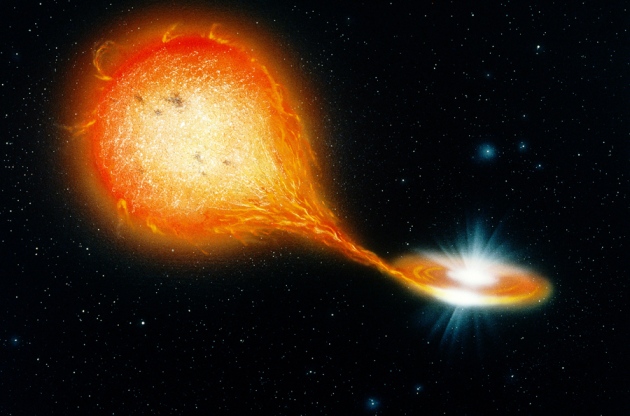
Astronomers spot best candidate for a Thorne-Zytkow object, a hybrid star proposed almost 40 years ago.
Astronomers say that they have discovered the first example of a long-sought cosmic oddity: a bloated, dying star with a surprise in its core — an ultradense neutron star.
. . .
The latest work, reported on 6 January at a meeting of the American Astronomical Society outside Washington DC, focuses on a red supergiant star in the Small Magellanic Cloud, a neighbouring galaxy to the Milky Way. The star is enriched in lithium, rubidium and molybdenum. Elevated amounts of these elements are thought to arise as by-products of Thorne-Zytkow objects, which have to burn through unusual nuclear fusion pathways.
. . .
Theorists have proposed several ways in which a Thorne-Zytkow object could form, but the most likely scenario involves a red giant swallowing an orbiting neutron star. There could be several to tens of them in the Milky Way, says Philipp Podsiadlowski, a stellar astrophysicist at the University of Oxford, UK. The presence of a neutron star — the corpse of a normal star left behind after a supernova — would disrupt the usual thermonuclear fires.
http://www.nature.com/news/bizarre-star ... re-1.14478
DrCaleb @ Thu Jan 09, 2014 8:47 am
$1:
Chandra’s Verdict on the Demise of a Star: “Death by Black Hole”
This week, astronomers announced the detection of a rare event, a star being torn to shreds by a massive black hole in the heart of a distant dwarf galaxy. The evidence was presented Wednesday January 8th at the ongoing 223rd meeting of the American Astronomical Society being held this week in Washington D.C.
Although other instances of the death of stars at the hands of black holes have been witnessed before, Chandra may have been the first to document an intermediate black hole at the heart of a dwarf galaxy “in the act”.
The results span observations carried out by the space-based Chandra X-ray observatory over a period spanning 1999 to 2005. The search is part of an archival study of observations, and revealed no further outbursts after 2005.
“We can’t see the star being torn apart by the black hole, but we can track what happens to the star’s remains,” said University of Alabama’s Peter Maksym in a recent press release. A comparison of with similar events seen in larger galaxies backs up the ruling of “death by black hole.” A competing team led by Davide Donato also looked at archival data from the Canada-France-Hawaii Telescope at the Keck observatory to gain similar results.
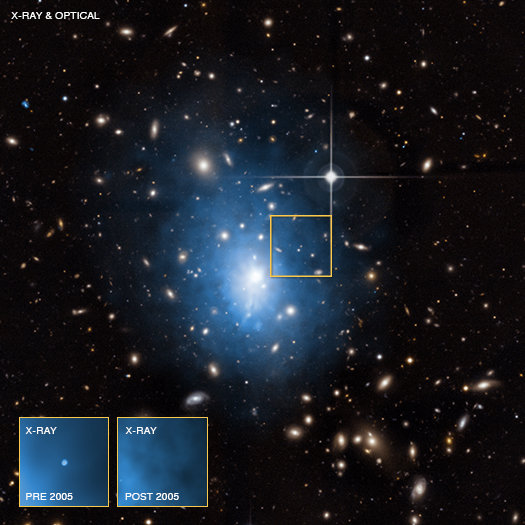
This week, astronomers announced the detection of a rare event, a star being torn to shreds by a massive black hole in the heart of a distant dwarf galaxy. The evidence was presented Wednesday January 8th at the ongoing 223rd meeting of the American Astronomical Society being held this week in Washington D.C.
Although other instances of the death of stars at the hands of black holes have been witnessed before, Chandra may have been the first to document an intermediate black hole at the heart of a dwarf galaxy “in the act”.
The results span observations carried out by the space-based Chandra X-ray observatory over a period spanning 1999 to 2005. The search is part of an archival study of observations, and revealed no further outbursts after 2005.
“We can’t see the star being torn apart by the black hole, but we can track what happens to the star’s remains,” said University of Alabama’s Peter Maksym in a recent press release. A comparison of with similar events seen in larger galaxies backs up the ruling of “death by black hole.” A competing team led by Davide Donato also looked at archival data from the Canada-France-Hawaii Telescope at the Keck observatory to gain similar results.
http://www.universetoday.com/107904/cha ... lack-hole/
DrCaleb @ Thu Jan 09, 2014 10:07 am
Check tonight for Northern Lights! They should be epic!
Tyler_1 @ Thu Jan 09, 2014 10:16 am
DrCaleb DrCaleb:
Check tonight for Northern Lights! They should be epic!
Okay!

DrCaleb @ Thu Jan 09, 2014 2:12 pm
DonnaWho DonnaWho:
DrCaleb DrCaleb:
Check tonight for Northern Lights! They should be epic!
Okay!
Tomorrow too!
DrCaleb @ Thu Jan 09, 2014 2:13 pm
$1:
'Hand of God' Spotted by NASA Space Telescope (Photo)
Religion and astronomy may not overlap often, but a new NASA X-ray image captures a celestial object that resembles the "Hand of God."
The cosmic "hand of God" photo was produced when a star exploded and ejected an enormous cloud of material, which NASA's Nuclear Spectroscopic Telescope Array, or NuSTAR, glimpsed in high-energy X-rays, shown in blue in the photo. NASA's Chandra X-ray Observatory had imaged the green and red parts previously, using lower-energy X-rays.
"NuSTAR's unique viewpoint, in seeing the highest-energy X-rays, is showing us well-studied objects and regions in a whole new light," NuSTAR telescope principal investigator Fiona Harrison, of the California Institute of Technology in Pasadena, said in a statement.
The new image depicts a pulsar wind nebula, produced by the dense remnant of a star that exploded in a supernova. What's left behind is a pulsar, called PSR B1509-58 (B1509 for short), which spins around 7 times per second blowing a wind of particles into material ejected during the star's death throes.

Religion and astronomy may not overlap often, but a new NASA X-ray image captures a celestial object that resembles the "Hand of God."
The cosmic "hand of God" photo was produced when a star exploded and ejected an enormous cloud of material, which NASA's Nuclear Spectroscopic Telescope Array, or NuSTAR, glimpsed in high-energy X-rays, shown in blue in the photo. NASA's Chandra X-ray Observatory had imaged the green and red parts previously, using lower-energy X-rays.
"NuSTAR's unique viewpoint, in seeing the highest-energy X-rays, is showing us well-studied objects and regions in a whole new light," NuSTAR telescope principal investigator Fiona Harrison, of the California Institute of Technology in Pasadena, said in a statement.
The new image depicts a pulsar wind nebula, produced by the dense remnant of a star that exploded in a supernova. What's left behind is a pulsar, called PSR B1509-58 (B1509 for short), which spins around 7 times per second blowing a wind of particles into material ejected during the star's death throes.
http://www.space.com/24225-hand-of-god- ... scope.html
DrCaleb @ Fri Jan 10, 2014 1:57 pm
$1:
Pleiades Star Cluster Sparkles in Amazing Stargazer Photo
The Pleiades star cluster dazzles brilliantly in this deep-exposure, widefield photo recently sent in to SPACE.com by a veteran astrophotographer.
"The exposure was deep enough to draw out the extended interstellar dust surrounding the cluster," night sky photographer Josh Knutson of Aurora, Colo.wrote SPACE.com. "There are also some tiny magnitude 15-17 galaxies showing up in the background."
Comprising 800 stars, the Pleiades star cluster (M45) was formed about 100 million years ago and is located 410 light-years from Earth in the constellation Taurus. One light-year is the distance light travels in a single year, which is about 6 trillion miles (10 trillion kilometers). Bright stars Atlas and Pleione, along with their seven daughter stars make up what we can typically see with the naked eye.

The Pleiades star cluster dazzles brilliantly in this deep-exposure, widefield photo recently sent in to SPACE.com by a veteran astrophotographer.
"The exposure was deep enough to draw out the extended interstellar dust surrounding the cluster," night sky photographer Josh Knutson of Aurora, Colo.wrote SPACE.com. "There are also some tiny magnitude 15-17 galaxies showing up in the background."
Comprising 800 stars, the Pleiades star cluster (M45) was formed about 100 million years ago and is located 410 light-years from Earth in the constellation Taurus. One light-year is the distance light travels in a single year, which is about 6 trillion miles (10 trillion kilometers). Bright stars Atlas and Pleione, along with their seven daughter stars make up what we can typically see with the naked eye.
http://www.space.com/24187-pleiades-sta ... photo.html
PluggyRug @ Fri Jan 10, 2014 4:21 pm
DrCaleb @ Mon Jan 13, 2014 9:31 am
$1:
Why northern lights didn't dazzle most Canadians
Solar phenomenon failed to align with Earth's magnetic field, NASA expert says
Most of Canada did not see the spectacular northern lights show that was predicted to make its way across the country last night. The lights, also known as the aurora borealis, were expected to appear at 3 a.m. ET in areas as far south as Oregon.
“People were predicting a major display. My understanding is that it wasn't really anything special,” said Larry Kepko, a research astrophysicist at NASA's Goddard Space Flight Center in Greenbelt, Md. "It was a fairly typical night of northern lights."
If the northern lights had displayed across all of Canada last night, as was hoped, they would have been bright enough to be seen even in large cities. The lights are usually a rural phenomenon.
Kepko said astronomers predicted a significant display because, on Tuesday, a mass of solar energy erupted from the sun. This solar eruption, known as a coronal mass ejection (CME), was headed toward earth at 500 km/s.
The dancing lights that typically appear in northern regions are displayed when charged particles from the sun interact with Earth's magnetic field, so the solar eruption could have created great conditions for northern lights.

Solar phenomenon failed to align with Earth's magnetic field, NASA expert says
Most of Canada did not see the spectacular northern lights show that was predicted to make its way across the country last night. The lights, also known as the aurora borealis, were expected to appear at 3 a.m. ET in areas as far south as Oregon.
“People were predicting a major display. My understanding is that it wasn't really anything special,” said Larry Kepko, a research astrophysicist at NASA's Goddard Space Flight Center in Greenbelt, Md. "It was a fairly typical night of northern lights."
If the northern lights had displayed across all of Canada last night, as was hoped, they would have been bright enough to be seen even in large cities. The lights are usually a rural phenomenon.
Kepko said astronomers predicted a significant display because, on Tuesday, a mass of solar energy erupted from the sun. This solar eruption, known as a coronal mass ejection (CME), was headed toward earth at 500 km/s.
The dancing lights that typically appear in northern regions are displayed when charged particles from the sun interact with Earth's magnetic field, so the solar eruption could have created great conditions for northern lights.
http://www.cbc.ca/news/technology/why-n ... -1.2491967
DrCaleb @ Mon Jan 13, 2014 10:34 am
$1:
Survey spots dwarf stars moving fast enough to exit the galaxy
May have been blasted to such incredible speeds by supernovae.
A new analysis of a survey of the stars in our galaxy has found a number that appear to have reached escape velocity, moving fast enough to exit the Milky Way. These aren't the first stars we've found that are moving this quickly, but all the previous ones are large, blue stars that were thrown out of the galaxy's core by its supermassive black hole. These are smaller stars, similar to our Sun, and they clearly do not originate at the galaxy's core. In fact, they're moving fast enough that they could have potentially originated in another galaxy.
The study relies on the Sloan Extension for Galactic Understanding and Exploration, a project that has mapped the location of 240,000 stars within our galaxy. With multiple exposures, it's possible to track stars as they move across the sky.
The authors of the new study limited their analysis to G- and K-class stars, those similar in mass to the Sun and often referred to as G and K dwarfs. Even so, that limitation provides a lot of candidates; there were about 43,000 G dwarfs alone in the survey's population. From there, the authors converted the apparent motion of the stars to motion relative to the galactic core. They could then identify those stars that are moving very quickly relative to the galaxy itself. They took only those stars that were clearly moving fast enough to escape our galaxy's gravitational clutches—600 kilometers a second and up.
That initial analysis picked out 42 possible high-velocity dwarfs, but there were potential problems with many of them, such as possible confusion with other nearby stars or too few exposures to get a good measure of the velocity. Even so, it was possible to identify 17 stars where the researchers could determine a velocity that they considered "reliable."
All of that seemed solid, which leaves a rather significant question: how did they possibly get moving so quickly? We know how this happens at the galactic core. A binary system of two stars can wander close to the supermassive black hole at the very center, which captures one of them. Nearly all the momentum of the system gets transferred to the other star, sending it rocketing out of the galaxy.
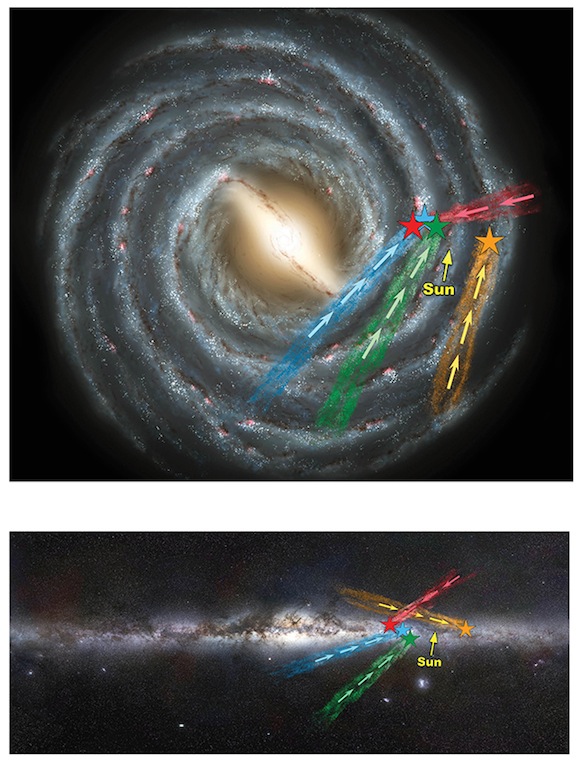
May have been blasted to such incredible speeds by supernovae.
A new analysis of a survey of the stars in our galaxy has found a number that appear to have reached escape velocity, moving fast enough to exit the Milky Way. These aren't the first stars we've found that are moving this quickly, but all the previous ones are large, blue stars that were thrown out of the galaxy's core by its supermassive black hole. These are smaller stars, similar to our Sun, and they clearly do not originate at the galaxy's core. In fact, they're moving fast enough that they could have potentially originated in another galaxy.
The study relies on the Sloan Extension for Galactic Understanding and Exploration, a project that has mapped the location of 240,000 stars within our galaxy. With multiple exposures, it's possible to track stars as they move across the sky.
The authors of the new study limited their analysis to G- and K-class stars, those similar in mass to the Sun and often referred to as G and K dwarfs. Even so, that limitation provides a lot of candidates; there were about 43,000 G dwarfs alone in the survey's population. From there, the authors converted the apparent motion of the stars to motion relative to the galactic core. They could then identify those stars that are moving very quickly relative to the galaxy itself. They took only those stars that were clearly moving fast enough to escape our galaxy's gravitational clutches—600 kilometers a second and up.
That initial analysis picked out 42 possible high-velocity dwarfs, but there were potential problems with many of them, such as possible confusion with other nearby stars or too few exposures to get a good measure of the velocity. Even so, it was possible to identify 17 stars where the researchers could determine a velocity that they considered "reliable."
All of that seemed solid, which leaves a rather significant question: how did they possibly get moving so quickly? We know how this happens at the galactic core. A binary system of two stars can wander close to the supermassive black hole at the very center, which captures one of them. Nearly all the momentum of the system gets transferred to the other star, sending it rocketing out of the galaxy.
http://arstechnica.com/science/2014/01/ ... content%29
DrCaleb @ Mon Jan 13, 2014 10:50 am
'Cosmos' was the book that got me really interested in astronomy. The series was just icing!
$1:
Rebooting 'Cosmos': Neil DeGrasse Tyson Explains Why Iconic TV Series Returns in 2014
Rebooting 'Cosmos': Neil DeGrasse Tyson Explains Why Iconic TV Series Returns in 2014
by Marshall Honoroff, SPACE.com Contributor | January 13, 2014 07:00am ET
Rebooting Carl Sagan's seminal "Cosmos" miniseries three decades later is almost impossible — unless you happen to be renowned astrophysicist and science educator Neil deGrasse Tyson.
For those who may have missed the original back in 1980, "Cosmos: A Personal Voyage" was a documentary series on PBS that explored the universe as well as the history of scientific discovery. Sagan's topics of discussion ranged from Japanese folklore to debunking astrology to the ultimate fate of the stars and galaxies that surround us.
Now Tyson is hosting a new version of the TV series called "Cosmos: A SpaceTime Odyssey," with the first episode airing in March on Fox and the National Geographic Channel.
During a roundtable discussion at New York Comic Con this past October, Tyson explained why it's time for a new iteration of the beloved astronomy documentary, and how he and his team of scientists and entertainers hope to engage and enlighten a new generation of viewers. SPACE.com sat in on this roundtable, which also included Ann Druyan, Brannon Braga and Mitchell Cannold, all producers for the 2014 reimagining of "Cosmos."
Bringing 'Cosmos' back
Druyan is the producer of the original "Cosmos" as well as Sagan's widow. Braga was a producer on three "Star Trek" series, while Cannold is a major Hollywood producer with a background in journalism. Not present was Seth MacFarlane, the creator and voice actor behind "Family Guy," who first went to bat for "Cosmos" on Fox and is now its executive producer.
"Seth has been our champion," Druyan said. Druyan and Cannold shopped the idea of a "Cosmos" rebootto a number of major science networks but couldn't find a good match. "They didn't want to give me relative control. They didn't want to give me support. We [couldn't] really do a 'Cosmos' that would be a worthy successor."
Although Tyson pointed out that he has an extensive fan base that will follow him to the reboot, many fans of the original remain skeptical that anyone — even the World's Sexiest Astrophysicist — can measure up to the legendary Carl Sagan, who died in 1996.
"No one can fill those shoes," Tyson said. "But I have another pair of shoes that are there, and they're my shoes. I can fill my shoes, and I can be a really good version of myself. Nobody could do me better than me!"
"Several other scientists were lobbying for this gig," Druyan said. "I knew it was Neil from the beginning for several reasons. Fist, his 'Neilitude.' He's not only a serious scientist; he's also a communicator without a scintilla of pretense or snobbery or the desire to impress people."
Some of the information and production values in the original "Cosmos" are dated, but the show remains an engrossing spectacle and a thought-provoking drama about the universeand humanity's place in it. The cast and crew of Fox's "Cosmos" thought that 34 years was long enough to wait for a new one.
"When isn't it the right time to bring 'Cosmos' back?" Braga asked. "There are always dark forces of irrational thinking. Science is always relevant. Reality is relevant. Nature is relevant. A believable view of the world that is real is relevant."
Rebooting 'Cosmos': Neil DeGrasse Tyson Explains Why Iconic TV Series Returns in 2014
by Marshall Honoroff, SPACE.com Contributor | January 13, 2014 07:00am ET
Rebooting Carl Sagan's seminal "Cosmos" miniseries three decades later is almost impossible — unless you happen to be renowned astrophysicist and science educator Neil deGrasse Tyson.
For those who may have missed the original back in 1980, "Cosmos: A Personal Voyage" was a documentary series on PBS that explored the universe as well as the history of scientific discovery. Sagan's topics of discussion ranged from Japanese folklore to debunking astrology to the ultimate fate of the stars and galaxies that surround us.
Now Tyson is hosting a new version of the TV series called "Cosmos: A SpaceTime Odyssey," with the first episode airing in March on Fox and the National Geographic Channel.
During a roundtable discussion at New York Comic Con this past October, Tyson explained why it's time for a new iteration of the beloved astronomy documentary, and how he and his team of scientists and entertainers hope to engage and enlighten a new generation of viewers. SPACE.com sat in on this roundtable, which also included Ann Druyan, Brannon Braga and Mitchell Cannold, all producers for the 2014 reimagining of "Cosmos."
Bringing 'Cosmos' back
Druyan is the producer of the original "Cosmos" as well as Sagan's widow. Braga was a producer on three "Star Trek" series, while Cannold is a major Hollywood producer with a background in journalism. Not present was Seth MacFarlane, the creator and voice actor behind "Family Guy," who first went to bat for "Cosmos" on Fox and is now its executive producer.
"Seth has been our champion," Druyan said. Druyan and Cannold shopped the idea of a "Cosmos" rebootto a number of major science networks but couldn't find a good match. "They didn't want to give me relative control. They didn't want to give me support. We [couldn't] really do a 'Cosmos' that would be a worthy successor."
Although Tyson pointed out that he has an extensive fan base that will follow him to the reboot, many fans of the original remain skeptical that anyone — even the World's Sexiest Astrophysicist — can measure up to the legendary Carl Sagan, who died in 1996.
"No one can fill those shoes," Tyson said. "But I have another pair of shoes that are there, and they're my shoes. I can fill my shoes, and I can be a really good version of myself. Nobody could do me better than me!"
"Several other scientists were lobbying for this gig," Druyan said. "I knew it was Neil from the beginning for several reasons. Fist, his 'Neilitude.' He's not only a serious scientist; he's also a communicator without a scintilla of pretense or snobbery or the desire to impress people."
Some of the information and production values in the original "Cosmos" are dated, but the show remains an engrossing spectacle and a thought-provoking drama about the universeand humanity's place in it. The cast and crew of Fox's "Cosmos" thought that 34 years was long enough to wait for a new one.
"When isn't it the right time to bring 'Cosmos' back?" Braga asked. "There are always dark forces of irrational thinking. Science is always relevant. Reality is relevant. Nature is relevant. A believable view of the world that is real is relevant."
http://www.space.com/24243-cosmos-tv-se ... tyson.html
DrCaleb @ Tue Jan 14, 2014 9:52 am
$1:
Hubble Spies Tarantula Star Factory
Spidey senses tingling yet? The Hubble Space Telescope provides a never-before-seen, panoramic portrait of the innards of the creepy Tarantula Nebula, a monster star factory filled with some 800,000 sparkling newborn stars sitting about 170,000 light-years from Earth.
The cosmic arachnoid, also known as Doradus 30, stretches across roughly 600 light-years in space. It is nestled within the Large Magellanic Cloud, the largest satellite galaxy of the Milky Way.
Using the orbiting observatory’s exquisitely sensitive near-infrared vision, astronomers were able to create a mosaic that was stitched together from 438 individual snapshots of the nebula. That allowed them to peer through the nebula’s weblike veil of clouds and dust to catch a glimpse of a cluster of stars in the process of hatching.

Spidey senses tingling yet? The Hubble Space Telescope provides a never-before-seen, panoramic portrait of the innards of the creepy Tarantula Nebula, a monster star factory filled with some 800,000 sparkling newborn stars sitting about 170,000 light-years from Earth.
The cosmic arachnoid, also known as Doradus 30, stretches across roughly 600 light-years in space. It is nestled within the Large Magellanic Cloud, the largest satellite galaxy of the Milky Way.
Using the orbiting observatory’s exquisitely sensitive near-infrared vision, astronomers were able to create a mosaic that was stitched together from 438 individual snapshots of the nebula. That allowed them to peer through the nebula’s weblike veil of clouds and dust to catch a glimpse of a cluster of stars in the process of hatching.
http://newswatch.nationalgeographic.com ... r-factory/
Tyler_1 @ Tue Jan 14, 2014 9:55 am
That is the best looking spider I have ever seen. 
DrCaleb @ Tue Jan 14, 2014 10:19 am
$1:
Monster Sunspot Dominates Sun Photos by Amateur Astronomers
Amateur astronomers have safely captured amazing views of a colossal sunspot seven times the size of Earth that is currently making its way across the face of the sun.
Stargazer Giuseppe Petricca of Sulmona, Italy, sent SPACE.com a series spectacular images of the massive, active sunspot region AR1944. The sunspot unleashed the first major solar flare of 2014 on Tuesday (Jan. 7) in the form of an X1.2-class sun storm, which is the strongest class of solar flares the sun experiences.
"The sunspot is really big, visible even to the naked eye, using the appropriate filters," Petricca wrote in an email, adding that some high level clouds helped in filtering the solar light
http://www.space.com/24211-monster-suns ... hotos.html
Amateur astronomers have safely captured amazing views of a colossal sunspot seven times the size of Earth that is currently making its way across the face of the sun.
Stargazer Giuseppe Petricca of Sulmona, Italy, sent SPACE.com a series spectacular images of the massive, active sunspot region AR1944. The sunspot unleashed the first major solar flare of 2014 on Tuesday (Jan. 7) in the form of an X1.2-class sun storm, which is the strongest class of solar flares the sun experiences.
"The sunspot is really big, visible even to the naked eye, using the appropriate filters," Petricca wrote in an email, adding that some high level clouds helped in filtering the solar light
http://www.space.com/24211-monster-suns ... hotos.html
$1:
Giuseppe Petricca sent SPACE.com this HDR filtered photo of the sun with sunspot AR 1944 visible toward the center. Petricca took this photo on Jan. 7 from Sulmona, Italy using a Nikon P90 bridge camera on a tripod (ISO 64, f/6.3, 1/1200" exposure). Welding glass was used giving the photo a green color.
Credit: Giuseppe Petricca

Credit: Giuseppe Petricca
$1:
This image shows the sun with massive sunspot AR 1944 visible near the center of the image. Giuseppe Petricca took this photo on Jan. 7 from Sulmona, Italy using a Nikon P90 bridge camera on a tripod (ISO 64, f/6.3, 1/1200" exposure).
Credit: Giuseppe Petricca

Credit: Giuseppe Petricca
$1:
Astrophotographer Andrew Kwon sent in a photo of sunspot group 1944 taken on Jan. 8, 2014, from his backyard observatory in Mississauga, Ontario.
Credit: Andrew Kwon

Credit: Andrew Kwon
DrCaleb @ Thu Jan 16, 2014 7:48 am
$1:
John Dobson, Inventor of the Popular Dobsonian Telescope, Dead at 98
The cosmos lost a good soul Wednesday. John Dobson, famous as the creator of the simple, low-cost Dobsonian telescope, passed away on Jan. 15, 2014. His obituary appeared on the website of the Sidewalk Astronomers:
“It is with heavy hearts that we must report the passing of John Dobson. He died peacefully this morning, Wednesday, January 15th, in Burbank, California. He was 98 years old. He leaves behind a son, numerous close friends, and fans and admirers worldwide.
On March 8th, in honor of John, this year’s ISAN (International Sidewalk Astronomy Night) will be dedicated to his memory. Amateur astronomers around the globe can join in and celebrate John’s life and continue to carry the torch that he lit back in 1968 when he co-founded the San Francisco Sidewalk Astronomers.”
Dobson was born in Beijing, China but moved with his parents to San Francisco in 1927. After spending 23 years in a monastery, some of which time was spent sneaking out to build telescopes and observe the night sky, he left to co-found the San Francisco Sidewalk Astronomers in 1968, a group dedicated to showing people on the street the wonders of the night sky using large (for the time) telescopes.
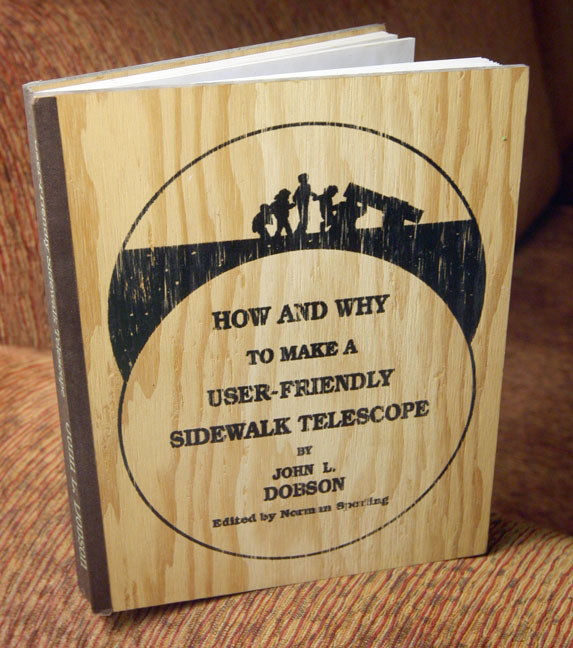
Dobson’s interest in astronomy started in the early 1950s when he built a small telescope using spare parts found in a junk store. He wanted to see for himself what the universe looked like. By 1956, John got a hold of a 12-inch slab of porthole glass and ground it into a mirror following instructions from Allyn J. Thompson’s classic book Making Your Own Telescope. His first look at the last quarter turned him into an astro-evangelist:
“It looks like you’re coming in for a landing,” he wrote in his own telescope making book many years later. From that moment on Dobson felt “that everybody who lives in this world has to see that.”
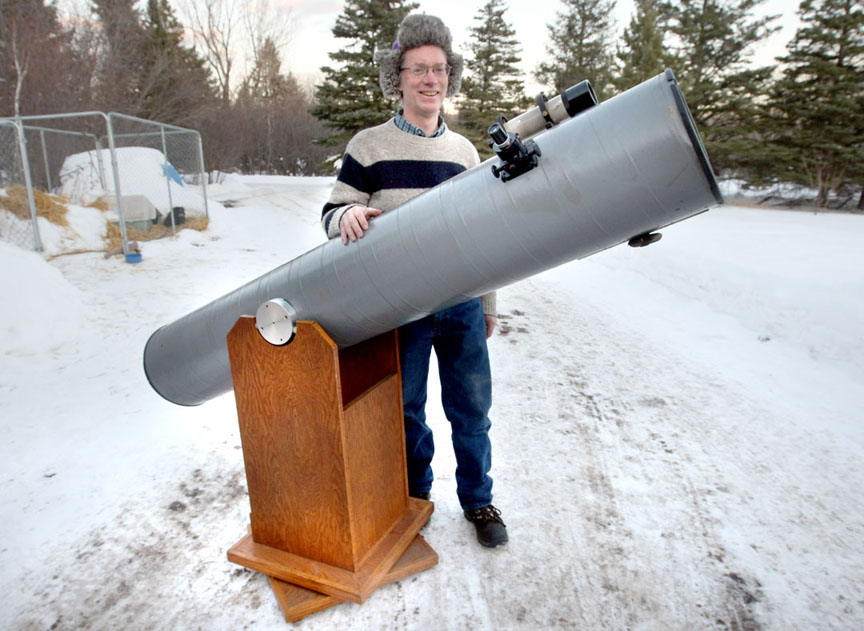
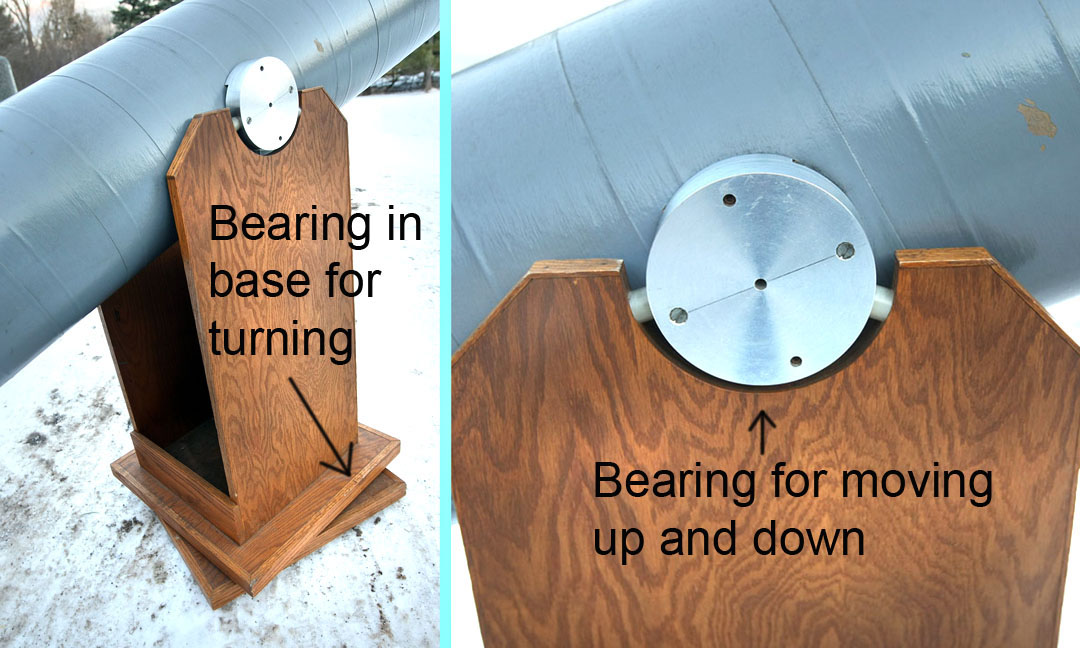
The writer with his 10-inch Dobsonian reflecting telescope. The scope comes in two pieces like John Dobson's original design - a cardboard tube with the optics that sits in a cradle. See photo below to see how a "Dob" works. Credit: Bob King
The writer with his 10-inch Dobsonian reflecting telescope. The scope breaks down into two pieces like John Dobson’s original design – a cardboard tube with the optics and a cradle. See photo below to see how a “Dob” works. Credit: Bob King
Toting beat-up, monster telescopes everywhere from downtown San Francisco and to national parks across the country, Dobson made good on his promise. He lectured widely on astronomy and cosmology, rejecting the Big Bang Theory for his own Recycling Steady State Theory.
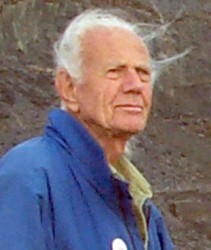
The cosmos lost a good soul Wednesday. John Dobson, famous as the creator of the simple, low-cost Dobsonian telescope, passed away on Jan. 15, 2014. His obituary appeared on the website of the Sidewalk Astronomers:
“It is with heavy hearts that we must report the passing of John Dobson. He died peacefully this morning, Wednesday, January 15th, in Burbank, California. He was 98 years old. He leaves behind a son, numerous close friends, and fans and admirers worldwide.
On March 8th, in honor of John, this year’s ISAN (International Sidewalk Astronomy Night) will be dedicated to his memory. Amateur astronomers around the globe can join in and celebrate John’s life and continue to carry the torch that he lit back in 1968 when he co-founded the San Francisco Sidewalk Astronomers.”
Dobson was born in Beijing, China but moved with his parents to San Francisco in 1927. After spending 23 years in a monastery, some of which time was spent sneaking out to build telescopes and observe the night sky, he left to co-found the San Francisco Sidewalk Astronomers in 1968, a group dedicated to showing people on the street the wonders of the night sky using large (for the time) telescopes.
Dobson’s interest in astronomy started in the early 1950s when he built a small telescope using spare parts found in a junk store. He wanted to see for himself what the universe looked like. By 1956, John got a hold of a 12-inch slab of porthole glass and ground it into a mirror following instructions from Allyn J. Thompson’s classic book Making Your Own Telescope. His first look at the last quarter turned him into an astro-evangelist:
“It looks like you’re coming in for a landing,” he wrote in his own telescope making book many years later. From that moment on Dobson felt “that everybody who lives in this world has to see that.”
The writer with his 10-inch Dobsonian reflecting telescope. The scope comes in two pieces like John Dobson's original design - a cardboard tube with the optics that sits in a cradle. See photo below to see how a "Dob" works. Credit: Bob King
The writer with his 10-inch Dobsonian reflecting telescope. The scope breaks down into two pieces like John Dobson’s original design – a cardboard tube with the optics and a cradle. See photo below to see how a “Dob” works. Credit: Bob King
Toting beat-up, monster telescopes everywhere from downtown San Francisco and to national parks across the country, Dobson made good on his promise. He lectured widely on astronomy and cosmology, rejecting the Big Bang Theory for his own Recycling Steady State Theory.
http://www.universetoday.com/108150/joh ... ead-at-98/
Previous 1 ... 33 34 35 36 37 38 39 ... 244 Next