
Space Thread
Previous 1 ... 36 37 38 39 40 41 42 ... 244 Next
DrCaleb @ Fri Jan 31, 2014 10:41 am
DonnaWho DonnaWho:
DrCaleb DrCaleb:
OMG!! Official trailer for "Cosmos" with Neil DeGrass Tyson.
That looks good!
Might even be better than the original!
DrCaleb @ Tue Feb 04, 2014 8:48 am
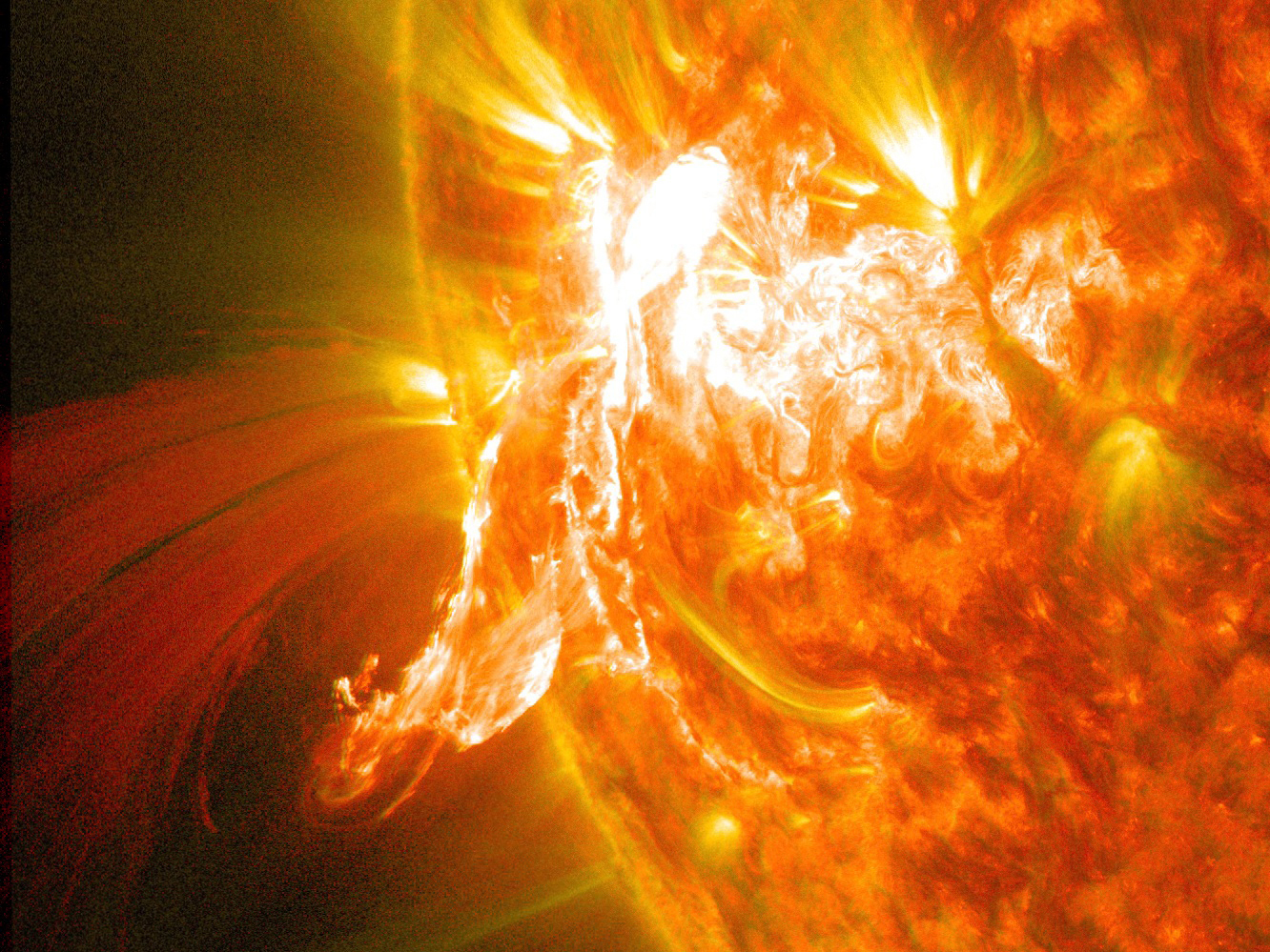
NASA's Solar Dynamics Observatory has a captured a movie of 13 flares over the past couple days:
$1:
A busy active region just rotating into view offered up about 13 flares in just two and a half days (Jan. 27-29, 2014). Five of them were of the M-Class (Medium) flares and the rest were smaller. The video clip, taken in extreme ultraviolet light at a cadence of an image every eight minutes, shows ionized iron at about 10 million degrees K. The still of an M-class flare was taken at 19:39 UT on Jan. 28. The brightness of the flare causes very bright saturation and 'blooming' above and below the flare region on the CCD detector and caused extended diffraction patterns to spread out across the SDO imager. Credit: Solar Dynamics Observatory/NASA.
http://sdo.gsfc.nasa.gov/assets/gallery ... sDozen.mp4
http://sdo.gsfc.nasa.gov/gallery/potw/item/486
DrCaleb @ Tue Feb 04, 2014 8:55 am
$1:
Dramatic Sun Storm, Partial Solar Eclipse Spied by NASA Spacecraft
A NASA satellite has captured stunning views of a partial solar eclipse and a stormy eruption on the sun as seen from space, two amazing events that occurred on the same day last week..
The space agency's sun-watching Solar Dynamics Observatory saw the dual phenomena on Jan. 30, as this video of the solar flare and partial solar eclipse shows. During the solar eclipse, called a lunar transit, the moon took two and a half hours to cross —the longest transit ever recorded by the satellite.
The crisp silhouette of the moon creeps in front of the sun starting at 8:31 a.m. EST (1331 GMT), creating a partial solar eclipse from SDO's viewpoint. Near the end of the moon's crossing, a mid-level M6.6-class flare erupts from a giant cluster of sunspots that's been quite active recently. The flare peaked at 11:11 a.m. EST (1611 GMT), NASA officials said.

A NASA satellite has captured stunning views of a partial solar eclipse and a stormy eruption on the sun as seen from space, two amazing events that occurred on the same day last week..
The space agency's sun-watching Solar Dynamics Observatory saw the dual phenomena on Jan. 30, as this video of the solar flare and partial solar eclipse shows. During the solar eclipse, called a lunar transit, the moon took two and a half hours to cross —the longest transit ever recorded by the satellite.
The crisp silhouette of the moon creeps in front of the sun starting at 8:31 a.m. EST (1331 GMT), creating a partial solar eclipse from SDO's viewpoint. Near the end of the moon's crossing, a mid-level M6.6-class flare erupts from a giant cluster of sunspots that's been quite active recently. The flare peaked at 11:11 a.m. EST (1611 GMT), NASA officials said.
http://www.space.com/24544-solar-flare- ... a-sdo.html
If you want a movie of that, go to the SDO website and enter the times of: 2014-01-30 00:00:00 and 2014-01-30 17:00:00 and pick a wavelength and watch the moon go *woosh!*.
http://sdo.gsfc.nasa.gov/data/aiahmi/
DrCaleb @ Wed Feb 05, 2014 11:33 am
Must see video of recent Aurora over Sweden.
DrCaleb @ Wed Feb 05, 2014 11:37 am
The NOAA sent out an alert that they predict an 80% chance that a large sunspot visible will produce an Earthbound CME in the next day or so.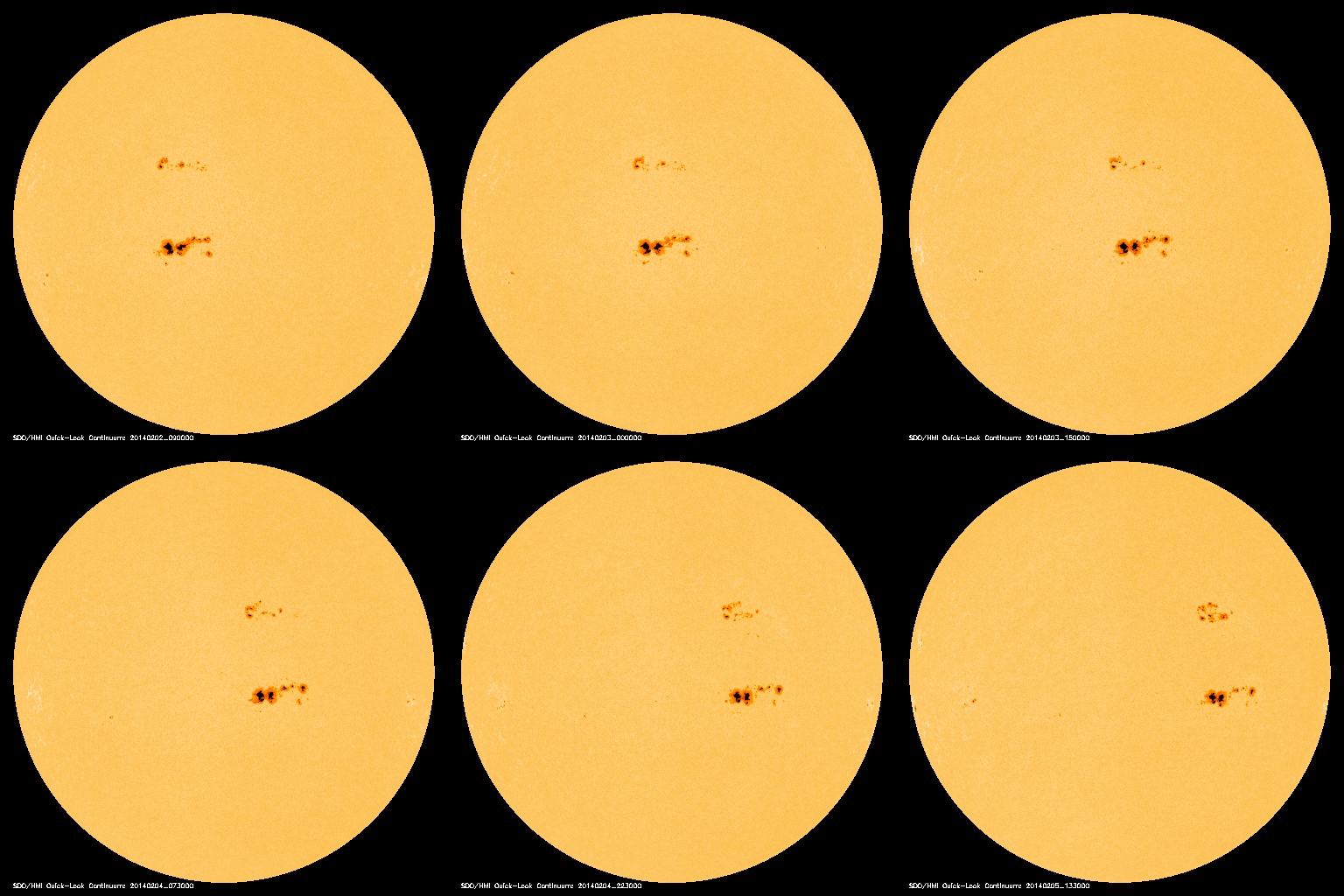
Strutz @ Wed Feb 05, 2014 1:42 pm
Awesome aurora vid DrC!
Re: above post
Is the CME anticipated to cause any disruptions or anything?
DrCaleb @ Wed Feb 05, 2014 1:55 pm
Strutz Strutz:
Awesome aurora vid DrC!
Re: above post
Is the CME anticipated to cause any disruptions or anything?
Re: above post
Is the CME anticipated to cause any disruptions or anything?
No idea. It's only a prediction. We'll have to see if there is a CME, and if it heads toward Earth. Having the sunspot on that side of the sun usually is bad because the magnetic field flings stuff toward us.
If anything happens, these two sites have the details:
http://www.swpc.noaa.gov/
http://www.spaceweather.com/
DrCaleb @ Wed Feb 05, 2014 2:23 pm
$1:
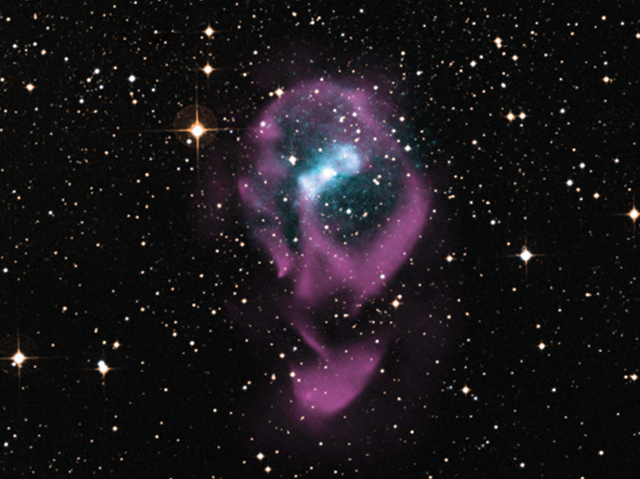
New model: Black holes, neutron stars drove Universe’s reionization
During the first billion years of the Universe's history, the gradual cooling from the Big Bang was reversed, and much of the gas was re-heated and ionized. This event, known as reionization, happened in the epoch where the first stars and galaxies formed. Largely due to the challenges of observing galaxies that far back in time, much is still mysterious about it. Most of our understanding of reionization comes from theoretical models.
One new model, proposed by Anastasia Fialkov, Rennan Barkana, and Eli Visbal, suggests that energetic X-rays could have heated the primoridal gas to the point that reionization happened relatively rapidly. That's in contrast with other hypotheses, which predict a more gradual reionization process. The X-rays in the new model were emitted by systems that include neutron stars or black holes. The nicest feature of the new proposal is that it predicts a unique pattern in light emission from the primordial gas, which could conceivably be measured by current radio telescopes.
Roughly 380,000 years after the Big Bang, the Universe became transparent. Before that time, the ordinary matter—mostly protons and electrons, with a smattering of helium nuclei—was a hot plasma mixed with photons. The transition to transparency occurred when the temperature of the plasma dropped low enough that electrons could join protons to make hydrogen, freeing the photons that we now observe as the cosmic microwave background.
Some time after stable atoms formed, something reionized much of the gas in the Universe. Reionization happened somewhere between 150 million and one billion years after the Big Bang, the same era that saw the formation of the first stars and galaxies. However, this epoch is challenging to observe: astronomers have yet to see examples of the first generation of stars, and the great distance means that only a few of the earliest galaxies have been seen. Those were only visible thanks to magnification by gravitational lensing.
The culprits behind the reionization likely included energetic ultraviolet radiation from newborn stars in the first galaxies as well as X-ray light from the remnants of the first generation of stars to die. According to various models, high-mass stars formed in large numbers early in the Universe's history, but something that massive explodes in a supernova after a relatively short time. Many of the remains—neutron stars and black holes—would form binary systems with stars or other remnants, generating huge numbers of X-ray photons as they fed on stray matter
During the first billion years of the Universe's history, the gradual cooling from the Big Bang was reversed, and much of the gas was re-heated and ionized. This event, known as reionization, happened in the epoch where the first stars and galaxies formed. Largely due to the challenges of observing galaxies that far back in time, much is still mysterious about it. Most of our understanding of reionization comes from theoretical models.
One new model, proposed by Anastasia Fialkov, Rennan Barkana, and Eli Visbal, suggests that energetic X-rays could have heated the primoridal gas to the point that reionization happened relatively rapidly. That's in contrast with other hypotheses, which predict a more gradual reionization process. The X-rays in the new model were emitted by systems that include neutron stars or black holes. The nicest feature of the new proposal is that it predicts a unique pattern in light emission from the primordial gas, which could conceivably be measured by current radio telescopes.
Roughly 380,000 years after the Big Bang, the Universe became transparent. Before that time, the ordinary matter—mostly protons and electrons, with a smattering of helium nuclei—was a hot plasma mixed with photons. The transition to transparency occurred when the temperature of the plasma dropped low enough that electrons could join protons to make hydrogen, freeing the photons that we now observe as the cosmic microwave background.
Some time after stable atoms formed, something reionized much of the gas in the Universe. Reionization happened somewhere between 150 million and one billion years after the Big Bang, the same era that saw the formation of the first stars and galaxies. However, this epoch is challenging to observe: astronomers have yet to see examples of the first generation of stars, and the great distance means that only a few of the earliest galaxies have been seen. Those were only visible thanks to magnification by gravitational lensing.
The culprits behind the reionization likely included energetic ultraviolet radiation from newborn stars in the first galaxies as well as X-ray light from the remnants of the first generation of stars to die. According to various models, high-mass stars formed in large numbers early in the Universe's history, but something that massive explodes in a supernova after a relatively short time. Many of the remains—neutron stars and black holes—would form binary systems with stars or other remnants, generating huge numbers of X-ray photons as they fed on stray matter
http://arstechnica.com/science/2014/02/ ... onization/
Zipperfish @ Wed Feb 05, 2014 4:45 pm
DrCaleb DrCaleb:
During the first billion years of the Universe's history, the gradual cooling from the Big Bang was reversed, and much of the gas was re-heated and ionized. This event, known as reionization, happened in the epoch where the first stars and galaxies formed. Largely due to the challenges of observing galaxies that far back in time, much is still mysterious about it. Most of our understanding of reionization comes from theoretical models.
Sure, where it's cold where I am now, therefore your reionization climate change theory is a load of crap. Grrrr.
ShepherdsDog @ Wed Feb 05, 2014 5:01 pm
wuzzah matta is it close to zero on the coast?
Zipperfish @ Wed Feb 05, 2014 5:11 pm
ShepherdsDog ShepherdsDog:
wuzzah matta is it close to zero on the coast?
How about -7!!!!!!
Crazy cold.
I'm from Winnipeg, so I know cold. I also know that a body has no memory and that anything below zero feels like -15 used to feel in Winnipeg.
DrCaleb @ Thu Feb 06, 2014 9:04 am
$1:
Nasa's Curiosity Mars rover looks to 'jump' sand dune
The Curiosity Mars rover is to try to drive over a one metre-high dune.

The sand bank is currently blocking the robot's path into a small valley and a route with fewer of the sharp rocks that lately have been making big dents in the vehicle's aluminium wheels.
US space agency engineers will take no risks, however. The rover will be commanded initially to climb only part way up the dune to see how it behaves.
The team is mindful that Nasa's Spirit rover was lost in a sand trap in 2009.
And the Opportunity rover, which has just celebrated 10 working years on the planet, very nearly went the same way in 2005 when it became stuck for several weeks in a deep dirt pile later dubbed "Purgatory Dune".
Curiosity has already had one scuff at the base of the barrier, using a wheel to test the sand's consistency.

The robot would have no problem managing the incline but mission planners will be concerned about the potential for any rocks hidden inside the dune to damage or snare Curiosity.
Engineers believe the path ahead between two scarps referred to as "Dingo Gap" will be kinder on the rover's 50cm-diameter wheels.

The Curiosity Mars rover is to try to drive over a one metre-high dune.
The sand bank is currently blocking the robot's path into a small valley and a route with fewer of the sharp rocks that lately have been making big dents in the vehicle's aluminium wheels.
US space agency engineers will take no risks, however. The rover will be commanded initially to climb only part way up the dune to see how it behaves.
The team is mindful that Nasa's Spirit rover was lost in a sand trap in 2009.
And the Opportunity rover, which has just celebrated 10 working years on the planet, very nearly went the same way in 2005 when it became stuck for several weeks in a deep dirt pile later dubbed "Purgatory Dune".
Curiosity has already had one scuff at the base of the barrier, using a wheel to test the sand's consistency.
The robot would have no problem managing the incline but mission planners will be concerned about the potential for any rocks hidden inside the dune to damage or snare Curiosity.
Engineers believe the path ahead between two scarps referred to as "Dingo Gap" will be kinder on the rover's 50cm-diameter wheels.

http://www.bbc.co.uk/news/science-environment-26032673
DrCaleb @ Thu Feb 06, 2014 9:10 am
$1:
International Space Station will soon contain the coldest spot in the known universe
Space has a reputation for being cold — frigid even, but the tremendous chill of deep space is nothing compared to what NASA is preparing to create very near to Earth. Researchers are planning to generate a super-cold spot on the International Space Station (ISS) to study the intricacies of quantum mechanics. How cold? It’s going to be the coldest spot in the known universe.
In the vast expanses of nothingness between galaxies, the diffuse gaseous matter regularly reaches roughly 3 Kelvin — close to absolute zero, where all motion on the subatomic level is believed to stop. The experiment being carried out in the ISS Cold Atom Lab is going to reach temperatures as low as 100 pico-Kelvin above absolute zero (“pico” denotes one-trillionth).
The team will be working with Bose-Einstein Condensates, a type of dilute gas that shows fascinating macro-quantum effects at temperatures near absolute zero. The space station offers a uniquely well-suited environment for this testing. When gas expands, it cools, and this is the basis of the cooling that will take place on the ISS. Magnetic traps will be used to expand gas until it gets down to the desired temperature. These traps can be very low-power because the gas doesn’t need to be supported against the pull of gravity, allowing it to reach incredibly low temperatures.
Bose-Einstein Condensates offer a window into the strange world of quantum mechanics. Two Bose-Einstein Condensates that are placed together don’t mix, instead they interfere like waves. The Cold Atom Lab on the ISS will offer scientists a chance to study these remarkable effects at the lowest temperature yet. This is the absolute forefront of science — no one’s exactly sure what we’ll find.

Space has a reputation for being cold — frigid even, but the tremendous chill of deep space is nothing compared to what NASA is preparing to create very near to Earth. Researchers are planning to generate a super-cold spot on the International Space Station (ISS) to study the intricacies of quantum mechanics. How cold? It’s going to be the coldest spot in the known universe.
In the vast expanses of nothingness between galaxies, the diffuse gaseous matter regularly reaches roughly 3 Kelvin — close to absolute zero, where all motion on the subatomic level is believed to stop. The experiment being carried out in the ISS Cold Atom Lab is going to reach temperatures as low as 100 pico-Kelvin above absolute zero (“pico” denotes one-trillionth).
The team will be working with Bose-Einstein Condensates, a type of dilute gas that shows fascinating macro-quantum effects at temperatures near absolute zero. The space station offers a uniquely well-suited environment for this testing. When gas expands, it cools, and this is the basis of the cooling that will take place on the ISS. Magnetic traps will be used to expand gas until it gets down to the desired temperature. These traps can be very low-power because the gas doesn’t need to be supported against the pull of gravity, allowing it to reach incredibly low temperatures.
Bose-Einstein Condensates offer a window into the strange world of quantum mechanics. Two Bose-Einstein Condensates that are placed together don’t mix, instead they interfere like waves. The Cold Atom Lab on the ISS will offer scientists a chance to study these remarkable effects at the lowest temperature yet. This is the absolute forefront of science — no one’s exactly sure what we’ll find.
http://www.geek.com/science/internation ... e-1583820/
DrCaleb @ Thu Feb 06, 2014 9:47 am
$1:
Spectacular new Martian impact crater spotted from orbit
Somewhere between July 2010 and May 2012, Mars got a good smack.
Yesterday, the team that runs the HiRISE camera on the Mars Reconnaissance Orbiter released the photo shown above. It's a new impact crater on Mars, formed sometime early this decade. The crater at the center is about 30 meters in diameter, and the material ejected during its formation extends out as far as 15 kilometers.

Somewhere between July 2010 and May 2012, Mars got a good smack.
Yesterday, the team that runs the HiRISE camera on the Mars Reconnaissance Orbiter released the photo shown above. It's a new impact crater on Mars, formed sometime early this decade. The crater at the center is about 30 meters in diameter, and the material ejected during its formation extends out as far as 15 kilometers.
http://arstechnica.com/science/2014/02/ ... rom-orbit/
DrCaleb @ Thu Feb 06, 2014 1:21 pm
$1:
New Type of Star Emerges From Inside Black Holes
Born inside black holes, “Planck stars” could explain one of astrophysics’ biggest mysteries and may already have been observed by orbiting gamma ray telescopes, say cosmologists
Black holes have fascinated scientists and the public alike for decades. There is special appeal in the idea that the universe contains regions of space so dense that light itself cannot escape and so extreme that the laws of physics no longer apply. What secrets can these extraordinary objects hide?
Today, we get an answer thanks to the work of Carlo Rovelli at the University of Toulon in France, and Francesca Vidotto at Radboud University in the Netherlands. These guys say that inside every black hole is the ghostly, quantum remains of the star from which it formed. And that these stars can later emerge as the black hole evaporates.
Rovelli and Vidotto call these objects “Planck stars” and say they could solve one of the most important questions in astrophysics. What’s more, evidence for the existence of Planck stars may be readily available, simply by looking to the heavens.
Black holes arise naturally from Einstein’s theory of general relativity which predicts that gravity influences the trajectory of photons moving through space. Indeed, when gravity is strong enough, light shouldn’t be able to escape at all. That region is then a black hole.
Astrophysicists have long believed that black holes form when stars a little bigger than the Sun run out of fuel. No longer supported by thermal energy, the star collapses under its own weight to form a black hole. Since there is no known force that can stop this collapse, astrophysicists have always assumed that it eventually forms a singularity, a region of space that is infinitely dense.
But this has never been entirely satisfactory. The laws of physics break down in a region of infinite density, leaving physicists scratching their heads over what must be going on inside a black hole.
Even worse, many physicists believe black holes slowly evaporate and disappear. That raises problems because the information that describes an object must fully determine its future and be fully derivable from its past, at least in principle. But if black holes disappear, what happens to this information?
Nobody knows, a problem known as the “information paradox” and one of the hottest mysteries in astrophysics.
Now Rovelli and Vidotto have the answer. They begin by revisiting some ideas about what might happen should the universe end in a big crunch, the opposite of a big bang. Their key insight is that quantum gravitational effects prevent the universe from collapsing to infinite density. Instead, the universe ”bounces” when the energy density of matter reaches the Planck scale, the smallest possible size in physics.
That’s hugely significant. “The bounce does not happen when the universe is of planckian size, as was previously expected; it happens when the matter energy density reaches the Planck density,” they say. In other words, quantum gravity could become relevant when the volume of the universe is some 75 orders of magnitude larger than the Planck volume.
Rovelli and Vidotto say the same reasoning can be applied to a black hole. Instead of forming a singularity, the collapse of a star is eventually stopped by the same quantum pressure, a force that is similar to the one that prevents an electron falling into the nucleus of an atom. “We call a star in this phase a “Planck star”,” they say.
Planck stars would be small— stellar-mass black hole would form a Planck star about 10^-10 centimetres in diameter. But that’s still some 30 orders of magnitude larger than the Planck length.
Born inside black holes, “Planck stars” could explain one of astrophysics’ biggest mysteries and may already have been observed by orbiting gamma ray telescopes, say cosmologists
Black holes have fascinated scientists and the public alike for decades. There is special appeal in the idea that the universe contains regions of space so dense that light itself cannot escape and so extreme that the laws of physics no longer apply. What secrets can these extraordinary objects hide?
Today, we get an answer thanks to the work of Carlo Rovelli at the University of Toulon in France, and Francesca Vidotto at Radboud University in the Netherlands. These guys say that inside every black hole is the ghostly, quantum remains of the star from which it formed. And that these stars can later emerge as the black hole evaporates.
Rovelli and Vidotto call these objects “Planck stars” and say they could solve one of the most important questions in astrophysics. What’s more, evidence for the existence of Planck stars may be readily available, simply by looking to the heavens.
Black holes arise naturally from Einstein’s theory of general relativity which predicts that gravity influences the trajectory of photons moving through space. Indeed, when gravity is strong enough, light shouldn’t be able to escape at all. That region is then a black hole.
Astrophysicists have long believed that black holes form when stars a little bigger than the Sun run out of fuel. No longer supported by thermal energy, the star collapses under its own weight to form a black hole. Since there is no known force that can stop this collapse, astrophysicists have always assumed that it eventually forms a singularity, a region of space that is infinitely dense.
But this has never been entirely satisfactory. The laws of physics break down in a region of infinite density, leaving physicists scratching their heads over what must be going on inside a black hole.
Even worse, many physicists believe black holes slowly evaporate and disappear. That raises problems because the information that describes an object must fully determine its future and be fully derivable from its past, at least in principle. But if black holes disappear, what happens to this information?
Nobody knows, a problem known as the “information paradox” and one of the hottest mysteries in astrophysics.
Now Rovelli and Vidotto have the answer. They begin by revisiting some ideas about what might happen should the universe end in a big crunch, the opposite of a big bang. Their key insight is that quantum gravitational effects prevent the universe from collapsing to infinite density. Instead, the universe ”bounces” when the energy density of matter reaches the Planck scale, the smallest possible size in physics.
That’s hugely significant. “The bounce does not happen when the universe is of planckian size, as was previously expected; it happens when the matter energy density reaches the Planck density,” they say. In other words, quantum gravity could become relevant when the volume of the universe is some 75 orders of magnitude larger than the Planck volume.
Rovelli and Vidotto say the same reasoning can be applied to a black hole. Instead of forming a singularity, the collapse of a star is eventually stopped by the same quantum pressure, a force that is similar to the one that prevents an electron falling into the nucleus of an atom. “We call a star in this phase a “Planck star”,” they say.
Planck stars would be small— stellar-mass black hole would form a Planck star about 10^-10 centimetres in diameter. But that’s still some 30 orders of magnitude larger than the Planck length.
More at:
https://medium.com/the-physics-arxiv-blog/6cf7ec0ed28b
http://arxiv.org/abs/1401.6562
Previous 1 ... 36 37 38 39 40 41 42 ... 244 Next