
Space Thread
Previous 1 ... 37 38 39 40 41 42 43 ... 244 Next
DrCaleb @ Thu Feb 06, 2014 1:50 pm
$1:
Gaia comes into focus
Europe's billion-star surveyor Gaia is slowly being brought into focus.
Once Gaia starts making routine measurements, it will generate truly enormous amounts of data. To maximize the key science of the mission, only small 'cut-outs' centered on each of the stars it detects will be sent back to Earth for analysis.
This test picture, taken as part of commissioning the mission to 'fine tune' the behavior of the instruments, is one of the first proper 'images' to be seen from Gaia, but ironically, it will also be one of the last.
Professor Gerry Gilmore, from the University of Cambridge and UK Principal Investigator for Gaia, said: "Seeing the first magnificent images from Gaia's UK-built billion pixel camera first of all generates a huge vote of thanks to all those scientists and engineers who have worked so hard to make this happen. Second, it provides just a tiny taste of the excellence and challenges ahead, to turn Gaia data into human understanding of the Milky Way's origins. One substantial step for astronomy, one huge leap still to come."
Gaia was launched on 19 December 2013, and is orbiting around a virtual point in space called L2, 1.5 million kilometers from Earth.
Gaia's goal is to create the most accurate map yet of the Milky Way. It will make precise measurements of the positions and motions of about 1% of the total population of roughly 100 billion stars in our home galaxy to help answer questions about its origin and evolution.

Europe's billion-star surveyor Gaia is slowly being brought into focus.
Once Gaia starts making routine measurements, it will generate truly enormous amounts of data. To maximize the key science of the mission, only small 'cut-outs' centered on each of the stars it detects will be sent back to Earth for analysis.
This test picture, taken as part of commissioning the mission to 'fine tune' the behavior of the instruments, is one of the first proper 'images' to be seen from Gaia, but ironically, it will also be one of the last.
Professor Gerry Gilmore, from the University of Cambridge and UK Principal Investigator for Gaia, said: "Seeing the first magnificent images from Gaia's UK-built billion pixel camera first of all generates a huge vote of thanks to all those scientists and engineers who have worked so hard to make this happen. Second, it provides just a tiny taste of the excellence and challenges ahead, to turn Gaia data into human understanding of the Milky Way's origins. One substantial step for astronomy, one huge leap still to come."
Gaia was launched on 19 December 2013, and is orbiting around a virtual point in space called L2, 1.5 million kilometers from Earth.
Gaia's goal is to create the most accurate map yet of the Milky Way. It will make precise measurements of the positions and motions of about 1% of the total population of roughly 100 billion stars in our home galaxy to help answer questions about its origin and evolution.
http://phys.org/news/2014-02-gaia-focus.html
FYI - the 'L' points, L1, L2 . . are the 'Lagrange' points, where the gravity of two objects balances so something at that point falls toward neither body. L2 is the point where the sun and Earth's gravity balance on the side of Earth away from the sun.
In this place, Gaia will never need fuel to keep from re-entering Earth's atmosphere like Hubble, but it also can never be serviced by astronauts nor be de-orbited once it's lifetime is up.

DrCaleb @ Thu Feb 06, 2014 1:54 pm
No, it's not a midget joke ..
$1:
Brown Dwarf with Bizarre Red Atmosphere Spotted by ESO's Very Large Telescope
From the Atacama Desert in northern Chile, the European Southern Observatory's Very Large Telescope has spotted a distant brown dwarf with an unusual red atmosphere.
Brown dwarfs are peculiar celestial bodies, too big to be classified as planets yet lacking the material to fully fuse hydrogen in their cores to form into proper stars. They are cold, faint space objects that do not produce heat at their cores. (Brown dwarfs are often called failed stars.)
Astronomers from the University of Hertfordshire's Centre for Astrophysics Research used the VLT to spot the odd brown dwarf, which is extremely red compared to "normal" brown dwarfs, and further investigate its puzzling hue.
Writing in the journal Monthly Notices of the Royal Astronomical Society, lead astronomer Federico Marocco reports that the brown dwarf, officially recognized as ULAS J222711-004547, is red because of an unusually thick layer of clouds in its upper atmosphere.
"These are not the type of clouds that we are used to seeing on Earth. The thick clouds on this particular brown dwarf are mostly made of mineral dust, like enstatite and corundum," Marocco said. "Not only have we been able to infer their presence, but we have also been able to estimate the size of the dust grains in the clouds."

From the Atacama Desert in northern Chile, the European Southern Observatory's Very Large Telescope has spotted a distant brown dwarf with an unusual red atmosphere.
Brown dwarfs are peculiar celestial bodies, too big to be classified as planets yet lacking the material to fully fuse hydrogen in their cores to form into proper stars. They are cold, faint space objects that do not produce heat at their cores. (Brown dwarfs are often called failed stars.)
Astronomers from the University of Hertfordshire's Centre for Astrophysics Research used the VLT to spot the odd brown dwarf, which is extremely red compared to "normal" brown dwarfs, and further investigate its puzzling hue.
Writing in the journal Monthly Notices of the Royal Astronomical Society, lead astronomer Federico Marocco reports that the brown dwarf, officially recognized as ULAS J222711-004547, is red because of an unusually thick layer of clouds in its upper atmosphere.
"These are not the type of clouds that we are used to seeing on Earth. The thick clouds on this particular brown dwarf are mostly made of mineral dust, like enstatite and corundum," Marocco said. "Not only have we been able to infer their presence, but we have also been able to estimate the size of the dust grains in the clouds."
http://www.natureworldnews.com/articles ... escope.htm
Brenda @ Fri Feb 07, 2014 9:50 am
Mars to Earth...
$1:
NASA's Curiosity rover on Mars has captured its first view of Earth from the surface of the Red Planet — a striking image that shows our home planet as a bright light in the Martian sky, with the moon shining nearby.
The Curiosity rover photographed Earth from Mars on Jan. 31 using the left-eye camera on its head-like science mast. You can see a video of Curiosity's Earth-from-Mars images here.
The Curiosity rover photographed Earth from Mars on Jan. 31 using the left-eye camera on its head-like science mast. You can see a video of Curiosity's Earth-from-Mars images here.
http://www.huffingtonpost.com/2014/02/0 ... lp00000009
DrCaleb @ Fri Feb 07, 2014 12:03 pm
A really good explanation of the California drought, from NASA.
Gunnair @ Fri Feb 07, 2014 6:32 pm

$1:
If you could stand on Mars -- what might you see? Scroll right to find out. The robotic Spirit rover that rolled around Mars from 2004 to 2009 Mars climbed to the top of a hill in 2005 and took a series of images over three days that were then digitally combined into a 360 degree panorama. Spirit was instructed to take images having the same resolution as a human with 20-20 eyesight. The full panoramic result can be found by clicking on the above image and has a level of detail unparalleled in the history of Martian surface photography. The panorama was taken from the pinnacle of Husband Hill and has been dubbed the Everest panorama, in honor of the view from the tallest mountain on Earth. Visible in Gusev Crater are rocks, rusting sand, a Martian sundial, vast plains, nearby peaks, faraway peaks, and sand drifts. In the distance, fast moving dust devils can be seen as slight apparitions of red, green, or blue, the colors of filters used to build up this natural color vista.
http://apod.nasa.gov/apod/ap131208.html
Gunnair @ Fri Feb 07, 2014 6:35 pm
$1:
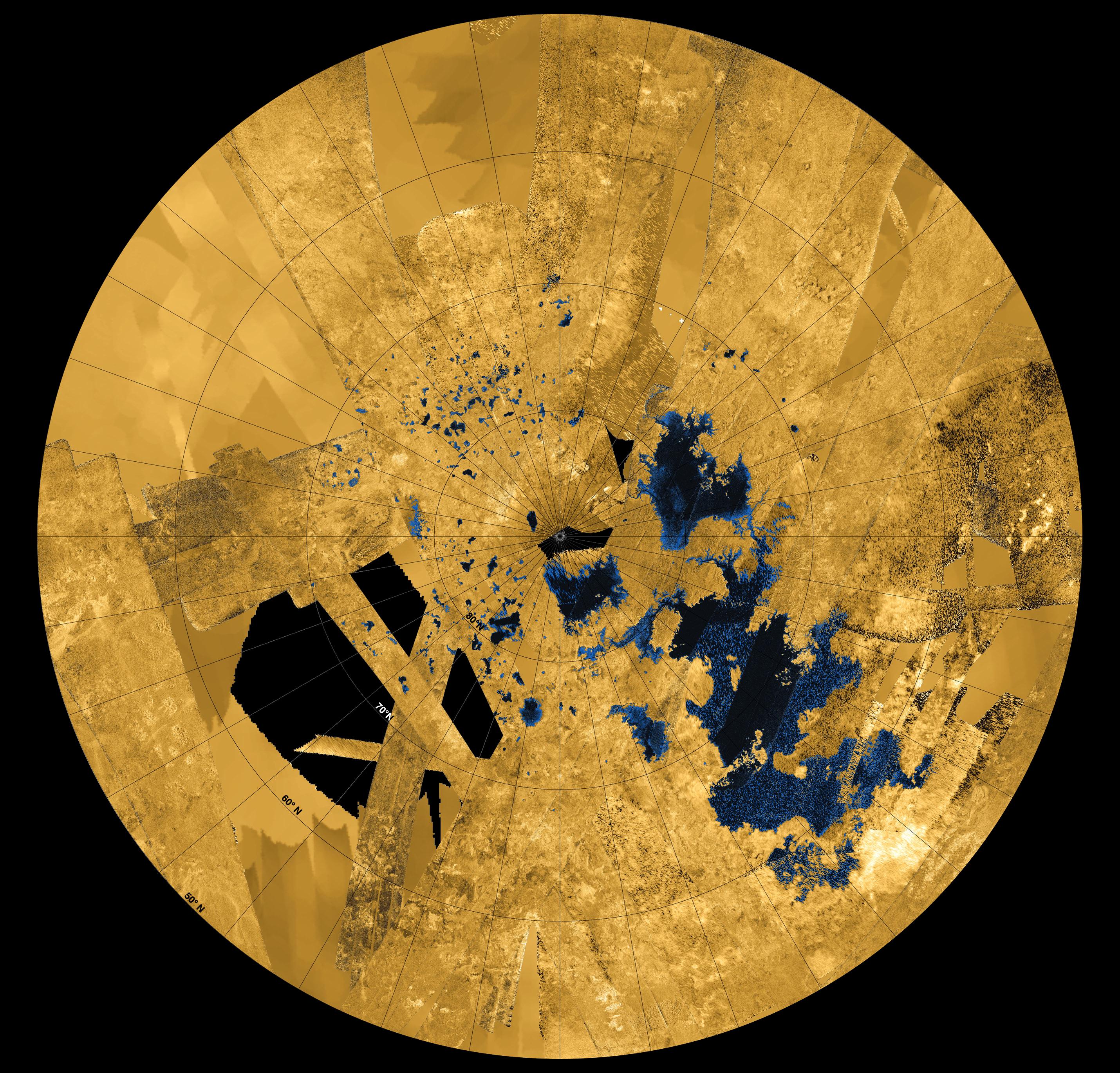
Saturn's large moon Titan would be unique in our solar system, the only world with stable liquid lakes and seas on its surface ... except for planet Earth of course. Centered on the north pole, this colorized map shows Titan's bodies of methane and ethane in blue and black, still liquid at frigid surface temperatures of -180 degrees C (-292 degrees F). The map is based on data from the Cassini spacecraft's radar, taken during flybys between 2004 and 2013. Roughly heart-shaped, the lake above and right of the pole is Ligeia Mare, the second largest known body of liquid on Titan and larger than Lake Superior on Earth. Just below the north pole is Punga Mare. The sprawling sea below and right of Punga is the (hopefully sleeping) Kraken Mare, Titan's largest known sea. Above and left of the pole, the moon's surface is dotted with smaller lakes that range up to 50 kilometers across.
http://apod.nasa.gov/apod/ap131220.html
Gunnair @ Fri Feb 07, 2014 6:37 pm
$1:
What does the Martian moon Phobos look like? To better visualize this unusual object, images from ESA's Mars Express orbiter have been combined into a virtual rotation movie. The rotation is actually a digital illusion -- tidally-locked Phobos always keeps the same face toward its home planet, as does Earth's moon. The above video highlights Phobos' chunky shape and an unusually dark surface covered with craters and grooves. What lies beneath the surface is a topic of research since the moon is not dense enough to be filled with solid rock. Phobos is losing about of centimeter of altitude a year and is expected to break up and crash onto Mars within the next 50 million years. To better understand this unusual world, Mars Express is on course to make the closest flyby ever on Sunday.
http://apod.nasa.gov/apod/ap131225.html
Gunnair @ Sat Feb 08, 2014 4:20 pm
$1:
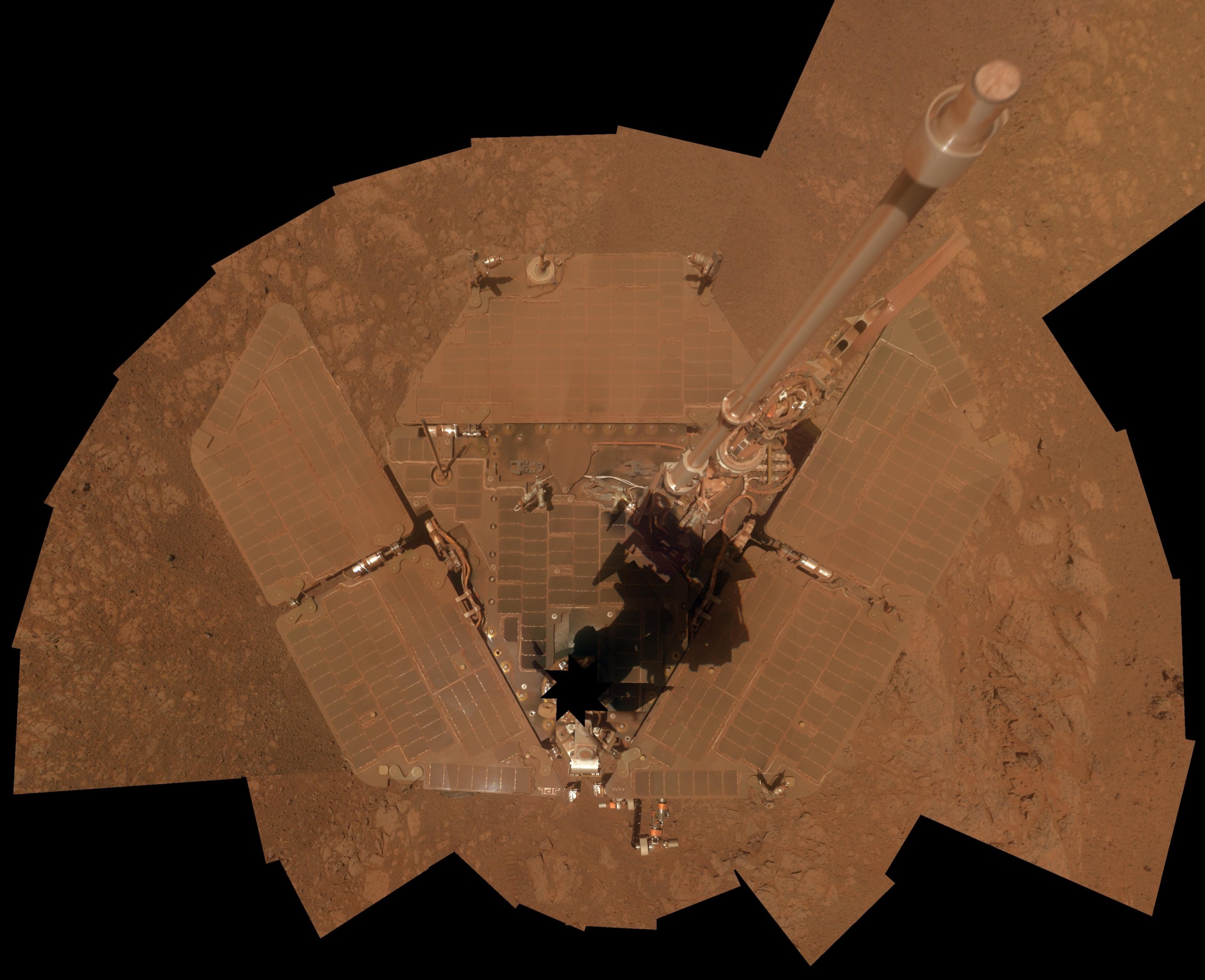
On January 25 (UT) 2004, the Opportunity rover fell to Mars, making today the 10th anniversary of its landing. After more than 3,500 sols (Mars solar days) the golf cart-sized robot from Earth is still actively exploring the Red Planet, though its original mission plan was for three months. This self-portrait was made with Opportunity's panoramic camera earlier this month. The camera's supporting mast has been edited out of the image mosaic but its shadow is visible on the dusty solar panels arrayed across the rover's deck. For comparison, a similar self-portrait from late 2004 is shown in the inset. Having driven some 39 kilometers (24 miles) from its landing site, Opportunity now rests at Solander Point at the rim of Endeavour Crater.
http://apod.nasa.gov/apod/ap140125.html
Gunnair @ Sat Feb 08, 2014 4:25 pm


$1:
Enceladus is the sixth-largest of the moons of Saturn.[12] It was discovered in 1789 by William Herschel.[13]
Enceladus seems to have liquid water under its icy surface. Cryovolcanoes at the south pole shoot large jets of water vapor, other volatiles, and some solid particles (e.g. ice crystals, NaCl particles, etc.) into space, totaling approximately 200 kg per second.[14][15][16] Some of this water falls back onto the moon as "snow", some of it adds to Saturn's rings, and some of it reaches Saturn. The whole of Saturn's E Ring is believed to have been made from these ice particles. Because of the apparent water at or near the surface, Enceladus may be one of the best places for humans to look for extraterrestrial life. By contrast, the water thought to be on Jupiter's moon Europa is locked under a very thick layer of surface ice, though recent evidence may show that Europa also experiences water plumes.[17]
Until the two Voyager spacecraft passed near it in the early 1980s very little was known about this small moon besides the identification of water ice on its surface. The Voyagers showed that the diameter of Enceladus is only 500 kilometers (310 mi), about a tenth of that of Saturn's largest moon, Titan, and that it reflects almost all of the sunlight that strikes it. Voyager 1 found that Enceladus orbited in the densest part of Saturn's diffuse E ring, indicating a possible association between the two, while Voyager 2 revealed that despite the moon's small size, it had a wide range of terrains ranging from old, heavily cratered surfaces to young, tectonically deformed terrain, with some regions with surface ages as young as 100 million years old.
In 2005 the Cassini spacecraft performed several close flybys of Enceladus, revealing the moon's surface and environment in greater detail. In particular, the probe discovered a water-rich plume venting from the moon's south polar region. This discovery, along with the presence of escaping internal heat and very few (if any) impact craters in the south polar region, shows that Enceladus is geologically active today. Moons in the extensive satellite systems of gas giants often become trapped in orbital resonances that lead to forced libration or orbital eccentricity; proximity to Saturn can then lead to tidal heating of Enceladus's interior, offering a possible explanation for the activity.
Enceladus is one of only two outer Solar System bodies with confirmed liquid water, with water-containing plumes also present on Jupiter's moon Europa. Active eruptions on Jupiter's moon Io's sulfur volcanoes and Neptune's moon Triton's nitrogen "geysers" have also been observed, but these do not contain water. Analysis of the outgassing suggests that it originates from a body of subsurface liquid water, which along with the unique chemistry found in the plume, has fueled speculations that Enceladus may be important in the study of astrobiology.[18] The discovery of the plume has added further weight to the argument that material released from Enceladus is the source of the E ring.
In May 2011 NASA scientists at an Enceladus Focus Group Conference reported that Enceladus "is emerging as the most habitable spot beyond Earth in the Solar System for life as we know it".[19]
Enceladus seems to have liquid water under its icy surface. Cryovolcanoes at the south pole shoot large jets of water vapor, other volatiles, and some solid particles (e.g. ice crystals, NaCl particles, etc.) into space, totaling approximately 200 kg per second.[14][15][16] Some of this water falls back onto the moon as "snow", some of it adds to Saturn's rings, and some of it reaches Saturn. The whole of Saturn's E Ring is believed to have been made from these ice particles. Because of the apparent water at or near the surface, Enceladus may be one of the best places for humans to look for extraterrestrial life. By contrast, the water thought to be on Jupiter's moon Europa is locked under a very thick layer of surface ice, though recent evidence may show that Europa also experiences water plumes.[17]
Until the two Voyager spacecraft passed near it in the early 1980s very little was known about this small moon besides the identification of water ice on its surface. The Voyagers showed that the diameter of Enceladus is only 500 kilometers (310 mi), about a tenth of that of Saturn's largest moon, Titan, and that it reflects almost all of the sunlight that strikes it. Voyager 1 found that Enceladus orbited in the densest part of Saturn's diffuse E ring, indicating a possible association between the two, while Voyager 2 revealed that despite the moon's small size, it had a wide range of terrains ranging from old, heavily cratered surfaces to young, tectonically deformed terrain, with some regions with surface ages as young as 100 million years old.
In 2005 the Cassini spacecraft performed several close flybys of Enceladus, revealing the moon's surface and environment in greater detail. In particular, the probe discovered a water-rich plume venting from the moon's south polar region. This discovery, along with the presence of escaping internal heat and very few (if any) impact craters in the south polar region, shows that Enceladus is geologically active today. Moons in the extensive satellite systems of gas giants often become trapped in orbital resonances that lead to forced libration or orbital eccentricity; proximity to Saturn can then lead to tidal heating of Enceladus's interior, offering a possible explanation for the activity.
Enceladus is one of only two outer Solar System bodies with confirmed liquid water, with water-containing plumes also present on Jupiter's moon Europa. Active eruptions on Jupiter's moon Io's sulfur volcanoes and Neptune's moon Triton's nitrogen "geysers" have also been observed, but these do not contain water. Analysis of the outgassing suggests that it originates from a body of subsurface liquid water, which along with the unique chemistry found in the plume, has fueled speculations that Enceladus may be important in the study of astrobiology.[18] The discovery of the plume has added further weight to the argument that material released from Enceladus is the source of the E ring.
In May 2011 NASA scientists at an Enceladus Focus Group Conference reported that Enceladus "is emerging as the most habitable spot beyond Earth in the Solar System for life as we know it".[19]
http://en.wikipedia.org/wiki/Enceladus
Gunnair @ Sat Feb 08, 2014 5:41 pm

$1:
Just as Saturn's famous hexagonal shaped jet stream encircles the planet's north pole, the rings encircle the planet, as seen from Cassini's position high above. Around and around everything goes!
This view looks toward the sunlit side of the rings from about 43 degrees above the ringplane. The image was taken with the Cassini spacecraft wide-angle camera on Nov. 23, 2013 using a spectral filter that preferentially admits wavelengths of near-infrared light centered at 752 nanometers.
The view was obtained at a distance of approximately 1.6 million miles (2.5 million kilometers) from Saturn and at a Sun-Saturn-spacecraft, or phase, angle of 97 degrees. Image scale is 93 miles (150 kilometers) per pixel.
The Cassini-Huygens mission is a cooperative project of NASA, the European Space Agency and the Italian Space Agency. The Jet Propulsion Laboratory, a division of the California Institute of Technology in Pasadena, manages the mission for NASA's Science Mission Directorate, Washington, D.C. The Cassini orbiter and its two onboard cameras were designed, developed and assembled at JPL. The imaging operations center is based at the Space Science Institute in Boulder, Colo.
For more information about the Cassini-Huygens mission, visit: http://saturn.jpl.nasa.gov and http://www.nasa.gov/cassini.
This view looks toward the sunlit side of the rings from about 43 degrees above the ringplane. The image was taken with the Cassini spacecraft wide-angle camera on Nov. 23, 2013 using a spectral filter that preferentially admits wavelengths of near-infrared light centered at 752 nanometers.
The view was obtained at a distance of approximately 1.6 million miles (2.5 million kilometers) from Saturn and at a Sun-Saturn-spacecraft, or phase, angle of 97 degrees. Image scale is 93 miles (150 kilometers) per pixel.
The Cassini-Huygens mission is a cooperative project of NASA, the European Space Agency and the Italian Space Agency. The Jet Propulsion Laboratory, a division of the California Institute of Technology in Pasadena, manages the mission for NASA's Science Mission Directorate, Washington, D.C. The Cassini orbiter and its two onboard cameras were designed, developed and assembled at JPL. The imaging operations center is based at the Space Science Institute in Boulder, Colo.
For more information about the Cassini-Huygens mission, visit: http://saturn.jpl.nasa.gov and http://www.nasa.gov/cassini.
Gunnair @ Sat Feb 08, 2014 5:45 pm

Gunnair @ Sun Feb 09, 2014 7:07 pm

DrCaleb @ Mon Feb 10, 2014 8:34 am
$1:
Oldest known star discovered by astronomers
Chemical fingerprint of star that formed 13.7 billion years ago detected
Australian astronomers have found the oldest known star in the universe, a discovery that may help to resolve a long-standing discrepancy between observations and predictions of the Big Bang billions of years ago.
Stefan Keller, lead researcher at the Australian National University Research School of Astronomy and Astrophysics, told Reuters his team had seen the chemical fingerprint of the "first star". After 11 years of searching, the star was discovered using the SkyMapper telescope at the Siding Spring Observatory.
'This is the first time we've unambiguously been able to say we've got material from the first generation of stars.'- Stefan Keller, Australian National University Research School
"This star was formed shortly after the Big Bang 13.7 billion years ago," Keller said.
"It's giving us insight into our fundamental place in the universe. What we're seeing is the origin of where all the material around us that we need to survive came from."
Simply put, the Big Bang was the inception of the universe, he said, with nothing before that event.
The ancient star is about 6,000 light years from Earth — relatively close in astronomical terms. It was one of 60 million stars photographed by SkyMapper in its first year.
"This is the first time we've unambiguously been able to say we've got material from the first generation of stars," Keller said. "We're now going to be able to put that piece of the jigsaw puzzle in its right place."

Chemical fingerprint of star that formed 13.7 billion years ago detected
Australian astronomers have found the oldest known star in the universe, a discovery that may help to resolve a long-standing discrepancy between observations and predictions of the Big Bang billions of years ago.
Stefan Keller, lead researcher at the Australian National University Research School of Astronomy and Astrophysics, told Reuters his team had seen the chemical fingerprint of the "first star". After 11 years of searching, the star was discovered using the SkyMapper telescope at the Siding Spring Observatory.
'This is the first time we've unambiguously been able to say we've got material from the first generation of stars.'- Stefan Keller, Australian National University Research School
"This star was formed shortly after the Big Bang 13.7 billion years ago," Keller said.
"It's giving us insight into our fundamental place in the universe. What we're seeing is the origin of where all the material around us that we need to survive came from."
Simply put, the Big Bang was the inception of the universe, he said, with nothing before that event.
The ancient star is about 6,000 light years from Earth — relatively close in astronomical terms. It was one of 60 million stars photographed by SkyMapper in its first year.
"This is the first time we've unambiguously been able to say we've got material from the first generation of stars," Keller said. "We're now going to be able to put that piece of the jigsaw puzzle in its right place."
http://www.cbc.ca/news/technology/oldes ... -1.2530356
DrCaleb @ Tue Feb 11, 2014 11:14 am
$1:
Music Video From Saturn Shows Off Dazzling Aurora Light Show
While the images are reminiscent of what could play during an awesome Friday night party, what you’re actually seeing is a timelapse of auroras on Saturn. These pictures are pretty to look at, but they also tell us more about how the sun’s belches of stuff influence the magnetic field around the ringed gas giant.
“Saturn’s auroras can be fickle — you may see fireworks, you may see nothing,” stated Jonathan Nichols of the University of Leicester in England, who led the work on the Hubble Space Telescope images shown in the video. “In 2013, we were treated to a veritable smorgasbord of dancing auroras, from steadily shining rings to super-fast bursts of light shooting across the pole.”
The light show was captured by both the Saturn-orbiting Cassini spacecraft and the Earth-orbiting Hubble. Cassini managed to nab its images from three Saturn distances away (which is apparently an unusually close vantage point.) This location “provided a look at the changing patterns of faint emissions on scales of a few hundred miles (kilometers) and tied the changes in the auroras to the fluctuating wind of charged particles blowing off the sun and flowing past Saturn,” NASA stated.
While the images are reminiscent of what could play during an awesome Friday night party, what you’re actually seeing is a timelapse of auroras on Saturn. These pictures are pretty to look at, but they also tell us more about how the sun’s belches of stuff influence the magnetic field around the ringed gas giant.
“Saturn’s auroras can be fickle — you may see fireworks, you may see nothing,” stated Jonathan Nichols of the University of Leicester in England, who led the work on the Hubble Space Telescope images shown in the video. “In 2013, we were treated to a veritable smorgasbord of dancing auroras, from steadily shining rings to super-fast bursts of light shooting across the pole.”
The light show was captured by both the Saturn-orbiting Cassini spacecraft and the Earth-orbiting Hubble. Cassini managed to nab its images from three Saturn distances away (which is apparently an unusually close vantage point.) This location “provided a look at the changing patterns of faint emissions on scales of a few hundred miles (kilometers) and tied the changes in the auroras to the fluctuating wind of charged particles blowing off the sun and flowing past Saturn,” NASA stated.
http://www.universetoday.com/109273/mus ... ight-show/
DrCaleb @ Tue Feb 11, 2014 12:26 pm
Celebrating 4 years of the Solar Dynamics Observatory.
3 minutes of your life well spent.
Previous 1 ... 37 38 39 40 41 42 43 ... 244 Next