
Space Thread
Previous 1 ... 34 35 36 37 38 39 40 ... 244 Next
stratos @ Thu Jan 16, 2014 7:54 am
R.I.P Mr. Dobson you brought the stars to many people. ![[B-o]](./images/smilies/drinkup.gif "Drink up")
DrCaleb @ Fri Jan 17, 2014 12:02 pm
$1:
Mystery Rock 'Appears' in Front of Mars Rover
After a decade of exploring the Martian surface, the scientists overseeing veteran rover Opportunity thought they’d seen it all. That was until a rock mysteriously “appeared” a few feet in front of the six wheeled rover a few days ago.
News of the errant rock was announced by NASA Mars Exploration Rover lead scientist Steve Squyres of Cornell University at a special NASA Jet Propulsion Laboratory “10 years of roving Mars” event at the California Institute of Technology (Caltech), Pasadena, Calif., on Thursday night. The science star-studded public event was held in celebration of the decade since twin rovers Spirit and Opportunity landed on the red planet in January 2004.
While chronicling the scientific discoveries made by both rovers over the years, Squyres discussed the recent finding of suspected gypsum near the rim of Endeavour Crater — a region of Meridiani Planum that Opportunity has been studying since 2011 — and the discovery of clays that likely formed in a pH-neutral wet environment in Mars past. While these discoveries have been nothing short of groundbreaking, Squyres shared the Mars rover’s team’s excitement for that one strange rock, exclaiming: “Mars keeps throwing new stuff at us!”
In a comparison of recent photographs captured by the rover’s panoramic camera, or Pancam, on sol 3528 of the mission, only bare bedrock can be seen. But on sol 3540, a fist-sized rock had appeared (raw Pancam images can be found in the mission archive). MER scientists promptly nicknamed the object “Pinnacle Island.”
“It’s about the size of a jelly doughnut,” Squyres told Discovery News. “It was a total surprise, we were like ‘wait a second, that wasn’t there before, it can’t be right. Oh my god! It wasn’t there before!’ We were absolutely startled.”
But the rover didn’t roll over that area, so where did Pinnacle Island come from?

After a decade of exploring the Martian surface, the scientists overseeing veteran rover Opportunity thought they’d seen it all. That was until a rock mysteriously “appeared” a few feet in front of the six wheeled rover a few days ago.
News of the errant rock was announced by NASA Mars Exploration Rover lead scientist Steve Squyres of Cornell University at a special NASA Jet Propulsion Laboratory “10 years of roving Mars” event at the California Institute of Technology (Caltech), Pasadena, Calif., on Thursday night. The science star-studded public event was held in celebration of the decade since twin rovers Spirit and Opportunity landed on the red planet in January 2004.
While chronicling the scientific discoveries made by both rovers over the years, Squyres discussed the recent finding of suspected gypsum near the rim of Endeavour Crater — a region of Meridiani Planum that Opportunity has been studying since 2011 — and the discovery of clays that likely formed in a pH-neutral wet environment in Mars past. While these discoveries have been nothing short of groundbreaking, Squyres shared the Mars rover’s team’s excitement for that one strange rock, exclaiming: “Mars keeps throwing new stuff at us!”
In a comparison of recent photographs captured by the rover’s panoramic camera, or Pancam, on sol 3528 of the mission, only bare bedrock can be seen. But on sol 3540, a fist-sized rock had appeared (raw Pancam images can be found in the mission archive). MER scientists promptly nicknamed the object “Pinnacle Island.”
“It’s about the size of a jelly doughnut,” Squyres told Discovery News. “It was a total surprise, we were like ‘wait a second, that wasn’t there before, it can’t be right. Oh my god! It wasn’t there before!’ We were absolutely startled.”
But the rover didn’t roll over that area, so where did Pinnacle Island come from?
http://news.discovery.com/space/mystery ... 140117.htm
DrCaleb @ Fri Jan 17, 2014 1:01 pm
$1:
Rosette Nebula's Colorful Bloom Shines in Gorgeous Amateur Astronomer Photo
The beautiful petal-like formation of clouds of gas and dust that give the Rosette Nebula its name take center stage in this amazing image captured by an amateur astronomer.
Astrophotographer Steve Coates captured this amazing view of the Rosette Nebula on Dec. 24 from Ocala, Fla. Radiation from hot, young stars within the central cluster form the nebula's rose-like shape.
The Rosette Nebula , also known as Caldwell 49 or NGC 2237, is a nebula located approximately 5,200 light-years away at the edge of the molecular cloud Monoceros. One light-year is the distance light travels in one year, or about 6 trillion miles (10 trillion kilometers).

The beautiful petal-like formation of clouds of gas and dust that give the Rosette Nebula its name take center stage in this amazing image captured by an amateur astronomer.
Astrophotographer Steve Coates captured this amazing view of the Rosette Nebula on Dec. 24 from Ocala, Fla. Radiation from hot, young stars within the central cluster form the nebula's rose-like shape.
The Rosette Nebula , also known as Caldwell 49 or NGC 2237, is a nebula located approximately 5,200 light-years away at the edge of the molecular cloud Monoceros. One light-year is the distance light travels in one year, or about 6 trillion miles (10 trillion kilometers).
http://www.space.com/24313-rosette-nebu ... oates.html
DrCaleb @ Mon Jan 20, 2014 10:02 am
$1:
Wake Up, Rosetta!
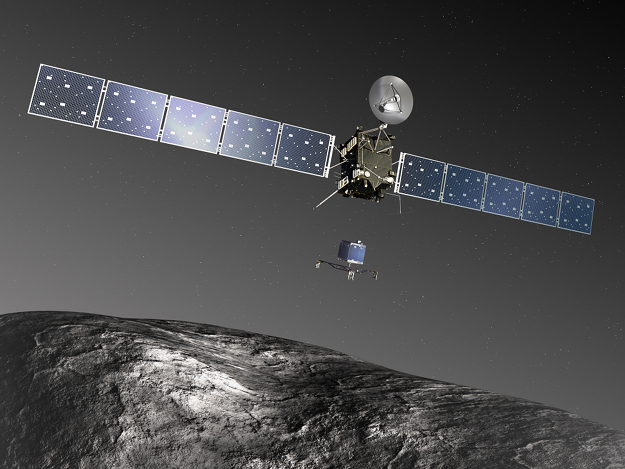
It’s being called “the most important alarm clock in the Solar System” — this Monday, January 20, at 10:00 GMT (which is 5:00 a.m. for U.S. East Coasters like me) the wake-up call will ring on ESA’s Rosetta spacecraft, bringing it out of hibernation after over two and a half years in preparation of its upcoming and highly-anticipated rendezvous with a comet.
The wake-up will incite the warming of Rosetta’s star trackers, which allow it to determine its orientation in space. Six hours later its thrusters will fire to stop its slow rotation and ensure that its solar arrays are receiving the right amount of sunlight. Using its thawed-out star trackers Rosetta will aim its transmitter towards Earth and, from 500 million miles (807 million km) away, will send a thumbs-up signal that everything is OK and it’s time to get back to work.
From that distance the transmission will take 45 minutes to reach us. Rosetta’s first signal is expected between 17:30 – 18:30 GMT (12:30 – 1:30 p.m. ET). Once we’re assured all is well, Rosetta has a very exciting year ahead!
After nearly a decade of soaring through the inner solar system, flying past Mars and Earth several times and even briefly visiting a couple of asteroids (2867 Steins on September 5, 2008 and 21 Lutetia on July 10, 2010) Rosetta is finally entering the home stretch of its mission to orbit the 4-km-wide comet 67P/Churyumov-Gerasimenko.
Once Rosetta enters orbit around the comet — the first time a spacecraft has ever done so — it will map its surface and, three months later in November, deploy the 220-lb (100-kg) Philae lander that will intimately investigate the surface of the nucleus using a suite of advanced science instruments
http://www.universetoday.com/108254/wake-up-rosetta/
DrCaleb @ Mon Jan 20, 2014 10:07 am
$1:
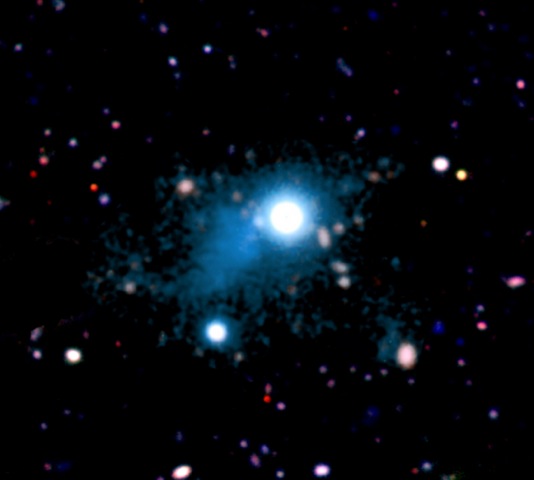
Quasar illuminates a cosmic filament—and a mystery
Filament is just like we'd predicted, except for a bad case of gas.
Dark matter binds the galaxy together. According to detailed computer simulations, it also binds galaxies to each other, creating a vast structure often called the "cosmic web" due to its appearance. In these models, the filaments that connect this web are traced by a combination of dark matter and atoms in the form of very low-density gas. While astronomers can identify the nodes of this web in the form of dark matter halos surrounding galaxies, the connecting threads have proven a little more challenging to spot.
Now, a group of astronomers identified one such filament close to a very distant galaxy. Sebastiano Cantapulo and colleagues observed the light emitted by the filament's gas as it glowed under bombardment from a quasar, a powerful jet of particles propelled from a massive black hole. However, the researchers also found at least ten times more gas than expected from cosmological simulations, which suggests that there may be more gas between galaxies than models predict.
Early in its history, the Universe had no stars or galaxies, and the density of all matter was remarkably uniform. However, tiny fluctuations in this density—as observed in the cosmic microwave background—led to small regions where the amount of dark matter was slightly higher than elsewhere. Those slight overdensities in turn attracted more matter, producing a slow cascade: some places collected a lot of dark matter and gas, while others were largely emptied out.
According to sophisticated supercomputer simulations, the result was the cosmic web: nodes of dark matter linked by thinner filaments, with vast voids between. (Computer models are necessary because the calculations are far too involved to perform by hand from first principles.) Galaxies and clusters of galaxies formed in the denser regions from gas attracted by the gravitational pull of dark matter. The resulting web is termed the large-scale structure of the Universe, and much of observational cosmology involves the process of mapping this cosmic web in three dimensions. (We see the sky as a two-dimensional surface and must use sophisticated techniques to infer the third dimension: distance from Earth.)

Filament is just like we'd predicted, except for a bad case of gas.
Dark matter binds the galaxy together. According to detailed computer simulations, it also binds galaxies to each other, creating a vast structure often called the "cosmic web" due to its appearance. In these models, the filaments that connect this web are traced by a combination of dark matter and atoms in the form of very low-density gas. While astronomers can identify the nodes of this web in the form of dark matter halos surrounding galaxies, the connecting threads have proven a little more challenging to spot.
Now, a group of astronomers identified one such filament close to a very distant galaxy. Sebastiano Cantapulo and colleagues observed the light emitted by the filament's gas as it glowed under bombardment from a quasar, a powerful jet of particles propelled from a massive black hole. However, the researchers also found at least ten times more gas than expected from cosmological simulations, which suggests that there may be more gas between galaxies than models predict.
Early in its history, the Universe had no stars or galaxies, and the density of all matter was remarkably uniform. However, tiny fluctuations in this density—as observed in the cosmic microwave background—led to small regions where the amount of dark matter was slightly higher than elsewhere. Those slight overdensities in turn attracted more matter, producing a slow cascade: some places collected a lot of dark matter and gas, while others were largely emptied out.
According to sophisticated supercomputer simulations, the result was the cosmic web: nodes of dark matter linked by thinner filaments, with vast voids between. (Computer models are necessary because the calculations are far too involved to perform by hand from first principles.) Galaxies and clusters of galaxies formed in the denser regions from gas attracted by the gravitational pull of dark matter. The resulting web is termed the large-scale structure of the Universe, and much of observational cosmology involves the process of mapping this cosmic web in three dimensions. (We see the sky as a two-dimensional surface and must use sophisticated techniques to infer the third dimension: distance from Earth.)
http://arstechnica.com/science/2014/01/ ... content%29
Full paper at:
http://www.nature.com/nature/journal/va ... 12898.html
This image is amazing. The 'dots' are galaxies, and the filaments are the 'dark matter' tendrils that link the gravity between galaxies and throughout the Universe.

DrCaleb @ Wed Jan 22, 2014 8:29 am
$1:
After bright explosion, astronomers rush to study new supernova
Overnight, astronomers spotted what may be a very close white dwarf supernova—close in cosmic terms at least. This bright explosion, seen in the M82 "Cigar" galaxy, is roughly 12 million light-years away—close enough to be seen with small telescopes and observed in detail by larger instruments. Even amateur astronomers and astrophotographers can see an explosion this bright and close.
By 08:47 UT (3:47am US ET) on January 22, 2014, astronomers working with the ARC 3.5-meter telescope at the Apache Point Observatory reported they had measured the spectrum of the supernova. Based on those data, they identified it as a probable type Ia supernova, meaning it has little hydrogen, but significant amounts of silicon and other heavier elements.
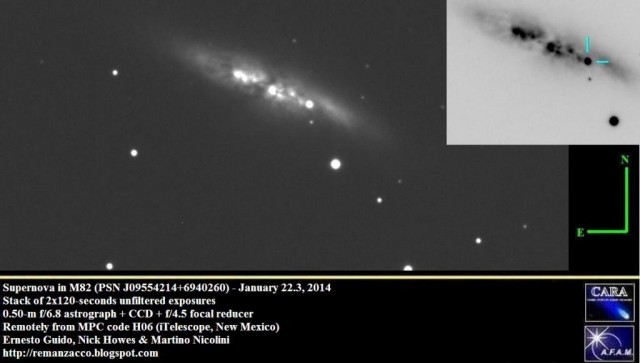
Overnight, astronomers spotted what may be a very close white dwarf supernova—close in cosmic terms at least. This bright explosion, seen in the M82 "Cigar" galaxy, is roughly 12 million light-years away—close enough to be seen with small telescopes and observed in detail by larger instruments. Even amateur astronomers and astrophotographers can see an explosion this bright and close.
By 08:47 UT (3:47am US ET) on January 22, 2014, astronomers working with the ARC 3.5-meter telescope at the Apache Point Observatory reported they had measured the spectrum of the supernova. Based on those data, they identified it as a probable type Ia supernova, meaning it has little hydrogen, but significant amounts of silicon and other heavier elements.
http://arstechnica.com/science/2014/01/ ... content%29
DrCaleb @ Wed Jan 22, 2014 10:48 am
$1:
Cosmic Lagoon Shines in Spectacular Views from Very Large Telescope
A pink lagoon glows in the Milky Way. New photos taken by a telescope in Chile put the Lagoon Nebula — a giant cloud of gas and dust located 5,000 light-years from Earth — on rosy display.
The Lagoon Nebula (also called Messier 8 ) is about 100 light-years across and harbors young stars that shine brightly in the image, according to European Southern Observatory officials. The VLT Survey Telescope in Chile captured the picture, taken as part of a sweeping set of surveys designed to unlock mysteries of the universe. You can watch a video flythrough of the new Lagoon Nebula image from ESO, based on the new VLT telescope images.
"The surveys are addressing many important questions in modern astronomy," ESO officials said in a statement. "These include the nature of dark energy, searching for brilliant quasars in the early universe, probing the structure of the Milky Way and looking for unusual and hidden objects, studying the neighboring Magellanic Clouds in great detail, and many other topics.

http://www.space.com/24357-lagoon-nebul ... video.html
A pink lagoon glows in the Milky Way. New photos taken by a telescope in Chile put the Lagoon Nebula — a giant cloud of gas and dust located 5,000 light-years from Earth — on rosy display.
The Lagoon Nebula (also called Messier 8 ) is about 100 light-years across and harbors young stars that shine brightly in the image, according to European Southern Observatory officials. The VLT Survey Telescope in Chile captured the picture, taken as part of a sweeping set of surveys designed to unlock mysteries of the universe. You can watch a video flythrough of the new Lagoon Nebula image from ESO, based on the new VLT telescope images.
"The surveys are addressing many important questions in modern astronomy," ESO officials said in a statement. "These include the nature of dark energy, searching for brilliant quasars in the early universe, probing the structure of the Milky Way and looking for unusual and hidden objects, studying the neighboring Magellanic Clouds in great detail, and many other topics.
http://www.space.com/24357-lagoon-nebul ... video.html
DrCaleb @ Wed Jan 22, 2014 1:46 pm
$1:
Telescope spies water plumes on dwarf planet Ceres
(Phys.org) —Scientists using the Herschel space observatory have made the first definitive detection of water vapor on the largest and roundest object in the asteroid belt, Ceres.
Plumes of water vapor are thought to shoot up periodically from Ceres when portions of its icy surface warm slightly. Ceres is classified as a dwarf planet, a solar system body bigger than an asteroid and smaller than a planet.
"This is the first time water vapor has been unequivocally detected on Ceres or any other object in the asteroid belt and provides proof that Ceres has an icy surface and an atmosphere," said Michael Küppers of ESA in Spain, lead author of a paper in the journal Nature.
The results come at the right time for NASA's Dawn mission, which is on its way to Ceres now after spending more than a year orbiting the large asteroid Vesta. Dawn is scheduled to arrive at Ceres in the spring of 2015, where it will take the closest look ever at its surface.
"We've got a spacecraft on the way to Ceres, so we don't have to wait long before getting more context on this intriguing result, right from the source itself," said Carol Raymond, the deputy principal investigator for Dawn at NASA's Jet Propulsion Laboratory in Pasadena, Calif. "Dawn will map the geology and chemistry of the surface in high resolution, revealing the processes that drive the outgassing activity."
(Phys.org) —Scientists using the Herschel space observatory have made the first definitive detection of water vapor on the largest and roundest object in the asteroid belt, Ceres.
Plumes of water vapor are thought to shoot up periodically from Ceres when portions of its icy surface warm slightly. Ceres is classified as a dwarf planet, a solar system body bigger than an asteroid and smaller than a planet.
"This is the first time water vapor has been unequivocally detected on Ceres or any other object in the asteroid belt and provides proof that Ceres has an icy surface and an atmosphere," said Michael Küppers of ESA in Spain, lead author of a paper in the journal Nature.
The results come at the right time for NASA's Dawn mission, which is on its way to Ceres now after spending more than a year orbiting the large asteroid Vesta. Dawn is scheduled to arrive at Ceres in the spring of 2015, where it will take the closest look ever at its surface.
"We've got a spacecraft on the way to Ceres, so we don't have to wait long before getting more context on this intriguing result, right from the source itself," said Carol Raymond, the deputy principal investigator for Dawn at NASA's Jet Propulsion Laboratory in Pasadena, Calif. "Dawn will map the geology and chemistry of the surface in high resolution, revealing the processes that drive the outgassing activity."
http://phys.org/news/2014-01-telescope- ... lanet.html
DrCaleb @ Fri Jan 24, 2014 7:15 am
$1:
Mars Rover Opportunity Finds Life-Friendly Niche
Gale Crater, the region being explored by NASA’s Curiosity rover, isn’t the only place on Mars where ancient microbes may have thrived.
The Mars rover Curiosity just found out that Martian soil is 2 percent water! Anthony tells us what that means for the age-old question of whether life once existed on Mars and what it means for future human colonists on the red planet.
NASA/JPL-Caltech
New evidence from NASA’s senior robotic Mars scout, Opportunity, shows life-friendly water once mixed with telltale, clay-bearing rocks that now lie on the broken rim of Endeavour Crater, an ancient 14-mile wide basin on the other side of the planet from Gale.
“If I were to go Mars early in time and wanted to do a well, I’d do it there,” planetary scientist Ray Arvidson, with Washington University in St. Louis, told Discovery News.
“It’s like drinking water,” he said, as opposed to the “acidic goo” Opportunity found at a previous site.
“This would have been a niche for whatever life at the time existed,” Arvidson said.
The finding dovetails with similar discoveries made by newcomer Curiosity, which, unlike Opportunity, is outfitted with a drill, onboard chemistry lab, and other instruments to hunt for potential life-friendly habitats. Opportunity’s mission -- to find signs of past water -- was more basic.
“You’ve got the same kind of clay minerals on a completely different part of the planet, and in a much older -- relatively speaking, hundreds of millions of years older -- succession of rocks,” geologist John Grotzinger, with the California Institute of Technology, told Discovery News.
Curiosity, which arrived in August 2012, already completed the primary goal if its mission. Analysis of samples drilled out from inside a slab of once water-covered bedrock shows that Mars did indeed have the right conditions and chemistry to support life.
Curiosity scientists now are focused on a more ambitious challenge to find places where organic carbon may be shielded from the radiation-rich and highly oxidizing environment of present-day Mars.

Gale Crater, the region being explored by NASA’s Curiosity rover, isn’t the only place on Mars where ancient microbes may have thrived.
The Mars rover Curiosity just found out that Martian soil is 2 percent water! Anthony tells us what that means for the age-old question of whether life once existed on Mars and what it means for future human colonists on the red planet.
NASA/JPL-Caltech
New evidence from NASA’s senior robotic Mars scout, Opportunity, shows life-friendly water once mixed with telltale, clay-bearing rocks that now lie on the broken rim of Endeavour Crater, an ancient 14-mile wide basin on the other side of the planet from Gale.
“If I were to go Mars early in time and wanted to do a well, I’d do it there,” planetary scientist Ray Arvidson, with Washington University in St. Louis, told Discovery News.
“It’s like drinking water,” he said, as opposed to the “acidic goo” Opportunity found at a previous site.
“This would have been a niche for whatever life at the time existed,” Arvidson said.
The finding dovetails with similar discoveries made by newcomer Curiosity, which, unlike Opportunity, is outfitted with a drill, onboard chemistry lab, and other instruments to hunt for potential life-friendly habitats. Opportunity’s mission -- to find signs of past water -- was more basic.
“You’ve got the same kind of clay minerals on a completely different part of the planet, and in a much older -- relatively speaking, hundreds of millions of years older -- succession of rocks,” geologist John Grotzinger, with the California Institute of Technology, told Discovery News.
Curiosity, which arrived in August 2012, already completed the primary goal if its mission. Analysis of samples drilled out from inside a slab of once water-covered bedrock shows that Mars did indeed have the right conditions and chemistry to support life.
Curiosity scientists now are focused on a more ambitious challenge to find places where organic carbon may be shielded from the radiation-rich and highly oxidizing environment of present-day Mars.
http://news.discovery.com/space/mars-ro ... 140123.htm
DrCaleb @ Fri Jan 24, 2014 7:17 am
$1:
Stephen Hawking: 'There are no black holes'
Notion of an 'event horizon', from which nothing can escape, is incompatible with quantum theory, physicist claims.
Most physicists foolhardy enough to write a paper claiming that “there are no black holes” — at least not in the sense we usually imagine — would probably be dismissed as cranks. But when the call to redefine these cosmic crunchers comes from Stephen Hawking, it’s worth taking notice. In a paper posted online, the physicist, based at the University of Cambridge, UK, and one of the creators of modern black-hole theory, does away with the notion of an event horizon, the invisible boundary thought to shroud every black hole, beyond which nothing, not even light, can escape.
“There is no escape from a black hole in classical theory, but quantum theory enables energy and information to escape.”
In its stead, Hawking’s radical proposal is a much more benign “apparent horizon”, which only temporarily holds matter and energy prisoner before eventually releasing them, albeit in a more garbled form.
“There is no escape from a black hole in classical theory,” Hawking told Nature. Quantum theory, however, “enables energy and information to escape from a black hole”. A full explanation of the process, the physicist admits, would require a theory that successfully merges gravity with the other fundamental forces of nature. But that is a goal that has eluded physicists for nearly a century. “The correct treatment,” Hawking says, “remains a mystery.”
Hawking posted his paper on the arXiv preprint server on 22 Januar. He titled it, whimsically, 'Information preservation and weather forecasting for black holes', and it has yet to pass peer review. The paper was based on a talk he gave via Skype at a meeting at the Kavli Institute for Theoretical Physics in Santa Barbara, California, in August 2013.
Fire fighting
Hawking's new work is an attempt to solve what is known as the black-hole firewall paradox, which has been vexing physicists for almost two years, after it was discovered by theoretical physicist Joseph Polchinski of the Kavli Institute and his colleagues (see 'Astrophysics: Fire in the hole!').
In a thought experiment, the researchers asked what would happen to an astronaut unlucky enough to fall into a black hole. Event horizons are mathematically simple consequences of Einstein's general theory of relativity that were first pointed out by the German astronomer Karl Schwarzschild in a letter he wrote to Einstein in late 1915, less than a month after the publication of the theory. In that picture, physicists had long assumed, the astronaut would happily pass through the event horizon, unaware of his or her impending doom, before gradually being pulled inwards — stretched out along the way, like spaghetti — and eventually crushed at the 'singularity', the black hole’s hypothetical infinitely dense core.
But on analysing the situation in detail, Polchinski’s team came to the startling realization that the laws of quantum mechanics, which govern particles on small scales, change the situation completely. Quantum theory, they said, dictates that the event horizon must actually be transformed into a highly energetic region, or 'firewall', that would burn the astronaut to a crisp.
This was alarming because, although the firewall obeyed quantum rules, it flouted Einstein’s general theory of relativity. According to that theory, someone in free fall should perceive the laws of physics as being identical everywhere in the Universe — whether they are falling into a black hole or floating in empty intergalactic space. As far as Einstein is concerned, the event horizon should be an unremarkable place.

Notion of an 'event horizon', from which nothing can escape, is incompatible with quantum theory, physicist claims.
Most physicists foolhardy enough to write a paper claiming that “there are no black holes” — at least not in the sense we usually imagine — would probably be dismissed as cranks. But when the call to redefine these cosmic crunchers comes from Stephen Hawking, it’s worth taking notice. In a paper posted online, the physicist, based at the University of Cambridge, UK, and one of the creators of modern black-hole theory, does away with the notion of an event horizon, the invisible boundary thought to shroud every black hole, beyond which nothing, not even light, can escape.
“There is no escape from a black hole in classical theory, but quantum theory enables energy and information to escape.”
In its stead, Hawking’s radical proposal is a much more benign “apparent horizon”, which only temporarily holds matter and energy prisoner before eventually releasing them, albeit in a more garbled form.
“There is no escape from a black hole in classical theory,” Hawking told Nature. Quantum theory, however, “enables energy and information to escape from a black hole”. A full explanation of the process, the physicist admits, would require a theory that successfully merges gravity with the other fundamental forces of nature. But that is a goal that has eluded physicists for nearly a century. “The correct treatment,” Hawking says, “remains a mystery.”
Hawking posted his paper on the arXiv preprint server on 22 Januar. He titled it, whimsically, 'Information preservation and weather forecasting for black holes', and it has yet to pass peer review. The paper was based on a talk he gave via Skype at a meeting at the Kavli Institute for Theoretical Physics in Santa Barbara, California, in August 2013.
Fire fighting
Hawking's new work is an attempt to solve what is known as the black-hole firewall paradox, which has been vexing physicists for almost two years, after it was discovered by theoretical physicist Joseph Polchinski of the Kavli Institute and his colleagues (see 'Astrophysics: Fire in the hole!').
In a thought experiment, the researchers asked what would happen to an astronaut unlucky enough to fall into a black hole. Event horizons are mathematically simple consequences of Einstein's general theory of relativity that were first pointed out by the German astronomer Karl Schwarzschild in a letter he wrote to Einstein in late 1915, less than a month after the publication of the theory. In that picture, physicists had long assumed, the astronaut would happily pass through the event horizon, unaware of his or her impending doom, before gradually being pulled inwards — stretched out along the way, like spaghetti — and eventually crushed at the 'singularity', the black hole’s hypothetical infinitely dense core.
But on analysing the situation in detail, Polchinski’s team came to the startling realization that the laws of quantum mechanics, which govern particles on small scales, change the situation completely. Quantum theory, they said, dictates that the event horizon must actually be transformed into a highly energetic region, or 'firewall', that would burn the astronaut to a crisp.
This was alarming because, although the firewall obeyed quantum rules, it flouted Einstein’s general theory of relativity. According to that theory, someone in free fall should perceive the laws of physics as being identical everywhere in the Universe — whether they are falling into a black hole or floating in empty intergalactic space. As far as Einstein is concerned, the event horizon should be an unremarkable place.
http://www.nature.com/news/stephen-hawk ... es-1.14583
DrCaleb @ Fri Jan 24, 2014 9:01 am
$1:
Extreme power of black hole revealed
Astronomers have used NASA's Chandra X-ray Observatory and a suite of other telescopes to reveal one of the most powerful black holes known. The black hole has created enormous structures in the hot gas surrounding it and prevented trillions of stars from forming.
The black hole is in a galaxy cluster named RX J1532.9+3021 (RX J1532 for short), located about 3.9 billion light years from Earth.
The image here is a composite of X-ray data from Chandra revealing hot gas in the cluster in purple and optical data from the Hubble Space Telescope showing galaxies in yellow. The cluster is very bright in X-rays implying that it is extremely massive, with a mass about a quadrillion - a thousand trillion - times that of the sun. At the center of the cluster is a large elliptical galaxy containing the supermassive black hole.
The large amount of hot gas near the center of the cluster presents a puzzle. Hot gas glowing with X-rays should cool, and the dense gas in the center of the cluster should cool the fastest. The pressure in this cool central gas is then expected to drop, causing gas further out to sink in towards the galaxy, forming trillions of stars along the way. However, astronomers have found no such evidence for this burst of stars forming at the center of this cluster.
This problem has been noted in many galaxy clusters but RX J1532 is an extreme case, where the cooling of gas should be especially dramatic because of the high density of gas near the center. Out of the thousands of clusters known to date, less than a dozen are as extreme as RX J1532. The Phoenix Cluster is the most extreme, where, conversely, large numbers of stars have been observed to be forming.
What is stopping large numbers of stars from forming in RX J1532? Images from the Chandra X-ray Observatory and the NSF's Karl G. Jansky Very Large Array (VLA) have provided an answer to this question. The X-ray image shows two large cavities in the hot gas on either side of the central galaxy. The Chandra image has been specially processed to emphasize the cavities. Both cavities are aligned with jets seen in radio images from the VLA. The location of the supermassive black hole between the cavities is strong evidence that the supersonic jets generated by the black hole have drilled into the hot gas and pushed it aside, forming the cavities.

Astronomers have used NASA's Chandra X-ray Observatory and a suite of other telescopes to reveal one of the most powerful black holes known. The black hole has created enormous structures in the hot gas surrounding it and prevented trillions of stars from forming.
The black hole is in a galaxy cluster named RX J1532.9+3021 (RX J1532 for short), located about 3.9 billion light years from Earth.
The image here is a composite of X-ray data from Chandra revealing hot gas in the cluster in purple and optical data from the Hubble Space Telescope showing galaxies in yellow. The cluster is very bright in X-rays implying that it is extremely massive, with a mass about a quadrillion - a thousand trillion - times that of the sun. At the center of the cluster is a large elliptical galaxy containing the supermassive black hole.
The large amount of hot gas near the center of the cluster presents a puzzle. Hot gas glowing with X-rays should cool, and the dense gas in the center of the cluster should cool the fastest. The pressure in this cool central gas is then expected to drop, causing gas further out to sink in towards the galaxy, forming trillions of stars along the way. However, astronomers have found no such evidence for this burst of stars forming at the center of this cluster.
This problem has been noted in many galaxy clusters but RX J1532 is an extreme case, where the cooling of gas should be especially dramatic because of the high density of gas near the center. Out of the thousands of clusters known to date, less than a dozen are as extreme as RX J1532. The Phoenix Cluster is the most extreme, where, conversely, large numbers of stars have been observed to be forming.
What is stopping large numbers of stars from forming in RX J1532? Images from the Chandra X-ray Observatory and the NSF's Karl G. Jansky Very Large Array (VLA) have provided an answer to this question. The X-ray image shows two large cavities in the hot gas on either side of the central galaxy. The Chandra image has been specially processed to emphasize the cavities. Both cavities are aligned with jets seen in radio images from the VLA. The location of the supermassive black hole between the cavities is strong evidence that the supersonic jets generated by the black hole have drilled into the hot gas and pushed it aside, forming the cavities.
http://www.tgdaily.com/space-features/8 ... e-revealed
DrCaleb @ Mon Jan 27, 2014 12:49 pm
$1:
Haze in the Sichuan Basin, as seen from space
The Sichuan Basin is home to many cities, including the province’s capital Chengdu, a city with more than 14 million residents.
Haze is trapped in the basin because of a temperature inversion. The same process that gives us beautiful fog in the Grand Canyon also works for pollutants

http://blogs.scientificamerican.com/plu ... rom-space/
DrCaleb @ Mon Jan 27, 2014 12:53 pm
January 30th 2014 will also be a 'Supermoon', the moon has it's closest approach to Earth, and it will be a full moon - the second full moon this calendar month!
Tyler_1 @ Mon Jan 27, 2014 1:04 pm
DrCaleb DrCaleb:
January 30th 2014 will also be a 'Supermoon', the moon has it's closest approach to Earth, and it will be a full moon - the second full moon this calendar month!
Not fair! I'm already tired and here we go again.

I do like looking at it though.

DrCaleb @ Tue Jan 28, 2014 7:17 am
DonnaWho DonnaWho:
DrCaleb DrCaleb:
January 30th 2014 will also be a 'Supermoon', the moon has it's closest approach to Earth, and it will be a full moon - the second full moon this calendar month!
Not fair! I'm already tired and here we go again.
I do like looking at it though.
Do you turn into a were-cat on the full moon?
Previous 1 ... 34 35 36 37 38 39 40 ... 244 Next