
Space Thread
Previous 1 ... 38 39 40 41 42 43 44 ... 244 Next
stratos @ Wed Feb 12, 2014 12:16 am
You know sometimes it is just nice to kick back and enjoy the wonders of Gods creation. Thanks DrCaleb you are right that was 3 minutes 43 seconds well spent. ![[B-o]](./images/smilies/drinkup.gif "Drink up")
DrCaleb @ Wed Feb 12, 2014 7:49 am
stratos stratos:
You know sometimes it is just nice to kick back and enjoy the wonders of Gods creation. Thanks DrCaleb you are right that was 3 minutes 43 seconds well spent.
I love that kind of stuff. And our sun is called an 'unremarkable' star. Even little ones like Wolf 359 or big ones like Betelgeuse must be even more interesting.
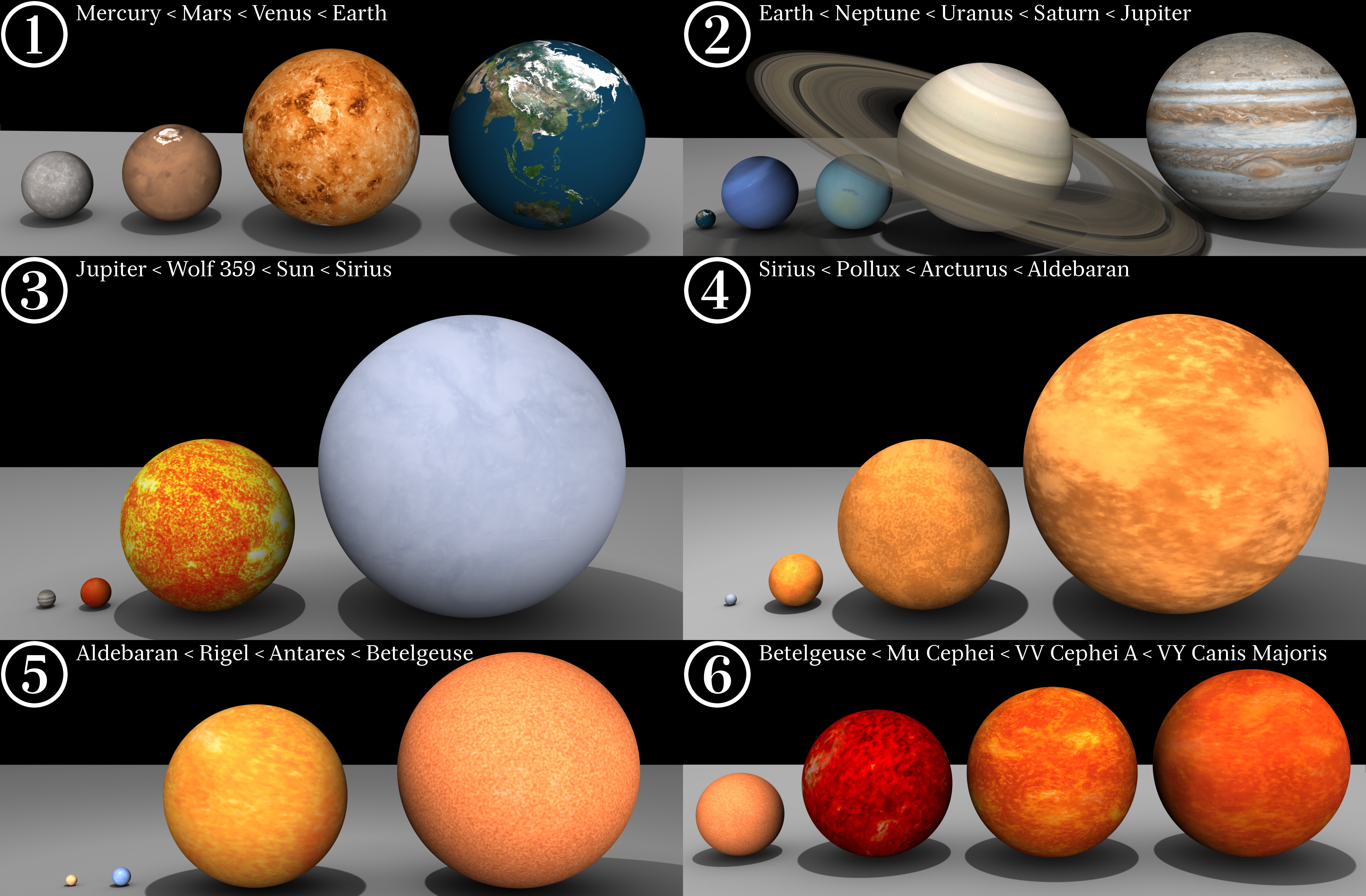
For a size comparison, if you took a fast intercontinental Jet, you could go once around the Earth in about 30 hours. If you took that jet and went around Canus Majoris, it would take 22,000 years.
 When she pops, I wonder how many star systems will form from the debris?
stratos @ Wed Feb 12, 2014 8:09 am
DrCaleb DrCaleb:
stratos stratos:
You know sometimes it is just nice to kick back and enjoy the wonders of Gods creation. Thanks DrCaleb you are right that was 3 minutes 43 seconds well spent.
I love that kind of stuff. And our sun is called an 'unremarkable' star. Even little ones like Wolf 359 or big ones like Betelgeuse must be even more interesting.
For a size comparison, if you took a fast intercontinental Jet, you could go once around the Earth in about 30 hours. If you took that jet and went around Canus Majoris, it would take 22,000 years.
When she pops, I wonder how many star systems will form from the debris?Can you imagine how far away you would have to be planet wise just to be able to have life like we do here on earth. I'm thinking about the range from the Sun to Pluto for a planet to be habitable in the Canus Majoris system.
DrCaleb @ Wed Feb 12, 2014 8:42 am
stratos stratos:
DrCaleb DrCaleb:
stratos stratos:
You know sometimes it is just nice to kick back and enjoy the wonders of Gods creation. Thanks DrCaleb you are right that was 3 minutes 43 seconds well spent.
I love that kind of stuff. And our sun is called an 'unremarkable' star. Even little ones like Wolf 359 or big ones like Betelgeuse must be even more interesting.
For a size comparison, if you took a fast intercontinental Jet, you could go once around the Earth in about 30 hours. If you took that jet and went around Canus Majoris, it would take 22,000 years.
When she pops, I wonder how many star systems will form from the debris?Can you imagine how far away you would have to be planet wise just to be able to have life like we do here on earth. I'm thinking about the range from the Sun to Pluto for a planet to be habitable in the Canus Majoris system.
Pluto might not be far enough. Mars orbit is 1.5 AU. Jupiter orbit is 5 AU.
Canus Majoris is 6.6 AU in diameter, so it would be right in between those two.
Imagine the heat of a star that huge! I'd bet something like Sedna might not be far enough!http://en.wikipedia.org/wiki/90377_Sedna
stratos @ Wed Feb 12, 2014 8:48 am
$1:
Canus Majoris is 6.6 AU in diameter, so it would be right in between those two. Imagine the heat of a star that huge! I'd bet something like Sedna might not be far enough!
Well at least we would all have nice tans.

DrCaleb @ Wed Feb 12, 2014 11:39 am
$1:
NASA’s Curiosity drives on after crossing Martian dune
NASA’s Curiosity Mars rover is continuing its traverse toward enticing science destinations after climbing over a dune spanning a gap in a ridge.
The rover covered 135 feet (41.1 meters) on Feb. 9, in its first drive since the 23-foot (7-meter) crossing of the dune on Feb. 6. That put Curiosity’s total odometry since its August 2012 landing at 3.09 miles (4.97 kilometers).
An animated sequence of images from the low-slung Hazard-Avoidance Camera on the rear of the vehicle documents the up-then-down crossing of the dune.

NASA’s Curiosity Mars rover is continuing its traverse toward enticing science destinations after climbing over a dune spanning a gap in a ridge.
The rover covered 135 feet (41.1 meters) on Feb. 9, in its first drive since the 23-foot (7-meter) crossing of the dune on Feb. 6. That put Curiosity’s total odometry since its August 2012 landing at 3.09 miles (4.97 kilometers).
An animated sequence of images from the low-slung Hazard-Avoidance Camera on the rear of the vehicle documents the up-then-down crossing of the dune.
http://www.euronews.com/2014/02/12/watc ... tian-dune/
Jabberwalker @ Wed Feb 12, 2014 12:39 pm
Shouldn't they be checking that dust for organic compounds? terrestrial dust is just full of life-connected things.
DrCaleb @ Thu Feb 13, 2014 8:12 am
^^ I bet they forgot about that. Perhaps you should email them your suggestion?
$1:
Adoring fans cheer on Jade Rabbit moon rover
"It's alive!! The rabbit is still alive!! The rabbit's awake!! It's really awake!!", wrote one user on weibo, China's version of Twitter.
"Wake up darling baby," cooed another. "Billions of people are calling out to you!"
What, pray tell, were they speaking to?
China's moon rover, of course.
The Jade Rabbit, named after the mythical pet of China's moon goddess, has captured the attention of millions in China.
The six-wheeled exploration vehicle is equipped with cutting-edge radars that allow it to study the moon's crust. Multiple cameras on the rover's exterior allow it to photograph its surroundings and beam them back to Earth.

"It's alive!! The rabbit is still alive!! The rabbit's awake!! It's really awake!!", wrote one user on weibo, China's version of Twitter.
"Wake up darling baby," cooed another. "Billions of people are calling out to you!"
What, pray tell, were they speaking to?
China's moon rover, of course.
The Jade Rabbit, named after the mythical pet of China's moon goddess, has captured the attention of millions in China.
The six-wheeled exploration vehicle is equipped with cutting-edge radars that allow it to study the moon's crust. Multiple cameras on the rover's exterior allow it to photograph its surroundings and beam them back to Earth.
http://www.bbc.co.uk/news/blogs-china-blog-26167671
Jabberwalker @ Thu Feb 13, 2014 9:36 am
[quote="DrCaleb"]^^ I bet they forgot about that. Perhaps you should email them your suggestion?

DrCaleb @ Thu Feb 13, 2014 9:55 am
Jabberwalker Jabberwalker:
DrCaleb DrCaleb:
^^ I bet they forgot about that. Perhaps you should email them your suggestion?
![[BB]](./images/smilies/beers.gif "Beers")
DrCaleb @ Fri Feb 14, 2014 11:05 am
$1:
First geologic map of Ganymede made with Voyager data
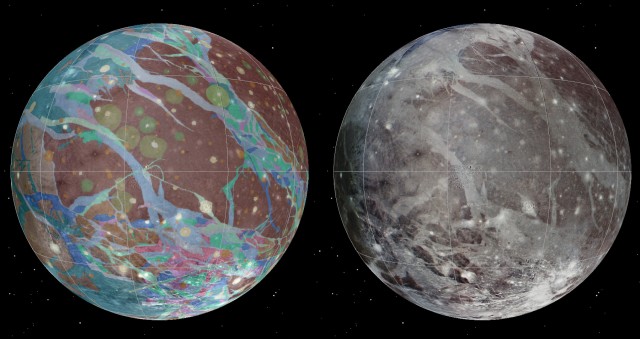
Maps have always been an integral part of exploration. They take the in out of terra incognita. Some things are easier to map than others, of course. The geology of a world a few hundred million miles away is one of those other things. Nevertheless, the United States Geological Survey just released a geologic map of Jupiter’s moon Ganymede—an icy satellite larger than Mercury.
The map was created through the hard work of a team led by Wheaton College’s Geoffrey Collins using imagery from the Voyager probes and the more recent Galileo mission. Much in the way that geologists can determine the relative ages of Earth rocks by noting which rocks cut into or through others, Ganymede’s surface can tell us about its own geologic history.
Maps have always been an integral part of exploration. They take the in out of terra incognita. Some things are easier to map than others, of course. The geology of a world a few hundred million miles away is one of those other things. Nevertheless, the United States Geological Survey just released a geologic map of Jupiter’s moon Ganymede—an icy satellite larger than Mercury.
The map was created through the hard work of a team led by Wheaton College’s Geoffrey Collins using imagery from the Voyager probes and the more recent Galileo mission. Much in the way that geologists can determine the relative ages of Earth rocks by noting which rocks cut into or through others, Ganymede’s surface can tell us about its own geologic history.
http://arstechnica.com/science/2014/02/ ... ager-data/
For a 5 foot high printable map, go here: http://pubs.usgs.gov/sim/3237/
DrCaleb @ Wed Feb 19, 2014 10:55 am
$1:
Astronomers Capture Stunning New Image of Messier 7
A team of astronomers using the MPG/ESO 2.2-m telescope at ESO’s La Silla Observatory in Chile has captured a new image of the open star cluster Messier 7, also known as NGC 6475.
Messier 7 is a small cluster of about 100 stars located in the constellation of Scorpius, about 800 light-years away.
The cluster is about 200 million years old and spans some 25 light-years across.
The first to mention this stellar object was the Roman mathematician and astronomer Claudius Ptolemy, as early as 130 AD, who described it as a “nebula following the sting of Scorpius.” In his honor, Messier 7 is sometimes called Ptolemy’s Cluster.
In 1764, Charles Messier included it as the seventh entry in his Messier catalogue.

A team of astronomers using the MPG/ESO 2.2-m telescope at ESO’s La Silla Observatory in Chile has captured a new image of the open star cluster Messier 7, also known as NGC 6475.
Messier 7 is a small cluster of about 100 stars located in the constellation of Scorpius, about 800 light-years away.
The cluster is about 200 million years old and spans some 25 light-years across.
The first to mention this stellar object was the Roman mathematician and astronomer Claudius Ptolemy, as early as 130 AD, who described it as a “nebula following the sting of Scorpius.” In his honor, Messier 7 is sometimes called Ptolemy’s Cluster.
In 1764, Charles Messier included it as the seventh entry in his Messier catalogue.
http://www.sci-news.com/astronomy/scien ... 01772.html
DrCaleb @ Thu Feb 20, 2014 11:36 am
$1:
Lumps in a supernova reveal nature of explosion—and a mystery
Titanium obeys theory, iron and nickel are rebels.
The death of a massive star is among the most energetic events in the cosmos. However, the particular way a star explodes is a matter of some dispute: different theoretical models predict different shapes for the dispersion of material, which in turn affects how new chemical elements forged in the supernova spread out into space. That's a rather significant area of disagreement given that past explosions created many of the chemical elements on Earth.
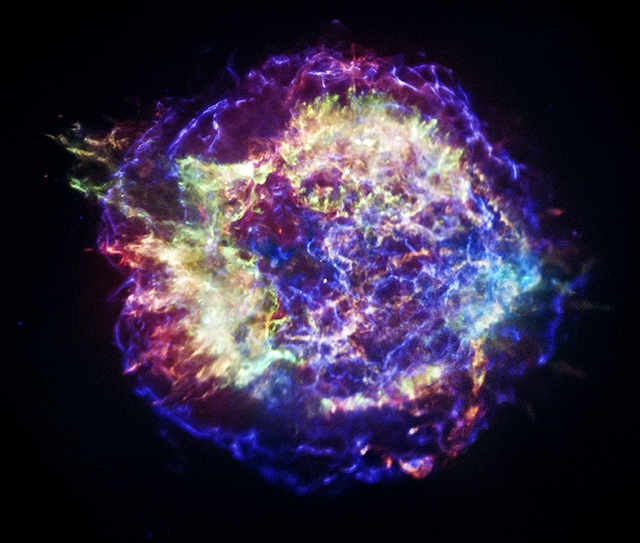
A new analysis of the remnant of a relatively recent supernova revealed some clear details about the shape of the original explosion. B.W. Grefenstette and colleagues mapped the distribution of radioactive titanium in the Cassiopeia A supernova remnant and found significant asymmetries in its dispersal pattern. The titanium results are congruent with theory, but the researchers also found a striking disconnect between emissions from titanium and those from iron, which is difficult to reconcile with any popular supernova model.
Since there haven't been any recent supernovae to observe in the Milky Way, astronomers must operate forensically, reconstructing the initial explosion from the matter left behind. Thankfully, supernovae are sufficiently energetic that their remnants glow strongly, even centuries after the fact. Even though we haven't observed a Milky Way supernova in our lifetimes, there are a handful of remnants to study using X-ray telescopes and other means.
Cassiopeia A (abbreviated Cas A) is a historical oddity. The supernova was relatively close to Earth—a mere 11,000 light-years distant—and should have been visible around CE 1671, yet no astronomers of any culture recorded it. That's in stark contrast to famous earlier explosions: Tycho's supernova, Kepler's supernova, and of course the supernova that made the Crab Nebula. This mysterious absence has led some astronomers to speculate that some unknown mechanism diffused the energy from the explosion, making the supernova far less bright than expected.
Titanium obeys theory, iron and nickel are rebels.
The death of a massive star is among the most energetic events in the cosmos. However, the particular way a star explodes is a matter of some dispute: different theoretical models predict different shapes for the dispersion of material, which in turn affects how new chemical elements forged in the supernova spread out into space. That's a rather significant area of disagreement given that past explosions created many of the chemical elements on Earth.
A new analysis of the remnant of a relatively recent supernova revealed some clear details about the shape of the original explosion. B.W. Grefenstette and colleagues mapped the distribution of radioactive titanium in the Cassiopeia A supernova remnant and found significant asymmetries in its dispersal pattern. The titanium results are congruent with theory, but the researchers also found a striking disconnect between emissions from titanium and those from iron, which is difficult to reconcile with any popular supernova model.
Since there haven't been any recent supernovae to observe in the Milky Way, astronomers must operate forensically, reconstructing the initial explosion from the matter left behind. Thankfully, supernovae are sufficiently energetic that their remnants glow strongly, even centuries after the fact. Even though we haven't observed a Milky Way supernova in our lifetimes, there are a handful of remnants to study using X-ray telescopes and other means.
Cassiopeia A (abbreviated Cas A) is a historical oddity. The supernova was relatively close to Earth—a mere 11,000 light-years distant—and should have been visible around CE 1671, yet no astronomers of any culture recorded it. That's in stark contrast to famous earlier explosions: Tycho's supernova, Kepler's supernova, and of course the supernova that made the Crab Nebula. This mysterious absence has led some astronomers to speculate that some unknown mechanism diffused the energy from the explosion, making the supernova far less bright than expected.
http://arstechnica.com/science/2014/02/ ... a-mystery/
DrCaleb @ Thu Feb 20, 2014 1:40 pm
$1:
Looking Back to the Cradle of Our Universe
NASA's Spitzer and Hubble Space Telescopes have spotted what might be one of the most distant galaxies known, harkening back to a time when our universe was only about 650 million years old (our universe is 13.8 billion years old). The galaxy, known as Abell2744 Y1, is about 30 times smaller than our Milky Way galaxy and is producing about 10 times more stars, as is typical for galaxies in our young universe.
The discovery comes from the Frontier Fields program, which is pushing the limits of how far back we can see into the distant universe using NASA's multi-wavelength suite of Great Observatories. Spitzer sees infrared light, Hubble sees visible and shorter-wavelength infrared light, and NASA's Chandra X-ray Observatory sees X-rays. The telescopes are getting a boost from natural lenses: they peer through clusters of galaxies, where gravity magnifies the light of more distant galaxies.
The Frontier Fields program will image six galaxy clusters in total. Hubble images of the region are used to spot candidate distant galaxies, and then Spitzer is needed to determine if the galaxies are, in fact, as far as they seem. Spitzer data also help determine how many stars are in the galaxy.
These early results from the program come from images of the Abell 2744 galaxy cluster. The distance to this galaxy, if confirmed, would make it one of the farthest known. Astronomers say it has a redshift of 8, which is a measure of the degree to which its light has been shifted to redder wavelengths due to the expansion of our universe. The farther a galaxy, the higher the redshift. The farthest confirmed galaxy has a redshift of more than 7. Other candidates have been identified with redshifts as high as 11.

NASA's Spitzer and Hubble Space Telescopes have spotted what might be one of the most distant galaxies known, harkening back to a time when our universe was only about 650 million years old (our universe is 13.8 billion years old). The galaxy, known as Abell2744 Y1, is about 30 times smaller than our Milky Way galaxy and is producing about 10 times more stars, as is typical for galaxies in our young universe.
The discovery comes from the Frontier Fields program, which is pushing the limits of how far back we can see into the distant universe using NASA's multi-wavelength suite of Great Observatories. Spitzer sees infrared light, Hubble sees visible and shorter-wavelength infrared light, and NASA's Chandra X-ray Observatory sees X-rays. The telescopes are getting a boost from natural lenses: they peer through clusters of galaxies, where gravity magnifies the light of more distant galaxies.
The Frontier Fields program will image six galaxy clusters in total. Hubble images of the region are used to spot candidate distant galaxies, and then Spitzer is needed to determine if the galaxies are, in fact, as far as they seem. Spitzer data also help determine how many stars are in the galaxy.
These early results from the program come from images of the Abell 2744 galaxy cluster. The distance to this galaxy, if confirmed, would make it one of the farthest known. Astronomers say it has a redshift of 8, which is a measure of the degree to which its light has been shifted to redder wavelengths due to the expansion of our universe. The farther a galaxy, the higher the redshift. The farthest confirmed galaxy has a redshift of more than 7. Other candidates have been identified with redshifts as high as 11.
http://www.nasa.gov/jpl/spitzer/galaxy- ... index.html
DrCaleb @ Tue Feb 25, 2014 7:44 am
$1:
'Biggest observed meteorite impact' hits Moon
Scientists say they have observed a record-breaking impact on the Moon.
Spanish astronomers spotted a meteorite with a mass of about half a tonne crashing into the lunar surface last September.
They say the collision would have generated a flash of light so bright that it would have been visible from Earth.
The event is reported in the Monthly Notices of the Royal Astronomical Society.
"This is the largest, brightest impact we have ever observed on the Moon," said Prof Jose Madiedo, of the University of Huelva in south-western Spain.
Continue reading the main story
“Start Quote
The impact we detected lasted over eight seconds”
Prof Jose Madiedo University of Huelva
The explosive strike was spotted by the Moon Impacts Detection and Analysis System (Midas) of telescopes in southern Spain on 11 September at 20:07 GMT.
"Usually lunar impacts have a very short duration - just a fraction of a second. But the impact we detected lasted over eight seconds. It was almost as bright as the Pole Star, which makes it the brightest impact event that we have recorded from Earth," said Prof Madiedo.
The researchers say a lump of rock weighing about 400kg (900lb) and travelling at 61,000km/h (38,000mph) slammed into the surface of the Moon.
They believe the dense mass, which had a width of 0.6-1.4m (2-4.6ft), hit with energy equivalent to about 15 tonnes of TNT.
This is about three times more explosive than another lunar impact spotted by Nasa last March. That space rock weighed about 40kg and was about 0.3-0.4m wide.

Scientists say they have observed a record-breaking impact on the Moon.
Spanish astronomers spotted a meteorite with a mass of about half a tonne crashing into the lunar surface last September.
They say the collision would have generated a flash of light so bright that it would have been visible from Earth.
The event is reported in the Monthly Notices of the Royal Astronomical Society.
"This is the largest, brightest impact we have ever observed on the Moon," said Prof Jose Madiedo, of the University of Huelva in south-western Spain.
Continue reading the main story
“Start Quote
The impact we detected lasted over eight seconds”
Prof Jose Madiedo University of Huelva
The explosive strike was spotted by the Moon Impacts Detection and Analysis System (Midas) of telescopes in southern Spain on 11 September at 20:07 GMT.
"Usually lunar impacts have a very short duration - just a fraction of a second. But the impact we detected lasted over eight seconds. It was almost as bright as the Pole Star, which makes it the brightest impact event that we have recorded from Earth," said Prof Madiedo.
The researchers say a lump of rock weighing about 400kg (900lb) and travelling at 61,000km/h (38,000mph) slammed into the surface of the Moon.
They believe the dense mass, which had a width of 0.6-1.4m (2-4.6ft), hit with energy equivalent to about 15 tonnes of TNT.
This is about three times more explosive than another lunar impact spotted by Nasa last March. That space rock weighed about 40kg and was about 0.3-0.4m wide.
Previous 1 ... 38 39 40 41 42 43 44 ... 244 Next