
Space Thread
Previous 1 ... 41 42 43 44 45 46 47 ... 244 Next
ShepherdsDog @ Mon Mar 10, 2014 10:01 am
a volksvogon? That`d leave a scratch
Jabberwalker @ Mon Mar 10, 2014 10:05 am
No, the Vogons slated Earth to be demolished to make room for an interstellar bypass. The edict has been posted out there for years in the planning dep't. but the Earthings have been too lazy to go to the right star system and look at them.
http://hitchhikers.wikia.com/wiki/Vogon ... ctor_Fleet
ShepherdsDog @ Mon Mar 10, 2014 10:08 am
oh...42
stratos @ Tue Mar 11, 2014 2:32 am
Orion death stars destroy potential planets: Is Earth the next target?
http://www.examiner.com/article/orion-d ... rget-video
Gunnair @ Tue Mar 11, 2014 5:09 pm
$1:
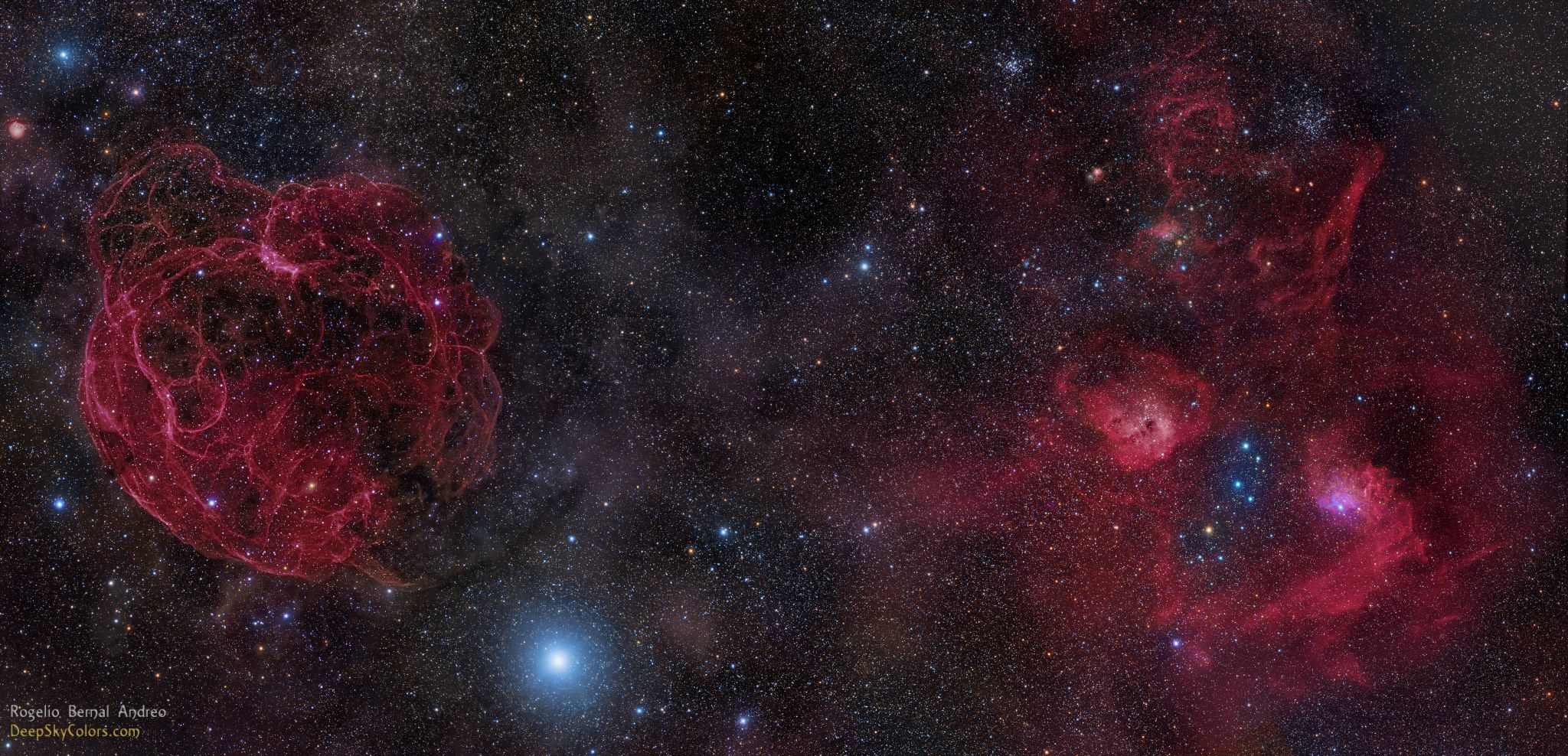
Rich in star clusters and nebulae, the ancient constellation of Auriga, the Charioteer, rides high in northern winter night skies. Spanning nearly 24 full moons (12 degrees) on the sky, this deep telescopic mosaic view recorded in January shows off some of Auriga's most popular sights for cosmic tourists. The crowded field sweeps along the plane of our Milky Way galaxy in the direction opposite the galactic center. Need directions? Near the bottom of the frame, at the Charioteer's boundary with Taurus the Bull, the bright bluish star Elnath is known as both Beta Tauri and Gamma Aurigae. On the far left and almost 3000 light-years away, the busy, looping filaments of supernova remnant Simeis 147 cover about 150 light-years. Look toward the right to find emission nebula IC 410, significantly more distant, some 12,000 light-years away. Star forming IC 410 is famous for its embedded young star cluster, NGC 1893, and tadpole-shaped clouds of dust and gas. The Flaming Star Nebula, IC 405, is just a little farther along. Its red, convoluted clouds of glowing hydrogen gas are energized by hot O-type star AE Aurigae. Two of our galaxy's open star clusters, Charles Messier's M36 and M38 line up in the starfield above, familiar to many binocular-equipped skygazers.
Gunnair @ Tue Mar 11, 2014 5:10 pm
$1:
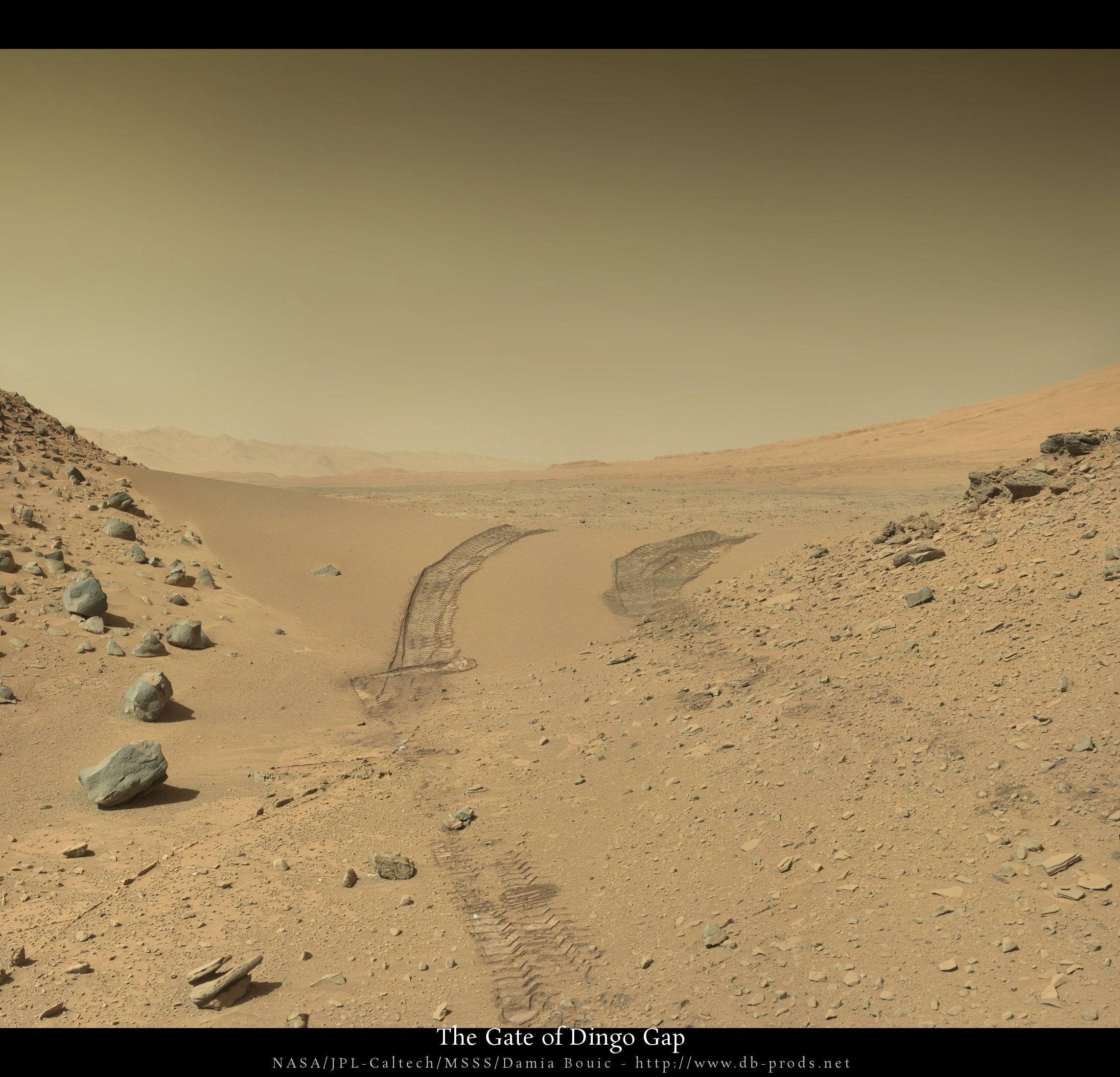
An important threshold on Mars has now been crossed. Landing in mid-2012, the Curiosity rover is searching for clues of whether life could ever have existed on the red planet. Recent findings of Curiosity include evidence for an ancient (but now dried) freshwater lake, and the non-detection of the biomarker methane in the Martian atmosphere. To continue its investigation, the car-sized rover is on an expedition to roll up Mt. Sharp, the central peak of the large crater in which it landed. Life might have shown preference for water that once ran down the Martian mountain. Two weeks ago, to avoid more dangerous and rocky terrain, Curiosity was directed to roll across a one-meter high sand dune that blocked a useful entrance to Mt. Sharp. Just after the short trip over Dingo Gap was successful, the robotic rover took the above image showing the now-traversed sand mound covered with its wheel tracks.
DrCaleb @ Wed Mar 12, 2014 10:00 am
$1:
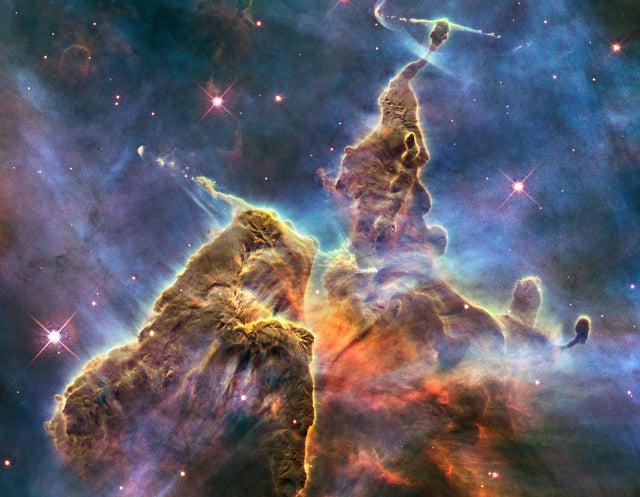
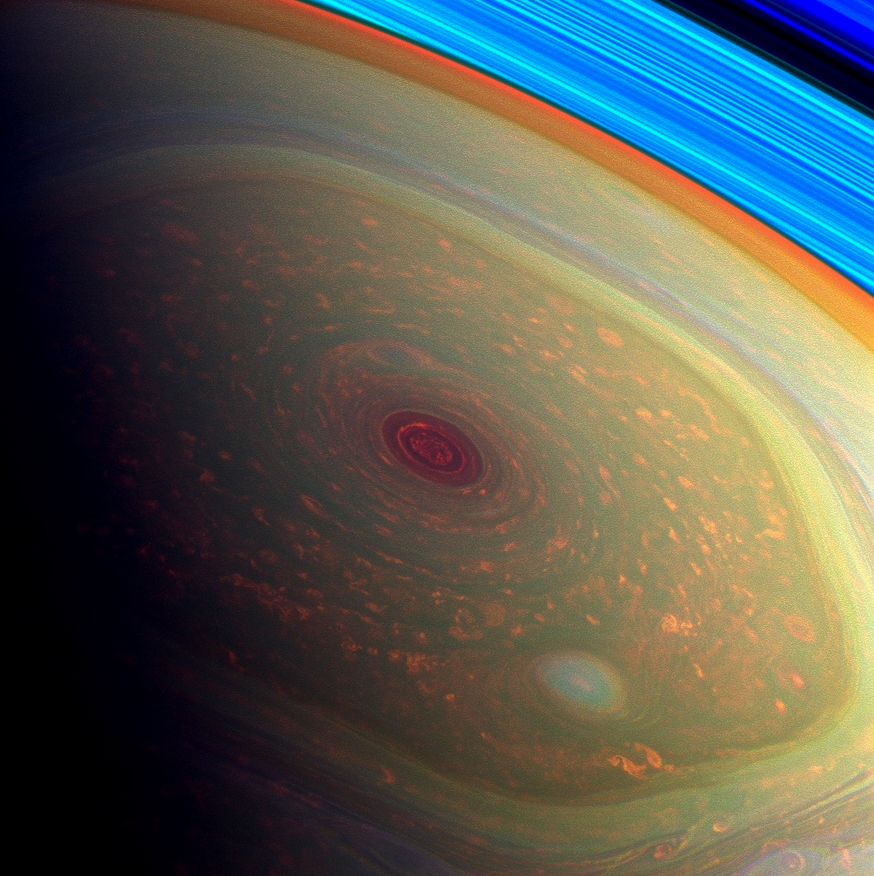
NASA unveils a gorgeous new gallery of celestial images
To get you sufficiently pumped for the new Cosmos re-make, NASA has put together a stunning set of 43 cosmic images that are guaranteed to instill a sense of wonder and awe.
Hosted by Neil deGrasse Tyson, the premier of the 13-episode series aired last night at 9:00 pm EST and was shown in no less than 70 countries. The remake comes 34 years after the original series hosted by Carl Sagan. NASA will be live-tweeting during the show, so be sure to follow @NASAGoddard and @NASAGoddardPix.
Many of these images are old favorites, but they're certainly worth re-visiting. Here are some of best the gallery has to offer (images and captions via NASA/JPL/Hubble).


To get you sufficiently pumped for the new Cosmos re-make, NASA has put together a stunning set of 43 cosmic images that are guaranteed to instill a sense of wonder and awe.
Hosted by Neil deGrasse Tyson, the premier of the 13-episode series aired last night at 9:00 pm EST and was shown in no less than 70 countries. The remake comes 34 years after the original series hosted by Carl Sagan. NASA will be live-tweeting during the show, so be sure to follow @NASAGoddard and @NASAGoddardPix.
Many of these images are old favorites, but they're certainly worth re-visiting. Here are some of best the gallery has to offer (images and captions via NASA/JPL/Hubble).
http://io9.com/ive-got-more-on-the-hexa ... 1540411297
Gallery at: http://www.flickr.com/photos/gsfc/sets/ ... 13369213/#
Seriously, why haven't you clicked that link yet?!!
DrCaleb @ Wed Mar 12, 2014 1:12 pm
$1:
VLT Spots Largest Yellow Hypergiant Star
ESO’s Very Large Telescope Interferometer has revealed the largest yellow star — and one of the ten largest stars found so far. This hypergiant has been found to measure more than 1300 times the diameter of the Sun, and to be part of a double star system, with the second component so close that it is in contact with the main star. Observations spanning over sixty years, some from amateur observers, also indicate that this rare and remarkable object is changing very rapidly and has been caught during a very brief phase of its life.
Using ESO’s Very Large Telescope Interferometer (VLTI), Olivier Chesneau (Observatoire de la Côte d’Azur, Nice, France) and an international team of collaborators have found that the yellow hypergiant star HR 5171 A [1] is absolutely huge — 1300 times the diameter of the Sun and much bigger than was expected [2]. This makes it the largest yellow star known. It is also in the top ten of the largest stars known — 50% larger than the famous red supergiant Betelgeuse — and about one million times brighter than the Sun.
“The new observations also showed that this star has a very close binary partner, which was a real surprise,” says Chesneau. “The two stars are so close that they touch and the whole system resembles a gigantic peanut.”
The astronomers made use of a technique called interferometry to combine the light collected from multiple individual telescopes, effectively creating a giant telescope up to 140 metres in size. The new results prompted the team to thoroughly investigate older observations of the star spanning more than sixty years, to see how it had behaved in the past.
Yellow hypergiants are very rare, with only a dozen or so known in our galaxy — the best-known example being Rho Cassiopeiae. They are among the biggest and brightest stars known and are at a stage of their lives when they are unstable and changing rapidly. Due to this instability, yellow hypergiants also expel material outwards, forming a large, extended atmosphere around the star.
Despite its great distance of nearly 12 000 light-years from Earth, the object can just about be seen with the naked eye by the keen-sighted. HR 5171 A has been found to be getting bigger over the last 40 years, cooling as it grows, and its evolution has now been caught in action. Only a few stars are caught in this very brief phase, where they undergo a dramatic change in temperature as they rapidly evolve.
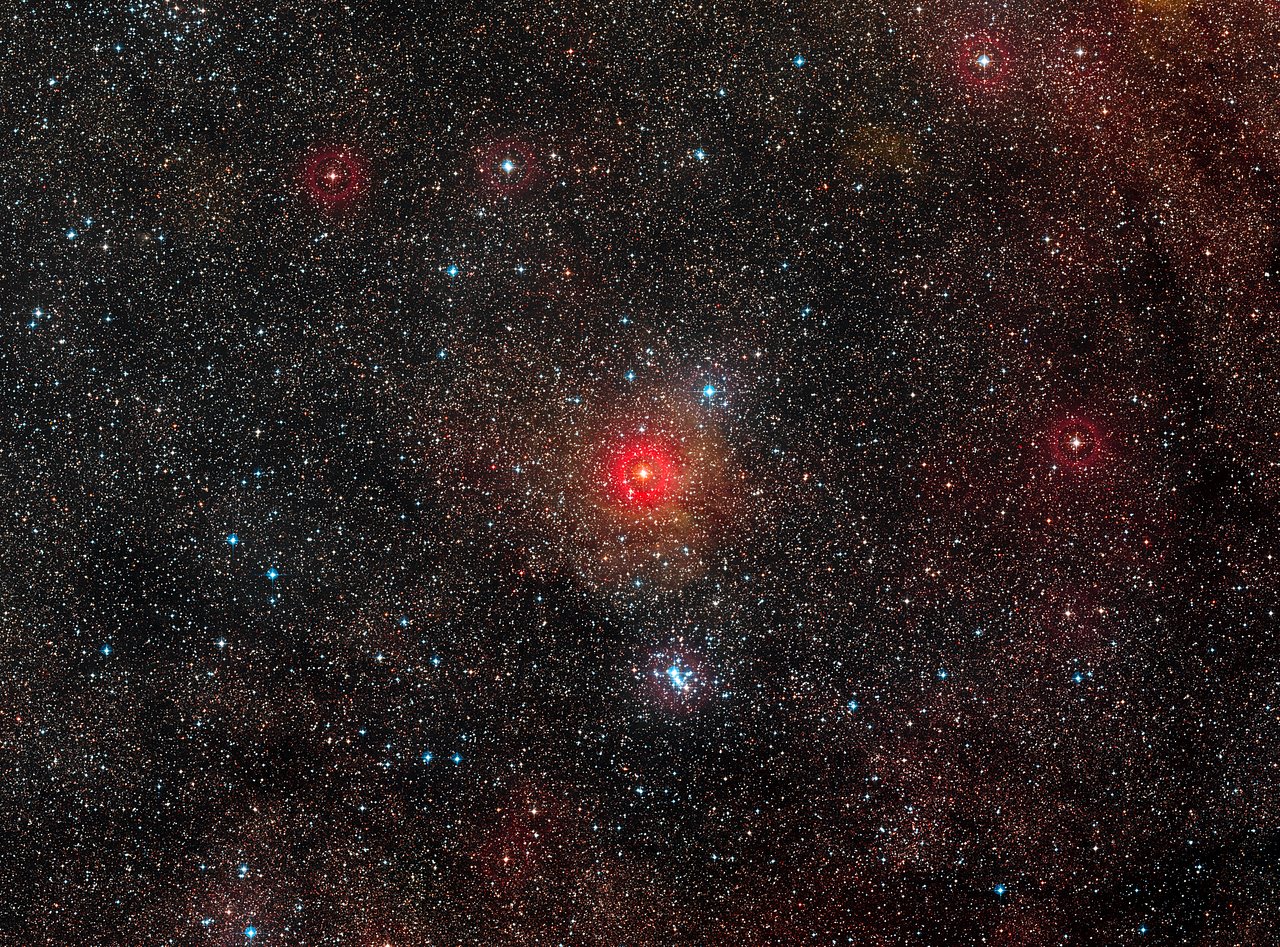
(Artist impression)
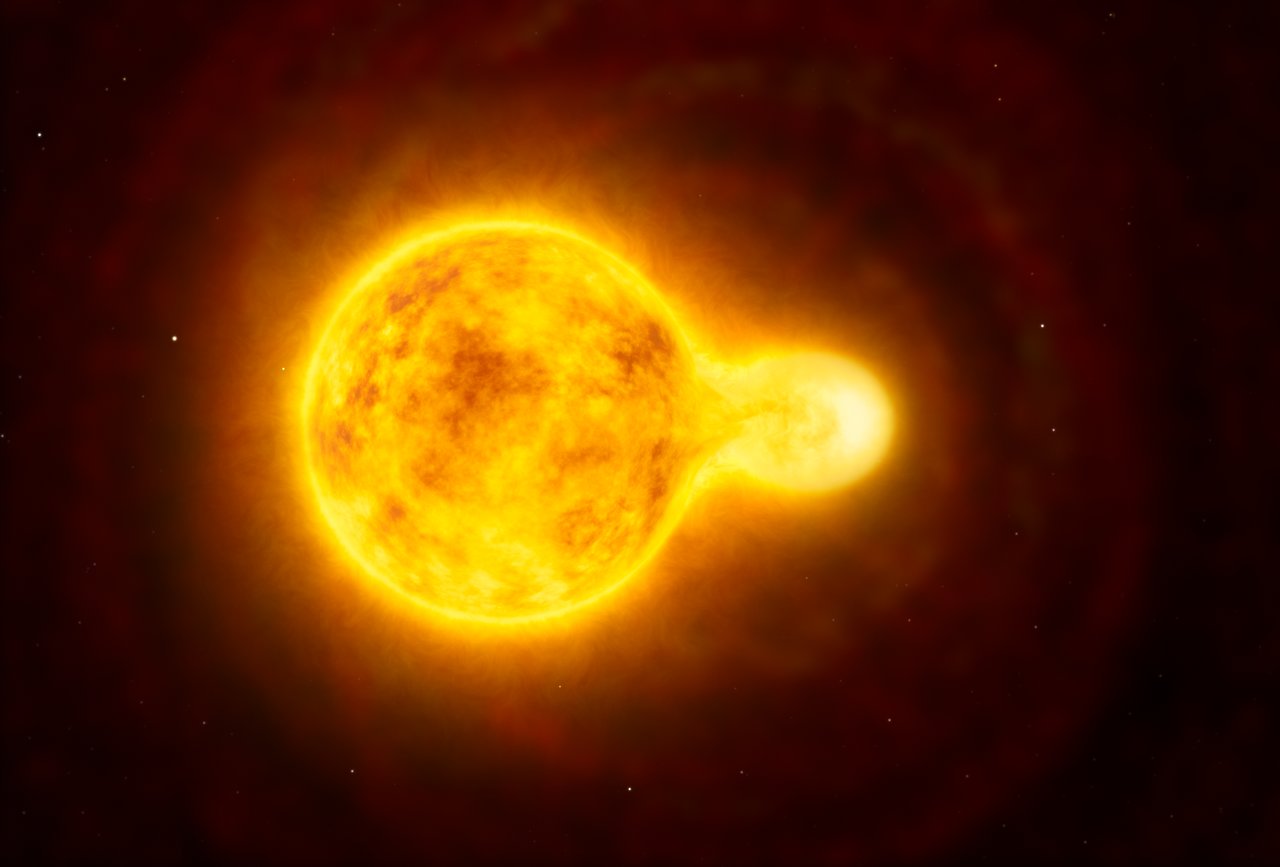
ESO’s Very Large Telescope Interferometer has revealed the largest yellow star — and one of the ten largest stars found so far. This hypergiant has been found to measure more than 1300 times the diameter of the Sun, and to be part of a double star system, with the second component so close that it is in contact with the main star. Observations spanning over sixty years, some from amateur observers, also indicate that this rare and remarkable object is changing very rapidly and has been caught during a very brief phase of its life.
Using ESO’s Very Large Telescope Interferometer (VLTI), Olivier Chesneau (Observatoire de la Côte d’Azur, Nice, France) and an international team of collaborators have found that the yellow hypergiant star HR 5171 A [1] is absolutely huge — 1300 times the diameter of the Sun and much bigger than was expected [2]. This makes it the largest yellow star known. It is also in the top ten of the largest stars known — 50% larger than the famous red supergiant Betelgeuse — and about one million times brighter than the Sun.
“The new observations also showed that this star has a very close binary partner, which was a real surprise,” says Chesneau. “The two stars are so close that they touch and the whole system resembles a gigantic peanut.”
The astronomers made use of a technique called interferometry to combine the light collected from multiple individual telescopes, effectively creating a giant telescope up to 140 metres in size. The new results prompted the team to thoroughly investigate older observations of the star spanning more than sixty years, to see how it had behaved in the past.
Yellow hypergiants are very rare, with only a dozen or so known in our galaxy — the best-known example being Rho Cassiopeiae. They are among the biggest and brightest stars known and are at a stage of their lives when they are unstable and changing rapidly. Due to this instability, yellow hypergiants also expel material outwards, forming a large, extended atmosphere around the star.
Despite its great distance of nearly 12 000 light-years from Earth, the object can just about be seen with the naked eye by the keen-sighted. HR 5171 A has been found to be getting bigger over the last 40 years, cooling as it grows, and its evolution has now been caught in action. Only a few stars are caught in this very brief phase, where they undergo a dramatic change in temperature as they rapidly evolve.
(Artist impression)
http://www.eso.org/public/news/eso1409/
DrCaleb @ Wed Mar 12, 2014 1:17 pm
Just a caveat on that last one - stars don't really have a 'surface', so 'touching' is a bit of a stretch.
stratos @ Thu Mar 13, 2014 5:01 am
$1:
“The new observations also showed that this star has a very close binary partner, which was a real surprise,” says Chesneau. “The two stars are so close that they touch and the whole system resembles a gigantic peanut.”
Could the stars size be attributed to sucking off matter from it's binary partner. Thus as it gets bigger the other gets smaller?
DrCaleb @ Thu Mar 13, 2014 7:00 am
stratos stratos:
$1:
“The new observations also showed that this star has a very close binary partner, which was a real surprise,” says Chesneau. “The two stars are so close that they touch and the whole system resembles a gigantic peanut.”
Could the stars size be attributed to sucking off matter from it's binary partner. Thus as it gets bigger the other gets smaller?
Yes. The yellow colour of the supergiant is rare because colour is normally associated with the processes going on inside the star. Betelgeuse for example at half it's diameter is a red variable supergiant, indicating it's undergoing some massive reactions inside. VV Cephei is nearly as big as the yellow supergiant and it's a red supergiant, and it's companion is a Blue supergiant indicates some extremely hot fusion in it's core.
VY Canis Majoris - the largest star we know of - is also a red hypergiant, so having a yellow hypergiant is indeed rare. The paper I read seemed to indicate that the 'cooler' yellow colour is because the corona of the star is extended and keeps the star cooler that the mass of it would normally produce. The reason most likely is it's supergiant companion star that is attracting matter away from the core.
Incidentally, some news reports say this star is 1300 time as massive as ours - but like most reporters they got it wrong. It's 1300 times the diameter of our star, so that's 2.2 billion times our sun's volume and mass (pi*r^3).
Tyler_1 @ Thu Mar 13, 2014 9:02 am
DrCaleb DrCaleb:
Gallery at: http://www.flickr.com/photos/gsfc/sets/ ... 13369213/#
Seriously, why haven't you clicked that link yet?!!
Seriously, why haven't you clicked that link yet?!!
I did and it was beautiful!
![[B-o]](./images/smilies/drinkup.gif "Drink up")
DrCaleb @ Mon Mar 17, 2014 9:17 am
$1:
Cosmic inflation: 'Spectacular' discovery hailed
Scientists say they have extraordinary new evidence to support a Big Bang Theory for the origin of the Universe.
Researchers believe they have found the signal left in the sky by the super-rapid expansion of space that must have occurred just fractions of a second after everything came into being.
It takes the form of a distinctive twist in the oldest light detectable with telescopes.
(Gravitational waves from inflation put a distinctive twist pattern in the polarisation of the CMB)

The work will be scrutinised carefully, but already there is talk of a Nobel.
"This is spectacular," commented Prof Marc Kamionkowski, from Johns Hopkins University.
"I've seen the research; the arguments are persuasive, and the scientists involved are among the most careful and conservative people I know," he told BBC News.
The breakthrough was announced by an American team working on a project known as BICEP2.
This has been using a telescope at the South Pole to make detailed observations of a small patch of sky.
The aim has been to try to find a residual marker for "inflation" - the idea that the cosmos experienced an exponential growth spurt in its first trillionth, of a trillionth of a trillionth of a second.

Scientists say they have extraordinary new evidence to support a Big Bang Theory for the origin of the Universe.
Researchers believe they have found the signal left in the sky by the super-rapid expansion of space that must have occurred just fractions of a second after everything came into being.
It takes the form of a distinctive twist in the oldest light detectable with telescopes.
(Gravitational waves from inflation put a distinctive twist pattern in the polarisation of the CMB)
The work will be scrutinised carefully, but already there is talk of a Nobel.
"This is spectacular," commented Prof Marc Kamionkowski, from Johns Hopkins University.
"I've seen the research; the arguments are persuasive, and the scientists involved are among the most careful and conservative people I know," he told BBC News.
The breakthrough was announced by an American team working on a project known as BICEP2.
This has been using a telescope at the South Pole to make detailed observations of a small patch of sky.
The aim has been to try to find a residual marker for "inflation" - the idea that the cosmos experienced an exponential growth spurt in its first trillionth, of a trillionth of a trillionth of a second.
http://www.bbc.co.uk/news/science-environment-26605974
DrCaleb @ Wed Mar 19, 2014 6:57 am
$1:
Space Thief Or Hero? One Man's Quest To Reawaken An Old Friend
More than 30 years ago, Robert Farquhar stole a spacecraft.
Now he's trying to give it back.
The green satellite, covered with solar panels, is hurtling back toward the general vicinity of Earth, after nearly three decades of traveling in a large, looping orbit around the sun.
If Farquhar, a former mission design specialist for NASA, gets his way, the agency will command the spacecraft to fire its thrusters, veer close to the moon, and slip back into the spot where it was intended to be when it was launched in 1978 — and where it was when Farquhar and his accomplices "borrowed" it.
Whatever name it sailed under — International Sun-Earth Explorer 3, and International Cometary Explorer, among others --- this spacecraft has scored a number of firsts over the years, including the first comet flyby.
Back in the 1980s, space agencies were racing to . But NASA wasn't going — officials said a comet mission was too expensive. That did not sit well with Farquhar, who had dreamed of achieving the first comet encounter ever.
So he figured out how to divert an existing satellite, called the (ISEE-3), that was stationed between the Earth and the sun in an innovative that he had pioneered.
Farquhar came up with a complicated trajectory that would let this spacecraft intercept a different comet called in September of 1985, months before the armada of other space probes would arrive at Halley's.
"We beat all the other countries of the world," recalls Farquhar. "The European Space Agency. The Russians. The Japanese."
President Reagan even sent him a congratulatory letter.
But some of the scientists who'd been using ISEE-3 to study things like solar wind were not amused by the comet caper.
"They thought that — it was in the newspapers, even — that we stole their spacecraft," says Farquhar. "We didn't steal it; we just borrowed it for a while! That's what I tried to tell them."
After all, he notes, the spacecraft was set on a course that would eventually bring it back.
"OK, so we took it away in 1983 and you get it back in 2014. How many years is that?" says Farquhar, quickly calculating. "Oh, that's about 31 years."
Farquhar is now 81 years old. He's been called the master of getting to places. His genius is inventing esoteric flight plans that take advantage of gravitational boosts from the moon and close flybys of Earth to send space probes zipping around the solar system in surprising ways.
In 1986, the European spacecraft Giotto looked into the heart of Halley's Comet as it approached the sun. Data from Giotto's camera were used to generate this enhanced image of the comet's potato-shaped nucleus, measuring roughly 15 kilometers across.
He's so adept at calculating these exotic trajectories that often, just for fun, he's made sure that key mission events fall on birthdays or anniversaries.
An artist's rendering of the Nimbus 1.
The exploits of ISEE-3 were the first ones to really show off what Farquhar could do. "Certainly all the people in the space business know that that's my spacecraft. It's very personal with me," he says.
His makes it clear how personal. For example, Farquhar writes that when he was hospitalized after a heart attack, the spacecraft suffered a battery failure — making him believe they shared a "supernatural connection."
"It's my baby," says Farquhar. "It's something I worked on for a long time and I had to sell it to NASA, and sell it to a lot of people."
What Farquhar is selling now is the idea of waking up this old satellite and doing what he promised.
There's a short window in the next few months, before August, when ISEE-3 could be commanded to slow down and follow a flight path that would return it to the spot where it was stationed before it went off chasing comets.
"It would not just be a curiosity. It would actually be a useful scientific tool," says , director of the Laboratory for Atmospheric and Space Physics at the University of Colorado.
These days, other satellites monitor space between the Earth and the sun, says Baker. But he believes ISEE-3 could provide additional measurements that would be valuable.
"It's not often that something that you've sent off supposedly into oblivion sort of comes back to you," says Baker, who worked with data from ISEE-3 when he was younger. "It really, to me, is a fascinating thing that we can even dream of reassembling the puzzle here and put it back the way, sort of, it was — before Bob stole the spacecraft."
But waking up an old spacecraft, as though it were Rip Van Winkle, is not easy.
"No other spacecraft has been what you might call asleep for such a long period of time," says Edward Smith, one of the scientists who worked on the mission at NASA's Jet Propulsion Laboratory in Pasadena, Calif. "I'll believe it when I see it, but it's an exciting opportunity and I'm taking it seriously."

More than 30 years ago, Robert Farquhar stole a spacecraft.
Now he's trying to give it back.
The green satellite, covered with solar panels, is hurtling back toward the general vicinity of Earth, after nearly three decades of traveling in a large, looping orbit around the sun.
If Farquhar, a former mission design specialist for NASA, gets his way, the agency will command the spacecraft to fire its thrusters, veer close to the moon, and slip back into the spot where it was intended to be when it was launched in 1978 — and where it was when Farquhar and his accomplices "borrowed" it.
Whatever name it sailed under — International Sun-Earth Explorer 3, and International Cometary Explorer, among others --- this spacecraft has scored a number of firsts over the years, including the first comet flyby.
Back in the 1980s, space agencies were racing to . But NASA wasn't going — officials said a comet mission was too expensive. That did not sit well with Farquhar, who had dreamed of achieving the first comet encounter ever.
So he figured out how to divert an existing satellite, called the (ISEE-3), that was stationed between the Earth and the sun in an innovative that he had pioneered.
Farquhar came up with a complicated trajectory that would let this spacecraft intercept a different comet called in September of 1985, months before the armada of other space probes would arrive at Halley's.
"We beat all the other countries of the world," recalls Farquhar. "The European Space Agency. The Russians. The Japanese."
President Reagan even sent him a congratulatory letter.
But some of the scientists who'd been using ISEE-3 to study things like solar wind were not amused by the comet caper.
"They thought that — it was in the newspapers, even — that we stole their spacecraft," says Farquhar. "We didn't steal it; we just borrowed it for a while! That's what I tried to tell them."
After all, he notes, the spacecraft was set on a course that would eventually bring it back.
"OK, so we took it away in 1983 and you get it back in 2014. How many years is that?" says Farquhar, quickly calculating. "Oh, that's about 31 years."
Farquhar is now 81 years old. He's been called the master of getting to places. His genius is inventing esoteric flight plans that take advantage of gravitational boosts from the moon and close flybys of Earth to send space probes zipping around the solar system in surprising ways.
In 1986, the European spacecraft Giotto looked into the heart of Halley's Comet as it approached the sun. Data from Giotto's camera were used to generate this enhanced image of the comet's potato-shaped nucleus, measuring roughly 15 kilometers across.
He's so adept at calculating these exotic trajectories that often, just for fun, he's made sure that key mission events fall on birthdays or anniversaries.
An artist's rendering of the Nimbus 1.
The exploits of ISEE-3 were the first ones to really show off what Farquhar could do. "Certainly all the people in the space business know that that's my spacecraft. It's very personal with me," he says.
His makes it clear how personal. For example, Farquhar writes that when he was hospitalized after a heart attack, the spacecraft suffered a battery failure — making him believe they shared a "supernatural connection."
"It's my baby," says Farquhar. "It's something I worked on for a long time and I had to sell it to NASA, and sell it to a lot of people."
What Farquhar is selling now is the idea of waking up this old satellite and doing what he promised.
There's a short window in the next few months, before August, when ISEE-3 could be commanded to slow down and follow a flight path that would return it to the spot where it was stationed before it went off chasing comets.
"It would not just be a curiosity. It would actually be a useful scientific tool," says , director of the Laboratory for Atmospheric and Space Physics at the University of Colorado.
These days, other satellites monitor space between the Earth and the sun, says Baker. But he believes ISEE-3 could provide additional measurements that would be valuable.
"It's not often that something that you've sent off supposedly into oblivion sort of comes back to you," says Baker, who worked with data from ISEE-3 when he was younger. "It really, to me, is a fascinating thing that we can even dream of reassembling the puzzle here and put it back the way, sort of, it was — before Bob stole the spacecraft."
But waking up an old spacecraft, as though it were Rip Van Winkle, is not easy.
"No other spacecraft has been what you might call asleep for such a long period of time," says Edward Smith, one of the scientists who worked on the mission at NASA's Jet Propulsion Laboratory in Pasadena, Calif. "I'll believe it when I see it, but it's an exciting opportunity and I'm taking it seriously."
http://www.npr.org/2014/03/18/289628696 ... old-friend
DrCaleb @ Wed Mar 19, 2014 7:21 am
$1:
Herschel maps the dust in nearby galaxies
The European Space Agency’s Herschel space telescope may be long dead, but its years of work are continuing to produce valuable results for the world’s astronomers.
Its latest published finding is a census of how much dust there is in hundreds of galaxies that exist in the near neighbourhood of our own Milky Way.
Herschel’s 3.5 metre-wide infrared eye was particularly suited to see the vast deposits of cold dust in these remote cities of stars. It has allowed astronomers to catalogue the galaxies properly for the first time according to the amounts they contained.
The survey was an important one for the scientists because the dust grains out in space are, along with gas, a basic ingredient in the recipe to produce new stars and planets. Despite that importance, astronomers previously had an incomplete picture of how much dust local galaxies contained.
Herschel, which was launched in May 2009, on an Ariane 5 from ESA’s Spaceport in Kourou, French Guiana, ran out of the essential helium coolant that had allowed it to study the cold Universe in April 2013.
But during its nearly four years of operation, from a point about 2 million km from Earth, it measured the dust in 323 galaxies, within a distance of 50-80 million light-years, for a project involving an international science team, led by Dr Luca Cortese from Swinburne University of Technology in Melbourne, Australia.
Their study, made by observing dust at far-infrared and sub-millimetre wavelengths is published in a paper in the journal Monthly Notices of the Royal Astronomical Society.
Astronomers have found that the dust-rich galaxies are typically spiral or irregular, whereas the dust-poor ones are usually elliptical in form. Dust is gently heated across a range of temperatures by the combined light from all of the stars in each galaxy, with the warmest dust being concentrated in regions where new stars are being born.
“These dust grains are believed to be fundamental ingredients for the formation of stars and planets, but until now very little was known about their abundance and physical properties in galaxies other than our own Milky Way,” said Dr Cortese. “Cosmic dust is heated by starlight to temperatures of only a few tens of degrees above absolute zero, and can thus be only seen at far-infrared/sub-millimetre wavelengths.”

The European Space Agency’s Herschel space telescope may be long dead, but its years of work are continuing to produce valuable results for the world’s astronomers.
Its latest published finding is a census of how much dust there is in hundreds of galaxies that exist in the near neighbourhood of our own Milky Way.
Herschel’s 3.5 metre-wide infrared eye was particularly suited to see the vast deposits of cold dust in these remote cities of stars. It has allowed astronomers to catalogue the galaxies properly for the first time according to the amounts they contained.
The survey was an important one for the scientists because the dust grains out in space are, along with gas, a basic ingredient in the recipe to produce new stars and planets. Despite that importance, astronomers previously had an incomplete picture of how much dust local galaxies contained.
Herschel, which was launched in May 2009, on an Ariane 5 from ESA’s Spaceport in Kourou, French Guiana, ran out of the essential helium coolant that had allowed it to study the cold Universe in April 2013.
But during its nearly four years of operation, from a point about 2 million km from Earth, it measured the dust in 323 galaxies, within a distance of 50-80 million light-years, for a project involving an international science team, led by Dr Luca Cortese from Swinburne University of Technology in Melbourne, Australia.
Their study, made by observing dust at far-infrared and sub-millimetre wavelengths is published in a paper in the journal Monthly Notices of the Royal Astronomical Society.
Astronomers have found that the dust-rich galaxies are typically spiral or irregular, whereas the dust-poor ones are usually elliptical in form. Dust is gently heated across a range of temperatures by the combined light from all of the stars in each galaxy, with the warmest dust being concentrated in regions where new stars are being born.
“These dust grains are believed to be fundamental ingredients for the formation of stars and planets, but until now very little was known about their abundance and physical properties in galaxies other than our own Milky Way,” said Dr Cortese. “Cosmic dust is heated by starlight to temperatures of only a few tens of degrees above absolute zero, and can thus be only seen at far-infrared/sub-millimetre wavelengths.”
Previous 1 ... 41 42 43 44 45 46 47 ... 244 Next