
Space Thread
Previous 1 ... 44 45 46 47 48 49 50 ... 244 Next
DrCaleb @ Wed Apr 16, 2014 11:36 am
$1:
The Puzzle of Iapetus and the Mountains That Fell From Space
Saturn’s moon has a narrow ridge of mountains some 20 kilometres high that stretches half way round its equator. Now evidence is mounting that the entire mountain range fell from space
When the Cassini spacecraft first photographed Saturn’s moon Iapetus on 31st of December 2004, astronomers were hoping to find out more about the moon’s dramatic two tone colouring, first observed by Giovanni Cassini more than 400 years earlier.
Instead, the images sent back by the spacecraft revealed something much more astonishing. Around this moon’s equator there is a dramatic mountain range some 1300 kilometres long, 20 kilometres wide and 13 kilometres high. There is nothing like it anywhere else in the Solar System.
That raises an obvious question: how could such a ridge have formed?
There are two possibilities. The first is that volcanic or tectonic forces caused the surface to warp. In other words, that the mountains are the result of internal forces.
The problem with this is that there ought to be other signs of volcanic or tectonic activity. But planetary geologists have yet to see any evidence of this.
The second explanation is that the mountains are the result of external, or exogenic, forces. In other words, the material from which these mountains are made somehow fell from space.
If this second explanation is correct, the sides of the mountains should be roughly at the angle of repose, the steepest angle that a granular material can adopt before it avalanches. So an important question is what shape are these mountains.
Today we get an answer thanks to the work of Erika Lopez Garcia at Brown University in Providence, Rhode Island, and a few pals. These guys have used data from Cassini images to reconstruct the shape of the mountains and work out once and for all whether they could indeed have fallen from space.
Iapetus is Saturn’s third-largest satellite. It is about half the radius of our Moon, tidally locked so the same side always faces Saturn and perhaps best-known for its two-tone colouring.
. . .

Saturn’s moon has a narrow ridge of mountains some 20 kilometres high that stretches half way round its equator. Now evidence is mounting that the entire mountain range fell from space
When the Cassini spacecraft first photographed Saturn’s moon Iapetus on 31st of December 2004, astronomers were hoping to find out more about the moon’s dramatic two tone colouring, first observed by Giovanni Cassini more than 400 years earlier.
Instead, the images sent back by the spacecraft revealed something much more astonishing. Around this moon’s equator there is a dramatic mountain range some 1300 kilometres long, 20 kilometres wide and 13 kilometres high. There is nothing like it anywhere else in the Solar System.
That raises an obvious question: how could such a ridge have formed?
There are two possibilities. The first is that volcanic or tectonic forces caused the surface to warp. In other words, that the mountains are the result of internal forces.
The problem with this is that there ought to be other signs of volcanic or tectonic activity. But planetary geologists have yet to see any evidence of this.
The second explanation is that the mountains are the result of external, or exogenic, forces. In other words, the material from which these mountains are made somehow fell from space.
If this second explanation is correct, the sides of the mountains should be roughly at the angle of repose, the steepest angle that a granular material can adopt before it avalanches. So an important question is what shape are these mountains.
Today we get an answer thanks to the work of Erika Lopez Garcia at Brown University in Providence, Rhode Island, and a few pals. These guys have used data from Cassini images to reconstruct the shape of the mountains and work out once and for all whether they could indeed have fallen from space.
Iapetus is Saturn’s third-largest satellite. It is about half the radius of our Moon, tidally locked so the same side always faces Saturn and perhaps best-known for its two-tone colouring.
. . .
https://medium.com/p/58a20c16fefa
Jabberwalker @ Wed Apr 16, 2014 2:26 pm
... another thesis ...
DrCaleb @ Thu Apr 17, 2014 12:07 pm
$1:
Astronomers find ‘habitable’ Earth-like planet for first time
After years of combing the heavens, astronomers have found planets that are the same size as Earth as well as a planets in a temperature zone where water may be able to remain liquid.
But until now they have never found a planet that is both of those things.
That moment has finally arrived with the announcement of a distant world that has at least the possibility of being a close cousin to our own.
“This is a big milestone,” said Jason Rowe, a member of the discovery team and a scientist at the National Aeronautics and Space Administration’s Ames Research Center in California. “We know if you have something Earth-sized, you can produce something that’s Earth-like.”
Astronomers have long been looking for signs of worlds that are like Earth – the only kind of planet in the universe that can demonstrably support life.
But most planets discovered to date have either been too large – and therefore unlikely to have a solid surface – or have been found in orbits that would render them too hot for life.
Dubbed Kepler 186-f, the newly found planet is one of five circling a star about 500 light years from our solar system. It is the best Earth analog so far to emerge from roughly 3,600 candidate planets detected by the Kepler spacecraft.
Kepler is unable to observe planets directly but instead infers their existence by measuring how much a star dims when an orbiting planet temporarily crosses in front of it. The change in the star’s brightness is related to the size of the planet, while the speed at which the planet moves is related to its distance from the star, and therefore its temperature.
What makes Kepler 186-f unique, so far, is that it is only 10 per cent larger than Earth in size and it orbits just inside the “habitable zone,” a Goldilocks region where the energy of the star is sufficient to keep water liquid but not boil it away (assuming the planet has an atmosphere). While it receives less energy than Earth does from the sun, it still falls within the range of livable.
“Like a cloudy day outside” here on Earth, Dr. Rowe said.
However, the planet also differs from Earth in a more significant way: The star it orbits is much cooler than the sun. A shorter distance to the star is what keeps the planet at a potentially livable temperature.

After years of combing the heavens, astronomers have found planets that are the same size as Earth as well as a planets in a temperature zone where water may be able to remain liquid.
But until now they have never found a planet that is both of those things.
That moment has finally arrived with the announcement of a distant world that has at least the possibility of being a close cousin to our own.
“This is a big milestone,” said Jason Rowe, a member of the discovery team and a scientist at the National Aeronautics and Space Administration’s Ames Research Center in California. “We know if you have something Earth-sized, you can produce something that’s Earth-like.”
Astronomers have long been looking for signs of worlds that are like Earth – the only kind of planet in the universe that can demonstrably support life.
But most planets discovered to date have either been too large – and therefore unlikely to have a solid surface – or have been found in orbits that would render them too hot for life.
Dubbed Kepler 186-f, the newly found planet is one of five circling a star about 500 light years from our solar system. It is the best Earth analog so far to emerge from roughly 3,600 candidate planets detected by the Kepler spacecraft.
Kepler is unable to observe planets directly but instead infers their existence by measuring how much a star dims when an orbiting planet temporarily crosses in front of it. The change in the star’s brightness is related to the size of the planet, while the speed at which the planet moves is related to its distance from the star, and therefore its temperature.
What makes Kepler 186-f unique, so far, is that it is only 10 per cent larger than Earth in size and it orbits just inside the “habitable zone,” a Goldilocks region where the energy of the star is sufficient to keep water liquid but not boil it away (assuming the planet has an atmosphere). While it receives less energy than Earth does from the sun, it still falls within the range of livable.
“Like a cloudy day outside” here on Earth, Dr. Rowe said.
However, the planet also differs from Earth in a more significant way: The star it orbits is much cooler than the sun. A shorter distance to the star is what keeps the planet at a potentially livable temperature.
http://www.theglobeandmail.com/technolo ... e18054565/
Goober911 @ Sat Apr 19, 2014 3:17 pm
http://www.youtube.com/watch?v=HEheh1BH34Q
DrCaleb @ Mon Apr 21, 2014 12:01 pm
$1:
Venus’ crust heals too fast for plate tectonics
On Earth, fractures stayed fractured and created plate boundaries.
The emergence of plate tectonics is arguably Earth's defining moment, the authors of a new Nature paper write. Out of all the planets we’ve looked at carefully, Earth is the only one that has a hard outer crust with distinct pieces that shift and move. Our home is unique in its continents and quakes.
Some scientists think that plate tectonics are essential for life—so much so that if they could figure out a way to spot tectonic action on exoplanets, they think it would be a good indication that there might be life there, too. Tectonic activity recirculates minerals and recycles carbon. As one plate slides under another (a process called subduction), it pushes carbon down into the mantle with it.
Without plate tectonics, carbon would build up in the atmosphere. Venus, which does not have tectonics, shows the results: an atmosphere that is 96 percent carbon dioxide. It's toxic. Yet Venus is about the same size and composition as our planet, so why doesn't it have plate tectonics?
Some researchers made a model to explore how Earth initiated plate movements, and these same researchers made one model of its neighbor for comparison. A 1.5-billion-year-old Earth and a similarly aged Venus were modeled as a hot, mushy material made of tiny particles of rock. The model uses physics at the one-millimeter rock grain scale to explain how the whole planet behaves. According to David Bercovici, a geophysicist at Yale who was an author on the paper, the model also shows how plate tectonics emerged on Earth but not on her twin.
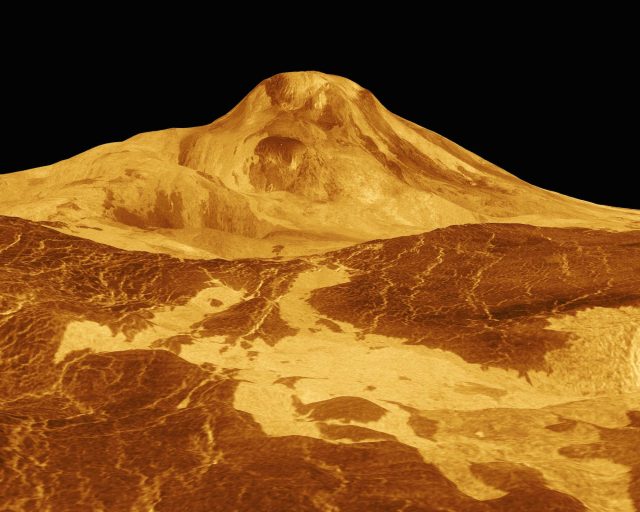
Maat Mons, one of Venus' volcanoes. The planet is clearly geologically active, but hasn't developed plate tectonics.
On Earth, fractures stayed fractured and created plate boundaries.
The emergence of plate tectonics is arguably Earth's defining moment, the authors of a new Nature paper write. Out of all the planets we’ve looked at carefully, Earth is the only one that has a hard outer crust with distinct pieces that shift and move. Our home is unique in its continents and quakes.
Some scientists think that plate tectonics are essential for life—so much so that if they could figure out a way to spot tectonic action on exoplanets, they think it would be a good indication that there might be life there, too. Tectonic activity recirculates minerals and recycles carbon. As one plate slides under another (a process called subduction), it pushes carbon down into the mantle with it.
Without plate tectonics, carbon would build up in the atmosphere. Venus, which does not have tectonics, shows the results: an atmosphere that is 96 percent carbon dioxide. It's toxic. Yet Venus is about the same size and composition as our planet, so why doesn't it have plate tectonics?
Some researchers made a model to explore how Earth initiated plate movements, and these same researchers made one model of its neighbor for comparison. A 1.5-billion-year-old Earth and a similarly aged Venus were modeled as a hot, mushy material made of tiny particles of rock. The model uses physics at the one-millimeter rock grain scale to explain how the whole planet behaves. According to David Bercovici, a geophysicist at Yale who was an author on the paper, the model also shows how plate tectonics emerged on Earth but not on her twin.
Maat Mons, one of Venus' volcanoes. The planet is clearly geologically active, but hasn't developed plate tectonics.
http://arstechnica.com/science/2014/04/ ... tectonics/
saturn_656 @ Mon Apr 21, 2014 12:07 pm
Just because we would find a 96% CO2 atmosphere toxic doesn't mean that it is "inhospitable to life".
Just inhospitable to (most?) life that developed on Earth.
DrCaleb @ Tue Apr 22, 2014 12:06 pm
saturn_656 saturn_656:
Just because we would find a 96% CO2 atmosphere toxic doesn't mean that it is "inhospitable to life".
Just inhospitable to (most?) life that developed on Earth.
Just inhospitable to (most?) life that developed on Earth.
Yea, pretty much all life we know of. And the 900C temperature doesn't help either.
DrCaleb @ Tue Apr 22, 2014 12:06 pm
$1:
Asteroids Whack Earth More Often Than Thought
A global network that listens for telltale traces of nuclear weapons tests detected 26 explosions between 2000 and 2013 caused not by nuclear explosions but by asteroids blasting apart in the atmosphere, a video visualization released on Tuesday shows.
Only one impact, the 2013 strike over Chelyabinsk, Russia, caused widespread injuries and damages on the ground, but the study is a somber reminder that Earth's lucky days may be numbered.
"Most of the impacts are too small and too high up to cause major damage ... but it does show you ... an asteroid large enough to destroy a city is likely to occur about once every century or so," Ed Lu, a former NASA astronaut who now oversees the asteroid-hunting B612 Foundation, told reporters on a conference call.
Photos: Russian Meteor Strike Aftermath
Play Video
Russian Meteor: The Full Story
We now know the size of the massive space rock...and just wait till you hear how fast it was moving!
Nikulin Vyacheslav/ITAR-TASS Photo/Corbis
"There is a popular misconception that asteroid impacts are extraordinarily rare -- millions of years between large asteroid impacts -- and that's incorrect. We think that actually seeing these things on a map, on a globe of the Earth with the date will help them understand that," Lu said.
The data used in the video was collected by a global network of infrasound stations, consisting of microbarometers that continuously measure miniscule changes in air pressure at frequencies much lower than the range of human hearing. The network is operated by the Nuclear Test Ban Treaty Organization.
The B612 Foundation -- named after a fictional planet in the book The Little Prince by French author and pilot Antoine de Saint-Exupery -- plans to launch a telescope in 2018 to scope out potentially dangerous asteroids, such as the one that exploded over Chelyabinsk with the force of 600 kilotons of energy. More than 1,000 people were injured by flying glass and debris.
In comparison, the atomic bomb dropped on Hiroshima in 1945 had an energy impact of 15 kilotons.

A global network that listens for telltale traces of nuclear weapons tests detected 26 explosions between 2000 and 2013 caused not by nuclear explosions but by asteroids blasting apart in the atmosphere, a video visualization released on Tuesday shows.
Only one impact, the 2013 strike over Chelyabinsk, Russia, caused widespread injuries and damages on the ground, but the study is a somber reminder that Earth's lucky days may be numbered.
"Most of the impacts are too small and too high up to cause major damage ... but it does show you ... an asteroid large enough to destroy a city is likely to occur about once every century or so," Ed Lu, a former NASA astronaut who now oversees the asteroid-hunting B612 Foundation, told reporters on a conference call.
Photos: Russian Meteor Strike Aftermath
Play Video
Russian Meteor: The Full Story
We now know the size of the massive space rock...and just wait till you hear how fast it was moving!
Nikulin Vyacheslav/ITAR-TASS Photo/Corbis
"There is a popular misconception that asteroid impacts are extraordinarily rare -- millions of years between large asteroid impacts -- and that's incorrect. We think that actually seeing these things on a map, on a globe of the Earth with the date will help them understand that," Lu said.
The data used in the video was collected by a global network of infrasound stations, consisting of microbarometers that continuously measure miniscule changes in air pressure at frequencies much lower than the range of human hearing. The network is operated by the Nuclear Test Ban Treaty Organization.
The B612 Foundation -- named after a fictional planet in the book The Little Prince by French author and pilot Antoine de Saint-Exupery -- plans to launch a telescope in 2018 to scope out potentially dangerous asteroids, such as the one that exploded over Chelyabinsk with the force of 600 kilotons of energy. More than 1,000 people were injured by flying glass and debris.
In comparison, the atomic bomb dropped on Hiroshima in 1945 had an energy impact of 15 kilotons.
http://news.discovery.com/space/asteroi ... 140422.htm
saturn_656 @ Tue Apr 22, 2014 1:28 pm
DrCaleb DrCaleb:
saturn_656 saturn_656:
Just because we would find a 96% CO2 atmosphere toxic doesn't mean that it is "inhospitable to life".
Just inhospitable to (most?) life that developed on Earth.
Just inhospitable to (most?) life that developed on Earth.
Yea, pretty much all life we know of. And the 900C temperature doesn't help either.
I wasn't talking about Venus, but rather CO2 rich atmospheres.
DrCaleb @ Wed Apr 23, 2014 1:29 pm
saturn_656 saturn_656:
DrCaleb DrCaleb:
saturn_656 saturn_656:
Just because we would find a 96% CO2 atmosphere toxic doesn't mean that it is "inhospitable to life".
Just inhospitable to (most?) life that developed on Earth.
Just inhospitable to (most?) life that developed on Earth.
Yea, pretty much all life we know of. And the 900C temperature doesn't help either.
I wasn't talking about Venus, but rather CO2 rich atmospheres.
Sorry, since you quoted the "96%" figure the same as the article, I thought you were referencing the article about Venus.

DrCaleb @ Wed Apr 23, 2014 1:34 pm
Go to the full article - many awesome photos!
$1:
The Hackers Who Recovered NASA’s Lost Lunar Photos
Sitting incongruously among the hangars and laboratories of NASA’s Ames Research Center in Silicon Valley is the squat facade of an old McDonald’s. You won’t get a burger there, though–its cash registers and soft-serve machines have given way to old tape drives and modern computers run by a rogue team of hacker engineers who’ve rechristened the place McMoon’s. These self-described techno-archaeologists have been on a mission to recover and digitize forgotten photos taken in the ‘60s by a quintet of scuttled lunar satellites.
The Lunar Orbiter Image Recovery Project has since 2007 brought some 2,000 pictures back from 1,500 analog data tapes. They contain the first high-resolution photographs ever taken from behind the lunar horizon, including the first photo of an earthrise (first slide above). Thanks to the technical savvy and DIY engineering of the team at LOIRP, it’s being seen at a higher resolution than was ever previously possible.
“We’re reaching back to a capability that existed but couldn’t be touched back when it was created,” says Keith Cowing, co-lead and founding member at LOIRP. “It’s like having a DVD in 1966, you can’t play it. We had resolution of the earth of about a kilometer [per pixel]. This is an image taken a quarter of a fucking million miles away in 1966. The Beatles were warming up to play Shea Stadium at the moment it was being taken.”
Between 1966 and ’67, five Lunar Orbiters snapped pictures onto 70mm film from about 30 miles above the moon. The satellites were sent mainly to scout potential landing sites for manned moon missions. Each satellite would point its dual lens Kodak camera at a target, snap a picture, then develop the photograph. High- and low-resolution photos were then scanned into strips called framelets using something akin to an old fax machine reader.
The images were beamed in modulated signals to one of three receiving stations in Australia, Spain, or California, where the pictures–and collateral chatter from the NASA operators–were recorded straight to tape. After finishing their missions, the satellites were unceremoniously dashed against the moon rocks, clearing the way for Apollo. The brilliant and ballsy engineering was typical of NASA during its golden age, a time when it was also more closely linked to other government agencies with an interest in taking pictures from space.
“These guys were operating right at the edge,” Cowing says with a reverence for these NASA engineers that’s shared by his team. “There’s a certain spy program heritage to all this, but these guys went above that, because those spy satellites would send their images back. These didn’t. They couldn’t. They were in lunar orbit.”
The photos were stored with remarkably high fidelity on the tapes, but at the time had to be copied from projection screens onto paper, sometimes at sizes so large that warehouses and even old churches were rented out to hang them up. The results were pretty grainy, but clear enough to identify landing sites and potential hazards. After the low-fi printing, the tapes were shoved into boxes and forgotten.
Earthrise over the Moon as seen by Lunar Orbiter 1 on August 24, 1966.
Comparison of the original Earthrise image as seen by the public in 1966 and the restored image released in 2008.

Crater Copernicus as seen from an oblique angle by Lunar Orbiter 2 on 24 November 1966

Sitting incongruously among the hangars and laboratories of NASA’s Ames Research Center in Silicon Valley is the squat facade of an old McDonald’s. You won’t get a burger there, though–its cash registers and soft-serve machines have given way to old tape drives and modern computers run by a rogue team of hacker engineers who’ve rechristened the place McMoon’s. These self-described techno-archaeologists have been on a mission to recover and digitize forgotten photos taken in the ‘60s by a quintet of scuttled lunar satellites.
The Lunar Orbiter Image Recovery Project has since 2007 brought some 2,000 pictures back from 1,500 analog data tapes. They contain the first high-resolution photographs ever taken from behind the lunar horizon, including the first photo of an earthrise (first slide above). Thanks to the technical savvy and DIY engineering of the team at LOIRP, it’s being seen at a higher resolution than was ever previously possible.
“We’re reaching back to a capability that existed but couldn’t be touched back when it was created,” says Keith Cowing, co-lead and founding member at LOIRP. “It’s like having a DVD in 1966, you can’t play it. We had resolution of the earth of about a kilometer [per pixel]. This is an image taken a quarter of a fucking million miles away in 1966. The Beatles were warming up to play Shea Stadium at the moment it was being taken.”
Between 1966 and ’67, five Lunar Orbiters snapped pictures onto 70mm film from about 30 miles above the moon. The satellites were sent mainly to scout potential landing sites for manned moon missions. Each satellite would point its dual lens Kodak camera at a target, snap a picture, then develop the photograph. High- and low-resolution photos were then scanned into strips called framelets using something akin to an old fax machine reader.
The images were beamed in modulated signals to one of three receiving stations in Australia, Spain, or California, where the pictures–and collateral chatter from the NASA operators–were recorded straight to tape. After finishing their missions, the satellites were unceremoniously dashed against the moon rocks, clearing the way for Apollo. The brilliant and ballsy engineering was typical of NASA during its golden age, a time when it was also more closely linked to other government agencies with an interest in taking pictures from space.
“These guys were operating right at the edge,” Cowing says with a reverence for these NASA engineers that’s shared by his team. “There’s a certain spy program heritage to all this, but these guys went above that, because those spy satellites would send their images back. These didn’t. They couldn’t. They were in lunar orbit.”
The photos were stored with remarkably high fidelity on the tapes, but at the time had to be copied from projection screens onto paper, sometimes at sizes so large that warehouses and even old churches were rented out to hang them up. The results were pretty grainy, but clear enough to identify landing sites and potential hazards. After the low-fi printing, the tapes were shoved into boxes and forgotten.
Earthrise over the Moon as seen by Lunar Orbiter 1 on August 24, 1966.
Comparison of the original Earthrise image as seen by the public in 1966 and the restored image released in 2008.
Crater Copernicus as seen from an oblique angle by Lunar Orbiter 2 on 24 November 1966
http://www.wired.com/2014/04/lost-lunar ... mcdonalds/
DrCaleb @ Thu Apr 24, 2014 7:39 am
DrCaleb @ Mon Apr 28, 2014 8:11 am
$1:
Astronomer Finds a Brown Dwarf Literally as Cold as Ice… and It’s Right Next Door
Stars are hot, right? You might think that’s one of their defining characteristics.
But that’s not entirely true. Brown dwarfs are star-like objects that are more massive than planets, but not quite massive enough to ignite sustained fusion in their cores. Hydrogen fusion is what powers the Sun, and makes it hot; it’s the mighty pressure of the Sun’s core that makes that happen. Brown dwarfs don’t have the oomph needed to keep that going*.
Brown dwarfs are born hot, then cool over time. And now one has been found that is literally as cold as ice. Not only that, but it’s very close to our solar system: Just 7.2 light years away! That makes it the 7th closest known star to the Sun.
The object is called WISE J085510.83-071442.5. I know, I know, but it’s given that designation based on the fact that it was discovered in data taken by the Wide-field Infrared Survey Explorer, with the rest of the number salad based on its coordinates on the sky, so let’s call it J0855 for short. WISE observed the entire sky several times over its short 13-month lifetime, looking at cooler and downright cold objects in the Universe. It saw stars, dust clouds, galaxies… and brown dwarfs. Hundreds of brown dwarfs, in fact.
One of them caught the eye of Kevin Luhman, an astronomer who specializes in them. This one was very red and very faint — as you’d expect for a very cold object — but it was also moving. Fast. Stars aren’t stationary; they actually move around the sky as they each follow their orbits around the center of the Milky Way Galaxy. That motion in space is usually a few hundred kilometers per second, but stars are so far away their motion across the sky is pretty slow. It could take centuries to see some of them move noticeably. But if a star is close, very close, to the Sun, that motion can be detected in just a few years, or even months.

J0855 moved quite a bit between May and November 2010 when WISE saw it, and Luhman figured that meant it was close. It also showed significant parallax, a change in position that reflects the Earth’s orbit around the Sun. By measuring these two motions, Luhman was able to determine the brown dwarf was a mere 7.2 light years away. There are only six stars closer than that to the Sun that we know of, so this object really is nearby as these things go.
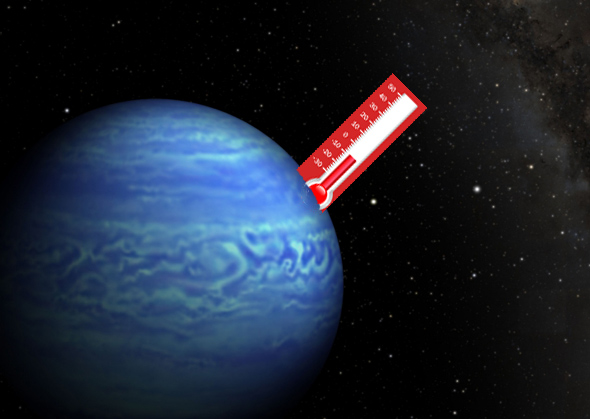
He was able to determine its temperature by measuring how much light it gave off in different colors; hotter objects are bluer, and colder ones red. This object is so cold it’s incredibly faint even in the near infrared; he had to look at even longer wavelengths to get a temperature. It was even invisible to the massive Gemini telescope in Hawaii! He was able to spot it using the Spitzer Space Telescope, though, and was able to nail down its temperature. And this is the part that kills me: the best fit temperature he found was around 225 – 260 Kelvins. Even at the high end, that’s -13° C (9° F). That’s literally colder than ice (or at least the freezing point of water). That’s barely warmer than the temperature of the freezer in my kitchen.
That’s incredible. It implies this object is very old, too, because it would’ve been a few thousands degrees when it formed, and would take at least a billion years to cool down to its current chilly temperature. It’s hard to determine how old it actually is, but it’s most likely 1-10 billion years old.
It has a very low mass, too, probably between 3 and 10 times the mass of Jupiter. That’s pretty lightweight even for a brown dwarf. And here’s another amazing thing about it: It might be a planet. What I mean is, it may have formed around a star like a planet does, then got ejected by gravitational interactions with other planets. If so, it was kicked out of its solar system, doomed to wander the galaxy on its own as a rogue planet. We know such objects exist, and there must be many billions of them in deep, cold space.
Stars are hot, right? You might think that’s one of their defining characteristics.
But that’s not entirely true. Brown dwarfs are star-like objects that are more massive than planets, but not quite massive enough to ignite sustained fusion in their cores. Hydrogen fusion is what powers the Sun, and makes it hot; it’s the mighty pressure of the Sun’s core that makes that happen. Brown dwarfs don’t have the oomph needed to keep that going*.
Brown dwarfs are born hot, then cool over time. And now one has been found that is literally as cold as ice. Not only that, but it’s very close to our solar system: Just 7.2 light years away! That makes it the 7th closest known star to the Sun.
The object is called WISE J085510.83-071442.5. I know, I know, but it’s given that designation based on the fact that it was discovered in data taken by the Wide-field Infrared Survey Explorer, with the rest of the number salad based on its coordinates on the sky, so let’s call it J0855 for short. WISE observed the entire sky several times over its short 13-month lifetime, looking at cooler and downright cold objects in the Universe. It saw stars, dust clouds, galaxies… and brown dwarfs. Hundreds of brown dwarfs, in fact.
One of them caught the eye of Kevin Luhman, an astronomer who specializes in them. This one was very red and very faint — as you’d expect for a very cold object — but it was also moving. Fast. Stars aren’t stationary; they actually move around the sky as they each follow their orbits around the center of the Milky Way Galaxy. That motion in space is usually a few hundred kilometers per second, but stars are so far away their motion across the sky is pretty slow. It could take centuries to see some of them move noticeably. But if a star is close, very close, to the Sun, that motion can be detected in just a few years, or even months.
J0855 moved quite a bit between May and November 2010 when WISE saw it, and Luhman figured that meant it was close. It also showed significant parallax, a change in position that reflects the Earth’s orbit around the Sun. By measuring these two motions, Luhman was able to determine the brown dwarf was a mere 7.2 light years away. There are only six stars closer than that to the Sun that we know of, so this object really is nearby as these things go.
He was able to determine its temperature by measuring how much light it gave off in different colors; hotter objects are bluer, and colder ones red. This object is so cold it’s incredibly faint even in the near infrared; he had to look at even longer wavelengths to get a temperature. It was even invisible to the massive Gemini telescope in Hawaii! He was able to spot it using the Spitzer Space Telescope, though, and was able to nail down its temperature. And this is the part that kills me: the best fit temperature he found was around 225 – 260 Kelvins. Even at the high end, that’s -13° C (9° F). That’s literally colder than ice (or at least the freezing point of water). That’s barely warmer than the temperature of the freezer in my kitchen.
That’s incredible. It implies this object is very old, too, because it would’ve been a few thousands degrees when it formed, and would take at least a billion years to cool down to its current chilly temperature. It’s hard to determine how old it actually is, but it’s most likely 1-10 billion years old.
It has a very low mass, too, probably between 3 and 10 times the mass of Jupiter. That’s pretty lightweight even for a brown dwarf. And here’s another amazing thing about it: It might be a planet. What I mean is, it may have formed around a star like a planet does, then got ejected by gravitational interactions with other planets. If so, it was kicked out of its solar system, doomed to wander the galaxy on its own as a rogue planet. We know such objects exist, and there must be many billions of them in deep, cold space.
http://www.slate.com/blogs/bad_astronom ... ghbor.html
DrCaleb @ Mon Apr 28, 2014 8:13 am
$1:
Dazzling supernova mystery solved

An exceptionally bright supernova that baffled scientists has been explained.
It is so luminous because a galaxy sitting in front amplifies its light - making it appear 100 billion times more dazzling than our Sun.
This cosmic magnifying glass lay hidden between Earth and the supernova - and has now been detected with a telescope in Hawaii.
The discovery, reported in the journal Science, settles an important controversy in the field of astronomy.
In 2010, a team of scientists observed the supernova, PS1-10afx, shining 30 times brighter than any other in its class.
They concluded it was a completely new type of stellar explosion.
But while there are a few, rare supernovas that have been found with comparable luminosities, there was something odd about this one, according to Dr Robert Quimby of the University of Tokyo's Kavli Institute.
"PS1-10afx was different in just about every way. It evolved too fast, its host galaxy is too big, and it was way, way too red," he explained.
His team had another idea. They ventured that PS1-10afx was a normal Type Ia supernova magnified by a lens in the form of a massive object, such as supermassive black hole, nearby.
The only problem: "We had no direct evidence for the lens," said Dr Quimby.
"Thus [our] explanation required a bit of magic... and scientists don't generally buy into magic."
However, he reasoned that if there was a gravitational lens magnifying the supernova, this lens would still be there today - even though the supernova has faded away.
To find it, his team used the Keck telescope in Hawaii to observe PS1-10afx's host galaxy.
"Looking at the spectra we could check to see if there was light coming from two sources at two separate distances, which is what we found," said Dr Quimby.
"There is a second, previously unidentified galaxy, hiding in plain sight in front of the supernova."


An exceptionally bright supernova that baffled scientists has been explained.
It is so luminous because a galaxy sitting in front amplifies its light - making it appear 100 billion times more dazzling than our Sun.
This cosmic magnifying glass lay hidden between Earth and the supernova - and has now been detected with a telescope in Hawaii.
The discovery, reported in the journal Science, settles an important controversy in the field of astronomy.
In 2010, a team of scientists observed the supernova, PS1-10afx, shining 30 times brighter than any other in its class.
They concluded it was a completely new type of stellar explosion.
But while there are a few, rare supernovas that have been found with comparable luminosities, there was something odd about this one, according to Dr Robert Quimby of the University of Tokyo's Kavli Institute.
"PS1-10afx was different in just about every way. It evolved too fast, its host galaxy is too big, and it was way, way too red," he explained.
His team had another idea. They ventured that PS1-10afx was a normal Type Ia supernova magnified by a lens in the form of a massive object, such as supermassive black hole, nearby.
The only problem: "We had no direct evidence for the lens," said Dr Quimby.
"Thus [our] explanation required a bit of magic... and scientists don't generally buy into magic."
However, he reasoned that if there was a gravitational lens magnifying the supernova, this lens would still be there today - even though the supernova has faded away.
To find it, his team used the Keck telescope in Hawaii to observe PS1-10afx's host galaxy.
"Looking at the spectra we could check to see if there was light coming from two sources at two separate distances, which is what we found," said Dr Quimby.
"There is a second, previously unidentified galaxy, hiding in plain sight in front of the supernova."
http://www.bbc.co.uk/news/science-environment-27118405
DrCaleb @ Mon Apr 28, 2014 10:05 am
$1:
Where Is the Center of the Universe?
In a previous episode we hinted that every spot is at the center of the Universe. But why? It turns out, every way you look at it, you’re standing dead center at the middle of everything. And so is everyone else.
We ended a previous episode with how the center of the Universe is everywhere, and then quickly moved on to “Thanks for watching” without providing any details other than a wink and a nod.
Good news, here come your details. First, imagine the expanding Universe in your mind. You might be picturing an inflating ball pushing out in all directions. Perhaps you’re seeing some kind of giant expanding celestial pumpkin. Unfortunately, that idea is incorrect. But don’t feel bad, our thinking meat parts just aren’t built to do this sort of thing.
This 14-hour exposure from the Hubble Space Telescope zooms in on a galaxy cluster and shows objects around a billion times fainter than can be seen with the naked eye. Credit: NASA/ESA.
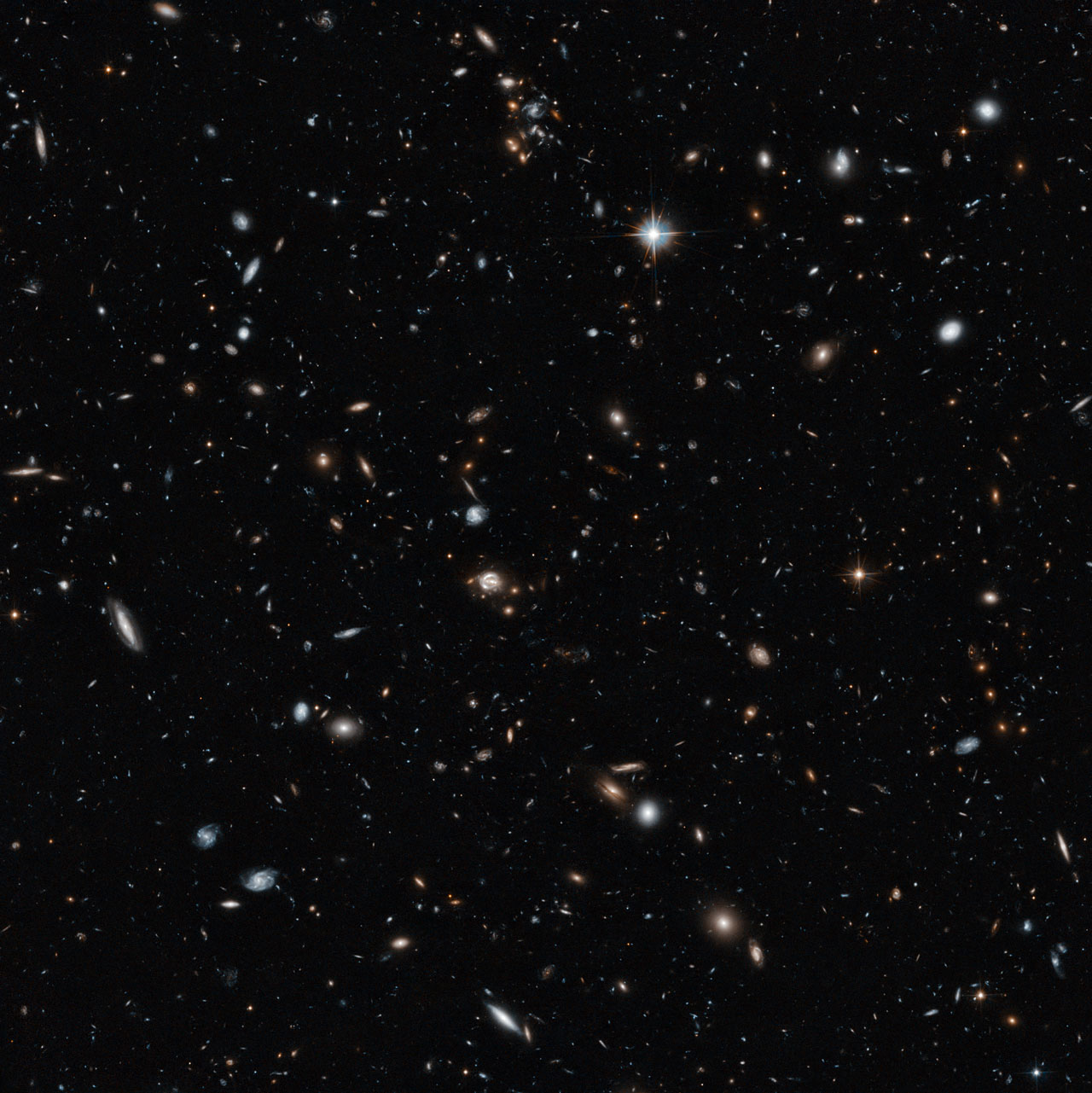
Hubble’s images might look flat, but this one shows a remarkable depth of field that lets us see more than halfway to the edge of the observable Universe. Credit: NASA/ESA.
The region of space that we can see is the observable Universe. When we look in any direction, we’re seeing the light that left stars millions and even billions of years ago. When you get out to the 13.8 billion light year mile marker, you’re seeing the light that was emitted shortly after the Big Bang, when the Universe cooled down to the point that it became transparent. So the observable Universe is a sphere around you, it’s relative to your position.
My observable Universe is a sphere around me, relative to my position. So if I’m 10 meters away from you, I can see a little further into the Universe in that direction. If you look behind you, you’re seeing the observable Universe a little further in the that direction.
Imagine you’re standing in a dark room holding a candle. You can see out into a sphere around you. You’re at the center of your observable space. And if I’m in a different location, I’ll have a different observable sphere. This is why we say that everyone is at the center of their own personal observable Universe.
This has hints of pedantry and it’s a little unsatisfying, so let’s dig a little deeper. Where is the actual center of the Universe, regardless of who’s observing it? Our Universe might be finite or it might be infinite. Astronomers don’t actually know for sure. Their most precise calculations say that the observable Universe is 93 billion light years across.
Representation of the timeline of the universe over 13.7 billion years, and the expansion in the universe that followed. Credit: NASA/WMAP Science Team.
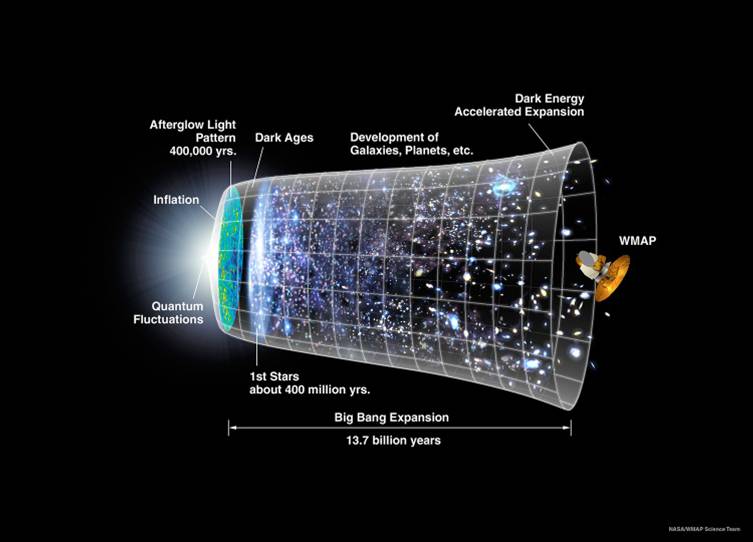
Remember that light from the Big Bang that took 13.8 billion light years to get to you? Well the expansion of the Universe has pushed that region out to more than 46 billion light-years away. Look as far as you can to the right and as far as you can to the left. Those two spots are currently 93 billion light-years away from each other. So we can’t see how big the Universe really is. It’s got to be larger than 93 billion light-years. Everything outside that region we just can’t see… yet. It might be infinite.
In a previous episode we hinted that every spot is at the center of the Universe. But why? It turns out, every way you look at it, you’re standing dead center at the middle of everything. And so is everyone else.
We ended a previous episode with how the center of the Universe is everywhere, and then quickly moved on to “Thanks for watching” without providing any details other than a wink and a nod.
Good news, here come your details. First, imagine the expanding Universe in your mind. You might be picturing an inflating ball pushing out in all directions. Perhaps you’re seeing some kind of giant expanding celestial pumpkin. Unfortunately, that idea is incorrect. But don’t feel bad, our thinking meat parts just aren’t built to do this sort of thing.
This 14-hour exposure from the Hubble Space Telescope zooms in on a galaxy cluster and shows objects around a billion times fainter than can be seen with the naked eye. Credit: NASA/ESA.
Hubble’s images might look flat, but this one shows a remarkable depth of field that lets us see more than halfway to the edge of the observable Universe. Credit: NASA/ESA.
The region of space that we can see is the observable Universe. When we look in any direction, we’re seeing the light that left stars millions and even billions of years ago. When you get out to the 13.8 billion light year mile marker, you’re seeing the light that was emitted shortly after the Big Bang, when the Universe cooled down to the point that it became transparent. So the observable Universe is a sphere around you, it’s relative to your position.
My observable Universe is a sphere around me, relative to my position. So if I’m 10 meters away from you, I can see a little further into the Universe in that direction. If you look behind you, you’re seeing the observable Universe a little further in the that direction.
Imagine you’re standing in a dark room holding a candle. You can see out into a sphere around you. You’re at the center of your observable space. And if I’m in a different location, I’ll have a different observable sphere. This is why we say that everyone is at the center of their own personal observable Universe.
This has hints of pedantry and it’s a little unsatisfying, so let’s dig a little deeper. Where is the actual center of the Universe, regardless of who’s observing it? Our Universe might be finite or it might be infinite. Astronomers don’t actually know for sure. Their most precise calculations say that the observable Universe is 93 billion light years across.
Representation of the timeline of the universe over 13.7 billion years, and the expansion in the universe that followed. Credit: NASA/WMAP Science Team.
Remember that light from the Big Bang that took 13.8 billion light years to get to you? Well the expansion of the Universe has pushed that region out to more than 46 billion light-years away. Look as far as you can to the right and as far as you can to the left. Those two spots are currently 93 billion light-years away from each other. So we can’t see how big the Universe really is. It’s got to be larger than 93 billion light-years. Everything outside that region we just can’t see… yet. It might be infinite.
http://www.universetoday.com/111561/whe ... -universe/
Previous 1 ... 44 45 46 47 48 49 50 ... 244 Next