
Space Thread
Previous 1 ... 42 43 44 45 46 47 48 ... 244 Next
DrCaleb @ Fri Mar 21, 2014 7:44 am
$1:
Gorgeous NASA photo of our closest supernova
Earlier this year, a group of college students discovered what would be called a "Holy Grail" for astronomers, a supernova that occurrred millions of lightyears away, but is one of the closest to Earth. NASA has published this beautiful composite image of it as it neared peak brightness. Here's the story behind this image, from NASA Goddard Space Flight Center:
This is a Hubble Space Telescope composite image of a supernova explosion designated SN 2014J in the galaxy M82. At a distance of approximately 11.5 million light-years from Earth it is the closest supernova of its type discovered in the past few decades. The explosion is categorized as a Type Ia supernova, which is theorized to be triggered in binary systems consisting of a white dwarf and another star — which could be a second white dwarf, a star like our sun, or a giant star.
Astronomers using a ground-based telescope discovered the explosion on January 21, 2014. This Hubble photograph was taken on January 31, as the supernova approached its peak brightness.

Earlier this year, a group of college students discovered what would be called a "Holy Grail" for astronomers, a supernova that occurrred millions of lightyears away, but is one of the closest to Earth. NASA has published this beautiful composite image of it as it neared peak brightness. Here's the story behind this image, from NASA Goddard Space Flight Center:
This is a Hubble Space Telescope composite image of a supernova explosion designated SN 2014J in the galaxy M82. At a distance of approximately 11.5 million light-years from Earth it is the closest supernova of its type discovered in the past few decades. The explosion is categorized as a Type Ia supernova, which is theorized to be triggered in binary systems consisting of a white dwarf and another star — which could be a second white dwarf, a star like our sun, or a giant star.
Astronomers using a ground-based telescope discovered the explosion on January 21, 2014. This Hubble photograph was taken on January 31, as the supernova approached its peak brightness.
http://www.mnn.com/earth-matters/space/ ... -supernova
DrCaleb @ Fri Mar 21, 2014 8:56 am
I've drooled over the Spitzer Galactic images ever since I had a computer powerful enough to open them. (some are 300mb in size!!)
$1:
NASA's Spitzer Telescope Brings 360-Degree View of Galaxy to Our Fingertips
Touring the Milky Way now is as easy as clicking a button with NASA's new zoomable, 360-degree mosaic presented Thursday at the TEDActive 2014 Conference in Vancouver, Canada.
The star-studded panorama of our galaxy is constructed from more than 2 million infrared snapshots taken over the past 10 years by NASA's Spitzer Space Telescope.
"If we actually printed this out, we'd need a billboard as big as the Rose Bowl Stadium to display it," said Robert Hurt, an imaging specialist at NASA's Spitzer Space Science Center in Pasadena, Calif. "Instead, we've created a digital viewer that anyone, even astronomers, can use."
The 20-gigapixel mosaic uses Microsoft's WorldWide Telescope visualization platform. It captures about three percent of our sky, but because it focuses on a band around Earth where the plane of the Milky Way lies, it shows more than half of all the galaxy's stars.
The image, derived primarily from the Galactic Legacy Mid-Plane Survey Extraordinaire project, or GLIMPSE, is online at:
http://www.spitzer.caltech.edu/glimpse360
. . .
Some sections of the GLIMPSE mosaic include longer-wavelength data from NASA's Wide-field Infrared Survey Explorer, or WISE, which scanned the whole sky in infrared light.
The GLIMPSE data are also part of a citizen science project, where users can help catalog bubbles and other objects in our Milky Way galaxy. To participate, visit:
http://www.milkywayproject.org
More information about Spitzer is online at:
http://www.nasa.gov/spitzer
The Jet Propulsion Laboratory, Pasadena, Calif., manages the Spitzer and WISE missions for NASA. The Spitzer Science Center is at the California Institute of Technology in Pasadena. Caltech manages JPL for NASA.

Touring the Milky Way now is as easy as clicking a button with NASA's new zoomable, 360-degree mosaic presented Thursday at the TEDActive 2014 Conference in Vancouver, Canada.
The star-studded panorama of our galaxy is constructed from more than 2 million infrared snapshots taken over the past 10 years by NASA's Spitzer Space Telescope.
"If we actually printed this out, we'd need a billboard as big as the Rose Bowl Stadium to display it," said Robert Hurt, an imaging specialist at NASA's Spitzer Space Science Center in Pasadena, Calif. "Instead, we've created a digital viewer that anyone, even astronomers, can use."
The 20-gigapixel mosaic uses Microsoft's WorldWide Telescope visualization platform. It captures about three percent of our sky, but because it focuses on a band around Earth where the plane of the Milky Way lies, it shows more than half of all the galaxy's stars.
The image, derived primarily from the Galactic Legacy Mid-Plane Survey Extraordinaire project, or GLIMPSE, is online at:
http://www.spitzer.caltech.edu/glimpse360
. . .
Some sections of the GLIMPSE mosaic include longer-wavelength data from NASA's Wide-field Infrared Survey Explorer, or WISE, which scanned the whole sky in infrared light.
The GLIMPSE data are also part of a citizen science project, where users can help catalog bubbles and other objects in our Milky Way galaxy. To participate, visit:
http://www.milkywayproject.org
More information about Spitzer is online at:
http://www.nasa.gov/spitzer
The Jet Propulsion Laboratory, Pasadena, Calif., manages the Spitzer and WISE missions for NASA. The Spitzer Science Center is at the California Institute of Technology in Pasadena. Caltech manages JPL for NASA.
http://www.jpl.nasa.gov/news/news.php?release=2014-088
DrCaleb @ Mon Mar 24, 2014 1:41 pm
DrCaleb @ Wed Mar 26, 2014 8:07 am
$1:
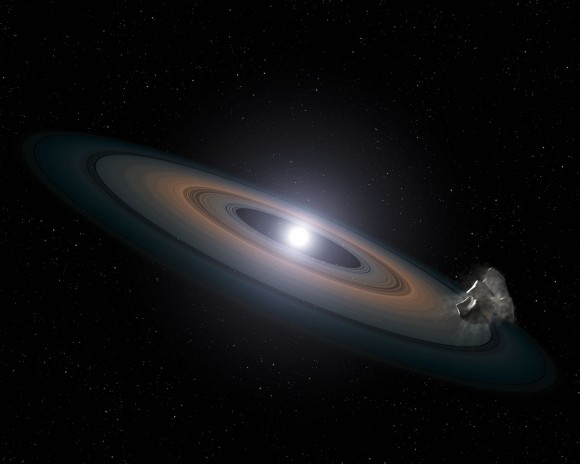
Rocky Alien Planet Leftovers ‘Polluted’ White Dwarf Stars With Metal
What’s with all the metals in the atmosphere of white dwarfs, those things that are corpses of stars like our own Sun? While before scientists had theories about levitating star layers that “polluted” the white dwarfs, new research shows it’s more likely due to rocky material. More specifically, material left over from planet formation.
Researchers surveyed 89 of these objects with the Far Ultraviolet Spectroscopic Explorer, a NASA space telescope which operated from 1999 to 2008. The stars’ spectra was analyzed to see what distinctive wavelengths of elements showed up.
Scientists discovered that in one-third of these stars, the ratio of silicon to carbon material is pretty close to what is seen in rocks, and is much higher than what would be expected in stars. The work implies that only a fraction of stars like our Sun would have terrestrial planets, researchers added.
What’s with all the metals in the atmosphere of white dwarfs, those things that are corpses of stars like our own Sun? While before scientists had theories about levitating star layers that “polluted” the white dwarfs, new research shows it’s more likely due to rocky material. More specifically, material left over from planet formation.
Researchers surveyed 89 of these objects with the Far Ultraviolet Spectroscopic Explorer, a NASA space telescope which operated from 1999 to 2008. The stars’ spectra was analyzed to see what distinctive wavelengths of elements showed up.
Scientists discovered that in one-third of these stars, the ratio of silicon to carbon material is pretty close to what is seen in rocks, and is much higher than what would be expected in stars. The work implies that only a fraction of stars like our Sun would have terrestrial planets, researchers added.
http://www.universetoday.com/110685/roc ... ith-metal/
DrCaleb @ Wed Mar 26, 2014 9:37 am
$1:
Comet probe to wake from hibernation
A fridge-sized robot lab hurtling through the Solar System aboard a European probe is about to wake from hibernation and prepare for the first-ever landing by a spacecraft on a comet.
The delicate operation, starting Friday, marks the next phase in the European Space Agency's billion-dollar mission to explore one of these ancient wanderers of our star system.
Sent to sleep in 2011 to save energy, the lander will start a weeks-long process of progressively waking up, checking and updating its systems ahead of its historic rendezvous with Comet 67P/Churyumov-Gerasimenko.
Dubbed Philae, the 100-kilo lander carried by the Rosetta spacecraft is the scientific star in a mission that has already taken 10 years and a seven-billion-kilometretrek around the inner Solar System.
Comets follow elliptical orbits around the Sun, spewing spectacular tails of gas and dust as close brushes with the hot star cause surface ice to evaporate.
They are sometimes called “dirty snowballs” - but cosmologists say comets' primeval mix of ice and dust are time capsules, offering insights into how the Solar System formed 4.5 billion years ago.
Some scientists believe comets may have brought much of the water in today's oceans and possibly complex molecules that kickstarted life on Earth.
This is where Philae comes in: it is stuffed with 10 instruments designed to probe and analyse the comet's surface, teasing out the secrets of its composition and organic chemistry.
Philippe Gaudon of France's CNES space agency said Philae's 33-month slumber was almost exactly “like an animal in hibernation,” for only its temperature was monitored during this time to check it remained alive in the chill of deep space.
The wakeup, he added: “will be like switching on a computer that's been off for three years.”
“By the beginning of July, Rosetta will be about 50 000km from the comet, by the beginning of August no more than 150 km,” said Gaudon.
In August, the satellite will be inserted into an orbit 25 kilometres above Comet “C-G”, which travels at speeds up to 135 000 kilometres per hour, to start scanning the surface for a suitable landing site for Philae.
On November 11, Rosetta will inch to within two to three kilometres of the comet surface to put down its precious load in a “delicate, difficult” operation, said Gaudon.
The box-shaped lander will touch down on its three legs, fire two harpoons into the surface to provide anchorage, and then further secure itself with ice screws before starting its work.

A fridge-sized robot lab hurtling through the Solar System aboard a European probe is about to wake from hibernation and prepare for the first-ever landing by a spacecraft on a comet.
The delicate operation, starting Friday, marks the next phase in the European Space Agency's billion-dollar mission to explore one of these ancient wanderers of our star system.
Sent to sleep in 2011 to save energy, the lander will start a weeks-long process of progressively waking up, checking and updating its systems ahead of its historic rendezvous with Comet 67P/Churyumov-Gerasimenko.
Dubbed Philae, the 100-kilo lander carried by the Rosetta spacecraft is the scientific star in a mission that has already taken 10 years and a seven-billion-kilometretrek around the inner Solar System.
Comets follow elliptical orbits around the Sun, spewing spectacular tails of gas and dust as close brushes with the hot star cause surface ice to evaporate.
They are sometimes called “dirty snowballs” - but cosmologists say comets' primeval mix of ice and dust are time capsules, offering insights into how the Solar System formed 4.5 billion years ago.
Some scientists believe comets may have brought much of the water in today's oceans and possibly complex molecules that kickstarted life on Earth.
This is where Philae comes in: it is stuffed with 10 instruments designed to probe and analyse the comet's surface, teasing out the secrets of its composition and organic chemistry.
Philippe Gaudon of France's CNES space agency said Philae's 33-month slumber was almost exactly “like an animal in hibernation,” for only its temperature was monitored during this time to check it remained alive in the chill of deep space.
The wakeup, he added: “will be like switching on a computer that's been off for three years.”
“By the beginning of July, Rosetta will be about 50 000km from the comet, by the beginning of August no more than 150 km,” said Gaudon.
In August, the satellite will be inserted into an orbit 25 kilometres above Comet “C-G”, which travels at speeds up to 135 000 kilometres per hour, to start scanning the surface for a suitable landing site for Philae.
On November 11, Rosetta will inch to within two to three kilometres of the comet surface to put down its precious load in a “delicate, difficult” operation, said Gaudon.
The box-shaped lander will touch down on its three legs, fire two harpoons into the surface to provide anchorage, and then further secure itself with ice screws before starting its work.
http://www.iol.co.za/scitech/science/sp ... -1.1666673
DrCaleb @ Wed Mar 26, 2014 11:42 am
$1:
Icy body found orbiting far from Sun
Scientists have identified a new dwarf planet in the distant reaches of our Solar System.
It is being called 2012 VP113 for the time being, is about 450km across and is very likely icy in composition.
To date, only one other such object has been seen orbiting beyond the major planets in its region of space referred to as the inner Oort Cloud.
That previous object, called Sedna, is about 1,000km across, and was found 10 years ago.
But researchers believe there are hundreds more such objects awaiting detection.
"We've been using a large camera on a four-metre telescope in Chile, and it's a very powerful facility," said Scott Sheppard from the Carnegie Institution of Science in Washington DC, US.
"Our survey covered just a very small area of the sky - about 220 full Moons of sky. So, there's a lot more sky out there, and we predict, based on this one object, that across the whole sky we could expect to find 900 objects of 1,000km or bigger in size.
"Some of these could be bigger than Pluto; some could even be bigger than Mars or the Earth. The problem is they're just so distant, especially when they're in the far parts of their orbits, that they're just too faint to detect," he told BBC News.
The observations of 2012 VP113 are reported in the journal Nature. They indicate that the object gets no closer than about 12 billion kilometres to the Sun, and at the farthest point in its eccentric orbit is a staggering 67 billion km from our star.
To put that in some context, the Earth is 149 million km from the Sun, and even the most distant major planet - Neptune - seems close at 4.5 billion km, by these standards.
Sheppard and his colleague Chad Trujillo, from the Gemini Observatory in Hawaii, have calculated that 2012 VP113 takes 4,000 years to go around the Sun.
The big question is: how did it and Sedna come to be where they are?

http://www.bbc.co.uk/news/science-environment-26737376
Scientists have identified a new dwarf planet in the distant reaches of our Solar System.
It is being called 2012 VP113 for the time being, is about 450km across and is very likely icy in composition.
To date, only one other such object has been seen orbiting beyond the major planets in its region of space referred to as the inner Oort Cloud.
That previous object, called Sedna, is about 1,000km across, and was found 10 years ago.
But researchers believe there are hundreds more such objects awaiting detection.
"We've been using a large camera on a four-metre telescope in Chile, and it's a very powerful facility," said Scott Sheppard from the Carnegie Institution of Science in Washington DC, US.
"Our survey covered just a very small area of the sky - about 220 full Moons of sky. So, there's a lot more sky out there, and we predict, based on this one object, that across the whole sky we could expect to find 900 objects of 1,000km or bigger in size.
"Some of these could be bigger than Pluto; some could even be bigger than Mars or the Earth. The problem is they're just so distant, especially when they're in the far parts of their orbits, that they're just too faint to detect," he told BBC News.
The observations of 2012 VP113 are reported in the journal Nature. They indicate that the object gets no closer than about 12 billion kilometres to the Sun, and at the farthest point in its eccentric orbit is a staggering 67 billion km from our star.
To put that in some context, the Earth is 149 million km from the Sun, and even the most distant major planet - Neptune - seems close at 4.5 billion km, by these standards.
Sheppard and his colleague Chad Trujillo, from the Gemini Observatory in Hawaii, have calculated that 2012 VP113 takes 4,000 years to go around the Sun.
The big question is: how did it and Sedna come to be where they are?
http://www.bbc.co.uk/news/science-environment-26737376
DrCaleb @ Wed Mar 26, 2014 11:49 am
$1:
Asteroid Chariklo's rings surprise astronomers
Centaur Chariklo is located between Saturn and Uranus
Rings been discovered around an asteroid for the first time to the dismay of astronomers who didn't think asteroids could have rings.
The asteroid Chariklo, which is also considered a minor planet, appears to be encircled by two narrow rings, reported an international team of scientists in a paper published online Wednesday in the journal Nature.
"We weren't looking for a ring and didn't think small bodies like Chariklo had them at all," said Felipe Braga-Ribas of the Observatório Nacional/MCTI in Rio de Janeiro, Brazil, lead author of the report, in a statement.
"So the discovery — and the amazing amount of detail we saw in the system — came as a complete surprise!"
Chariklo is the largest of the Centaurs, a group of asteroids orbiting between Saturn and Uranus. Its diameter is about 250 kilometres. In comparison, Lake Ontario is 310 kilometres long and Prince Edward Island is 224 kilometres long.
Chariklo closeup
The two rings, shown in an artist's impression, have been nicknamed Oiapoque and Chui after rivers near the northern and southern ends of Brazil. (L. Calçada/M. Kornmesser/Nick Risinger/ESO)
Chariklo is named after a nymph who was the wife of the centaur Chiron in Greek mythology.
Chariklo's rings were discovered when it passed in front of a star called UCAC4 on June 3, 2013, as viewed from South America. During such an event, called an occultation, the light from the star is temporarily blocked by an object passing in front of it. As researchers viewed the event from seven different telescopes around South America, they noticed two short dips in the star's brightness before and after the occultation.
A comparison of the data from the different telescopes and some calculations revealed that the dips were caused by two rings, one seven and one three kilometres wide, with a nine-kilometre gap in-between. They have been nicknamed Oiapoque and Chuí, two rivers near the northern and southern ends of Brazil

Centaur Chariklo is located between Saturn and Uranus
Rings been discovered around an asteroid for the first time to the dismay of astronomers who didn't think asteroids could have rings.
The asteroid Chariklo, which is also considered a minor planet, appears to be encircled by two narrow rings, reported an international team of scientists in a paper published online Wednesday in the journal Nature.
"We weren't looking for a ring and didn't think small bodies like Chariklo had them at all," said Felipe Braga-Ribas of the Observatório Nacional/MCTI in Rio de Janeiro, Brazil, lead author of the report, in a statement.
"So the discovery — and the amazing amount of detail we saw in the system — came as a complete surprise!"
Chariklo is the largest of the Centaurs, a group of asteroids orbiting between Saturn and Uranus. Its diameter is about 250 kilometres. In comparison, Lake Ontario is 310 kilometres long and Prince Edward Island is 224 kilometres long.
Chariklo closeup
The two rings, shown in an artist's impression, have been nicknamed Oiapoque and Chui after rivers near the northern and southern ends of Brazil. (L. Calçada/M. Kornmesser/Nick Risinger/ESO)
Chariklo is named after a nymph who was the wife of the centaur Chiron in Greek mythology.
Chariklo's rings were discovered when it passed in front of a star called UCAC4 on June 3, 2013, as viewed from South America. During such an event, called an occultation, the light from the star is temporarily blocked by an object passing in front of it. As researchers viewed the event from seven different telescopes around South America, they noticed two short dips in the star's brightness before and after the occultation.
A comparison of the data from the different telescopes and some calculations revealed that the dips were caused by two rings, one seven and one three kilometres wide, with a nine-kilometre gap in-between. They have been nicknamed Oiapoque and Chuí, two rivers near the northern and southern ends of Brazil
http://www.cbc.ca/news/technology/aster ... -1.2587266
DrCaleb @ Thu Mar 27, 2014 12:25 pm
DrCaleb DrCaleb:
$1:
It is being called 2012 VP113 for the time being, is about 450km across and is very likely icy in composition.
Object 2012 VP113 or 'VP' for short has been renamed 'Biden' because it's pretty far out there.
Who says scientists have no sense of humour?
DrCaleb @ Fri Mar 28, 2014 11:47 am
$1:
Slip-Sliding Away: Solar Flare’s Magnetic Lines Go For A Loop In This Video
When will the next big solar flare occur? How much damage could it cause to power lines and satellites? These are important questions for those looking to protect our infrastructure, but there’s still a lot we need to figure out concerning space weather.
The video above, however, shows magnetic lines weaving together from the surface of the Sun in 2012, eventually creating an eruption that was 35 times our planet’s size and sending out a surge of energy. It’s these energetic flares that can hit Earth’s atmosphere and cause auroras and power surges.
While models of this have been made before, this is the first time the phenomenon was caught in action. Scientists saw it using NASA’s Solar Dynamics Observatory.
Models of the flares show they typically occur amid distorted magnetic fields, the University of Cambridge noted, showing that the lines can “reconnect while slipping and flipping around each other.” Before the flare happens, the magnetic field lines line up in an arc across the sun’s surface (photosphere). That phenonemon is called field line footprints.
When will the next big solar flare occur? How much damage could it cause to power lines and satellites? These are important questions for those looking to protect our infrastructure, but there’s still a lot we need to figure out concerning space weather.
The video above, however, shows magnetic lines weaving together from the surface of the Sun in 2012, eventually creating an eruption that was 35 times our planet’s size and sending out a surge of energy. It’s these energetic flares that can hit Earth’s atmosphere and cause auroras and power surges.
While models of this have been made before, this is the first time the phenomenon was caught in action. Scientists saw it using NASA’s Solar Dynamics Observatory.
Models of the flares show they typically occur amid distorted magnetic fields, the University of Cambridge noted, showing that the lines can “reconnect while slipping and flipping around each other.” Before the flare happens, the magnetic field lines line up in an arc across the sun’s surface (photosphere). That phenonemon is called field line footprints.
http://www.universetoday.com/110779/sli ... his-video/
ShepherdsDog @ Fri Mar 28, 2014 12:03 pm
DrCaleb DrCaleb:
DrCaleb DrCaleb:
$1:
It is being called 2012 VP113 for the time being, is about 450km across and is very likely icy in composition.
Object 2012 VP113 or 'VP' for short has been renamed 'Biden' because it's pretty far out there.
Who says scientists have no sense of humour?
They were saying on the radio, that astronomers figure there is an object between 2 and 10 times the size of earth that is giving it this elliptical orbit....some gas giant likely, the sought after and much speculated Planet X, homeworld of the villainous Cowboy X
 . They were also speculating that thousands of dwarf worlds lay out there too, slowly circling the sun
DrCaleb @ Fri Mar 28, 2014 12:31 pm
ShepherdsDog ShepherdsDog:
DrCaleb DrCaleb:
Object 2012 VP113 or 'VP' for short has been renamed 'Biden' because it's pretty far out there.
Who says scientists have no sense of humour?
They were saying on the radio, that astronomers figure there is an object between 2 and 10 times the size of earth that is giving it this elliptical orbit....some gas giant likely, the sought after and much speculated Planet X, homeworld of the villainous Cowboy X
. They were also speculating that thousands of dwarf worlds lay out there too, slowly circling the sunPlanet X has been speculated for a while as the cause of the comets we see several times a week headed into the sun. Something needs to pull Oort cloud objects out of their orbits, and a large body far out in the solar system just makes sense in the calculations.
When they do computer simulations on the solar system forming from dust into planets, there were hundreds of planets that formed, but every once in a while they'd encounter some chance planetary alignment that yanked them out of their orbit and out into the solar system. Odds are that many survived in this new orbit, some may have been ejected from the solar system. And our solar system isn't unique, there could be millions of rogue planets wandering the galaxy.
DrCaleb @ Tue Apr 01, 2014 11:29 am
DrCaleb @ Tue Apr 01, 2014 1:06 pm
$1:
Must-See Spring Stargazing Guide: Eclipses, Meteor Showers and More
From eclipses and planets to meteor showers galore, the northern spring season of 2014 will bring a number of eye-catching celestial sights for stargazers on Earth.
Weather permitting, some of the best spring night sky events could be readily visible without the aid of binoculars or a telescope, even from brightly-lit cities. But you'll need to know when and where to look to make the most of the season.
I've always felt that many astronomers started their careers as perceptive children who responded to the thrill of witnessing a noteworthy astronomical event. So whether you want to impress a youngster, or you're simply hoping to witness a head-turning astronomical event for yourself, it always helps to be ready in advance by marking your calendar and highlighting a number of these special dates:
More at link.

From eclipses and planets to meteor showers galore, the northern spring season of 2014 will bring a number of eye-catching celestial sights for stargazers on Earth.
Weather permitting, some of the best spring night sky events could be readily visible without the aid of binoculars or a telescope, even from brightly-lit cities. But you'll need to know when and where to look to make the most of the season.
I've always felt that many astronomers started their careers as perceptive children who responded to the thrill of witnessing a noteworthy astronomical event. So whether you want to impress a youngster, or you're simply hoping to witness a head-turning astronomical event for yourself, it always helps to be ready in advance by marking your calendar and highlighting a number of these special dates:
More at link.
DrCaleb @ Tue Apr 01, 2014 4:12 pm
$1:
Massive solar flare results in isolated radio malfunctions
Saturday, March 29, witnessed a titanic eruption on the Sun. According to Space.com, the powerful X1-class flare arose from sunspot AR2017 at 1:48 p.m. Eastern Time. AR2017 is diminishing, but could generate additional flares in the near future. The flare was reported by the Space Weather Prediction Center, led by the National Oceanic and Atmospheric Administration. A video of the flare was taken by NASA’s Solar Dynamics Observatory.
Although Earth’s atmosphere protected life on the surface from the flare’s radiation, some of humanity’s technology was not so fortunate. As the flare erupted, it created shock waves that rippled through the Sun’s atmosphere at 11 million miles per hour. These waves emitted radio signals that blacked out radio signals on Earth for several minutes, causing them to emit only static. Flares can also interfere with GPS and other communications signals. Massive flares, if directed right at Earth, also can endanger astronauts, orbiting spacecraft, and satellites.
The flare also generated a “magnetic crochet” – ripples in Earth’s magnetic field. These disruptions occurred during the flare itself, in contrast to magnetic ripples caused by coronal mass ejections. Coronal mass ejections are blasts of super-heated plasma; it takes a few days for the plasma to reach Earth and cause disturbances in Earth’s magnetic field.

Saturday, March 29, witnessed a titanic eruption on the Sun. According to Space.com, the powerful X1-class flare arose from sunspot AR2017 at 1:48 p.m. Eastern Time. AR2017 is diminishing, but could generate additional flares in the near future. The flare was reported by the Space Weather Prediction Center, led by the National Oceanic and Atmospheric Administration. A video of the flare was taken by NASA’s Solar Dynamics Observatory.
Although Earth’s atmosphere protected life on the surface from the flare’s radiation, some of humanity’s technology was not so fortunate. As the flare erupted, it created shock waves that rippled through the Sun’s atmosphere at 11 million miles per hour. These waves emitted radio signals that blacked out radio signals on Earth for several minutes, causing them to emit only static. Flares can also interfere with GPS and other communications signals. Massive flares, if directed right at Earth, also can endanger astronauts, orbiting spacecraft, and satellites.
The flare also generated a “magnetic crochet” – ripples in Earth’s magnetic field. These disruptions occurred during the flare itself, in contrast to magnetic ripples caused by coronal mass ejections. Coronal mass ejections are blasts of super-heated plasma; it takes a few days for the plasma to reach Earth and cause disturbances in Earth’s magnetic field.
DrCaleb @ Thu Apr 03, 2014 12:02 pm
$1:
Saturn moon Enceladus has underground ocean
Finding may explain why water sprays out of 'tiger stripes' at planet's south pole
An ocean of water sloshes deep under the icy south pole of Saturn's tiny moon Enceladus, a new study suggests.
The new finding, based on data from NASA's Cassini spacecraft, may explain the geysers of water spouting from "tiger stripe" cracks in the moon's surface that were previously captured by the spacecraft's cameras.
It also adds to evidence that Enceladus may be able to support microbial life.
Enceladus is one of 53 known moons orbiting Saturn. It is just 500 kilometres in diameter – smaller than the length of the U.S.-Saskatchewan border. The moon is covered with a coating of clean, white ice that makes it "exceptionally bright" said Dave Stevenson, a planetary scientist who co-authored the paper published online in Science today.

Finding may explain why water sprays out of 'tiger stripes' at planet's south pole
An ocean of water sloshes deep under the icy south pole of Saturn's tiny moon Enceladus, a new study suggests.
The new finding, based on data from NASA's Cassini spacecraft, may explain the geysers of water spouting from "tiger stripe" cracks in the moon's surface that were previously captured by the spacecraft's cameras.
It also adds to evidence that Enceladus may be able to support microbial life.
Enceladus is one of 53 known moons orbiting Saturn. It is just 500 kilometres in diameter – smaller than the length of the U.S.-Saskatchewan border. The moon is covered with a coating of clean, white ice that makes it "exceptionally bright" said Dave Stevenson, a planetary scientist who co-authored the paper published online in Science today.
http://www.cbc.ca/news/politics/victims ... -1.2596307
Previous 1 ... 42 43 44 45 46 47 48 ... 244 Next