
Space Thread
Previous 1 ... 43 44 45 46 47 48 49 ... 244 Next
DrCaleb @ Fri Apr 04, 2014 8:07 am
$1:
Norwegian Skydiver Almost Gets Hit by Falling Meteor — and Captures it on Film

It sounds like a remarkable story, almost unbelievable: Anders Helstrup went skydiving nearly two years ago in Hedmark, Norway and while he didn’t realize it at the time, when he reviewed the footage taken by two cameras fixed to his helmet during the dive, he saw a rock plummet past him. He took it to experts and they realized he had captured a meteorite falling during its “dark flight” — when it has been slowed by atmospheric braking, and has cooled and is no longer luminous.
Norwegian astrophysicist Pål Brekke confirmed to Universe Today that the story is true. “I was part of the investigation – and kept secret for two years – in hope of finding the meteorite,” Brekke said via Twitter.
Since the search for the meteorite has come up empty so far, Helstrup’s story and video has been released in an effort to recruit more people to look for the rock.
“It has been a little hard to keep it as a secret,” Helstrup told Universe Today via email, “but everyone has been loyal to the project and helped us out!”
Here’s the video:
It rock zooms by at about :15 in this video:
It sounds like a remarkable story, almost unbelievable: Anders Helstrup went skydiving nearly two years ago in Hedmark, Norway and while he didn’t realize it at the time, when he reviewed the footage taken by two cameras fixed to his helmet during the dive, he saw a rock plummet past him. He took it to experts and they realized he had captured a meteorite falling during its “dark flight” — when it has been slowed by atmospheric braking, and has cooled and is no longer luminous.
Norwegian astrophysicist Pål Brekke confirmed to Universe Today that the story is true. “I was part of the investigation – and kept secret for two years – in hope of finding the meteorite,” Brekke said via Twitter.
Since the search for the meteorite has come up empty so far, Helstrup’s story and video has been released in an effort to recruit more people to look for the rock.
“It has been a little hard to keep it as a secret,” Helstrup told Universe Today via email, “but everyone has been loyal to the project and helped us out!”
Here’s the video:
It rock zooms by at about :15 in this video:
http://www.universetoday.com/110963/nor ... t-on-film/
Regina @ Fri Apr 04, 2014 8:11 am
 WOOOOOOO fuck!
DrCaleb @ Fri Apr 04, 2014 12:35 pm
$1:
Kamikaze Moon Probe to Carry out Risky Maneuver
Scientists have no delusions about the fate of NASA’s LADEE robotic probe, which has been exploring the shroud of dust and the trace gases that surround the moon.
On April 21 -- if not sooner -- the Lunar Atmosphere and Dust Environment Explorer will crash into the surface of the moon and vaporize.
But before its demise, scientists hope to break new ground by flying LADEE literally just above the ground.
“There is a chance that we could clip a mountain accidentally, but the risk is pretty low for that. And really, the value of the science that we can do with this attempt is worth this risk,” project manager Butler Hine, with NASA’s Ames Research Center in Moffett Field, Calif., told reporters on a conference call Thursday.
“The prime mission is in the bag,” added LADEE program executive Joan Salute, with NASA Headquarters in Washington DC. “We wouldn’t have authorized these low-altitude, high-risk attempts if all the requirements had not already been met.”
Beginning this weekend, LADEE will begin dropping its altitude until it ends up less than 2 miles above the lunar surface.

Scientists have no delusions about the fate of NASA’s LADEE robotic probe, which has been exploring the shroud of dust and the trace gases that surround the moon.
On April 21 -- if not sooner -- the Lunar Atmosphere and Dust Environment Explorer will crash into the surface of the moon and vaporize.
But before its demise, scientists hope to break new ground by flying LADEE literally just above the ground.
“There is a chance that we could clip a mountain accidentally, but the risk is pretty low for that. And really, the value of the science that we can do with this attempt is worth this risk,” project manager Butler Hine, with NASA’s Ames Research Center in Moffett Field, Calif., told reporters on a conference call Thursday.
“The prime mission is in the bag,” added LADEE program executive Joan Salute, with NASA Headquarters in Washington DC. “We wouldn’t have authorized these low-altitude, high-risk attempts if all the requirements had not already been met.”
Beginning this weekend, LADEE will begin dropping its altitude until it ends up less than 2 miles above the lunar surface.
http://news.discovery.com/space/kamikaz ... 140404.htm
DrCaleb @ Fri Apr 04, 2014 12:39 pm
$1:
Could This Be The Signal Of Dark Matter? Unsure Scientists Checking This Out
Sometimes a strange signal comes from the dark and it takes a while to figure out what that signal means. In this case, scientists analyzing high-energy gamma rays emanating from the galaxy’s center found an unexplained source of emission that they say is “consistent with some forms of dark matter.”
The data came courtesy of NASA’s Fermi Gamma-ray Space Telescope and was analyzed by a group of independent scientists. They found that by removing all known sources of gamma rays, they were left with gamma-ray emissions that so far, they cannot explain. More observations will be needed to characterize these emissions, they cautioned.
Scientists aren’t even sure what dark matter (which can only be detected through gravitational effects) is made of. One theoretical candidate could be something called Weakly Interacting Massive Particles (WIMPs), which could produce gamma rays in ranges that Fermi could detect.
Also, the location of the radiation at the galaxy’s center is an interesting spot, since scientists believe that’s where dark matter would lurk since the insofar invisible substance would be the base of normal structures like galaxies.
“The new maps allow us to analyze the excess and test whether more conventional explanations, such as the presence of undiscovered pulsars or cosmic-ray collisions on gas clouds, can account for it,” stated Dan Hooper, an astrophysicist at Fermilab and lead author of the study.
“The signal we find cannot be explained by currently proposed alternatives and is in close agreement with the predictions of very simple dark matter models.”
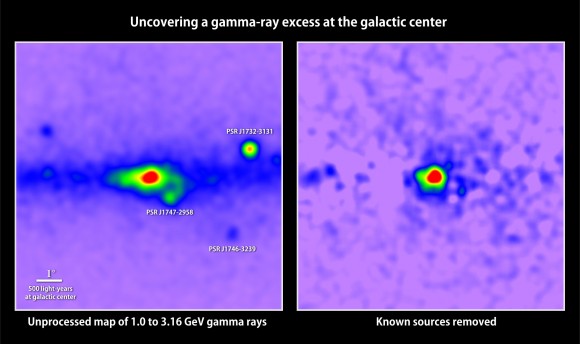
Sometimes a strange signal comes from the dark and it takes a while to figure out what that signal means. In this case, scientists analyzing high-energy gamma rays emanating from the galaxy’s center found an unexplained source of emission that they say is “consistent with some forms of dark matter.”
The data came courtesy of NASA’s Fermi Gamma-ray Space Telescope and was analyzed by a group of independent scientists. They found that by removing all known sources of gamma rays, they were left with gamma-ray emissions that so far, they cannot explain. More observations will be needed to characterize these emissions, they cautioned.
Scientists aren’t even sure what dark matter (which can only be detected through gravitational effects) is made of. One theoretical candidate could be something called Weakly Interacting Massive Particles (WIMPs), which could produce gamma rays in ranges that Fermi could detect.
Also, the location of the radiation at the galaxy’s center is an interesting spot, since scientists believe that’s where dark matter would lurk since the insofar invisible substance would be the base of normal structures like galaxies.
“The new maps allow us to analyze the excess and test whether more conventional explanations, such as the presence of undiscovered pulsars or cosmic-ray collisions on gas clouds, can account for it,” stated Dan Hooper, an astrophysicist at Fermilab and lead author of the study.
“The signal we find cannot be explained by currently proposed alternatives and is in close agreement with the predictions of very simple dark matter models.”
http://www.universetoday.com/110978/cou ... -this-out/
DrCaleb @ Tue Apr 08, 2014 10:38 am
$1:
Bright Blips on Mars Pictures Spark a Buzz Among UFO Fans
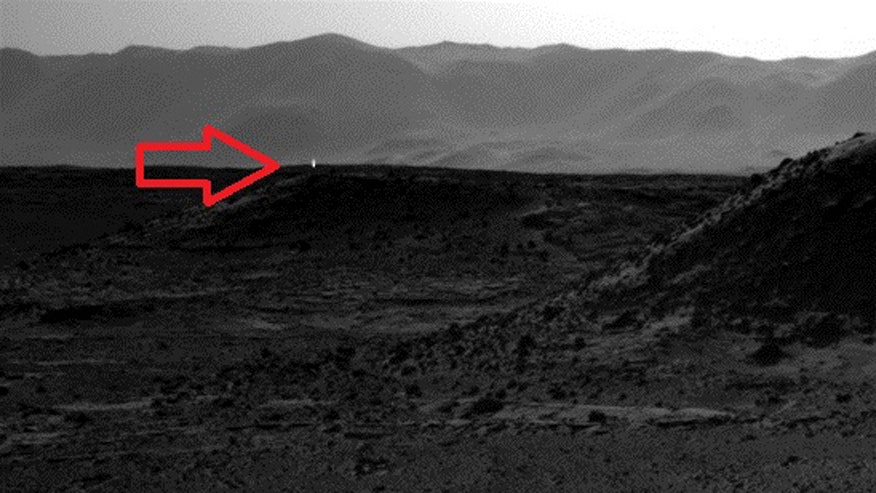
Bright spots that look like a beacon flashing from a distant Martian hillside are attracting attention from the UFO crowd — but are they real or just photographic glitches?
The evidence so far favors a pixel dropout as the explanation, but the coincidence is curious enough to stir up chatter on websites such as Disclose.tv and UFO Sightings Daily. The webmaster for the latter site, Scott C. Waring, is having as much fun with this one as he had last year with the Mars Rat and the Martian Iguana.
"This could indicate that there is intelligent life below the ground and uses light as we do," Waring wrote in a posting about the pic on Sunday.
The picture that caught Waring's eye was taken on April 3 by the right-hand navigation camera on NASA's Mars Curiosity rover as it was getting itself settled in a new study area known as the Kimberley. A bright speck that appears to flare upward can just be made out, right at the rim of a rise.
A picture taken by the right navcam on the day before shows a similar bright speck, seen from a slightly different perspective. The only problem is that the navigation camera is a stereo system, and the left-hand navcam doesn't show the bright spots on either day.
That suggests that the "light" might be a bit of lost data that left blank spots only on the right-hand navcam pictures. And it suggests that people are looking at the pictures from Curiosity very, very closely. If there's a message from Mars flashing in any photos, you can bet somebody's going to see it.
We've asked NASA's Jet Propulsion Laboratory to take a look at the pictures, and if we hear anything back, you'll find the update right here. Now, about that deer-cam UFO...
Update for 9 p.m. ET April 7: Doug Ellison, an imaging guru who happens to work at JPL, quickly told me in a Twitter update that the bright spot is due to a "cosmic ray hit" affecting the rover. (Later: The Surrey Space Center's Chris Bridges agrees.)
Bright spots that look like a beacon flashing from a distant Martian hillside are attracting attention from the UFO crowd — but are they real or just photographic glitches?
The evidence so far favors a pixel dropout as the explanation, but the coincidence is curious enough to stir up chatter on websites such as Disclose.tv and UFO Sightings Daily. The webmaster for the latter site, Scott C. Waring, is having as much fun with this one as he had last year with the Mars Rat and the Martian Iguana.
"This could indicate that there is intelligent life below the ground and uses light as we do," Waring wrote in a posting about the pic on Sunday.
The picture that caught Waring's eye was taken on April 3 by the right-hand navigation camera on NASA's Mars Curiosity rover as it was getting itself settled in a new study area known as the Kimberley. A bright speck that appears to flare upward can just be made out, right at the rim of a rise.
A picture taken by the right navcam on the day before shows a similar bright speck, seen from a slightly different perspective. The only problem is that the navigation camera is a stereo system, and the left-hand navcam doesn't show the bright spots on either day.
That suggests that the "light" might be a bit of lost data that left blank spots only on the right-hand navcam pictures. And it suggests that people are looking at the pictures from Curiosity very, very closely. If there's a message from Mars flashing in any photos, you can bet somebody's going to see it.
We've asked NASA's Jet Propulsion Laboratory to take a look at the pictures, and if we hear anything back, you'll find the update right here. Now, about that deer-cam UFO...
Update for 9 p.m. ET April 7: Doug Ellison, an imaging guru who happens to work at JPL, quickly told me in a Twitter update that the bright spot is due to a "cosmic ray hit" affecting the rover. (Later: The Surrey Space Center's Chris Bridges agrees.)
http://www.nbcnews.com/science/space/br ... ans-n74261
bootlegga @ Tue Apr 08, 2014 11:59 am
Here's a solar flare courtesy of NASA;
Jabberwalker @ Tue Apr 08, 2014 5:00 pm
DrCaleb DrCaleb:
$1:
Bright Blips on Mars Pictures Spark a Buzz Among UFO Fans
Bright spots that look like a beacon flashing from a distant Martian hillside are attracting attention from the UFO crowd — but are they real or just photographic glitches?
The evidence so far favors a pixel dropout as the explanation, but the coincidence is curious enough to stir up chatter on websites such as Disclose.tv and UFO Sightings Daily. The webmaster for the latter site, Scott C. Waring, is having as much fun with this one as he had last year with the Mars Rat and the Martian Iguana.
"This could indicate that there is intelligent life below the ground and uses light as we do," Waring wrote in a posting about the pic on Sunday.
The picture that caught Waring's eye was taken on April 3 by the right-hand navigation camera on NASA's Mars Curiosity rover as it was getting itself settled in a new study area known as the Kimberley. A bright speck that appears to flare upward can just be made out, right at the rim of a rise.
A picture taken by the right navcam on the day before shows a similar bright speck, seen from a slightly different perspective. The only problem is that the navigation camera is a stereo system, and the left-hand navcam doesn't show the bright spots on either day.
That suggests that the "light" might be a bit of lost data that left blank spots only on the right-hand navcam pictures. And it suggests that people are looking at the pictures from Curiosity very, very closely. If there's a message from Mars flashing in any photos, you can bet somebody's going to see it.
We've asked NASA's Jet Propulsion Laboratory to take a look at the pictures, and if we hear anything back, you'll find the update right here. Now, about that deer-cam UFO...
Update for 9 p.m. ET April 7: Doug Ellison, an imaging guru who happens to work at JPL, quickly told me in a Twitter update that the bright spot is due to a "cosmic ray hit" affecting the rover. (Later: The Surrey Space Center's Chris Bridges agrees.)
Bright spots that look like a beacon flashing from a distant Martian hillside are attracting attention from the UFO crowd — but are they real or just photographic glitches?
The evidence so far favors a pixel dropout as the explanation, but the coincidence is curious enough to stir up chatter on websites such as Disclose.tv and UFO Sightings Daily. The webmaster for the latter site, Scott C. Waring, is having as much fun with this one as he had last year with the Mars Rat and the Martian Iguana.
"This could indicate that there is intelligent life below the ground and uses light as we do," Waring wrote in a posting about the pic on Sunday.
The picture that caught Waring's eye was taken on April 3 by the right-hand navigation camera on NASA's Mars Curiosity rover as it was getting itself settled in a new study area known as the Kimberley. A bright speck that appears to flare upward can just be made out, right at the rim of a rise.
A picture taken by the right navcam on the day before shows a similar bright speck, seen from a slightly different perspective. The only problem is that the navigation camera is a stereo system, and the left-hand navcam doesn't show the bright spots on either day.
That suggests that the "light" might be a bit of lost data that left blank spots only on the right-hand navcam pictures. And it suggests that people are looking at the pictures from Curiosity very, very closely. If there's a message from Mars flashing in any photos, you can bet somebody's going to see it.
We've asked NASA's Jet Propulsion Laboratory to take a look at the pictures, and if we hear anything back, you'll find the update right here. Now, about that deer-cam UFO...
Update for 9 p.m. ET April 7: Doug Ellison, an imaging guru who happens to work at JPL, quickly told me in a Twitter update that the bright spot is due to a "cosmic ray hit" affecting the rover. (Later: The Surrey Space Center's Chris Bridges agrees.)
http://www.nbcnews.com/science/space/br ... ans-n74261
That's HIM man! That's ELVIS!!
I recognise the sequinned Viva Las Vegas suit!!
DrCaleb @ Wed Apr 09, 2014 8:21 am
$1:
Mars is at its brightest in 6 years
Tonight the Red Planet is in opposition, lined up with the Earth and sun
Go outside tonight and you may get your best view of the planet Mars in years.
Tonight marks the "opposition" of Mars, when the Earth passes between Mars and the sun, bringing the two planets toward their closest approach within their orbits — something that only happens every 26 months.
That will make Mars look like an unusually bright orange dot in the sky — almost 10 times brighter than the brightest stars, NASA says.
Mars should be easy for you to spot with the naked eye even in the city. If you have a backyard telescope, you may even be able to see details such as one of the planet's polar ice caps, the U.S. space agency says.
The relative closeness of Mars will make it appear bigger than usual. But the geometry of Mars relative to the sun also makes a difference, reports the astronomy news site EarthSky: "Mars’s disk not only covers more area of sky, but Mars’s surface reflects the light of the sun most directly back to Earth."
Tonight's celestial event is called "opposition" because the alignment of Earth between Mars and the sun will make them appear at opposites sides of the sky.


http://www.cbc.ca/news/technology/mars- ... -1.2602949
DrCaleb @ Fri Apr 11, 2014 9:00 am
$1:
A Mathematical Proof That The Universe Could Have Formed Spontaneously From Nothing
Cosmologists assume that natural quantum fluctuations allowed the Big Bang to happen spontaneously. Now they have a mathematical proof
One of the great theories of modern cosmology is that the universe began in a Big Bang. This is not just an idea but a scientific theory backed up by numerous lines of evidence.
For a start, there is the cosmic microwave background, which is a kind of echo of the big bang; then there is the ongoing expansion of the cosmos, which when imagined backwards, hints at a Big Bang-type origin; and the abundance of the primordial elements, such as helium-4, helium-3, deuterium and so on, can all be calculated using the theory.
But that still leaves a huge puzzle. What caused the Big Bang itself? For many years, cosmologists have relied on the idea that the universe formed spontaneously, that the Big Bang was the result of quantum fluctuations in which the Universe came into existence from nothing.
That’s plausible, given what we know about quantum mechanics. But physicists really need more — a mathematical proof to give the idea flesh.
Today they get their wish thanks to the work of Dongshan He and buddies at the Wuhan Institute of Physics and Mathematics in China. These guys have come up with the first rigorous proof that the Big Bang could indeed have occurred spontaneously because of quantum fluctuations.
The new proof is based on a special set of solutions to a mathematical entity known as the Wheeler-DeWitt equation. In the first half of the 20th century, cosmologists struggled to combine the two pillars of modern physics— quantum mechanics and general relativity—in a way that reasonably described the universe. As far as they could tell, these theories were entirely at odds with each other.
The breakthrough came in the 1960s when the physicists John Wheeler and Bryce DeWitt combined these previously incompatible ideas in a mathematical framework now known as the Wheeler-DeWitt equation. The new work of Dongshan and co explores some new solutions to this equation.
At the heart of their thinking is Heisenberg’s uncertainty principle. This allows a small empty space to come into existence probabilistically due to fluctuations in what physicists call the metastable false vacuum.
When this happens, there are two possibilities. If this bubble of space does not expand rapidly, it disappears again almost instantly. But if the bubble can expand to a large enough size, then a universe is created in a way that is irreversible.
The question is: does the Wheeler-DeWitt equation allow this? “We prove that once a small true vacuum bubble is created, it has the chance to expand exponentially,” say Dongshan and co.
Their approach is to consider a spherical bubble that is entirely described by its radius. They then derive the equation that describes the rate at which this radius can expand. They then consider three scenarios for the geometry of the bubble — whether closed, open or flat.
In each of these cases, they find a solution in which the bubble can expand exponentially and thereby reach a size in which a universe can form—a Big Bang.
That’s a result that cosmologists should be able to build on. It also has an interesting corollary.
One important factor in today’s models of the universe is called the cosmological constant. This is a term that describes the energy density of the vacuum of space. It was originally introduced by Einstein in his 1917 general theory of relativity and later abandoned by him after Hubble’s discovery that the universe was expanding.
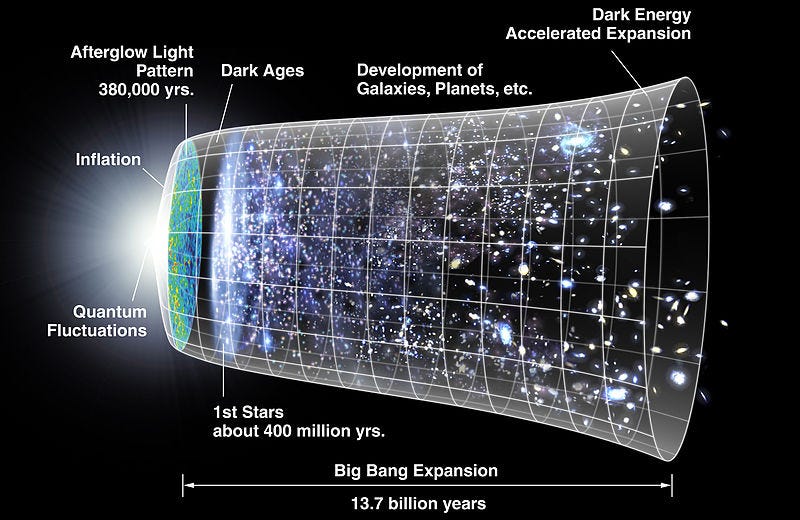
Cosmologists assume that natural quantum fluctuations allowed the Big Bang to happen spontaneously. Now they have a mathematical proof
One of the great theories of modern cosmology is that the universe began in a Big Bang. This is not just an idea but a scientific theory backed up by numerous lines of evidence.
For a start, there is the cosmic microwave background, which is a kind of echo of the big bang; then there is the ongoing expansion of the cosmos, which when imagined backwards, hints at a Big Bang-type origin; and the abundance of the primordial elements, such as helium-4, helium-3, deuterium and so on, can all be calculated using the theory.
But that still leaves a huge puzzle. What caused the Big Bang itself? For many years, cosmologists have relied on the idea that the universe formed spontaneously, that the Big Bang was the result of quantum fluctuations in which the Universe came into existence from nothing.
That’s plausible, given what we know about quantum mechanics. But physicists really need more — a mathematical proof to give the idea flesh.
Today they get their wish thanks to the work of Dongshan He and buddies at the Wuhan Institute of Physics and Mathematics in China. These guys have come up with the first rigorous proof that the Big Bang could indeed have occurred spontaneously because of quantum fluctuations.
The new proof is based on a special set of solutions to a mathematical entity known as the Wheeler-DeWitt equation. In the first half of the 20th century, cosmologists struggled to combine the two pillars of modern physics— quantum mechanics and general relativity—in a way that reasonably described the universe. As far as they could tell, these theories were entirely at odds with each other.
The breakthrough came in the 1960s when the physicists John Wheeler and Bryce DeWitt combined these previously incompatible ideas in a mathematical framework now known as the Wheeler-DeWitt equation. The new work of Dongshan and co explores some new solutions to this equation.
At the heart of their thinking is Heisenberg’s uncertainty principle. This allows a small empty space to come into existence probabilistically due to fluctuations in what physicists call the metastable false vacuum.
When this happens, there are two possibilities. If this bubble of space does not expand rapidly, it disappears again almost instantly. But if the bubble can expand to a large enough size, then a universe is created in a way that is irreversible.
The question is: does the Wheeler-DeWitt equation allow this? “We prove that once a small true vacuum bubble is created, it has the chance to expand exponentially,” say Dongshan and co.
Their approach is to consider a spherical bubble that is entirely described by its radius. They then derive the equation that describes the rate at which this radius can expand. They then consider three scenarios for the geometry of the bubble — whether closed, open or flat.
In each of these cases, they find a solution in which the bubble can expand exponentially and thereby reach a size in which a universe can form—a Big Bang.
That’s a result that cosmologists should be able to build on. It also has an interesting corollary.
One important factor in today’s models of the universe is called the cosmological constant. This is a term that describes the energy density of the vacuum of space. It was originally introduced by Einstein in his 1917 general theory of relativity and later abandoned by him after Hubble’s discovery that the universe was expanding.
https://medium.com/the-physics-arxiv-blog/ed7ed0f304a3
Jabberwalker @ Fri Apr 11, 2014 9:02 am
Interesting ... a crude schematic of the hologram that we are a part of ...
DrCaleb @ Fri Apr 11, 2014 9:14 am
Jabberwalker Jabberwalker:
Interesting ... a crude schematic of the hologram that we are a part of ...
We aren't part of a hologram. The Universe is holographic. Slight difference in English, but big consequences.
Jabberwalker @ Fri Apr 11, 2014 10:27 am
DrCaleb DrCaleb:
Jabberwalker Jabberwalker:
Interesting ... a crude schematic of the hologram that we are a part of ...
We aren't part of a hologram. The Universe is holographic. Slight difference in English, but big consequences.
Yes, but ... are we not part of the universe as well? We are both observers of and a part of the landscape.
DrCaleb @ Fri Apr 11, 2014 10:31 am
Jabberwalker Jabberwalker:
DrCaleb DrCaleb:
Jabberwalker Jabberwalker:
Interesting ... a crude schematic of the hologram that we are a part of ...
We aren't part of a hologram. The Universe is holographic. Slight difference in English, but big consequences.
Yes, but ... are we not part of the universe as well? We are both observers of and a part of the landscape.
"A hologram" is not the same as "holographic". We are 'holographic', we are not 'holograms'.
DrCaleb @ Tue Apr 15, 2014 6:53 am
$1:
NASA Cassini Images May Reveal Birth of a Saturn Moon
NASA's Cassini spacecraft has documented the formation of a small icy object within the rings of Saturn that may be a new moon, and may also provide clues to the formation of the planet's known moons.
Images taken with Cassini's narrow angle camera on April 15, 2013, show disturbances at the very edge of Saturn's A ring -- the outermost of the planet's large, bright rings. One of these disturbances is an arc about 20 percent brighter than its surroundings, 750 miles (1,200 kilometers) long and 6 miles (10 kilometers) wide. Scientists also found unusual protuberances in the usually smooth profile at the ring's edge. Scientists believe the arc and protuberances are caused by the gravitational effects of a nearby object. Details of the observations were published online today (April 14, 2014) by the journal Icarus.
The object is not expected to grow any larger, and may even be falling apart. But the process of its formation and outward movement aids in our understanding of how Saturn's icy moons, including the cloud-wrapped Titan and ocean-holding Enceladus, may have formed in more massive rings long ago. It also provides insight into how Earth and other planets in our solar system may have formed and migrated away from our star, the sun.
"We have not seen anything like this before," said Carl Murray of Queen Mary University of London, the report's lead author. "We may be looking at the act of birth, where this object is just leaving the rings and heading off to be a moon in its own right."
The object, informally named Peggy, is too small to be seen in images so far. Scientists estimate it is probably no more than about a half mile (about a kilometer) in diameter. Saturn's icy moons range in size depending on their proximity to the planet -- the farther from the planet, the larger. And many of Saturn's moons are composed primarily of ice, as are the particles that form Saturn's rings. Based on these facts, and other indicators, researchers recently proposed that the icy moons formed from ring particles and then moved outward, away from the planet, merging with other moons on the way.

http://saturn.jpl.nasa.gov/news/newsrel ... e20140414/
NASA's Cassini spacecraft has documented the formation of a small icy object within the rings of Saturn that may be a new moon, and may also provide clues to the formation of the planet's known moons.
Images taken with Cassini's narrow angle camera on April 15, 2013, show disturbances at the very edge of Saturn's A ring -- the outermost of the planet's large, bright rings. One of these disturbances is an arc about 20 percent brighter than its surroundings, 750 miles (1,200 kilometers) long and 6 miles (10 kilometers) wide. Scientists also found unusual protuberances in the usually smooth profile at the ring's edge. Scientists believe the arc and protuberances are caused by the gravitational effects of a nearby object. Details of the observations were published online today (April 14, 2014) by the journal Icarus.
The object is not expected to grow any larger, and may even be falling apart. But the process of its formation and outward movement aids in our understanding of how Saturn's icy moons, including the cloud-wrapped Titan and ocean-holding Enceladus, may have formed in more massive rings long ago. It also provides insight into how Earth and other planets in our solar system may have formed and migrated away from our star, the sun.
"We have not seen anything like this before," said Carl Murray of Queen Mary University of London, the report's lead author. "We may be looking at the act of birth, where this object is just leaving the rings and heading off to be a moon in its own right."
The object, informally named Peggy, is too small to be seen in images so far. Scientists estimate it is probably no more than about a half mile (about a kilometer) in diameter. Saturn's icy moons range in size depending on their proximity to the planet -- the farther from the planet, the larger. And many of Saturn's moons are composed primarily of ice, as are the particles that form Saturn's rings. Based on these facts, and other indicators, researchers recently proposed that the icy moons formed from ring particles and then moved outward, away from the planet, merging with other moons on the way.
http://saturn.jpl.nasa.gov/news/newsrel ... e20140414/
ShepherdsDog @ Tue Apr 15, 2014 7:56 am
only to be smashed back into rubble as it tries to merge into the traffic flow with the other moons
Previous 1 ... 43 44 45 46 47 48 49 ... 244 Next