
Space Thread
Previous 1 ... 46 47 48 49 50 51 52 ... 244 Next
DrCaleb @ Wed May 14, 2014 9:20 am
DrCaleb DrCaleb:
$1:
Giant planet around dwarf star a surprising discovery
First of its kind may reveal new insights about planets and brown dwarfs
A gigantic planet-like object like no other has been found circling a tiny star at a record distance.

First of its kind may reveal new insights about planets and brown dwarfs
A gigantic planet-like object like no other has been found circling a tiny star at a record distance.
http://www.cbc.ca/news/technology/giant ... -1.2641682
And read another great article on this planet - It may have formed only 10 million years ago! This is a picture of the system, with the gas cloud around it enhanced:

$1:
The mass suggests that this is a gas giant that formed from a non-rotating cloud of hot gas that contracted as it cooled. The surprising thing about this planet is the time scale on which it must have formed. With the host star only about 10 million years old, it must have formed in only a couple of million years, much faster than previous expectations. This work also offers up a new potential methodology for detecting exoplanets: looking for deformations in the gas-rich disks that exist around young stars.
http://arstechnica.com/science/2010/06/ ... ion-years/
DrCaleb @ Wed May 14, 2014 11:18 am
NASA simulation of two Neutron stars in orbit of each other, colliding to form a Black Hole (total simulated time, 20ms!):
DrCaleb @ Wed May 14, 2014 12:17 pm
$1:
Supermassive Black Hole At The Centre Of The Galaxy May Be A Wormhole In Disguise, Say Astronomers
And if it is a wormhole, this is how it would look…
One of the most extraordinary objects in the Milky Way galaxy is Sagittarius A* (pronounced Sagittarius A star). This small object is a bright source of radio waves in the constellation of Sagittarius that was discovered in 1974.
Since then, astronomers have made numerous observations of Sagittarius A* and the stars nearby, some of which orbit it at very high velocity. That implies that Sagittarius A* is extremely massive and since it is so small it must also be hugely dense.
That’s why many astronomers believe this object is a supermassive black hole lying at the centre of the galaxy. In fact, Sagittarius A* is about 4 million times more massive than the Sun packed into a volume not much bigger than the solar system.
But there is another explanation—that this massive dense object is a wormhole that connects our region of space to another point in the universe or even to another part of the multiverse. (Astrophysicists have long known that wormholes are allowed by the laws of general relativity and may well have formed soon after the Big Bang.)
And that raises an interesting question. If Sagittarius A* is a wormhole, how can astronomers distinguish it from a black hole? Today, we get an answer thanks to the work of Zilong Li and Cosimo Bambi at Fudan University in Shanghai.
These guys have calculated that plasma orbiting a black hole would look different to the same plasma orbiting a wormhole. They have calculated the difference and even simulated the resulting images that should be possible to collect using the next generation of interferometric telescopes. In other words, if there is a wormhole at the centre of our galaxy, we should be up to see it within the next few years.

The idea that a wormhole might exist at the centre of the galaxy is not as far-fetched as it sounds. In the early universe, quantum fluctuations may well have a connected different regions of the cosmos, creating wormholes that were preserved during inflation when universe increased in size by many orders of magnitude.
The presence of a wormhole would actually solve a major problem of galaxy formation. In recent years, astronomers have observed what appear to be supermassive black holes at the centre of many galaxies. Indeed, many believe that supermassive black holes are necessary for galaxies to form in the first place— they provide the gravitational pull to hold galaxies together in their early stages.
But if that’s true, how do supermassive black holes become so massive so quickly? After all, the one at the centre of our galaxy must have been in place about 100 million years after the Big Bang. That doesn’t leave much time to grow.
A wormhole, on the other hand, is a primordial object formed in the blink of an eye after creation. So if wormholes did form in this way, they would be present in the early universe to trigger the formation of the first galaxies.
That’s why telling one from the other is so significant— the difference provides important clues about the nature of the early universe.
And if it is a wormhole, this is how it would look…
One of the most extraordinary objects in the Milky Way galaxy is Sagittarius A* (pronounced Sagittarius A star). This small object is a bright source of radio waves in the constellation of Sagittarius that was discovered in 1974.
Since then, astronomers have made numerous observations of Sagittarius A* and the stars nearby, some of which orbit it at very high velocity. That implies that Sagittarius A* is extremely massive and since it is so small it must also be hugely dense.
That’s why many astronomers believe this object is a supermassive black hole lying at the centre of the galaxy. In fact, Sagittarius A* is about 4 million times more massive than the Sun packed into a volume not much bigger than the solar system.
But there is another explanation—that this massive dense object is a wormhole that connects our region of space to another point in the universe or even to another part of the multiverse. (Astrophysicists have long known that wormholes are allowed by the laws of general relativity and may well have formed soon after the Big Bang.)
And that raises an interesting question. If Sagittarius A* is a wormhole, how can astronomers distinguish it from a black hole? Today, we get an answer thanks to the work of Zilong Li and Cosimo Bambi at Fudan University in Shanghai.
These guys have calculated that plasma orbiting a black hole would look different to the same plasma orbiting a wormhole. They have calculated the difference and even simulated the resulting images that should be possible to collect using the next generation of interferometric telescopes. In other words, if there is a wormhole at the centre of our galaxy, we should be up to see it within the next few years.
The idea that a wormhole might exist at the centre of the galaxy is not as far-fetched as it sounds. In the early universe, quantum fluctuations may well have a connected different regions of the cosmos, creating wormholes that were preserved during inflation when universe increased in size by many orders of magnitude.
The presence of a wormhole would actually solve a major problem of galaxy formation. In recent years, astronomers have observed what appear to be supermassive black holes at the centre of many galaxies. Indeed, many believe that supermassive black holes are necessary for galaxies to form in the first place— they provide the gravitational pull to hold galaxies together in their early stages.
But if that’s true, how do supermassive black holes become so massive so quickly? After all, the one at the centre of our galaxy must have been in place about 100 million years after the Big Bang. That doesn’t leave much time to grow.
A wormhole, on the other hand, is a primordial object formed in the blink of an eye after creation. So if wormholes did form in this way, they would be present in the early universe to trigger the formation of the first galaxies.
That’s why telling one from the other is so significant— the difference provides important clues about the nature of the early universe.
https://medium.com/the-physics-arxiv-blog/bb5ae64fa4fa
ShepherdsDog @ Wed May 14, 2014 12:25 pm
So we'll find this close by?
DrCaleb @ Wed May 14, 2014 12:34 pm
ShepherdsDog ShepherdsDog:
So we'll find this close by?
One of my favourite Robert Heinlien Novels "The Number of the Beast" has the premise that the multiverse is not only filled with alternate versions of us, it's also filled with Universes created by our own fictions. The Land of Oz, John Carter of Mars, The Lensmen . . all of these exist in their own Universe.
No reason why Roddenberry's Fiction (and Spock-with-a-Beard!) shouldn't exist somewhere.
 If so, I want my own Defiant Class warship.
Jabberwalker @ Wed May 14, 2014 1:01 pm
To hell with that. Drop me off on Risa.
Jabberwalker @ Wed May 14, 2014 4:01 pm
The Russians are starting the squabble over the ISS.
http://www.telegraph.co.uk/news/worldne ... tions.html
DrCaleb @ Thu May 15, 2014 6:59 am
Jabberwalker Jabberwalker:
The Russians are starting the squabble over the ISS.
http://www.telegraph.co.uk/news/worldne ... tions.html
http://www.telegraph.co.uk/news/worldne ... tions.html
Let them. There are also European, Canadian and Japanese contributions to the station. If the Russians want to get all PMS-y and take their ball and go home, that's fine. SpaceX has already delivered cargo to the station, and should have human capability in the next couple years.
DrCaleb @ Thu May 15, 2014 11:42 am
$1:
Comet-Chasing Rosetta Probe Spies Dusty Veil Around Its Target
Far out in space, near the orbit of Jupiter, a European spacecraft named Rosetta is chasing a comet that has recently developed an ethereal veil.
New images from Rosetta show that an 800-mile-long (1,300 kilometers) cloud of dust, known as a coma, has sprouted from the core of the comet 67P/Churyumov-Gerasimenko. Rosetta's scientific imaging system, OSIRIS, captured this coma in a series of photos that were taken between March 27 and May 4 and released by the European Space Agency today (May 15).
"67P is beginning to look like a real comet," Holger Sierks, the principal investigator for OSIRIS at the Max Planck Institute for Solar System Research in Germany, said in a statement.
Rosetta is still 1.2 million miles (2 million km) away from the comet. But in just a few months, the spacecraft will be inside 67P's dusty cloud, accompanying the icy wanderer on an unprecedented journey to the inner reaches of the solar system.
The comet orbits the sun every 6.5 years. As it gets closer to the sun, the icy body starts to heat up; its surface ice sublimates and volatile gases laced with dust particles are released from its nucleus, creating a long dirty cloud that trails behind the comet. The new images of 67P show that it's already starting to warm up, even from its current distance of 375 million miles (600 million km) away from the sun. (For comparison, Earth is 93 million miles, or 150 million km, from the sun.)

Far out in space, near the orbit of Jupiter, a European spacecraft named Rosetta is chasing a comet that has recently developed an ethereal veil.
New images from Rosetta show that an 800-mile-long (1,300 kilometers) cloud of dust, known as a coma, has sprouted from the core of the comet 67P/Churyumov-Gerasimenko. Rosetta's scientific imaging system, OSIRIS, captured this coma in a series of photos that were taken between March 27 and May 4 and released by the European Space Agency today (May 15).
"67P is beginning to look like a real comet," Holger Sierks, the principal investigator for OSIRIS at the Max Planck Institute for Solar System Research in Germany, said in a statement.
Rosetta is still 1.2 million miles (2 million km) away from the comet. But in just a few months, the spacecraft will be inside 67P's dusty cloud, accompanying the icy wanderer on an unprecedented journey to the inner reaches of the solar system.
The comet orbits the sun every 6.5 years. As it gets closer to the sun, the icy body starts to heat up; its surface ice sublimates and volatile gases laced with dust particles are released from its nucleus, creating a long dirty cloud that trails behind the comet. The new images of 67P show that it's already starting to warm up, even from its current distance of 375 million miles (600 million km) away from the sun. (For comparison, Earth is 93 million miles, or 150 million km, from the sun.)
http://www.space.com/25890-rosetta-spac ... hotos.html
DrCaleb @ Fri May 16, 2014 7:07 am
$1:
The shrinking of Jupiter’s Great Red Spot
Hubble snaps stormy region at its smallest size ever
Jupiter's trademark Great Red Spot — a swirling storm feature larger than Earth — is shrinking. This downsizing, which is changing the shape of the spot from an oval into a circle, has been known about since the 1930s, but now these striking new NASA/ESA Hubble Space Telescope images capture the spot at a smaller size than ever before.
Jupiter's Great Red Spot is a churning anticyclonic storm [1]. It shows up in images of the giant planet as a conspicuous deep red eye embedded in swirling layers of pale yellow, orange and white. Winds inside this Jovian storm rage at immense speeds, reaching several hundreds of kilometres per hour.
Historic observations as far back as the late 1800s [2] gauged this turbulent spot to span about 41 000 kilometres at its widest point — wide enough to fit three Earths comfortably side by side. In 1979 and 1980 the NASA Voyager fly-bys measured the spot at a shrunken 23 335 kilometres across. Now, Hubble has spied this feature to be smaller than ever before.
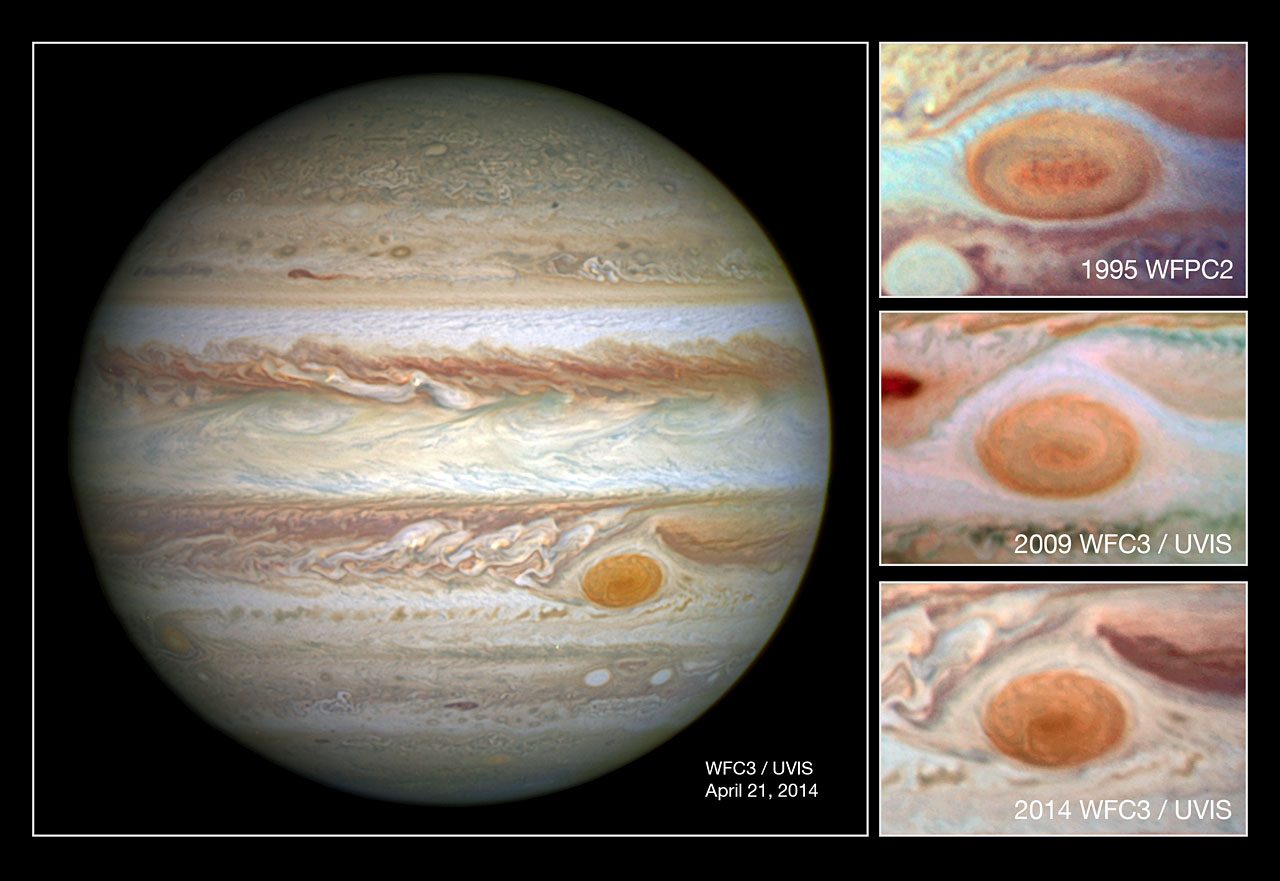
Hubble snaps stormy region at its smallest size ever
Jupiter's trademark Great Red Spot — a swirling storm feature larger than Earth — is shrinking. This downsizing, which is changing the shape of the spot from an oval into a circle, has been known about since the 1930s, but now these striking new NASA/ESA Hubble Space Telescope images capture the spot at a smaller size than ever before.
Jupiter's Great Red Spot is a churning anticyclonic storm [1]. It shows up in images of the giant planet as a conspicuous deep red eye embedded in swirling layers of pale yellow, orange and white. Winds inside this Jovian storm rage at immense speeds, reaching several hundreds of kilometres per hour.
Historic observations as far back as the late 1800s [2] gauged this turbulent spot to span about 41 000 kilometres at its widest point — wide enough to fit three Earths comfortably side by side. In 1979 and 1980 the NASA Voyager fly-bys measured the spot at a shrunken 23 335 kilometres across. Now, Hubble has spied this feature to be smaller than ever before.
http://www.spacetelescope.org/news/heic1410/
Jabberwalker @ Fri May 16, 2014 9:17 am
... no more Equatorial Vortex.
stratos @ Fri May 16, 2014 9:22 am
I'm sure someone will claim it's because of global warming. 
Sorry I couldn't resist. 
stratos @ Fri May 16, 2014 9:25 am
Russia loses $275 million satellite in latest rocket failure
A Proton-M launch vehicle with three Glonass-M satellites onboard while being mounted on its launch pad.
© EPA: Roscosmos, Handout
Reuters 4 hr ago | By Dmitry Solovyov of Reuters
ALMATY (Reuters) - A Russian rocket carrying a $275 million telecommunications satellite failed and burned up shortly after launch on Friday, the latest in a series of setbacks for Russia's once-pioneering space industry.
It was the second failure for Russia's workhorse Proton-M rocket in less than a year, and the second time that it had failed to deliver a European satellite intended to provide advanced telecoms and Internet access to remote parts of Russia, after the last one crashed shortly after launch in 2011.
Friday's unmanned mission went awry when the engine on the third stage of the Proton-M booster rocket failed, Oleg Ostapenko, head of the Russian space agency Roskosmos, told Russian news agencies. He said the precise cause was unknown.
The failure occurred at an altitude of 160 km (100 miles), about nine minutes after the early-morning lift-off from the Russian-leased Baikonur facility in Kazakhstan.
The state-run RIA quoted Ostapenko as saying that the rocket and all debris had burned up in the atmosphere: "We can say with certainty that nothing reached Earth."
However, Russian media said some debris may have fallen into the Pacific or been scattered over Siberia and Russia's Far East. No casualties or damage were reported on the ground.
The lost Express AM4R satellite, worth more than 200 million euros ($275 million), was described by its maker Astrium, a unit of the European aerospace group Airbus AIR.PA, as one of the most powerful satellites built in Europe.
Its loss delays a number of commercial projects by three to four years.
"It's a heavy blow, of course. And the thing is that our workhorse rocket - our most powerful and the most-used rocket - has such a bad record," Ivan Moiseyev, head of the Russian-based Institute of Space Policy think tank, told Kommersant-FM radio.
He said the rocket had a 7 percent failure rate, and its unreliability was making it harder for Russia to compete in the multibillion-dollar global satellite launch industry, giving a boost to its European rival Arianespace and the American newcomer SpaceX. (Full Story)
"It's a very unsuccessful picture on the whole and, if you compare it with our main competitors, with Europe, their last accident was 12 years ago," Moiseyev said.
Last July, three navigation satellites worth about $200 million were lost when the Proton-M rocket crashed near the launch pad shortly after take-off.
That accident strained relations between Kazakhstan and Russia and led Kazakhstan to temporarily ban Proton launches from Baikonur.
State-run Rossiya-24 television said all launches had been suspended from Kazakhstan after Friday's failure.
(Reporting by Dmitry Solovyov, editing by Jason Bush and Timolthy Heritage)
Jabberwalker @ Fri May 16, 2014 9:27 am
The whole concept of "global warming" came about after the first missions to Venus. They couldn't explain the extreme temperature on the surface based on proximity to the sun, alone. The "smoking gun" was found to be the high carbon dioxide content of the atmosphere and the "greenhouse effect" was first noticed.
Zipperfish @ Fri May 16, 2014 9:46 am
DrCaleb DrCaleb:
$1:
The shrinking of Jupiter’s Great Red Spot
Hubble snaps stormy region at its smallest size ever
Jupiter's trademark Great Red Spot — a swirling storm feature larger than Earth — is shrinking. This downsizing, which is changing the shape of the spot from an oval into a circle, has been known about since the 1930s, but now these striking new NASA/ESA Hubble Space Telescope images capture the spot at a smaller size than ever before.
Jupiter's Great Red Spot is a churning anticyclonic storm [1]. It shows up in images of the giant planet as a conspicuous deep red eye embedded in swirling layers of pale yellow, orange and white. Winds inside this Jovian storm rage at immense speeds, reaching several hundreds of kilometres per hour.
Historic observations as far back as the late 1800s [2] gauged this turbulent spot to span about 41 000 kilometres at its widest point — wide enough to fit three Earths comfortably side by side. In 1979 and 1980 the NASA Voyager fly-bys measured the spot at a shrunken 23 335 kilometres across. Now, Hubble has spied this feature to be smaller than ever before.
Hubble snaps stormy region at its smallest size ever
Jupiter's trademark Great Red Spot — a swirling storm feature larger than Earth — is shrinking. This downsizing, which is changing the shape of the spot from an oval into a circle, has been known about since the 1930s, but now these striking new NASA/ESA Hubble Space Telescope images capture the spot at a smaller size than ever before.
Jupiter's Great Red Spot is a churning anticyclonic storm [1]. It shows up in images of the giant planet as a conspicuous deep red eye embedded in swirling layers of pale yellow, orange and white. Winds inside this Jovian storm rage at immense speeds, reaching several hundreds of kilometres per hour.
Historic observations as far back as the late 1800s [2] gauged this turbulent spot to span about 41 000 kilometres at its widest point — wide enough to fit three Earths comfortably side by side. In 1979 and 1980 the NASA Voyager fly-bys measured the spot at a shrunken 23 335 kilometres across. Now, Hubble has spied this feature to be smaller than ever before.
http://www.spacetelescope.org/news/heic1410/
Clearasil?
Previous 1 ... 46 47 48 49 50 51 52 ... 244 Next