
Space Thread
Previous 1 ... 48 49 50 51 52 53 54 ... 244 Next
ShepherdsDog @ Wed May 28, 2014 7:14 am
so any life that may have existed in that galaxy is toast?
DrCaleb @ Wed May 28, 2014 7:27 am
ShepherdsDog ShepherdsDog:
so any life that may have existed in that galaxy is toast?
Any life that was near enough to the gamma burst, probably. Gamma bursts can be directional as well, so it's not for sure they are McNuggets. It might just be any life nearer the burst, and in it's path. Might even destroy life in our own galaxy too.
The Universe is a hostile place.
DrCaleb @ Wed May 28, 2014 9:58 am
Nope, not a Gamma Ray Burst.
$1:
A GRB in M31.... or not
Wednesday, 28 May 2014... what a day. Oh, it's only 9:17 am. As you may have noticed, the Twittersphere has been alive with speculation about a Gamma Ray Burst, or GRB, in the nearby galaxy M31. My phone has never been so noisy! The problem is, there was never a claim of such an event, and it turns out that the tentative result that triggered this story was overstated.
So, what happened, and why did everyone think it was a GRB?
It started with the Burst Alert Telescope, or BAT, on board Swift. This is designed to look for GRBs, but will ‘trigger’ on any burst of high-energy radiation that comes from an area of the sky not known to emit such rays. But working out if you've had such a burst is not straightforward, because of noise in the detector, background radiation etc. So Swift normally only triggers if it's really sure the burst of radiation is real; for the statisticians among you, we have a 6.5-σ threshold. Even then, we occasionally get false alarms. But we also have a program to try to spot faint GRBs in nearby galaxies. For this we accept lower significance triggers from BAT if they are near a known, nearby galaxy. But these lower significance triggers are much more likely to be spurious. Normally, we can tell that they are spurious because GRBs (almost always) have a glow of X-rays detectable for some time after the initial burst, an ‘afterglow’. The spurious triggers don't have this, of course.
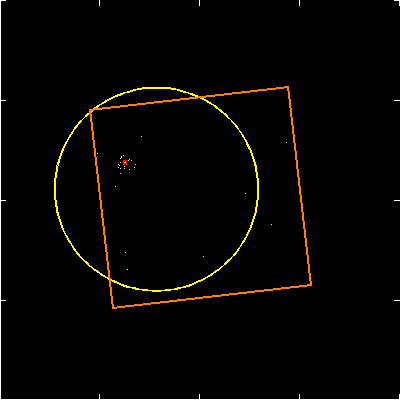
In this case, it was a bit more complicated There was an X-ray source consistent with the BAT position. The image to the right shows the early X-ray data. The yellow circle shows the BAT error box - that is, the BAT told us it thought it had seen something in that circle. The orange box shows what the XRT could see at the time, and they grey dots are detected X-rays. The little red circle marks where the X-ray source is.
So this is a GRB yes? No.
Firstly, that source is a known object. It's appeared in a bunch of previous observations, including those by Swift. In fact, in the catalogue that I published at the end of last year, you can see multiple detections of it (here are the catalogue results). And we knew this, indeed, the initial circular from the Swift team said as much. Secondly, that known source was probably something like an X-ray binary (a neutron-star in orbit with a normal, main-sequence star); such objects are not believed to be the progenitors of GRBs. And interestingly, the Swift team never claimed it was; indeed, I haven't seen any professional communication claiming that this was a GRB. Why it has been reported throughout the web as a GRB is something I can only speculate on, but Swift has been fabulously successful studying GRBs, indeed it was ranked #1 by NASA this month; I guess that enthusiastic followers of astronomy put two and two together and made five, unfortunately. I've even read people saying that there were loads of Gamma Rays from this object: there definitely weren't. In fact, the Swift-BAT team said that “this is a faint BAT transient”.
Wednesday, 28 May 2014... what a day. Oh, it's only 9:17 am. As you may have noticed, the Twittersphere has been alive with speculation about a Gamma Ray Burst, or GRB, in the nearby galaxy M31. My phone has never been so noisy! The problem is, there was never a claim of such an event, and it turns out that the tentative result that triggered this story was overstated.
So, what happened, and why did everyone think it was a GRB?
It started with the Burst Alert Telescope, or BAT, on board Swift. This is designed to look for GRBs, but will ‘trigger’ on any burst of high-energy radiation that comes from an area of the sky not known to emit such rays. But working out if you've had such a burst is not straightforward, because of noise in the detector, background radiation etc. So Swift normally only triggers if it's really sure the burst of radiation is real; for the statisticians among you, we have a 6.5-σ threshold. Even then, we occasionally get false alarms. But we also have a program to try to spot faint GRBs in nearby galaxies. For this we accept lower significance triggers from BAT if they are near a known, nearby galaxy. But these lower significance triggers are much more likely to be spurious. Normally, we can tell that they are spurious because GRBs (almost always) have a glow of X-rays detectable for some time after the initial burst, an ‘afterglow’. The spurious triggers don't have this, of course.
In this case, it was a bit more complicated There was an X-ray source consistent with the BAT position. The image to the right shows the early X-ray data. The yellow circle shows the BAT error box - that is, the BAT told us it thought it had seen something in that circle. The orange box shows what the XRT could see at the time, and they grey dots are detected X-rays. The little red circle marks where the X-ray source is.
So this is a GRB yes? No.
Firstly, that source is a known object. It's appeared in a bunch of previous observations, including those by Swift. In fact, in the catalogue that I published at the end of last year, you can see multiple detections of it (here are the catalogue results). And we knew this, indeed, the initial circular from the Swift team said as much. Secondly, that known source was probably something like an X-ray binary (a neutron-star in orbit with a normal, main-sequence star); such objects are not believed to be the progenitors of GRBs. And interestingly, the Swift team never claimed it was; indeed, I haven't seen any professional communication claiming that this was a GRB. Why it has been reported throughout the web as a GRB is something I can only speculate on, but Swift has been fabulously successful studying GRBs, indeed it was ranked #1 by NASA this month; I guess that enthusiastic followers of astronomy put two and two together and made five, unfortunately. I've even read people saying that there were loads of Gamma Rays from this object: there definitely weren't. In fact, the Swift-BAT team said that “this is a faint BAT transient”.
http://www.star.le.ac.uk/~pae9/twitter/GRBM31.html
DrCaleb @ Mon Jun 02, 2014 7:02 am
DrCaleb DrCaleb:
DrCaleb DrCaleb:
$1:
Space Thief Or Hero? One Man's Quest To Reawaken An Old Friend
More than 30 years ago, Robert Farquhar stole a spacecraft.
Now he's trying to give it back.
More than 30 years ago, Robert Farquhar stole a spacecraft.
Now he's trying to give it back.
http://www.npr.org/2014/03/18/289628696 ... old-friend
As an update:
$1:
NASA Blesses Volunteer Effort To Bring Vagabond Heliophysics Satellite Home
COLORADO SPRINGS, Colo. — NASA gave its official blessing to a group of volunteers trying to take control of a 36-year-old heliophysics spacecraft the agency retired in 1997, according to a May 21 press release.
NASA said it signed a nonreimbursable Space Act Agreement with Skycorp, Inc. of Los Gatos, California, to give the company legal approval to contact, command and control the International Sun-Earth Explorer (ISEE)-3 spacecraft as part of the company’s ISEE-3 Reboot Project.
Skycorp is owned by Dennis Wingo, who together with collaborator Keith Cowing, editor of the NASAwatch.com space blog, raised more than $125,000 on the crowdfunding website rockethub.com to cover the ISEE-3 reboot project’s operating costs.

COLORADO SPRINGS, Colo. — NASA gave its official blessing to a group of volunteers trying to take control of a 36-year-old heliophysics spacecraft the agency retired in 1997, according to a May 21 press release.
NASA said it signed a nonreimbursable Space Act Agreement with Skycorp, Inc. of Los Gatos, California, to give the company legal approval to contact, command and control the International Sun-Earth Explorer (ISEE)-3 spacecraft as part of the company’s ISEE-3 Reboot Project.
Skycorp is owned by Dennis Wingo, who together with collaborator Keith Cowing, editor of the NASAwatch.com space blog, raised more than $125,000 on the crowdfunding website rockethub.com to cover the ISEE-3 reboot project’s operating costs.
http://www.spacenews.com/article/civil- ... llite-home
$1:
We Are Now In Command of the ISEE-3 Spacecraft
The ISEE-3 Reboot Project is pleased to announce that our team has established two-way communication with the ISEE-3 spacecraft and has begun commanding it to perform specific functions. Over the coming days and weeks our team will make an assessment of the spacecraft's overall health and refine the techniques required to fire its engines and bring it back to an orbit near Earth.
First Contact with ISEE-3 was achieved at the Arecibo Radio Observatory in Puerto Rico. We would not have been able to achieve this effort without the gracious assistance provided by the entire staff at Arecibo. In addition to the staff at Arecibo, our team included simultaneous listening and analysis support by AMSAT-DL at the Bochum Observatory in Germany, the Space Science Center at Morehead State University in Kentucky, and the SETI Institute's Allen Telescope Array in California.
Of course this effort would not have been possible without the assistance of NASA and the Space Act Agreement crafted by NASA Headquarters, NASA Ames Research center, and the System Solar System Exploration Research Virtual Institute (SSERVI).
For further information on the ISEE-3 Reboot Project please visit our website at http://spacecollege.org/isee3 A much more detailed description of our First Contact efforts and future plans will be published on our website next week.
Here is how to stay up to date on our progress
Twitter: http://twitter.com/isee3reboot
Facebook: http://www.facebook.com/ISEE3Reboot
Google+: http://plus.google.com/110871408384252629393/
Web: http://spacecollege.org/isee3

The ISEE-3 Reboot Project is pleased to announce that our team has established two-way communication with the ISEE-3 spacecraft and has begun commanding it to perform specific functions. Over the coming days and weeks our team will make an assessment of the spacecraft's overall health and refine the techniques required to fire its engines and bring it back to an orbit near Earth.
First Contact with ISEE-3 was achieved at the Arecibo Radio Observatory in Puerto Rico. We would not have been able to achieve this effort without the gracious assistance provided by the entire staff at Arecibo. In addition to the staff at Arecibo, our team included simultaneous listening and analysis support by AMSAT-DL at the Bochum Observatory in Germany, the Space Science Center at Morehead State University in Kentucky, and the SETI Institute's Allen Telescope Array in California.
Of course this effort would not have been possible without the assistance of NASA and the Space Act Agreement crafted by NASA Headquarters, NASA Ames Research center, and the System Solar System Exploration Research Virtual Institute (SSERVI).
For further information on the ISEE-3 Reboot Project please visit our website at http://spacecollege.org/isee3 A much more detailed description of our First Contact efforts and future plans will be published on our website next week.
Here is how to stay up to date on our progress
Twitter: http://twitter.com/isee3reboot
Facebook: http://www.facebook.com/ISEE3Reboot
Google+: http://plus.google.com/110871408384252629393/
Web: http://spacecollege.org/isee3
http://spacecollege.org/isee3/we-are-no ... craft.html
DrCaleb @ Mon Jun 02, 2014 7:47 am
stratos @ Mon Jun 02, 2014 9:55 am
DrCaleb DrCaleb:
ShepherdsDog ShepherdsDog:
so any life that may have existed in that galaxy is toast?
Any life that was near enough to the gamma burst, probably. Gamma bursts can be directional as well, so it's not for sure they are McNuggets. It might just be any life nearer the burst, and in it's path. Might even destroy life in our own galaxy too.
The Universe is a hostile place.
Or there is now a planet of Incredible Hulks just waiting to Smash Puny Human Space Ships.
DrCaleb @ Tue Jun 03, 2014 6:53 am
$1:
Strange New World Discovered: The 'Mega Earth'
Meet “mega-Earth,” a souped-up, all-solid planet that, according to theory, should not exist.
NASA's Kepler telescope was launched to find other planets just like Earth -- and now, scientists think they may have found not just one, but three! Trace shows us where they are in the solar system and why the discovery is so important.
DCI
First spotted by NASA’s Kepler space telescope, the planet is about 2.3 times larger than Earth. Computer models showed planets that big would be more like Neptune or the other gas planets of the outer solar system because they would have the gravitational heft and time to collect vast amounts of hydrogen and helium from their primordial cradles.
But follow-up observations of the planet, designated as Kepler-10c, show it has 17 times as much mass as Earth, meaning it must be filled with rock and other materials much heavier than hydrogen and helium.
“Kepler-10c is a big problem for the theory,” astronomer Dimitar Sasselov, director of the Harvard Origins of Life Initiative, told Discovery News. “It’s nice that we have a solid piece of evidence and measurements for it because that gives motivations to the theorists to improve the theory,” he said.
Scientists aren’t sure how mega-Earths, or their diminutive cousins, super-Earths, form, nor why our solar system has nothing in between the largest rocky planet, Earth, and the smallest gas giant, Neptune.

http://news.discovery.com/space/alien-l ... 140602.htm
Meet “mega-Earth,” a souped-up, all-solid planet that, according to theory, should not exist.
NASA's Kepler telescope was launched to find other planets just like Earth -- and now, scientists think they may have found not just one, but three! Trace shows us where they are in the solar system and why the discovery is so important.
DCI
First spotted by NASA’s Kepler space telescope, the planet is about 2.3 times larger than Earth. Computer models showed planets that big would be more like Neptune or the other gas planets of the outer solar system because they would have the gravitational heft and time to collect vast amounts of hydrogen and helium from their primordial cradles.
But follow-up observations of the planet, designated as Kepler-10c, show it has 17 times as much mass as Earth, meaning it must be filled with rock and other materials much heavier than hydrogen and helium.
“Kepler-10c is a big problem for the theory,” astronomer Dimitar Sasselov, director of the Harvard Origins of Life Initiative, told Discovery News. “It’s nice that we have a solid piece of evidence and measurements for it because that gives motivations to the theorists to improve the theory,” he said.
Scientists aren’t sure how mega-Earths, or their diminutive cousins, super-Earths, form, nor why our solar system has nothing in between the largest rocky planet, Earth, and the smallest gas giant, Neptune.
http://news.discovery.com/space/alien-l ... 140602.htm
Jabberwalker @ Tue Jun 03, 2014 8:04 am
Anything walking around (or growing like a plant) on the surface of that would have to have steel bridgework for a skeleton in that gravity field. You want Hollywood-style mega-monsters? Here is a place to look for them
DrCaleb @ Tue Jun 03, 2014 11:02 am
Jabberwalker Jabberwalker:
Anything walking around (or growing like a plant) on the surface of that would have to have steel bridgework for a skeleton in that gravity field. You want Hollywood-style mega-monsters? Here is a place to look for them
Or be very waif and have bird-like hollow 'bones'. It's 17 times the mass, so it would have ~3 times the gravity because of it's diameter.
DrCaleb @ Tue Jun 03, 2014 11:03 am
$1:
Red Dwarfs Could Sterilize Alien Worlds of Life
Red dwarf stars -- the most common stars in the galaxy -- bathe planets in their habitable zones with potentially deadly stellar winds, a finding that could have significant impacts on the prevalence of life beyond Earth, new research shows.
About 70 percent of stars are red dwarfs, or M-type stars, which are cooler and smaller than the sun. Any red dwarf planets suitable for liquid water, therefore, would have to orbit much closer to their parent star than Earth circles the sun.
That presents a problem for life -- at least life as we know it on Earth, says physicist Ofer Cohen, with the Harvard-Smithsonian Center for Astrophysics.
Cohen and colleagues used a computer model based on data from the sun’s solar wind -- a continuous stream of charged particles that permeates and defines the solar system –- to estimate the space environment around red dwarf stars.
“We find that the conditions are very extreme. If you move planets very close to the star, the force of this flow is very, very strong. Essentially it can strip the atmosphere of the planet unless the planet has a strong magnetic field or a thick atmosphere to start with,” Cohen told Discovery News.

Red dwarf stars -- the most common stars in the galaxy -- bathe planets in their habitable zones with potentially deadly stellar winds, a finding that could have significant impacts on the prevalence of life beyond Earth, new research shows.
About 70 percent of stars are red dwarfs, or M-type stars, which are cooler and smaller than the sun. Any red dwarf planets suitable for liquid water, therefore, would have to orbit much closer to their parent star than Earth circles the sun.
That presents a problem for life -- at least life as we know it on Earth, says physicist Ofer Cohen, with the Harvard-Smithsonian Center for Astrophysics.
Cohen and colleagues used a computer model based on data from the sun’s solar wind -- a continuous stream of charged particles that permeates and defines the solar system –- to estimate the space environment around red dwarf stars.
“We find that the conditions are very extreme. If you move planets very close to the star, the force of this flow is very, very strong. Essentially it can strip the atmosphere of the planet unless the planet has a strong magnetic field or a thick atmosphere to start with,” Cohen told Discovery News.
http://news.discovery.com/space/alien-l ... 140602.htm
DrCaleb @ Wed Jun 04, 2014 7:06 am
$1:
The Disappearing Universe
Even at the speed of light, you’ll never reach these galaxies.

When you lie down on your back on a clear, dark, moonless night, what is it that you see? If your vision is outstanding and observing conditions are just right, you’re likely to see not only a few planets and thousands of stars, but also star clusters, some faint nebulae, the plane of the Milky Way, and maybe even a distant galaxy or two.
But when you start to look more deeply — beyond what you can see with your naked eye — you start to find that there’s an amazing Universe past our own galaxy, past the stars, clusters and nebulae of the Milky Way out there. What once seemed like faint, fuzzy, inconsequential smudges have since revealed themselves to be distant galaxies, or island Universes not so different than our own, consisting of anywhere from hundreds of millions to many trillions of stars.
And the Universe is full of them, with roughly as many galaxies in the part observable to us as there are stars in the entire galaxy we inhabit.

What’s perhaps surprising about these galaxies is that the farther away we find them, the faster they appear to be moving away from us. This was one of the most puzzling discoveries of the early 20th century, and it was finally put into order by Edwin Hubble (and, independently, Georges Lemaître) who realized that this was a consequence of living in an expanding Universe.
The resultant relation — that the farther away a galaxy is from us, the faster it appears to recede — is known as Hubble’s law. The only exceptions to this rule happen when a galaxy has been subject to an intense, local gravitational interaction, giving it what’s known as a significant peculiar velocity. But on the largest scales, Hubble’s law, or the velocity/redshift relation, shows itself incredibly clearly.

You might instinctively wonder, especially if you know about the framework of the Big Bang, whether this will continue forever or not? Hubble’s famous law was formulated all the way back in 1929, and for the majority of the 20th century, scientists were seeking the answer to that very question.
. . .
Imagine our surprise when the data came in — just in 1998 — indicating that it was none of these options! Instead, the expansion rate isn’t going to keep dropping, but will asymptote to a finite, non-zero value.
This means that each and every galaxy, as it moves farther away from us, will recede faster and faster over time, appearing to accelerate away!
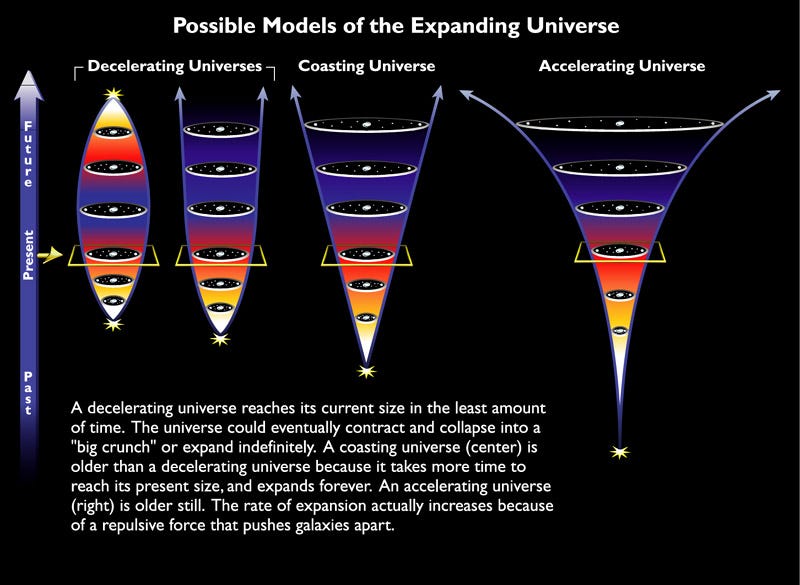
In one sense, this is just the nature of the Universe, doing what it does by obeying the laws of physics. But in another, more thoughtful sense, this is incredibly depressing.
You see, in the three scenarios we had envisioned previously, if you left Earth in a rocket ship that could move at arbitrary speeds, you could always reach any galaxy in the observable Universe, given enough time. Sure, the more distant a galaxy was, the longer you’d have to travel to get there, but everything was reachable in principle, no matter how dim, faint or distant it was. Because gravity would decelerate the expansion rate over time, if you were dedicated enough, and traveled at a fast enough speed for a long enough time, you could inevitably run down anything in the Universe.
But not if our Universe is accelerating. If something is receding from us right now at more than 299,792.458 km/s — faster than light speed — and it’s accelerating too, how could anything reach it? Even a photon, moving at the speed of light, wouldn’t be able to reach such a galaxy. Instead, anything beyond that point will do something that cosmologists call red out, which means they’re sufficiently redshifted that anything we do today could never, ever reach them, and only the light they emitted in the past will ever reach us. We are already causally disconnected from them.
And one incredibly frightening thing is that any galaxy with a redshift bigger than about 1.5 (which is not that big a number) is already gone.

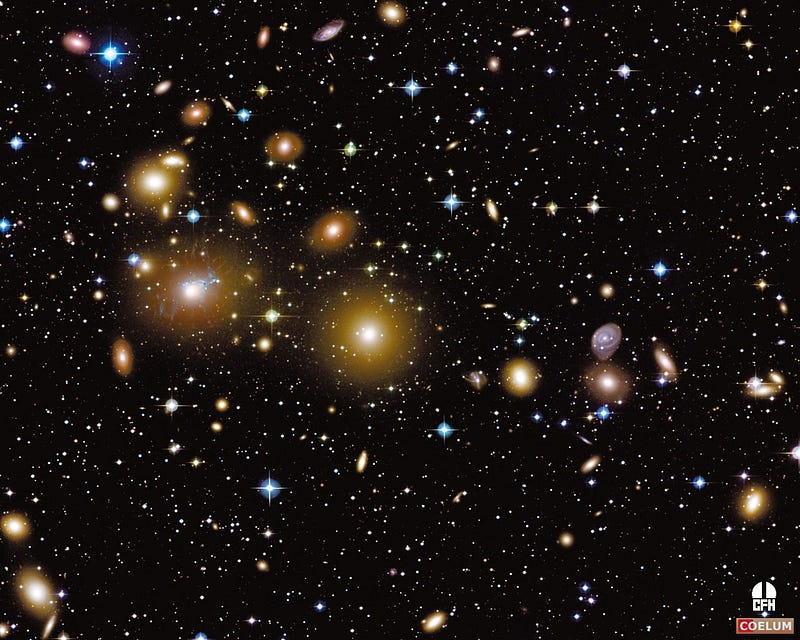
Consider an image like this: 10,000 of the faintest, most distant galaxies we’ve ever discovered. By measuring their redshifts, we can determine (going back to Hubble’s law) precisely how far away these galaxies are.
And as it turns out, about 40% of the galaxies in this image are already unreachable, even for a beam of light that left today. If we zoom in to this region of space and imagine what these galaxies look like as far as “depth” goes, as in the video below, we’d find that everything left in the image after about the 0:38 second mark has already redded out.
More:
Even at the speed of light, you’ll never reach these galaxies.
When you lie down on your back on a clear, dark, moonless night, what is it that you see? If your vision is outstanding and observing conditions are just right, you’re likely to see not only a few planets and thousands of stars, but also star clusters, some faint nebulae, the plane of the Milky Way, and maybe even a distant galaxy or two.
But when you start to look more deeply — beyond what you can see with your naked eye — you start to find that there’s an amazing Universe past our own galaxy, past the stars, clusters and nebulae of the Milky Way out there. What once seemed like faint, fuzzy, inconsequential smudges have since revealed themselves to be distant galaxies, or island Universes not so different than our own, consisting of anywhere from hundreds of millions to many trillions of stars.
And the Universe is full of them, with roughly as many galaxies in the part observable to us as there are stars in the entire galaxy we inhabit.
What’s perhaps surprising about these galaxies is that the farther away we find them, the faster they appear to be moving away from us. This was one of the most puzzling discoveries of the early 20th century, and it was finally put into order by Edwin Hubble (and, independently, Georges Lemaître) who realized that this was a consequence of living in an expanding Universe.
The resultant relation — that the farther away a galaxy is from us, the faster it appears to recede — is known as Hubble’s law. The only exceptions to this rule happen when a galaxy has been subject to an intense, local gravitational interaction, giving it what’s known as a significant peculiar velocity. But on the largest scales, Hubble’s law, or the velocity/redshift relation, shows itself incredibly clearly.
You might instinctively wonder, especially if you know about the framework of the Big Bang, whether this will continue forever or not? Hubble’s famous law was formulated all the way back in 1929, and for the majority of the 20th century, scientists were seeking the answer to that very question.
. . .
Imagine our surprise when the data came in — just in 1998 — indicating that it was none of these options! Instead, the expansion rate isn’t going to keep dropping, but will asymptote to a finite, non-zero value.
This means that each and every galaxy, as it moves farther away from us, will recede faster and faster over time, appearing to accelerate away!
In one sense, this is just the nature of the Universe, doing what it does by obeying the laws of physics. But in another, more thoughtful sense, this is incredibly depressing.
You see, in the three scenarios we had envisioned previously, if you left Earth in a rocket ship that could move at arbitrary speeds, you could always reach any galaxy in the observable Universe, given enough time. Sure, the more distant a galaxy was, the longer you’d have to travel to get there, but everything was reachable in principle, no matter how dim, faint or distant it was. Because gravity would decelerate the expansion rate over time, if you were dedicated enough, and traveled at a fast enough speed for a long enough time, you could inevitably run down anything in the Universe.
But not if our Universe is accelerating. If something is receding from us right now at more than 299,792.458 km/s — faster than light speed — and it’s accelerating too, how could anything reach it? Even a photon, moving at the speed of light, wouldn’t be able to reach such a galaxy. Instead, anything beyond that point will do something that cosmologists call red out, which means they’re sufficiently redshifted that anything we do today could never, ever reach them, and only the light they emitted in the past will ever reach us. We are already causally disconnected from them.
And one incredibly frightening thing is that any galaxy with a redshift bigger than about 1.5 (which is not that big a number) is already gone.
Consider an image like this: 10,000 of the faintest, most distant galaxies we’ve ever discovered. By measuring their redshifts, we can determine (going back to Hubble’s law) precisely how far away these galaxies are.
And as it turns out, about 40% of the galaxies in this image are already unreachable, even for a beam of light that left today. If we zoom in to this region of space and imagine what these galaxies look like as far as “depth” goes, as in the video below, we’d find that everything left in the image after about the 0:38 second mark has already redded out.
More:
https://medium.com/starts-with-a-bang/t ... 447467c63a
Jabberwalker @ Wed Jun 04, 2014 8:54 am
The Disappearing Universe
Even at the speed of light, you’ll never reach these galaxies.
Unless we learn of a method of dramatically exceeding the speed of light, we aren't going to reach any other galaxies.
DrCaleb @ Thu Jun 05, 2014 6:43 am
$1:
Astronomers discover first Thorne-Zytkow object, a bizarre type of hybrid star
In a discovery decades in the making, scientists have detected the first of a "theoretical" class of stars first proposed in 1975 by physicist Kip Thorne and astronomer Anna Żytkow. Thorne-Żytkow objects (TŻOs) are hybrids of red supergiant and neutron stars that superficially resemble normal red supergiants, such as Betelguese in the constellation Orion. They differ, however, in their distinct chemical signatures that result from unique activity in their stellar interiors.
TŻOs are thought to be formed by the interaction of two massive stars―a red supergiant and a neutron star formed during a supernova explosion―in a close binary system. While the exact mechanism is uncertain, the most commonly held theory suggests that, during the evolutionary interaction of the two stars, the much more massive red supergiant essentially swallows the neutron star, which spirals into the core of the red supergiant.
While normal red supergiants derive their energy from nuclear fusion in their cores, TŻOs are powered by the unusual activity of the absorbed neutron stars in their cores. The discovery of this TŻO thus provides evidence of a model of stellar interiors previously undetected by astronomers.
Project leader Emily Levesque of the University of Colorado Boulder, who earlier this year was awarded the American Astronomical Society's Annie Jump Cannon Award, said, "Studying these objects is exciting because it represents a completely new model of how stellar interiors can work. In these interiors we also have a new way of producing heavy elements in our universe. You've heard that everything is made of 'star stuff'—inside these stars we might now have a new way to make some of it."
. . .
When Levesque and her colleagues took a close look at the subtle lines in the spectrum they found that it contained excess rubidium, lithium and molybdenum. Past research has shown that normal stellar processes can create each of these elements. But high abundances of all three of these at the temperatures typical of red supergiants is a unique signature of TŻOs.
More:
In a discovery decades in the making, scientists have detected the first of a "theoretical" class of stars first proposed in 1975 by physicist Kip Thorne and astronomer Anna Żytkow. Thorne-Żytkow objects (TŻOs) are hybrids of red supergiant and neutron stars that superficially resemble normal red supergiants, such as Betelguese in the constellation Orion. They differ, however, in their distinct chemical signatures that result from unique activity in their stellar interiors.
TŻOs are thought to be formed by the interaction of two massive stars―a red supergiant and a neutron star formed during a supernova explosion―in a close binary system. While the exact mechanism is uncertain, the most commonly held theory suggests that, during the evolutionary interaction of the two stars, the much more massive red supergiant essentially swallows the neutron star, which spirals into the core of the red supergiant.
While normal red supergiants derive their energy from nuclear fusion in their cores, TŻOs are powered by the unusual activity of the absorbed neutron stars in their cores. The discovery of this TŻO thus provides evidence of a model of stellar interiors previously undetected by astronomers.
Project leader Emily Levesque of the University of Colorado Boulder, who earlier this year was awarded the American Astronomical Society's Annie Jump Cannon Award, said, "Studying these objects is exciting because it represents a completely new model of how stellar interiors can work. In these interiors we also have a new way of producing heavy elements in our universe. You've heard that everything is made of 'star stuff'—inside these stars we might now have a new way to make some of it."
. . .
When Levesque and her colleagues took a close look at the subtle lines in the spectrum they found that it contained excess rubidium, lithium and molybdenum. Past research has shown that normal stellar processes can create each of these elements. But high abundances of all three of these at the temperatures typical of red supergiants is a unique signature of TŻOs.
More:
http://phys.org/news/2014-06-astronomer ... -star.html
DrCaleb @ Thu Jun 05, 2014 7:06 am
$1:
June 3, 2014: Astronomers using the Hubble Space Telescope have assembled a comprehensive picture of the evolving universe — among the most colorful deep space images ever captured by the 24-year-old telescope. This study, which includes ultraviolet light, provides the missing link in star formation.

http://hubblesite.org/newscenter/archiv ... es/2014/27
DrCaleb @ Fri Jun 06, 2014 7:28 am
$1:
Traces of another world found on the Moon
Dr Caroline Smith of the Natural History Museum in London explains the indications of the planet believed to have formed the Moon
Researchers have found evidence of the world that crashed into the Earth billions of years ago to form the Moon.
Analysis of lunar rock brought back by Apollo astronauts shows traces of the "planet" called Theia.
The researchers claim that their discovery confirms the theory that the Moon was created by just such a cataclysmic collision.
The study has been published in the journal Science.
The accepted theory since the 1980s is that the Moon arose as a result of a collision between the Earth and Theia 4.5 billion years ago.
Theia was named after a goddess in Greek mythology who was said to be the mother of Selene, goddess of the Moon. It is thought to have disintegrated on impact with the resulting debris mingling with that from the Earth and coalescing into the Moon.
It is the simplest explanation, and fits in well with computer simulations. The main drawback with the theory is that no-one had found any evidence of Theia in lunar rock samples.
Earlier analyses had shown Moon rock to have originated entirely from the Earth whereas computer simulations had shown that the Moon ought to have been mostly derived from Theia.
Now a more refined analysis of Moon rock has found evidence of material thought to have an alien origin.
According to the lead researcher, Dr Daniel Herwartz, from the University of Goettingen, no-one has found definitive evidence for the collision theory, until now.
"It was getting to the stage where some people were suggesting that the collision had not taken place," he told BBC News.
"But we have now discovered small differences between the Earth and the Moon. This confirms the giant impact hypothesis."
But the difference, some say, could be explained by material absorbed by the Earth after the Moon formed.
And Prof Alex Halliday of Oxford University, is among many scientists who are surprised that the difference between the Theian material found in the Moon rock and the Earth is so small.
"What you are looking for is a much bigger difference, because that is what the rest of the Solar System looks like based on meteorite measurements," he said.
Dr Herwartz measured the difference in what is called the isotopic composition of the oxygen contained in rocks on Earth and Moon rock. This is the ratio of different forms of oxygen.
Studies of meteorites from Mars and the outer solar system show that these ratios are markedly different - rather like a fingerprint. So Prof Halliday and others are puzzled by the fact that the fingerprints of Earth and Theia seem almost identical.

Dr Caroline Smith of the Natural History Museum in London explains the indications of the planet believed to have formed the Moon
Researchers have found evidence of the world that crashed into the Earth billions of years ago to form the Moon.
Analysis of lunar rock brought back by Apollo astronauts shows traces of the "planet" called Theia.
The researchers claim that their discovery confirms the theory that the Moon was created by just such a cataclysmic collision.
The study has been published in the journal Science.
The accepted theory since the 1980s is that the Moon arose as a result of a collision between the Earth and Theia 4.5 billion years ago.
Theia was named after a goddess in Greek mythology who was said to be the mother of Selene, goddess of the Moon. It is thought to have disintegrated on impact with the resulting debris mingling with that from the Earth and coalescing into the Moon.
It is the simplest explanation, and fits in well with computer simulations. The main drawback with the theory is that no-one had found any evidence of Theia in lunar rock samples.
Earlier analyses had shown Moon rock to have originated entirely from the Earth whereas computer simulations had shown that the Moon ought to have been mostly derived from Theia.
Now a more refined analysis of Moon rock has found evidence of material thought to have an alien origin.
According to the lead researcher, Dr Daniel Herwartz, from the University of Goettingen, no-one has found definitive evidence for the collision theory, until now.
"It was getting to the stage where some people were suggesting that the collision had not taken place," he told BBC News.
"But we have now discovered small differences between the Earth and the Moon. This confirms the giant impact hypothesis."
But the difference, some say, could be explained by material absorbed by the Earth after the Moon formed.
And Prof Alex Halliday of Oxford University, is among many scientists who are surprised that the difference between the Theian material found in the Moon rock and the Earth is so small.
"What you are looking for is a much bigger difference, because that is what the rest of the Solar System looks like based on meteorite measurements," he said.
Dr Herwartz measured the difference in what is called the isotopic composition of the oxygen contained in rocks on Earth and Moon rock. This is the ratio of different forms of oxygen.
Studies of meteorites from Mars and the outer solar system show that these ratios are markedly different - rather like a fingerprint. So Prof Halliday and others are puzzled by the fact that the fingerprints of Earth and Theia seem almost identical.
More:
http://www.bbc.co.uk/news/science-environment-27688511
Previous 1 ... 48 49 50 51 52 53 54 ... 244 Next