
Space Thread
Previous 1 ... 47 48 49 50 51 52 53 ... 244 Next
DrCaleb @ Fri May 16, 2014 10:17 am
Jabberwalker Jabberwalker:
The whole concept of "global warming" came about after the first missions to Venus. They couldn't explain the extreme temperature on the surface based on proximity to the sun, alone. The "smoking gun" was found to be the high carbon dioxide content of the atmosphere and the "greenhouse effect" was first noticed.
Sorry, but John Tyndall produced the first measurements of the heat retention and radiation of all known gasses, including Carbon Dioxide, back in the 1850's.
Jabberwalker @ Mon May 19, 2014 4:13 am
I didn't mean that they invented the concept at NASA but they first noticed the principle at work when they explored Venus.
stratos @ Tue May 20, 2014 1:28 pm
http://local.msn.com/cosmic-anniversary ... -ago-today
|By Mike Wall, Senior Writer, Space.com
Space.com
Cosmic Anniversary: 'Big Bang Echo' Discovered 50 Years Ago Today On May 20, 1964, American radio astronomers Robert Wilson and Arno Penzias discovered the cosmic microwave background radiation, the ancient light that began saturating the universe 380,000 years after its creation. And they did so pretty much by accident.
Two Cosmic Microwave Background anomalies hinted at by the Planck observatory's predecessor, NASA's WMAP, are confirmed in new high-precision data revealed on March 21, 2013. In this image, the two anomalous regions have been enhanced with red and blue shading to make them more clearly visible. Credit: ESA and the Planck Collaboration
Two Cosmic Microwave Background anomalies hinted at by the Planck observatory's predecessor, NASA's WMAP, are confirmed in new high-precision data revealed on March 21, 2013. In this image, the two anomalous regions have been enhanced with red and blue shading to make them more clearly visible. Credit: ESA and the Planck Collaboration
Humanity's understanding of the universe took a giant leap forward 50 years ago today.
On May 20, 1964, American radio astronomers Robert Wilson and Arno Penzias discovered the cosmic microwave background radiation (CMB), the ancient light that began saturating the universe 380,000 years after its creation. And they did so pretty much by accident.
MSN Weather: Amazing time-lapse video shows evolution of universe like never before
MSN Weather: Evidence spotted for universe's early growth spurt
Bell Labs' Holmdale Horn Antenna in New Jersey picked up an odd buzzing sound that came from all parts of the sky at all times. The noise puzzled Wilson and Penzias, who did their best to eliminate all possible sources of interference, even removing some pigeons that were nesting in the antenna. [CMB: Big Bang Relic Explained (Infographic)]
"When we first heard that inexplicable 'hum,' we didn’t understand its significance, and we never dreamed it would be connected to the origins of the universe," Penzias said in a statement. "It wasn’t until we exhausted every possible explanation for the sound's origin that we realized we had stumbled upon something big."
And it was indeed big. Penzias and Wilson had spotted the CMB, the predicted thermal echo of the universe's explosive birth. The landmark find put the Big Bang theory on solid ground, suggesting that the cosmos did indeed grow from a tiny seed — a single point — about 13.8 billion years ago.
The two radio astronomers won the 1978 Nobel Prize in physics for their work, sharing the award with Soviet scientist Pyotr Kapitsa.
Ancient light
The CMB is the oldest light in the universe, dating from the first epoch in which photons could travel freely. Shortly after the Big Bang, the cosmos was a seething-hot, opaque fog of plasma and energy; things changed about 380,000 years later, when temperatures dropped enough for electrically neutral atoms to form, and the universe became transparent.
The CMB is markedly uniform, lending support to the theory of cosmic inflation, which posits that the universe expanded much faster than the speed of light just a few tiny fractions of a second after the Big Bang.
"Why the cosmic microwave background temperature is the same at different spots in the sky would be a mystery if it was not for inflation saying, well, our whole sky came from this tiny region," Charles Bennett of Johns Hopkins University in Baltimore told Space.com last year. Bennett is principal investigator of NASA's CMB-mapping Wilkinson Microwave Anisotropy Probe (WMAP), which launched in 2001 and stopped gathering data in 2010.
But the CMB also contains tiny temperature variations, which signify areas of different densities. These density fluctuations were the seeds that eventually gave rise to stars, galaxies and all the other structure that we observe in the universe today, researchers say.
Scientists have extracted a great deal of information from the CMB over the years. In March, for example, a team of astronomers announced that they had found evidence of primordial gravitational waves in the CMB — a discovery that, if confirmed, provides a long-sought "smoking gun" for the theory of cosmic inflation.
Such discoveries continue to impress Wilson.
"It's amazing to me that people can dig something out that's a tenth of a part per million of the cosmic background, especially given a lot of foreground that might get in the way," he told Space.com in March.
"And I guess my real thought is how much has come out of what can be seen in the cosmic background radiation," he added. "The real signature we saw was that it was absolutely constant, and now the tiny variations in it have turned out to hold a wealth of information." [Cosmic Inflation and Gravitational Waves: Complete Coverage]
Celebrating the discovery
Bell Labs is hosting a 50th anniversary celebration today at its Holmdale facility, which Penzias and Wilson — who are now 81 and 78 years old, respectively — will attend, as will Bell Labs president and CTO Marcus Weldon.
During the event, Bell Labs — the research arm of Paris-based company Alcatel-Lucent — will also announce the Bell Labs Prize, a competition that gives scientists around the globe the chance to introduce to the world their ideas in the fields of information and communications technology.
The challenge offers a grand prize of $100,000; second prize is worth $50,000 and third $25,000. Winners may also get the chance to develop their ideas at Bell Labs, company representatives said.
"I think it is fitting that today, as we honor and celebrate this incredible, Nobel Prize-winning achievement by Arno and Bob, we are launching a program intended to inspire world-changing discoveries and innovations by young researchers that may one day walk in their footsteps," Weldon said.
"The Bell Labs Prize is intended to recognize innovators with the ability and vision to challenge the common assumptions, and find ways to revolutionize the way we live, work, communicate, collaborate and connect with each other and our digital world," he added.
The deadline to enter the Bell Labs Prize is July 15. You can learn more about the competition here: www.bell-labs.com/prize
stratos @ Tue May 20, 2014 1:29 pm
Sorry about the crappy copy and paste job. Just hit the link it should work and the article is there. ![[B-o]](./images/smilies/drinkup.gif "Drink up")
DrCaleb @ Wed May 21, 2014 5:51 am
stratos stratos:
Sorry about the crappy copy and paste job. Just hit the link it should work and the article is there.
It was a pretty big discovery, and they thought they had faulty equipment!
DrCaleb @ Wed May 21, 2014 5:58 am
$1:
The Birth of a Meteor Shower
A comet that’s never crossed Earth’s orbit might lead to the most spectacular sky show in years!
Here in the inner Solar System, we think about space as a relatively empty, peaceful place. Aside from the Moon, large objects typically never make it anywhere near our world; most everything else is tiny.
Even most of the objects that occasionally whiz past (or even collide into) our world are too small to leave any sort of lasting legacy. But the asteroid belt, Kuiper belt and the Oort cloud are all full of objects not only the sizes of cars and trucks, but of mountains, countries, and even small planets! Because there are so many of these objects orbiting near one another — and in the case of the asteroid and Kuiper belts, massive gas giant planets nearby — every once in a while, one of these significant masses will have its motion altered so that it plunges into the inner Solar System.
As an object like this hurtles towards the Sun, it heats up as it approaches closer and closer. Unlike the inner, rocky planets, these outer, solid bodies are in large part made up of ices, including water ice, carbon dioxide, methane ice and more. (Even asteroids are at the Solar System’s frost line, and contain copious amounts of water ice.) When ice heats up in the vacuum of space, it sublimates directly into the gaseous phase. And this — combined with the outward particles emitted by the solar wind — produces a periodic sight familiar to fortunate skywatchers: a comet! (Or, in some cases, an asteroid with a tail, which I’ll just refer to for the rest of this article as a comet, also, for simplicity.)
While we normally think of comets as massive, ice-and-rock nuclei, we have to remember two important things about them:
It takes, on average, billions of years for the right combination of gravitational interactions to alter their orbits and send them into the inner Solar System. Once that happens, the odds that another gravitational interaction will alter their orbit again is very small. In other words, once you give one of these objects a very eccentric orbit that takes it near the Sun, it’s quite rare that another gravitational interaction will change its trajectory again. Rare, mind you, but not impossible.
As these objects pass near the Sun over and over again, periodically, small, rocky dust particles get expelled from the comet’s nucleus in a tail that curves away from the Sun. But in addition to the diffuse dusty tails, when comets (or asteroids) pass too close to a massive body (like the Sun) or get too hot (like, from the Sun), they tend to break up. It might only be by a little bit, it might just be a tiny chunk here-or-there that breaks off. But when that happens, there will be a slew of tiny particles that come off — some a little faster, some a little slower — that, over enough time and enough orbits, can create that ring of micrometeoroids we know must exist.
Most of the famous meteor showers that regularly occur during the year, including the Lyrids, the Leonids and the Perseids, can be traced to periodic comets: Comet C/1861 G1 (Thatcher), Comet Tempel-Tuttle (55P), and Comet Swift-Tuttle (109P), respectively. Over the course of many orbits, this cometary dust — some of which moves slightly slower than the main nucleus itself and some of which moves slightly faster — gets stretched out into a roughly even, elliptical ring.
But even in this case, the dust grains are never truly uniform. If a comet that completes an orbit every 200 years has a particularly violent outburst during one pass, then if Earth passes either just in front of or just behind the comet during the next time it enters the inner Solar System, we could wind up with a meteor storm, where observers could wind up seeing many hundreds or even thousands of meteors per hour!
Well, there’s a very short period comet — Comet 209P/LINEAR — that completes an orbit every 5.09 years. Because of the way the comet (first discovered in 2004) and its orbit were oriented, it (and the dusty debris surrounding it) didn’t come close to Earth. But this year will different; in 2012, it passed close by to Jupiter, which changed its orbit slightly. For the first time in history, this comet will pass within just 5 million miles (8 million km) of Earth on May 29th. Along with it, it’s expected that a large fraction of the dusty debris in that elliptical orbit will pass near Earth as well!
Just a few days prior to that — on the night of May 23rd/early morning of May 24th — Earth will cross the path of the expected debris from many previous passes of the comet from the 19th and 20th centuries. In fact, at 3 AM Eastern Time on the 24th / midnight Pacific on the 23rd, the Earth will pass just an estimated 30,000 km (or 19,000 miles) from the densest part of the comet’s expected dust path. Although a substantial amount of dust from this comet has never come in contact with Earth before, this year could be different!
If our most optimistic calculations and estimates for the dust — which we cannot see, mind you — are incorrect, we might see ten or fewer meteors per hour, barely worth noticing. But under the most optimistic of estimates, particularly for American skywatchers on the western portion of their continent, who won’t have to contend with a Moon in their skies when the shower is supposed to peak, we might see as many as 400 meteors per hour, or the most spectacular meteor shower in many years!
Here’s where you should look.


A comet that’s never crossed Earth’s orbit might lead to the most spectacular sky show in years!
Here in the inner Solar System, we think about space as a relatively empty, peaceful place. Aside from the Moon, large objects typically never make it anywhere near our world; most everything else is tiny.
Even most of the objects that occasionally whiz past (or even collide into) our world are too small to leave any sort of lasting legacy. But the asteroid belt, Kuiper belt and the Oort cloud are all full of objects not only the sizes of cars and trucks, but of mountains, countries, and even small planets! Because there are so many of these objects orbiting near one another — and in the case of the asteroid and Kuiper belts, massive gas giant planets nearby — every once in a while, one of these significant masses will have its motion altered so that it plunges into the inner Solar System.
As an object like this hurtles towards the Sun, it heats up as it approaches closer and closer. Unlike the inner, rocky planets, these outer, solid bodies are in large part made up of ices, including water ice, carbon dioxide, methane ice and more. (Even asteroids are at the Solar System’s frost line, and contain copious amounts of water ice.) When ice heats up in the vacuum of space, it sublimates directly into the gaseous phase. And this — combined with the outward particles emitted by the solar wind — produces a periodic sight familiar to fortunate skywatchers: a comet! (Or, in some cases, an asteroid with a tail, which I’ll just refer to for the rest of this article as a comet, also, for simplicity.)
While we normally think of comets as massive, ice-and-rock nuclei, we have to remember two important things about them:
It takes, on average, billions of years for the right combination of gravitational interactions to alter their orbits and send them into the inner Solar System. Once that happens, the odds that another gravitational interaction will alter their orbit again is very small. In other words, once you give one of these objects a very eccentric orbit that takes it near the Sun, it’s quite rare that another gravitational interaction will change its trajectory again. Rare, mind you, but not impossible.
As these objects pass near the Sun over and over again, periodically, small, rocky dust particles get expelled from the comet’s nucleus in a tail that curves away from the Sun. But in addition to the diffuse dusty tails, when comets (or asteroids) pass too close to a massive body (like the Sun) or get too hot (like, from the Sun), they tend to break up. It might only be by a little bit, it might just be a tiny chunk here-or-there that breaks off. But when that happens, there will be a slew of tiny particles that come off — some a little faster, some a little slower — that, over enough time and enough orbits, can create that ring of micrometeoroids we know must exist.
Most of the famous meteor showers that regularly occur during the year, including the Lyrids, the Leonids and the Perseids, can be traced to periodic comets: Comet C/1861 G1 (Thatcher), Comet Tempel-Tuttle (55P), and Comet Swift-Tuttle (109P), respectively. Over the course of many orbits, this cometary dust — some of which moves slightly slower than the main nucleus itself and some of which moves slightly faster — gets stretched out into a roughly even, elliptical ring.
But even in this case, the dust grains are never truly uniform. If a comet that completes an orbit every 200 years has a particularly violent outburst during one pass, then if Earth passes either just in front of or just behind the comet during the next time it enters the inner Solar System, we could wind up with a meteor storm, where observers could wind up seeing many hundreds or even thousands of meteors per hour!
Well, there’s a very short period comet — Comet 209P/LINEAR — that completes an orbit every 5.09 years. Because of the way the comet (first discovered in 2004) and its orbit were oriented, it (and the dusty debris surrounding it) didn’t come close to Earth. But this year will different; in 2012, it passed close by to Jupiter, which changed its orbit slightly. For the first time in history, this comet will pass within just 5 million miles (8 million km) of Earth on May 29th. Along with it, it’s expected that a large fraction of the dusty debris in that elliptical orbit will pass near Earth as well!
Just a few days prior to that — on the night of May 23rd/early morning of May 24th — Earth will cross the path of the expected debris from many previous passes of the comet from the 19th and 20th centuries. In fact, at 3 AM Eastern Time on the 24th / midnight Pacific on the 23rd, the Earth will pass just an estimated 30,000 km (or 19,000 miles) from the densest part of the comet’s expected dust path. Although a substantial amount of dust from this comet has never come in contact with Earth before, this year could be different!
If our most optimistic calculations and estimates for the dust — which we cannot see, mind you — are incorrect, we might see ten or fewer meteors per hour, barely worth noticing. But under the most optimistic of estimates, particularly for American skywatchers on the western portion of their continent, who won’t have to contend with a Moon in their skies when the shower is supposed to peak, we might see as many as 400 meteors per hour, or the most spectacular meteor shower in many years!
Here’s where you should look.
https://medium.com/starts-with-a-bang/b5bad1d9f4d9
DrCaleb @ Wed May 21, 2014 8:01 am
$1:
Dramatic Starscape Helps Astronomers Learn About Our Own Galaxy
Such stars, much science! Shining in front of darker dust, this star cluster (NGC 3590) is about 7,500 light-years from Earth. And because the cluster is located in a spiral arm of the Milky Way, looking at the new European Southern Observatory can help astronomers figure out more about our how galaxy came to be.
“These spiral arms are actually waves of piled up gas and stars sweeping through the galactic disc, triggering sparkling bursts of star formation and leaving clusters like NGC 3590 in their wake. By finding and observing young stars like those in NGC 3590, it is possible to determine the distances to the different parts of this spiral arm, telling us more about its structure,” ESO stated.
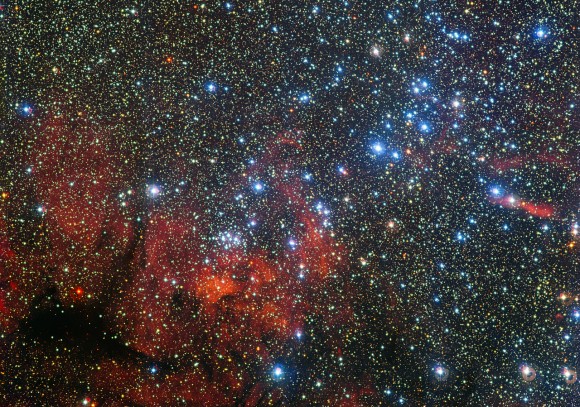
Such stars, much science! Shining in front of darker dust, this star cluster (NGC 3590) is about 7,500 light-years from Earth. And because the cluster is located in a spiral arm of the Milky Way, looking at the new European Southern Observatory can help astronomers figure out more about our how galaxy came to be.
“These spiral arms are actually waves of piled up gas and stars sweeping through the galactic disc, triggering sparkling bursts of star formation and leaving clusters like NGC 3590 in their wake. By finding and observing young stars like those in NGC 3590, it is possible to determine the distances to the different parts of this spiral arm, telling us more about its structure,” ESO stated.
http://www.universetoday.com/112019/dra ... wn-galaxy/
DrCaleb @ Thu May 22, 2014 6:52 am
$1:
Supernova caught in the act by Palomar Transient Factory
Supernovae are incredibly energetic, dynamic events. It’s easy to imagine that they are uncommon, but the universe is a big place and supernovae are actually fairly routine. The problem with observing supernovae is knowing just when and where one is occurring and being able to point a world-class telescope at it in the hours immediately afterward, when precious data about the supernova's progenitor star is available. Fortunately the intermediate Palomar Transient Factory (iPTF) operated by Caltech scans the sky constantly in search of dramatic astrophysical events. In 2013, it caught a star in the act of exploding.
The iPTF is a robotic observing system mounted on the 48-in Samuel Oschin Telescope on Palomar Mountain. It has been scanning the sky since February 2013. The iPTF (and its predecessor experiment, the Palomar Transient Factory [PTF], which operated between 2009 and 2012) regularly observes a wide swath of the night sky looking for astronomical objects that are moving and developing quickly, such as comets, asteroids, gamma-ray bursts and supernovae. Both the earlier PTF and the current iPTF collaborations are led by Shrinivas Kulkarni, a Caltech prof. of astronomy and planetary science and director of the Caltech Optical Observatories.
Last year the iPTF discovered an object of special interest: a supernova with a spectral signature suggesting that its progenitor star was a Wolf-Rayet star. Massive stars are typically structured like an onion, with the heaviest elements in the core, while lighter elements are layered over them and then frosted, if you will, by a layer of hydrogen gas on the stellar surface. Wolf-Rayet stars, which are unusually large and hot, are exceptions to this rule, being relatively deficient in hydrogen and characterized by strong stellar winds. Astronomers have long wondered if Wolf-Rayet stars are the progenitors of certain types of supernovae, and according to a recent paper published in Nature this is just what the iPTF found in May 2013.
This supernova, SN2013cu, was picked up on a routine sky scan by the iPTF. The on-duty iPTF team member in Israel promptly sounded an alert, asking colleagues at the W. M. Keck Observatory on Mauna Kea to take a spectral image of the supernova before the sun rose in Hawaii.
When supernovae explode, they briefly ionize the sky immediately around them. The ionized materials rapidly recombine, producing unique spectral features that enable astronomers to get a full picture of the ambient material of a supernova event. This process lasts from minutes to a few days and hence is called a "flash spectrum" of the event. Flash spectrography is a novel observational method developed by Avishay Gal-Yam of the Weizmann Institute of Science in Israel, leader of the team that published the Nature paper.

Supernovae are incredibly energetic, dynamic events. It’s easy to imagine that they are uncommon, but the universe is a big place and supernovae are actually fairly routine. The problem with observing supernovae is knowing just when and where one is occurring and being able to point a world-class telescope at it in the hours immediately afterward, when precious data about the supernova's progenitor star is available. Fortunately the intermediate Palomar Transient Factory (iPTF) operated by Caltech scans the sky constantly in search of dramatic astrophysical events. In 2013, it caught a star in the act of exploding.
The iPTF is a robotic observing system mounted on the 48-in Samuel Oschin Telescope on Palomar Mountain. It has been scanning the sky since February 2013. The iPTF (and its predecessor experiment, the Palomar Transient Factory [PTF], which operated between 2009 and 2012) regularly observes a wide swath of the night sky looking for astronomical objects that are moving and developing quickly, such as comets, asteroids, gamma-ray bursts and supernovae. Both the earlier PTF and the current iPTF collaborations are led by Shrinivas Kulkarni, a Caltech prof. of astronomy and planetary science and director of the Caltech Optical Observatories.
Last year the iPTF discovered an object of special interest: a supernova with a spectral signature suggesting that its progenitor star was a Wolf-Rayet star. Massive stars are typically structured like an onion, with the heaviest elements in the core, while lighter elements are layered over them and then frosted, if you will, by a layer of hydrogen gas on the stellar surface. Wolf-Rayet stars, which are unusually large and hot, are exceptions to this rule, being relatively deficient in hydrogen and characterized by strong stellar winds. Astronomers have long wondered if Wolf-Rayet stars are the progenitors of certain types of supernovae, and according to a recent paper published in Nature this is just what the iPTF found in May 2013.
This supernova, SN2013cu, was picked up on a routine sky scan by the iPTF. The on-duty iPTF team member in Israel promptly sounded an alert, asking colleagues at the W. M. Keck Observatory on Mauna Kea to take a spectral image of the supernova before the sun rose in Hawaii.
When supernovae explode, they briefly ionize the sky immediately around them. The ionized materials rapidly recombine, producing unique spectral features that enable astronomers to get a full picture of the ambient material of a supernova event. This process lasts from minutes to a few days and hence is called a "flash spectrum" of the event. Flash spectrography is a novel observational method developed by Avishay Gal-Yam of the Weizmann Institute of Science in Israel, leader of the team that published the Nature paper.
http://www.rdmag.com/news/2014/05/super ... nt-factory
DrCaleb @ Thu May 22, 2014 6:54 am
$1:
Huge Solar Flare Reveals Explosive Magnetic Trigger
For the first time, a massive solar flare revealed the process that created it, confirming new theories about flares and the explosive ejections of solar material often linked with them, a new study reports.
Understanding how solar flares form brings scientists a step closer to predicting them, along with the dangerous space weather that has the power to damage satellites and power grids on Earth, researchers said.
Captured by NASA's Solar Dynamics Observatory (SDO) spacecraft, the massive solar flare occurred on July 12, 2012 — less than a week after the publication of a new 3D model that suggested similar flares are driven by a process known as slipping reconnection, in which magnetic field lines disconnect and reconnect.
Bright Lights on the Sun
Solar flares — very intense brightenings of the sun's atmosphere — occur throughout the sun's 11-year activity cycle, with their frequency increasing as the cycle peaks, as it did around the 2012 event.
Flares are classified by the peak X-ray flux measured at Earth. Smaller C- and M-class flares are far more numerous, with dozens of C-class flares sometimes occurring daily during solar maximum, Dudik said.
But the most energetic type — X-class flares, like the July 12, 2012 event — are far more rare, occurring at a frequency of at most a few per month. In addition to being 35 times the size of Earth, the July 2012 flare lasted more than 12 hours, a duration that Dudik calls "somewhat unusual."


For the first time, a massive solar flare revealed the process that created it, confirming new theories about flares and the explosive ejections of solar material often linked with them, a new study reports.
Understanding how solar flares form brings scientists a step closer to predicting them, along with the dangerous space weather that has the power to damage satellites and power grids on Earth, researchers said.
Captured by NASA's Solar Dynamics Observatory (SDO) spacecraft, the massive solar flare occurred on July 12, 2012 — less than a week after the publication of a new 3D model that suggested similar flares are driven by a process known as slipping reconnection, in which magnetic field lines disconnect and reconnect.
Bright Lights on the Sun
Solar flares — very intense brightenings of the sun's atmosphere — occur throughout the sun's 11-year activity cycle, with their frequency increasing as the cycle peaks, as it did around the 2012 event.
Flares are classified by the peak X-ray flux measured at Earth. Smaller C- and M-class flares are far more numerous, with dozens of C-class flares sometimes occurring daily during solar maximum, Dudik said.
But the most energetic type — X-class flares, like the July 12, 2012 event — are far more rare, occurring at a frequency of at most a few per month. In addition to being 35 times the size of Earth, the July 2012 flare lasted more than 12 hours, a duration that Dudik calls "somewhat unusual."
http://news.discovery.com/space/huge-so ... 140521.htm
stratos @ Thu May 22, 2014 7:43 am
Sorry but some times the universe just makes me say Holly Shit that is so F'ing cool and scary at the same time. 
DrCaleb @ Thu May 22, 2014 12:00 pm
DrCaleb DrCaleb:
$1:
Space Thief Or Hero? One Man's Quest To Reawaken An Old Friend
More than 30 years ago, Robert Farquhar stole a spacecraft.
Now he's trying to give it back.
More than 30 years ago, Robert Farquhar stole a spacecraft.
Now he's trying to give it back.
http://www.npr.org/2014/03/18/289628696 ... old-friend
As an update:
$1:
NASA Blesses Volunteer Effort To Bring Vagabond Heliophysics Satellite Home
COLORADO SPRINGS, Colo. — NASA gave its official blessing to a group of volunteers trying to take control of a 36-year-old heliophysics spacecraft the agency retired in 1997, according to a May 21 press release.
NASA said it signed a nonreimbursable Space Act Agreement with Skycorp, Inc. of Los Gatos, California, to give the company legal approval to contact, command and control the International Sun-Earth Explorer (ISEE)-3 spacecraft as part of the company’s ISEE-3 Reboot Project.
Skycorp is owned by Dennis Wingo, who together with collaborator Keith Cowing, editor of the NASAwatch.com space blog, raised more than $125,000 on the crowdfunding website rockethub.com to cover the ISEE-3 reboot project’s operating costs.

COLORADO SPRINGS, Colo. — NASA gave its official blessing to a group of volunteers trying to take control of a 36-year-old heliophysics spacecraft the agency retired in 1997, according to a May 21 press release.
NASA said it signed a nonreimbursable Space Act Agreement with Skycorp, Inc. of Los Gatos, California, to give the company legal approval to contact, command and control the International Sun-Earth Explorer (ISEE)-3 spacecraft as part of the company’s ISEE-3 Reboot Project.
Skycorp is owned by Dennis Wingo, who together with collaborator Keith Cowing, editor of the NASAwatch.com space blog, raised more than $125,000 on the crowdfunding website rockethub.com to cover the ISEE-3 reboot project’s operating costs.
http://www.spacenews.com/article/civil- ... llite-home
DrCaleb @ Fri May 23, 2014 11:04 am
$1:
Cash-Starved NASA May Have to Nix 1 Space Telescope to Save Others
Hubble, Kepler, Chandra and other orbiting observatories got reprieves, but the Spitzer mission may be canceled
Based on the findings of an independent review panel, NASA has taken stock of its fleet of orbiting astrophysics telescopes and decided which to save and which to shutter. Among the winners were the Hubble Space Telescope, the Chandra X-Ray Observatory and the Kepler planet-hunting telescope, which will begin a modified mission designed to compensate for the recent failure of two of its four stabilizing reaction wheels. The infrared Spitzer Space Telescope, however, may be deactivated due to lack of funding. And a bid to convert data collected by the Near-Earth Object Wide-field Infrared Survey Explorer (NEOWISE) into a format usable for astrophysics was also deemed too expensive.
The decisions come at a time when Congress is tightening NASA’s budget, and about half of what astrophysics funding the agency does have goes to the James Webb Space Telescope (JWST), which is being readied for launch in 2018. In 2014, for example, the total astrophysics division funding was about $1.3 billion, of which $658 million went to JWST. Spitzer received $16.5 million this year, and was requesting even less for 2015, but NASA still judged even that amount to be too costly. “To me it’s really sad that this country can’t find just a few million bucks more to throw into this to keep these things active and running as they should be,” says senior review panel chair Ben R. Oppenheimer, an astronomer at the American Museum of Natural History in New York City.
Recommendations from the main Astrophysics Senior Review Panel (pdf) as well as two separate panels that reviewed the Hubble and Chandra missions came in earlier this spring, and NASA released its response May 16 (pdf). A similar process occurs every two years. In addition to Chandra, Hubble and Kepler, the Fermi Gamma-Ray Space Telescope, the Nuclear Spectroscopic Telescope Array (NuSTAR) and the Swift Gamma-Ray Burst Mission all received extensions through at least 2016, when each is invited to reapply again for another renewal. (NASA, however, turned down the Swift mission’s request for increased funding for special projects and the NuSTAR mission was ordered to lower its operating costs in 2015.) NASA also extended its participation in the European-led X-Ray Multi-Mirror Mission (XMM–Newton) observatory as well as Japan’s Suzaku telescope, and continued funding for analyzing data from NASA's Planck satellite, which was deactivated last year. NASA turned down the Spitzer Space Telescope’s request for an extension, but the team has a chance to resubmit their application with a reduced budget plan. “We are preparing another request, to be guided by what we saw in the senior review,” says George Helou, deputy director of the Spitzer Science Center at the California Institute of Technology.
Spitzer launched in 2003 as a multipurpose observatory targeted at the low-energy infrared wavelengths of light blocked by Earth’s atmosphere. Many objects, such as dim stars and planet-forming debris disks, radiate best in infrared light. Spitzer finished its prime mission in 2009 when it exhausted its supply of liquid helium coolant used to chill the instruments. The loss of the coolant left two of Spitzer’s three instruments unusable, but two of the four wavelength bands on its main camera continued to operate as the Spitzer Warm Mission. “Right now it can take images in a couple wavebands at tremendous sensitivity, but compared to what it used to do, its capabilities are far reduced,” Oppenheimer says. “The committee felt that instead of chopping off a bunch of money from other missions, if we end that one large mission we can save everything else.” Spitzer was already operating at just one third of its prime mission budget, Helou points out, and has been reducing costs every year. Finding further cuts to make without sacrificing too much capability on the observatory will be tough, he says. “But I am an optimist. I think we will find a solution.”
Hubble, Kepler, Chandra and other orbiting observatories got reprieves, but the Spitzer mission may be canceled
Based on the findings of an independent review panel, NASA has taken stock of its fleet of orbiting astrophysics telescopes and decided which to save and which to shutter. Among the winners were the Hubble Space Telescope, the Chandra X-Ray Observatory and the Kepler planet-hunting telescope, which will begin a modified mission designed to compensate for the recent failure of two of its four stabilizing reaction wheels. The infrared Spitzer Space Telescope, however, may be deactivated due to lack of funding. And a bid to convert data collected by the Near-Earth Object Wide-field Infrared Survey Explorer (NEOWISE) into a format usable for astrophysics was also deemed too expensive.
The decisions come at a time when Congress is tightening NASA’s budget, and about half of what astrophysics funding the agency does have goes to the James Webb Space Telescope (JWST), which is being readied for launch in 2018. In 2014, for example, the total astrophysics division funding was about $1.3 billion, of which $658 million went to JWST. Spitzer received $16.5 million this year, and was requesting even less for 2015, but NASA still judged even that amount to be too costly. “To me it’s really sad that this country can’t find just a few million bucks more to throw into this to keep these things active and running as they should be,” says senior review panel chair Ben R. Oppenheimer, an astronomer at the American Museum of Natural History in New York City.
Recommendations from the main Astrophysics Senior Review Panel (pdf) as well as two separate panels that reviewed the Hubble and Chandra missions came in earlier this spring, and NASA released its response May 16 (pdf). A similar process occurs every two years. In addition to Chandra, Hubble and Kepler, the Fermi Gamma-Ray Space Telescope, the Nuclear Spectroscopic Telescope Array (NuSTAR) and the Swift Gamma-Ray Burst Mission all received extensions through at least 2016, when each is invited to reapply again for another renewal. (NASA, however, turned down the Swift mission’s request for increased funding for special projects and the NuSTAR mission was ordered to lower its operating costs in 2015.) NASA also extended its participation in the European-led X-Ray Multi-Mirror Mission (XMM–Newton) observatory as well as Japan’s Suzaku telescope, and continued funding for analyzing data from NASA's Planck satellite, which was deactivated last year. NASA turned down the Spitzer Space Telescope’s request for an extension, but the team has a chance to resubmit their application with a reduced budget plan. “We are preparing another request, to be guided by what we saw in the senior review,” says George Helou, deputy director of the Spitzer Science Center at the California Institute of Technology.
Spitzer launched in 2003 as a multipurpose observatory targeted at the low-energy infrared wavelengths of light blocked by Earth’s atmosphere. Many objects, such as dim stars and planet-forming debris disks, radiate best in infrared light. Spitzer finished its prime mission in 2009 when it exhausted its supply of liquid helium coolant used to chill the instruments. The loss of the coolant left two of Spitzer’s three instruments unusable, but two of the four wavelength bands on its main camera continued to operate as the Spitzer Warm Mission. “Right now it can take images in a couple wavebands at tremendous sensitivity, but compared to what it used to do, its capabilities are far reduced,” Oppenheimer says. “The committee felt that instead of chopping off a bunch of money from other missions, if we end that one large mission we can save everything else.” Spitzer was already operating at just one third of its prime mission budget, Helou points out, and has been reducing costs every year. Finding further cuts to make without sacrificing too much capability on the observatory will be tough, he says. “But I am an optimist. I think we will find a solution.”
http://www.scientificamerican.com/artic ... e-others1/
DrCaleb @ Mon May 26, 2014 9:07 am
$1:
NASA Mars Weathercam Helps Find Big New Crater
Researchers have discovered on the Red Planet the largest fresh meteor-impact crater ever firmly documented with before-and-after images. The images were captured by NASA's Mars Reconnaissance Orbiter.
The crater spans half the length of a football field and first appeared in March 2012. The impact that created it likely was preceded by an explosion in the Martian sky caused by intense friction between an incoming asteroid and the planet's atmosphere. This series of events can be likened to the meteor blast that shattered windows in Chelyabinsk, Russia, last year. The air burst and ground impact darkened an area of the Martian surface about 5 miles (8 kilometers) across.
The darkened spot appears in images taken by the orbiter's weather-monitoring camera, the Mars Color Imager (MARCI). Images of the site from MARCI and from the two telescopic cameras on Mars Reconnaissance Orbiter are at:
http://go.usa.gov/8KgJ
Since the orbiter began its systematic observation of Mars in 2006, scientist Bruce Cantor has examined MARCI's daily global coverage, looking for evidence of dust storms and other observable weather events in the images. Cantor is this camera's deputy principal investigator at Malin Space Science Systems, the San Diego company that built and operates MARCI and the orbiter's telescopic Context Camera (CTX). Through his careful review of the images, he helps operators of NASA's solar-powered Mars rover, Opportunity, plan for weather events that may diminish the rover's energy. He also posts weekly Mars weather reports.
About two months ago, Cantor noticed an inconspicuous dark dot near the equator in one of the images.
"It wasn't what I was looking for," Cantor said. "I was doing my usual weather monitoring and something caught my eye. It looked usual, with rays emanating from a central spot."
He began examining earlier images, skipping back a month or more at a time. The images revealed that the dark spot was present a year ago, but not five years ago. He homed in further, checking images from about 40 different dates, and pinned down the date the impact event occurred; the spot was not there up through March 27, 2012, and then appeared before the daily imaging on March 28, 2012.

Researchers have discovered on the Red Planet the largest fresh meteor-impact crater ever firmly documented with before-and-after images. The images were captured by NASA's Mars Reconnaissance Orbiter.
The crater spans half the length of a football field and first appeared in March 2012. The impact that created it likely was preceded by an explosion in the Martian sky caused by intense friction between an incoming asteroid and the planet's atmosphere. This series of events can be likened to the meteor blast that shattered windows in Chelyabinsk, Russia, last year. The air burst and ground impact darkened an area of the Martian surface about 5 miles (8 kilometers) across.
The darkened spot appears in images taken by the orbiter's weather-monitoring camera, the Mars Color Imager (MARCI). Images of the site from MARCI and from the two telescopic cameras on Mars Reconnaissance Orbiter are at:
http://go.usa.gov/8KgJ
Since the orbiter began its systematic observation of Mars in 2006, scientist Bruce Cantor has examined MARCI's daily global coverage, looking for evidence of dust storms and other observable weather events in the images. Cantor is this camera's deputy principal investigator at Malin Space Science Systems, the San Diego company that built and operates MARCI and the orbiter's telescopic Context Camera (CTX). Through his careful review of the images, he helps operators of NASA's solar-powered Mars rover, Opportunity, plan for weather events that may diminish the rover's energy. He also posts weekly Mars weather reports.
About two months ago, Cantor noticed an inconspicuous dark dot near the equator in one of the images.
"It wasn't what I was looking for," Cantor said. "I was doing my usual weather monitoring and something caught my eye. It looked usual, with rays emanating from a central spot."
He began examining earlier images, skipping back a month or more at a time. The images revealed that the dark spot was present a year ago, but not five years ago. He homed in further, checking images from about 40 different dates, and pinned down the date the impact event occurred; the spot was not there up through March 27, 2012, and then appeared before the daily imaging on March 28, 2012.
http://www.jpl.nasa.gov/news/news.php?release=2014-162
DrCaleb @ Tue May 27, 2014 11:14 am
$1:
The Biggest Thing In The Universe Is So Gigantic It Shouldn't Exist At All
What's the biggest known structure in the universe?
Astronomers used to think it was a "filament" of galaxies known as the Sloan Great Wall. But recent research suggests a different structure is even bigger -- and its size has astronomers scratching their heads.
Meet the Hercules-Corona Borealis Great Wall (Her-CrB GW). Check it out in the video above.
"The Her-CrB GW is larger than the theoretical upper limit on how big universal structures can be," Dr. Jon Hakkila, an astrophysics professor at the College of Charleston in South Carolina and one of the astronomers who discovered the structure, told The Huffington Post in an email. "Thus, it is a conundrum: it shouldn't exist but apparently does."
Mysteries just like this are why astronomers scan the skies for a glimpse into the past, as they shed light not only on the early years of our universe, but also more about our galaxy, our solar system, and ultimately, ourselves.
"We are now mapping structures across the sky," astronomer Dr. Jay M. Pasachoff, director of the Hopkins Observatory at Williams College in Williamstown, Mass., who was not involved in the great wall's discovery, told The Huffington Post. "We’re learning how the universe grew up. So we’re learning about how our cluster of galaxies grew up and how our own galaxy grew up and how our sun formed, and how the Earth formed soon there after. We’re looking back at our history."
Because astronomers are still mapping the sky, there just may be something even grander than the Hercules-Corona Borealis Great Wall in our universe.
"The danger of finding the biggest, or most distant, or the oldest things in the universe is always that sooner or later someone is likely to come along and find something bigger, more distant, or older than the thing you found," Hakkila said. "So far we have not been upstaged, but it has only been about six months since we published."
The finding was published in the journal Astronomy & Astrophysics.
What's the biggest known structure in the universe?
Astronomers used to think it was a "filament" of galaxies known as the Sloan Great Wall. But recent research suggests a different structure is even bigger -- and its size has astronomers scratching their heads.
Meet the Hercules-Corona Borealis Great Wall (Her-CrB GW). Check it out in the video above.
"The Her-CrB GW is larger than the theoretical upper limit on how big universal structures can be," Dr. Jon Hakkila, an astrophysics professor at the College of Charleston in South Carolina and one of the astronomers who discovered the structure, told The Huffington Post in an email. "Thus, it is a conundrum: it shouldn't exist but apparently does."
Mysteries just like this are why astronomers scan the skies for a glimpse into the past, as they shed light not only on the early years of our universe, but also more about our galaxy, our solar system, and ultimately, ourselves.
"We are now mapping structures across the sky," astronomer Dr. Jay M. Pasachoff, director of the Hopkins Observatory at Williams College in Williamstown, Mass., who was not involved in the great wall's discovery, told The Huffington Post. "We’re learning how the universe grew up. So we’re learning about how our cluster of galaxies grew up and how our own galaxy grew up and how our sun formed, and how the Earth formed soon there after. We’re looking back at our history."
Because astronomers are still mapping the sky, there just may be something even grander than the Hercules-Corona Borealis Great Wall in our universe.
"The danger of finding the biggest, or most distant, or the oldest things in the universe is always that sooner or later someone is likely to come along and find something bigger, more distant, or older than the thing you found," Hakkila said. "So far we have not been upstaged, but it has only been about six months since we published."
The finding was published in the journal Astronomy & Astrophysics.
http://www.huffingtonpost.com/2014/05/2 ... 65111.html
DrCaleb @ Wed May 28, 2014 6:36 am
$1:
Was That Just a Gamma Ray Burst in Andromeda?!
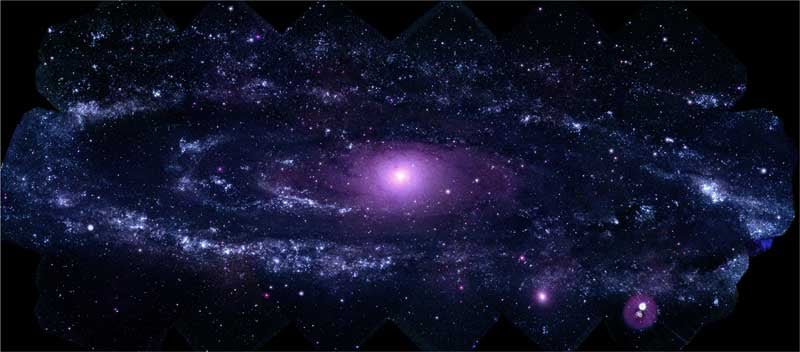
The Swift Gamma-Ray Burst Mission just saw something very bright in the Andromeda Galaxy, and we don't know what it is. It was either a Gamma-Ray Burst or an Ultraluminous X-Ray Object, but either way it will be the closest event we've ever observed.
Twitter exploded with excited astronomers and astrophysicists.We might have just seen a Gamma Ray Burst from the Andromeda Galaxy. If we did, that's incredible! But to hold on to proper journalist caution: we might not have.
Why would it be exciting? Because it'd be the closest gamma ray burst we've ever observed, yet far enough away to not fry us. Scientifically fascinating without planet-wide extinction! What's not to love?
Why the hedging? The data is scarce. An event was spotted that might be a Gamma Ray Burst (GRB), or it might be an Ultraluminous X-Ray Object (ULX). Either way would be exciting, as they'd both be the closest of their type we've ever seen, giving us new, detailed, juicy data.
It's very, very, very likely from the galaxy next door, Andromeda, but it could theoretically be from the background space somewhere past it. (I'll get into how confident we are on the location a bit later.) But if you've got access to a telescope and a view of Andromeda, now is a very good time to take a look.
The Swift space telescope is dedicated to sensing gamma ray bursts, quickly identifying their location, and feeding that information to Earth so all the other telescopes can scramble to catch up.
Was That Just a Gamma Ray Burst in Andromeda?!
As soon as Swift detects a burst, it reels around within minutes to capture their X-ray and optical afterglow. That glow fades out over days, weeks, or even months. (If you like your learning in song-format, the Chromatics have a song dedicated to Swift.)
Swift has been doing great at its mission, spotting about 90 new bursts per year since it launched in November 2004, but this is different. If it is a Gamma Ray Burst, it's from right next door, the closest one we've ever observed.
But don't freak out too much: at 2.2 to 2.5 million light years away, it isn't going to kill us. It's just going to be scientifically fascinating.
. . .
What is a Gamma Ray Burst?
Gamma Ray Bursts, or GRBs, are bright outpourings of gamma rays. They're the brightest electromagnetic events we've ever observed. The bursts are typically associated with exploding stars or nuclear fusion, although we sometimes also find them here on Earth associated with lightning storms.
If this is a gamma ray burst, it probably isn't from a supernova because that neighbourhood of space just doesn't have many stars large enough to die in a supernova. It's an unlikely-maybe, and coincidentally also the least-fascinating option.

. . .
What's an Ultraluminous X-ray Source?
If this isn't a gamma ray burst, it could be an Ultraluminous X-ray Source (ULX). If it is, it still won't kill us, but it will still be fascinating as the closest and most detailed look we've had at one of them.
Ultraluminous X-ray Source are fairly mysterious, but are probably generated by messy black holes eating infalling gas from an accretion disc. Jay Strader points out that there's a black hole candidate in the area. This X-Ray burst could be from that object suddenly brightening from it gobbling something new.
To reach the level of brightness we've observed, we need to turn to Eddington limits. The Eddington luminosity (or limit) is the maximum brightness an object can glow while balancing radiation force pushing out against gravity pulling in. Objects can briefly exceed their Eddington limit (going super-Eddington), blowing away gas with the increased radiation pressure. The increased luminosity is listed as a multiple of the Eddington luminosity, but the bigger a multiple is, the stranger and less likely it is to happen.
To match the brightness of this event, it could be a black hole with ten times the mass of the sun exhibiting a ten-fold Eddington luminosity, or a black hole with twenty times the mass of the sun at five-fold Eddington luminosity, or any other multiplicative combination. If this is an Ultraluminous X-ray Source caused by a feeding black hole, it'll take more observations to find out how big that hole was when it flared.
Another possibility raised by Laura Lopez and Katie Mack and listed in the bulletin text is that this could be the X-rays from a low-mass binary star system. The X-rays could be from a black hole or a neutron star munching on its more mundane companion.
The Swift Gamma-Ray Burst Mission just saw something very bright in the Andromeda Galaxy, and we don't know what it is. It was either a Gamma-Ray Burst or an Ultraluminous X-Ray Object, but either way it will be the closest event we've ever observed.
Twitter exploded with excited astronomers and astrophysicists.We might have just seen a Gamma Ray Burst from the Andromeda Galaxy. If we did, that's incredible! But to hold on to proper journalist caution: we might not have.
Why would it be exciting? Because it'd be the closest gamma ray burst we've ever observed, yet far enough away to not fry us. Scientifically fascinating without planet-wide extinction! What's not to love?
Why the hedging? The data is scarce. An event was spotted that might be a Gamma Ray Burst (GRB), or it might be an Ultraluminous X-Ray Object (ULX). Either way would be exciting, as they'd both be the closest of their type we've ever seen, giving us new, detailed, juicy data.
It's very, very, very likely from the galaxy next door, Andromeda, but it could theoretically be from the background space somewhere past it. (I'll get into how confident we are on the location a bit later.) But if you've got access to a telescope and a view of Andromeda, now is a very good time to take a look.
The Swift space telescope is dedicated to sensing gamma ray bursts, quickly identifying their location, and feeding that information to Earth so all the other telescopes can scramble to catch up.
Was That Just a Gamma Ray Burst in Andromeda?!
As soon as Swift detects a burst, it reels around within minutes to capture their X-ray and optical afterglow. That glow fades out over days, weeks, or even months. (If you like your learning in song-format, the Chromatics have a song dedicated to Swift.)
Swift has been doing great at its mission, spotting about 90 new bursts per year since it launched in November 2004, but this is different. If it is a Gamma Ray Burst, it's from right next door, the closest one we've ever observed.
But don't freak out too much: at 2.2 to 2.5 million light years away, it isn't going to kill us. It's just going to be scientifically fascinating.
. . .
What is a Gamma Ray Burst?
Gamma Ray Bursts, or GRBs, are bright outpourings of gamma rays. They're the brightest electromagnetic events we've ever observed. The bursts are typically associated with exploding stars or nuclear fusion, although we sometimes also find them here on Earth associated with lightning storms.
If this is a gamma ray burst, it probably isn't from a supernova because that neighbourhood of space just doesn't have many stars large enough to die in a supernova. It's an unlikely-maybe, and coincidentally also the least-fascinating option.
. . .
What's an Ultraluminous X-ray Source?
If this isn't a gamma ray burst, it could be an Ultraluminous X-ray Source (ULX). If it is, it still won't kill us, but it will still be fascinating as the closest and most detailed look we've had at one of them.
Ultraluminous X-ray Source are fairly mysterious, but are probably generated by messy black holes eating infalling gas from an accretion disc. Jay Strader points out that there's a black hole candidate in the area. This X-Ray burst could be from that object suddenly brightening from it gobbling something new.
To reach the level of brightness we've observed, we need to turn to Eddington limits. The Eddington luminosity (or limit) is the maximum brightness an object can glow while balancing radiation force pushing out against gravity pulling in. Objects can briefly exceed their Eddington limit (going super-Eddington), blowing away gas with the increased radiation pressure. The increased luminosity is listed as a multiple of the Eddington luminosity, but the bigger a multiple is, the stranger and less likely it is to happen.
To match the brightness of this event, it could be a black hole with ten times the mass of the sun exhibiting a ten-fold Eddington luminosity, or a black hole with twenty times the mass of the sun at five-fold Eddington luminosity, or any other multiplicative combination. If this is an Ultraluminous X-ray Source caused by a feeding black hole, it'll take more observations to find out how big that hole was when it flared.
Another possibility raised by Laura Lopez and Katie Mack and listed in the bulletin text is that this could be the X-rays from a low-mass binary star system. The X-rays could be from a black hole or a neutron star munching on its more mundane companion.
http://space.io9.com/was-that-just-a-ga ... 1582373688
Previous 1 ... 47 48 49 50 51 52 53 ... 244 Next